
Table of Contents
- Why Road Salt Damages Carpet and How to Spot It Early
- The Best Way to Remove Salt Stains from Carpet
- Winter Carpet Maintenance Tips for Lake Geneva Homeowners
- How Often Should Carpets Be Cleaned During Winter?
- Preventative Measures: Mats, Barriers, and Entryway Strategies
- Material-Specific Care: Protecting Different Carpet Fibers
- Eco-Friendly Alternatives for Salt Removal and Carpet Care
- Long-Term Storage Protection for Area Rugs and Carpets
- When to Call a Professional Carpet Cleaner
- Conclusion
- Frequently Asked Questions
Last Updated: September 11, 2026
Why Road Salt Damages Carpet and How to Spot It Early
Learning how to protect carpet from road salt in winter starts with understanding what you’re actually tracking inside. Road salt is not a single substance. It is a blend of sodium chloride, calcium chloride, and sometimes brine solutions that crews apply before and after storms. In Lake Geneva, Wisconsin, where lake-effect snow and freeze-thaw cycles keep entryways wet from November through March, those crystals ride in on boots and pet paws and settle deep into carpet fibers.
This guide from Lake Geneva Carpet Cleaning covers what salt does to carpet, how to remove stains safely, and how to keep winter grime out of your home in the first place.
What Road Salt Does to Carpet Fibers
Road salt damages carpet through two mechanisms: moisture and crystallization. When salt crystals dissolve in snowmelt, they wick into the carpet pile and the padding beneath it. As the water evaporates, salt recrystallizes inside the fiber structure, and those sharp crystals abrade fibers from the inside. Over a single season, this shows up as matted, brittle patches near entryways.
The residue also attracts more dirt. Salt left in a carpet acts like a magnet for winter grime, so a carpet that looks clean after vacuuming can turn dingy again within days.
Never let a salt stain sit until spring. The longer salt stays in the padding, the more it wicks outward, and a small entryway stain can spread into a large discolored patch that no amount of home blotting will lift.
Signs of Salt Damage You Should Not Ignore
Salt damage rarely appears all at once. Watch for these early signals:
- White or gray crusty patches near doors and high-traffic paths
- Stiff, crunchy texture when you walk across the affected area
- Dinginess that returns within days of vacuuming
- Dampness in the padding that never seems to dry
- A faint musty smell after snowmelt events
If you spot any of these, treat the area within 24 to 48 hours. Once salt reaches the backing, surface cleaning stops working, and you are looking at professional carpet extraction rather than spot treatment.
The Best Way to Remove Salt Stains from Carpet
The best way to remove salt stains from carpet is a two-part process: dissolve the salt with a diluted acid solution, then extract every trace of moisture so nothing recrystallizes. Skipping the extraction step is why so many DIY attempts fail and stains return.
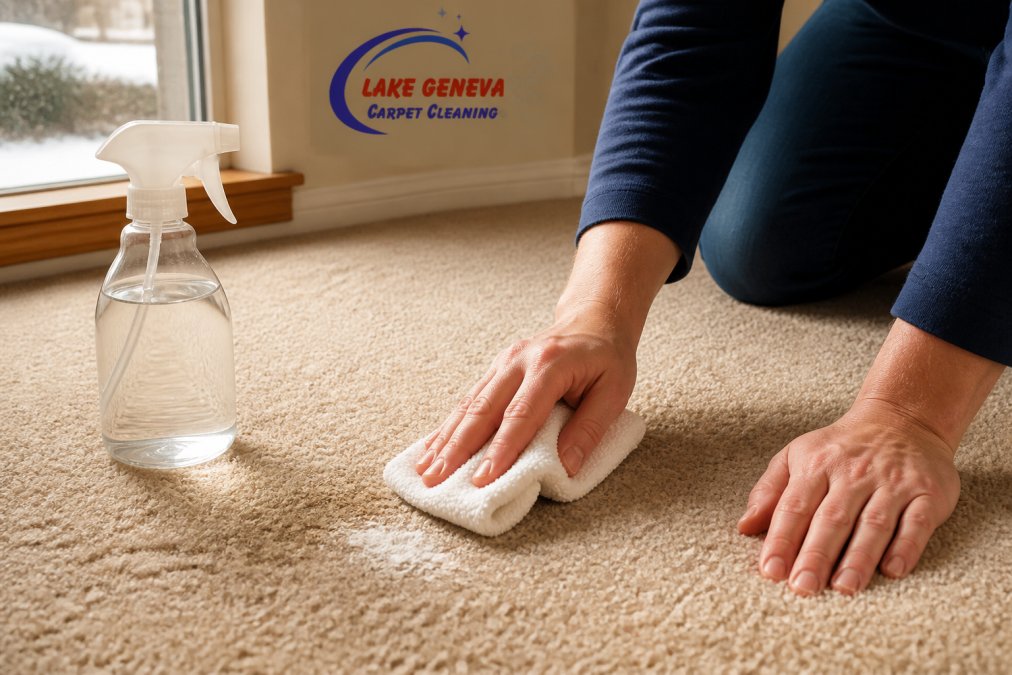
Step-by-Step Salt Stain Removal
Work through these steps in order. Rushing the drying stage undoes everything else.
- Vacuum the dry area first. Remove loose salt crystals before adding any liquid. A slow pass with strong suction lifts the surface layer.
- Mix a diluted white vinegar solution. Combine one part distilled white vinegar with two parts cool water. Vinegar’s mild acidity dissolves salt residue without saturating the backing.
- Test in a hidden spot. Apply a small amount to a closet corner or behind furniture. Wait ten minutes and check for color change.
- Blot, never rub. Dampen a microfiber cloth, press it into the stain, and lift. Rubbing pushes salt deeper into the pile.
- Work from the outside in. Blot the edges of the stain first, then move toward the center to avoid spreading the ring.
- Rinse with clean water. Dampen a fresh cloth with plain water and blot again to remove vinegar residue.
- Dry thoroughly. Layer dry towels over the area, weigh them down, and replace them as they absorb moisture.
Drying Techniques to Prevent Mold
Mold prevention is the step most homeowners skip, and it is the one that matters most. Carpet padding holds water long after the surface feels dry. Trapped dampness creates the conditions mold needs, and once mold colonizes padding, surface cleaning cannot fix it.
- Run fans and a dehumidifier for at least 12 to 24 hours
- Lift the carpet edge slightly if the stain reached the backing
- Avoid walking on the area until it is completely dry
- Check for a musty odor over the following week
If a basement or entryway carpet stays damp for more than a day after your best efforts, the padding is likely saturated. That is the point where professional extraction becomes the safer choice.
Winter Carpet Maintenance Tips for Lake Geneva Homeowners
Winter carpet maintenance tips for Lake Geneva homeowners come down to one principle: stop salt at the door, not at the carpet. What makes this region different is the combination of lake-effect snow, repeated freeze-thaw cycles, and heavy road salt and sand use on Highway 50 and the surrounding county roads. That mix keeps entryways wet and gritty from roughly November through March, and it means salt has more chances to dissolve, wick into pile, and recrystallize than it would in a drier climate.
A practical weekly routine for a Lake Geneva home looks like this:
- Vacuum entryways and traffic lanes twice a week, not once, and add a third pass after any snowmelt event
- Shake out exterior scraper mats weekly and rinse absorbent interior mats so they are not re-releasing brine into the carpet
- Keep a boot tray and a towel basket by every exterior door, and empty the tray before it overflows onto the carpet edge
- Wipe pet paws before they cross the threshold, since paw pads carry the same brine that boots do
- Watch the freeze-thaw window: on days when daytime melt refreezes overnight, entryway carpet stays damp longer and needs extra drying attention
- Schedule a mid-winter deep cleaning rather than waiting until spring, because salt that has already reached the padding will keep wicking outward all season
The salt that never touches your carpet is the salt you never have to remove. Local conditions reward consistency over intensity: a short routine repeated every week beats one deep cleanup in April.
Vacuum entryway carpet in slow, overlapping passes rather than quick back-and-forth strokes. Salt crystals are heavy and settle at the base of the pile, so slower passes with strong suction pull more of them out before they work into the padding.
Do not rely on a single doormat during a Lake Geneva winter. One mat at the door catches almost nothing once it is saturated, and a saturated mat can actually hold brine against the carpet edge, making the stain worse than if no mat were there at all.
For local business owners with a customer entrance, the same logic applies at higher volume. A retail or office entryway can see dozens of salty footfalls an hour during a storm, so mats need to be swapped or rinsed far more often than in a home, and a mid-season professional cleaning is usually the difference between a presentable lobby in February and a gray traffic lane that no amount of spot treatment will lift.
How Often Should Carpets Be Cleaned During Winter?
Carpets should be cleaned every four to six weeks during winter in high-traffic areas, and professionally deep cleaned at least once mid-season. That is more frequent than the once- or twice-a-year schedule many households follow, and there is a reason for the difference.
Winter introduces a contaminant load that does not exist in summer. Salt, sand, brine, and winter grime all enter through the same doorway, and each one binds to carpet fibers differently. Salt dissolves and recrystallizes. Sand abrades. Brine leaves a sticky residue that grabs dust. Together they accelerate the rate at which a carpet looks and feels worn.
For homes with pets, children, or anyone with allergies, tighten that schedule. Carpet that stays damp and salt-laden holds dust mites and allergens more readily, and regular extraction removes what vacuuming alone leaves behind.
Preventative Measures: Mats, Barriers, and Entryway Strategies
Preventative barriers are the highest-return investment in winter carpet care. The goal is a layered entry system that removes moisture and salt before anyone reaches the carpet, because once salt is in the pile you are cleaning, not preventing.
| Layer | Purpose | Placement |
|---|---|---|
| Exterior scraper mat | Removes ice, snow, and grit | Outside the door |
| Absorbent interior mat | Soaks up snowmelt and brine | Just inside the threshold |
| Boot tray | Contains standing water | Beside the interior mat |
| Towel station | Dries paws and boots | Within arm’s reach of the door |
| Runner rug | Captures remaining residue | Along the main traffic path |
All-weather floor mats do the heavy lifting. Look for a rubber-backed exterior mat with a raised scraping surface and an absorbent interior mat with a moisture barrier underneath so meltwater never reaches the carpet or subfloor. The exterior mat’s job is mechanical: its raised ridges break up packed snow and knock grit off the sole. The interior mat’s job is chemical and physical: its fibers wick up the brine that remains so it dries on the mat instead of in your carpet.
The strategy matters as much as the products. A single mat at the door catches almost nothing. A layered system of three or four mats, each doing a different job, removes the majority of salt before it ever touches carpet fiber. For homes with multiple entrances, prioritize the door your household actually uses most. That is where the salt comes in.
A few trade-offs are worth knowing before you buy:
- Thickness versus door clearance. A deep scraper mat can drag on the bottom of a door, so measure the gap before committing to a thick exterior mat.
- Absorbency versus drying speed. The most absorbent interior mats hold the most brine, which means they also need to be rinsed and dried more often. A mat that stays damp for days becomes a salt reservoir.
- Coverage versus appearance. A runner rug along the main traffic path captures residue a doormat misses, but it needs the same weekly vacuuming and periodic rinsing as the entry mats.
- Pet traffic. Paw pads carry brine the same way boot soles do, so a towel station near the door is not optional in a home with dogs.
For local business owners, the same layered approach scales up: a longer exterior scraper run, a larger absorbent interior mat, and a scheduled mat-swap rotation during storms. The principle does not change with foot traffic volume, only the frequency of maintenance.
Material-Specific Care: Protecting Different Carpet Fibers
Not every carpet handles salt the same way. Material-specific care prevents the wrong cleaning method from causing more damage than the salt itself.
Wool is durable but sensitive to alkalinity. Salt residue can dull wool’s natural luster, and harsh cleaners strip its oils. Stick to diluted vinegar and cool water, and dry wool quickly to prevent fiber saturation.
Nylon and polyester handle salt removal well and tolerate mild cleaning solutions. Their main vulnerability is abrasion from recrystallized salt, so thorough vacuuming matters more than chemical treatment.
Olefin resists moisture and most stains, but it crushes easily under heavy foot traffic. Salt-laden olefin near an entryway mats down faster than other fibers.
Cut pile versus loop pile changes how deeply salt penetrates. Cut pile traps crystals lower in the fiber structure, while loop pile lets more residue sit on the surface. Loop pile cleans more easily at home; cut pile often needs deeper extraction.
Whatever the fiber, always test any solution in a hidden area first. A method that works on one carpet can discolor another.
Eco-Friendly Alternatives for Salt Removal and Carpet Care
Eco-friendly salt removal starts with ingredients you likely already have. Distilled white vinegar is the workhorse: it dissolves salt, neutralizes residue, and breaks down without leaving harsh chemicals behind in a home with kids or pets.
Other low-impact options:
- Cool water rinses to flush dissolved salt without additives
- Baking soda sprinkled on dry, then vacuumed, to lift surface residue and odors
- A mild pH-balanced floor neutralizer for rinse water when stains are stubborn
- Microfiber cloths and soft-bristle brushes to reduce the need for strong chemicals
What matters is dilution ratio and rinsing. Even gentle solutions leave residue if you do not rinse them out, and residue attracts new dirt. Use the weakest solution that works, rinse thoroughly, and dry completely.
If you are managing allergies or want to avoid store-bought spot cleaners with unknown ingredients, these simple options cover most winter salt problems. For deep-set stains or odors that keep returning, professional hot water extraction reaches what household methods cannot.
Long-Term Storage Protection for Area Rugs and Carpets
Area rugs that come up for the season need protection too. Salt damage does not stop at the edge of the floor; a rug stored while still holding salt residue can develop fiber damage, discoloration, and odor over the off-season.
Before storing any rug:
- Vacuum both sides thoroughly
- Treat and remove any salt stains completely
- Ensure the rug is bone dry, since trapped dampness invites mold
- Roll, never fold, to prevent creasing and fiber stress
- Wrap in breathable material rather than sealed plastic
- Store flat or on a roll in a dry, climate-controlled space
Sealed plastic traps moisture and is one of the most common storage mistakes. Breathable wrapping lets any residual dampness escape. If a rug went through a full winter of foot traffic, a professional deep clean before storage protects the investment far better than a home vacuuming.
When to Call a Professional Carpet Cleaner
Call a professional when salt has reached the padding, when stains return after home treatment, or when dampness and odor persist. Those are the signs that surface cleaning has hit its limit.
Home methods handle fresh, surface-level salt well. They struggle with three situations:
- Salt that has wicked into the padding, where blotting cannot reach
- Recurring stains that reappear within days of cleaning
- Persistent dampness or musty odor suggesting mold in the backing
Truck-mounted hot water extraction solves all three. The process flushes dissolved salt and residue out of the fiber and padding, then extracts the moisture in a single pass. For households dealing with allergies, pet accidents, or years of winter buildup, that level of extraction is the difference between a carpet that looks clean and one that actually is.
If you are searching for carpet cleaning near me in the Lake Geneva area, look for a provider who uses hot water extraction and can explain exactly how they handle winter salt and moisture. Pricing depends on the job, so ask for a free quote before you commit.
Conclusion
Winter salt is relentless, and by March most carpets near an entryway have absorbed more of it than owners realize. The fix is a system: layered mats at every door, a weekly vacuuming routine, prompt stain treatment, and thorough drying every time. When salt has already worked its way into the padding, home methods stop being enough.
Lake Geneva Carpet Cleaning has served Wisconsin homeowners for over 32 years as an owner-operated business, using eco-friendly methods and truck-mounted hot water extraction to pull embedded salt, allergens, and odors out of carpet and padding. Every job is backed by a 10-day satisfaction guarantee and the kind of meticulous attention to detail that comes from three decades of local work.
Get started with Lake Geneva Carpet Cleaning and protect your carpets before the next snowmelt. Contact us for a free quote and see why our customers say, “Hire the best, forget the rest.”
Frequently Asked Questions
What gets road salt out of carpet?
A mixture of distilled white vinegar and water breaks down salt residue effectively. Mix equal parts vinegar and water, apply to the stain, and blot with a clean microfiber cloth. For deeper stains, add a drop of mild dish soap. Avoid over-wetting the carpet, as excess moisture can lead to mold. After treating, vacuum thoroughly once the area is dry.
Will salt ruin my carpet?
Salt itself does not instantly ruin carpet, but leaving it untreated causes fibers to stiffen, fade, and attract more dirt. Over time, salt crystallization can abrade fibers and create permanent traffic lanes. Regular vacuuming and prompt stain removal prevent long-term damage. If salt has been tracked in repeatedly without cleaning, professional extraction restores the carpet.
How do I prevent salt from being tracked into my home during winter?
Place all-weather floor mats at every entrance and encourage family members to remove shoes immediately. A two-mat system works well: a coarse outdoor mat removes bulk salt, and an absorbent indoor mat catches remaining brine. Vacuum entryway carpets frequently and consider a no-shoes policy during winter months to reduce salt tracking.
How often should I have my carpets professionally cleaned during winter?
In Lake Geneva and surrounding areas, schedule professional cleaning once or twice during winter, depending on foot traffic and weather severity. Homes with pets or children may need more frequent service. Professional hot water extraction removes embedded salt, brine, and winter grime that routine vacuuming cannot reach, keeping carpets fresh and extending their lifespan.