Table of Contents
- Does Dish Soap Actually Work on Carpet Stains?
- Why Dish Soap Is Harmful to Carpet Fibers
- The Science of Soap Residue and Dirt Attraction
- How to Remove Stubborn Carpet Stains Safely
- DIY Carpet Stain Removal Risks You Should Know
- Carpet Cleaning Best Practices for Long-Term Care
- Professional vs. DIY Carpet Cleaning Methods
- When to Call a Professional Cleaner
- Frequently Asked Questions
Last Updated: September 30, 2026
Does Dish Soap Actually Work on Carpet Stains?
The short answer is no, does dish soap work for carpet stains? While it may seem like a convenient household fix, it often causes more damage than it solves. Many homeowners struggle with the aftermath of DIY soap treatments, sticky residue, discolored fibers, and stains that come roaring back within weeks. Understanding why dish soap fails, and what actually works, is the key to protecting your carpets and keeping them looking fresh for years to come.
Dish soap is designed to cut through grease on dishes, not to work with carpet fibers. When it sits in carpet, it leaves behind a residue that attracts dirt like a magnet, making your carpet look dirtier faster.
Why Dish Soap Is Harmful to Carpet Fibers
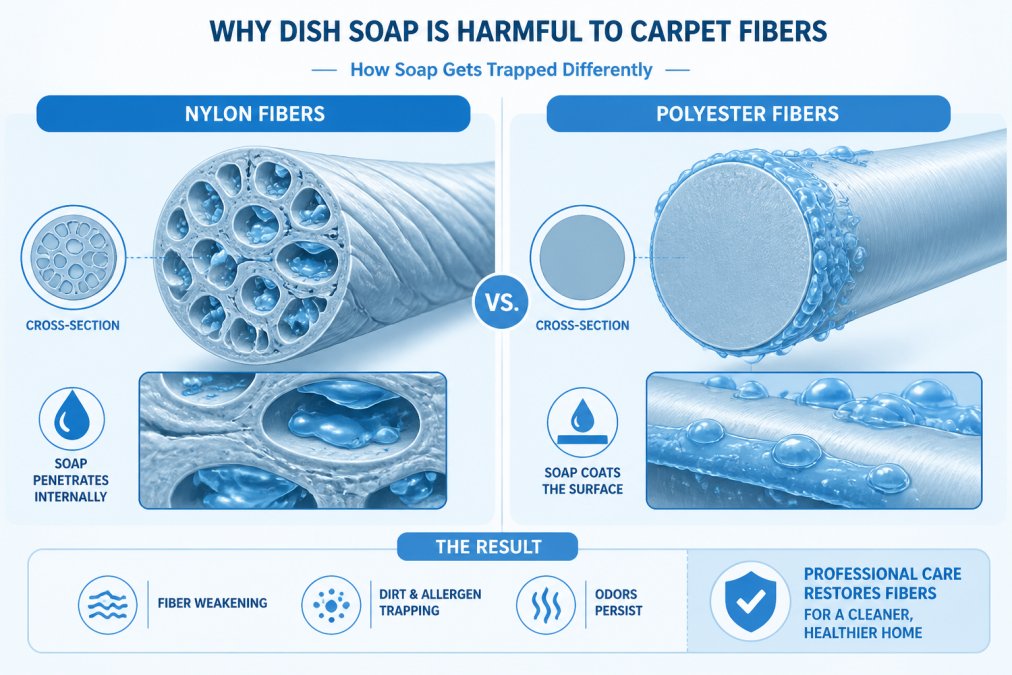
Dish soap strips away the protective coating on carpet fibers, but the damage mechanism differs significantly depending on your carpet’s material. Most residential carpets are made from synthetic fibers, primarily nylon or polyester, and each reacts differently to alkaline soap exposure.
Nylon Carpets and Soap Damage
Nylon is hygroscopic, meaning it naturally absorbs moisture. When dish soap (which is alkaline) contacts nylon fibers, it opens the fiber’s cuticle structure. This allows the soap molecules to penetrate deep into the fiber shaft rather than sitting on the surface. Once the soap dries, it hardens inside the fiber itself, not just on top of it. This internal buildup weakens the fiber’s structural integrity from within, causing the carpet to lose elasticity and bounce. Nylon carpets treated with dish soap often develop a dull, lifeless appearance because the soap residue scatters light rather than allowing it to reflect uniformly. Over time, repeated exposure can cause permanent yellowing or browning, especially in lighter-colored nylon carpets, because the alkaline environment chemically alters the dye molecules.
Polyester Carpets and Soap Residue
Polyester is hydrophobic, it naturally repels water and moisture. This means soap doesn’t penetrate as deeply into polyester fibers as it does nylon. However, this creates a different problem: the soap sits on the fiber surface and bonds to it through chemical adhesion. Because polyester fibers are smoother and less porous than nylon, soap residue clings to the surface like a film. This film is extremely difficult to rinse away completely, even with multiple water passes. The result is a sticky coating that traps dirt particles and causes rapid re-soiling. Polyester carpets treated with dish soap often look dingy again within days because the residue acts as a dirt magnet.
The Wicking Problem in Both Fiber Types
Regardless of fiber type, soap residue creates a wicking effect. Wicking occurs when moisture moves upward through carpet fibers after cleaning. The soap residue acts like a sponge, pulling moisture and dirt back to the surface. This is why stains often reappear after a few days or weeks, the stain wasn’t actually removed; it was just temporarily suspended by the soap, then re-deposited as the moisture evaporated.
pH Imbalance and Fiber Brittleness
Dish soap is alkaline (pH 8-10), while carpet fibers perform best in a neutral pH environment (6.5-7.5). Alkaline exposure causes synthetic fibers to become brittle and lose their natural sheen. The higher the pH of the cleaning solution, the greater the risk of permanent fiber damage. Professional cleaning solutions are carefully formulated to maintain the correct pH balance, protecting fibers while removing soil suspension.
Repeated soap applications can cause permanent fiber damage. The cumulative effect of multiple treatments can discolor synthetic carpet, especially lighter shades, leaving yellow or brown stains that won’t come out. Once fibers are chemically altered by alkaline exposure, the damage is irreversible.
The Science of Soap Residue and Dirt Attraction
To understand why does dish soap work for carpet stains is a common question with a clear answer, you need to know how soap actually behaves. Soap is a surfactant, which means it breaks down the bonds between dirt and fibers. On dishes, this is useful. In carpet, it’s destructive.
When you apply dish soap to carpet, the surfactant molecules surround dirt particles and lift them away from the fibers. That part works. But here’s where it fails: the soap doesn’t fully rinse out. Even after multiple rinses, microscopic soap residue remains trapped deep in the carpet pile and padding.
This residue creates a wicking effect. Wicking happens when moisture moves upward through carpet fibers after cleaning. The soap residue acts like a sponge, pulling moisture, and dirt, back to the surface. This is why stains often reappear after a few days or weeks. The stain wasn’t actually removed; it was just temporarily suspended.
The pH balance matters too. Dish soap is alkaline, which means it’s basic rather than acidic. Carpet fibers prefer a neutral pH. When exposed to alkaline soap, synthetic fibers can become brittle and lose their natural sheen. Professional cleaning solutions are carefully formulated to maintain the correct pH balance, protecting fibers while removing soil suspension.
How to Remove Stubborn Carpet Stains Safely
If dish soap isn’t the answer, what is? The key is using the right technique with the right solution. Most stubborn stains respond best to a combination of proper blotting, targeted treatment, and professional-grade extraction.
Blotting vs. Rubbing: The Critical Difference
The first rule of stain removal is this: blot, never rub. Rubbing pushes stain particles deeper into the carpet pile and can damage fibers. Blotting lifts stain material upward and away from the base of the carpet.
When you blot:
- Use a clean, white cloth or paper towel
- Press firmly for 10-15 seconds
- Work from the outside edge of the stain toward the center
- Rotate to a clean section of cloth as the stain transfers
- Repeat until no more stain transfers to the cloth
Rubbing does the opposite. It spreads the stain sideways, grinds particles into the fiber structure, and can fray the carpet surface. Once you’ve rubbed a stain, it becomes much harder to remove completely.
Spot Treatment Solutions That Won’t Damage Fibers
After blotting, a proper spot treatment solution can help. The best options are:
- Water and white vinegar (1:1 ratio): Vinegar is acidic, which helps neutralize alkaline stains. Mix equal parts and spray lightly on the stain. Blot after 5 minutes.
- Baking soda paste: Mix baking soda with a small amount of water to form a paste. Apply to the stain and let sit for 15 minutes. Vacuum thoroughly before blotting with a damp cloth.
- Hydrogen peroxide (3% solution): For organic stains like blood or pet accidents, hydrogen peroxide can break down the stain without damaging fibers. Test on a hidden area first.
The key difference between these solutions and dish soap is that they don’t leave behind sticky residue. They work with your carpet fibers rather than against them.
Always test any cleaning solution on a hidden area of carpet first. Even safe solutions can cause discoloration on certain dyes or fiber types.
DIY Carpet Stain Removal Risks You Should Know
DIY stain removal comes with real risks that extend far beyond the immediate problem of making a stain worse. Understanding these risks helps you avoid costly mistakes, and know when you’ve already made one.
Over-Wetting and Mold Growth
When you apply too much liquid to carpet, moisture soaks down into the padding underneath. If the padding stays wet for more than 24 hours, mold and mildew can develop. Once mold takes hold, it spreads quickly and creates health hazards. You may not see it, but you’ll smell it, a musty odor that indicates microbial growth is already underway. Mold in carpet padding is particularly dangerous because it’s hidden from view and difficult to remediate without professional equipment.
Setting Stains Permanently
Using the wrong cleaning agent can chemically bond stain particles to fibers in ways that make them impossible to remove later. Certain solutions, including dish soap, can actually set stains by altering the stain’s molecular structure. Once a stain is set, even professional equipment may struggle to fully extract it. This is why the first treatment matters so much, if you use the wrong solution, you may have permanently damaged your carpet’s appearance.
Fiber Distortion and Matting
Aggressive scrubbing or using abrasive tools can damage the carpet surface. Matting, fuzzing, and permanent discoloration can result. Once fibers are damaged, they don’t recover, you’re looking at replacement of that section or the entire carpet. This is why blotting (not rubbing) is the golden rule of stain removal.
Incomplete Rinsing and Residue Buildup
DIY methods tend to leave residue behind. Whether it’s soap, vinegar, baking soda, or commercial spot cleaners, incomplete rinsing means particles remain in the carpet. These attract more dirt, making the carpet look worse faster. The problem compounds over time: each incomplete cleaning leaves more residue, until the carpet becomes a dirt magnet that looks dingy no matter how often you vacuum.
How to Rescue Your Carpet After a Dish Soap Mistake
If you’ve already applied dish soap to your carpet, don’t panic. There are steps you can take to minimize damage and remove as much residue as possible before it sets permanently.
Immediate Action (First 24 Hours)
Stop using the carpet. Avoid walking on the treated area as much as possible. Every footstep pushes soap deeper into the fibers and padding.
Rinse with plain water. Use a spray bottle to apply lukewarm water to the soapy area. Do not oversaturate, you’re trying to dilute the soap, not flood the carpet. Spray lightly and blot immediately with clean white cloths or paper towels. Repeat this process 5-10 times, using a fresh cloth section each time. You’ll see soapy water transfer to the cloth; keep going until the cloth comes away nearly dry.
Apply white vinegar solution. Mix equal parts white vinegar and water in a spray bottle. Vinegar is acidic and helps neutralize the alkaline soap residue. Spray lightly on the treated area and let sit for 5 minutes. Blot thoroughly with clean cloths. This step is crucial because it chemically counteracts the soap’s pH.
Final rinse with water. Repeat the plain water rinse process 3-5 more times to remove vinegar residue. Blot aggressively to remove as much moisture as possible.
Dry the area. Open windows or use fans to increase air circulation. If you have a dehumidifier, run it in the room. The goal is to dry the carpet completely within 24 hours to prevent mold growth. Do not use heat sources like hair dryers, as these can set any remaining stain.
Within 48-72 Hours
If the area still feels damp or sticky after 24 hours, the soap residue is still present. Repeat the vinegar rinse and water rinse process. You may need to do this 2-3 times over several days to fully remove the soap.
If you notice the carpet still looks dull, feels sticky, or smells soapy after 72 hours, professional extraction is your best option. At this point, the residue has likely bonded to the fibers, and DIY methods alone won’t remove it completely. Professional equipment uses hot water extraction under pressure, followed by immediate suction removal, a process that pulls out soap residue that manual blotting cannot reach.
The key to minimizing soap damage is speed. The longer soap sits in your carpet, the more it bonds to the fibers. If you act within the first 24 hours, you can remove most of the residue. After 48 hours, professional help becomes increasingly necessary.
Carpet Cleaning Best Practices for Long-Term Care
The best approach to carpet stain removal starts with prevention and maintenance. Regular care extends the life of your carpet and prevents stains from becoming permanent problems.
Vacuum regularly: Vacuum high-traffic areas 2-3 times per week. Regular vacuuming removes soil before it gets ground into fibers and prevents dirt from accumulating.
Address spills immediately: The sooner you treat a spill, the easier it is to remove. Fresh stains respond much better to treatment than set-in stains.
Use walk-off mats: Place mats at entry points to trap dirt before it reaches your carpet. This simple step reduces the amount of soil tracked into your home.
Rotate furniture: Moving furniture periodically prevents permanent indentations and allows different areas of carpet to receive equal wear.
Maintain humidity levels: Carpet lasts longer in environments with moderate humidity (30-50%). Excess moisture promotes mold growth and fiber degradation.
Professional cleaning annually: Even with good maintenance, carpet needs professional deep cleaning once a year. Professional equipment removes embedded soil, allergens, and bacteria that vacuuming alone cannot reach.
Professional vs. DIY Carpet Cleaning Methods
There’s a fundamental difference between DIY spot cleaning and professional carpet cleaning. Understanding this difference helps explain why professional results last longer and look better.
DIY methods rely on manual effort and household products. You’re limited by the amount of water you can apply, the drying time you can tolerate, and the strength of the cleaning agent you’re comfortable using. Results are often incomplete, with residue remaining in the carpet.
Professional cleaning uses truck-mounted hot water extraction equipment. This technology applies heated water and cleaning solution under pressure, then immediately extracts the water and dissolved soil using powerful suction.
The key advantage is extraction. Professional equipment removes not just the stain, but the cleaning solution itself. This prevents residue buildup and the dirt-attraction problem that plagues DIY methods.
Professional cleaners also have access to specialized solutions formulated for different stain types. They know which treatment works best for pet stains, organic stains, oil-based stains, and more.
When to Call a Professional Cleaner
Some stains are beyond DIY repair. Knowing when to call a professional saves time, money, and frustration.
Call a professional if:
- The stain covers a large area or multiple spots
- The stain has been present for more than a few days (set-in stains)
- You’ve already tried DIY methods without success
- The stain involves pet accidents, blood, or other organic material
- You notice discoloration or fiber damage
- Your carpet smells musty or shows signs of mold
- You have allergies or health concerns related to carpet cleanliness
- Your carpet is expensive or delicate
Professional cleaners in the Lake Geneva area have the experience and equipment to handle stains that seem impossible. They can also assess whether a stain is permanent or removable.
For homeowners in Lake Geneva and surrounding counties dealing with stubborn stains, pet odors, or seasonal contaminants like road salt and mud, professional cleaning is often a valuable solution. The investment protects your carpet’s appearance and extends its lifespan significantly.
The truth about dish soap and carpet stains is simple: it doesn’t work, and it often makes things worse. If you’re struggling with a stubborn stain or concerned about the condition of your carpet, Lake Geneva Carpet Cleaning offers professional deep cleaning services designed to remove embedded soil, allergens, and odors while protecting your fibers. With over 32 years of experience serving Wisconsin homeowners, our team uses state-of-the-art hot water extraction technology to deliver results that last. Contact us for a quote and discover the difference professional care makes.
Frequently Asked Questions
Will dish soap leave a sticky residue on my carpet?
Yes. Dish soap contains surfactants designed to break down grease on dishes, not to rinse cleanly from carpet fibers. These surfactants cling to synthetic carpet materials and attract dirt, creating a sticky, dingy layer that accumulates over time. Even thorough rinsing often leaves residue behind, which causes the carpet to soil faster and look dull within weeks.
Is dish soap safe for all types of carpet fibers?
No. Dish soap can damage both nylon and polyester carpet fibers, though the damage varies. The alkaline pH of most dish soaps strips protective coatings from fibers, causing discoloration, matting, and weakening of the yarn. Delicate or antique carpets are especially vulnerable. Professional-grade, pH-balanced solutions are formulated to clean while protecting the fiber structure.
What is the best way to rinse dish soap out of a carpet?
Standard household rinsing methods rarely remove dish soap completely. Hot water extraction, used by professionals, applies high-pressure hot water to suspend and extract soap residue and dirt. If you’ve already used dish soap, spray the area with clean water, blot thoroughly, and avoid walking on it until fully dry. For stubborn residue, contact a professional who can properly extract the soap and restore the carpet.
Can dish soap remove old, set-in carpet stains?
Dish soap is ineffective on set-in stains and often makes them worse. Once a stain has dried and bonded to carpet fibers, dish soap cannot penetrate deeply enough to lift it. The soap may lighten the surface appearance temporarily, but the stain remains embedded in the padding. Professional spot removal techniques and specialized stain-neutralization products are effective for aged stains.