Table of Contents
- Why Some Carpet Stains Never Come Out (and What Experts Do Differently)
- How to Treat Carpet Stains Safely at Home
- Removing Pet Stains From Carpet: Why the Smell Returns
- Stain-Specific Treatment: What Works on Wine, Grease, Ink, and Road Salt
- Professional Upholstery Stain Removal: Sofas and Chairs Need a Different Approach
- DIY vs. Professional Stain Removal: When Each One Makes Sense
- Eco-Friendly Solutions and Safety for Kids and Pets
- How Lake Geneva’s Lakeside Environment Affects Your Carpet
- Fast Drying and Allergen Reduction: What to Expect After Professional Cleaning
- Conclusion
- Frequently Asked Questions
Last Updated: September 16, 2026
Why Some Carpet Stains Never Come Out (and What Experts Do Differently)
Carpet stain removal experts treat stains as a chemistry problem, not a scrubbing problem. That shift explains why a coffee spill that vanishes under professional care can leave a permanent shadow after a homeowner attacks it with a rag and a spray bottle. At Lake Geneva Carpet Cleaning, we have watched that difference play out in Wisconsin homes for more than 32 years.
Most stains do not set because the spill was unusually stubborn. They set because the treatment pushed the substance deeper into the backing or locked it in with heat.
Three things separate a professional result from a DIY one:
- Identification first. Fiber type and stain category determine the chemistry. Wool reacts to alkaline agents the way silk reacts to bleach.
- Controlled dwell time. Cleaning agents need time to break down the bond, but too long damages dye.
- Extraction, not dilution. Hot water extraction lifts residue out of the pad rather than spreading it across the surface.
A common mistake is treating every stain the same way. Wine, grease, ink, and road salt each require a different approach.
Carpet and Rug Institute stain removal guide
How to Treat Carpet Stains Safely at Home
The safest home method is to blot, never rub, working from the outside of the stain toward the center with a clean white cloth. Rubbing abrades the fiber tips, which is why a treated spot often looks duller than the carpet around it even after the stain is gone.
Here is the sequence that works for most water-based spills:
- Remove solids with a spoon, working inward.
- Blot with a clean white towel, rotating to a fresh section with each pass.
- Apply a small amount of cleaning solution to the cloth, not the carpet.
- Blot again until no more transfers to the towel.
- Rinse with cool water and blot dry.
- Weight a stack of towels over the area to wick remaining moisture.
Speed matters most in the first two minutes; after that, technique does.
EPA indoor [air quality(/professional-carpet-cleaning-air-quality-professional-carpet-cleaning-improves-air-quality/) and carpet guidance | epa.gov]
The Blotting Rule Most Homeowners Break
Most homeowners rub. It feels productive, and it is the fastest way to turn a removable spot into a permanent one.
Rubbing does two things at once: it grinds the staining agent into the fiber structure, and it frays the fiber surface so light reflects unevenly. That second effect leaves the “clean but still visible” ring that frustrates people for months.
Blotting works because capillary action pulls the substance up into the cloth. The trick is patience: press, hold a few seconds, lift, rotate the cloth, repeat. When the towel stops picking up color, you are done.
Keep a stack of white cotton towels on hand for spills, not paper towels. Paper towels shred under pressure and leave pulp behind in the fiber, which then attracts soil and creates a new gray spot within weeks.
Which Store-Bought Spot Cleaners to Avoid on Wool and Delicate Fibers
Store-bought spot cleaners are not interchangeable, and the wrong one can strip dye from wool in under a minute.
Avoid anything labeled for heavy-duty grease or with a high alkaline pH on wool, silk, or wool-blend rugs. These products are built for synthetic fiber and can dull or bleach natural fibers permanently. The same caution applies to oxygen-based brighteners, which lift color as readily as they lift stains.
Look instead for a pH-neutral spot treatment, a stated fiber compatibility list on the label, and no added optical brighteners. When in doubt, test on a hidden corner and wait a full hour before touching the visible area.
Water alone can damage delicate fibers. Wool can felt and shrink when it gets too wet, so use as little moisture as possible and dry the area quickly.
Removing Pet Stains From Carpet: Why the Smell Returns
Pet odor returns because urine soaked past the carpet into the padding and subfloor, where surface cleaning never reaches. The smell weeks later is not residue on top; it is the reservoir underneath, reactivated by humidity.
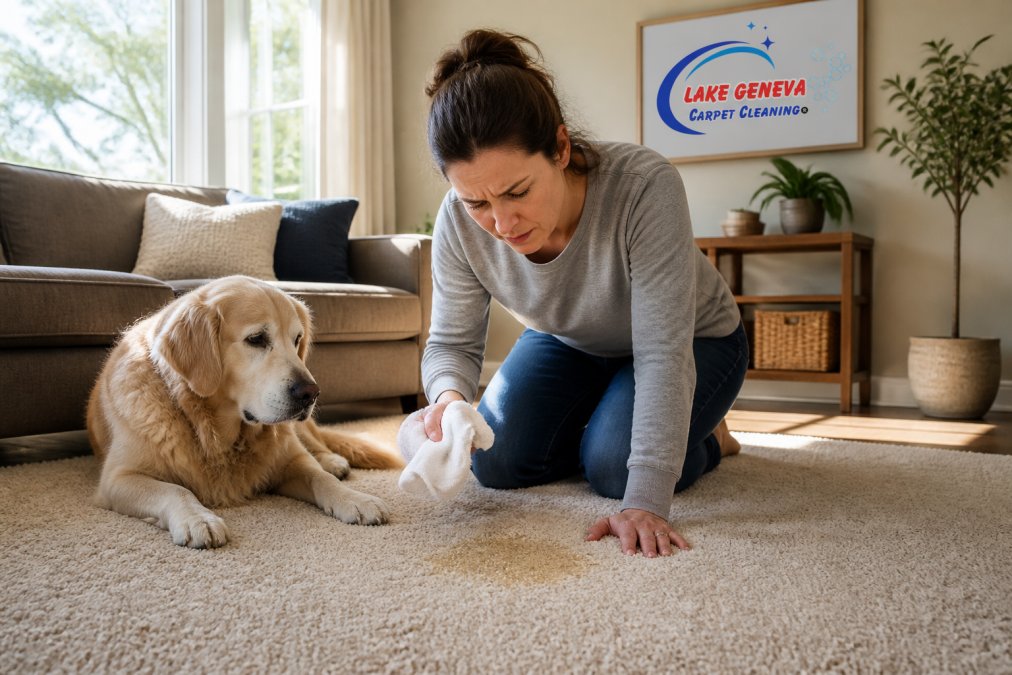
That is why a carpet can smell clean for two weeks and then turn sour again in July: warm, humid air pulls volatile compounds up through the pad.
Why Surface Cleaning Fails on Pet Accidents
Surface cleaning fails on pet accidents because the contamination sits below the surface. Urine travels through the face fiber, the backing, and into the pad within minutes.
A spray-and-blot approach treats maybe the top millimeter while the pad stays saturated, and every humid day reactivates it. This is also why enzyme products seem to work and then stop: they need to reach the source, and most homeowners cannot get enough product into the pad without oversaturating the carpet.
Getting rid of the odor permanently requires flushing the affected layers and extracting the residue, which is what truck-mounted hot water extraction is built to do. If you have lived with recurring pet odor for years, that is usually why.
Never use a steam cleaner or hot water on a fresh pet accident. Heat sets the protein in urine, and once it sets, the odor becomes far harder to remove. Use cool water and an enzyme treatment first.
Stain-Specific Treatment: What Works on Wine, Grease, Ink, and Road Salt
Different stains need different chemistry, and matching the treatment to the stain matters more than the brand on the bottle. Here is how the four most common categories break down.
| Stain | What Works | What Makes It Worse | Urgency |
|---|---|---|---|
| Red wine | Blot, then cool water and a mild dish solution | Salt, heat, scrubbing | Immediate |
| Grease | Absorbent powder first, then a degreaser | Water alone, which spreads it | Same day |
| Ink | Isopropyl alcohol on a white cloth, blotted | Rubbing, which spreads the dye | Same day |
| Road salt | Let it dry, vacuum, then rinse the residue | Wet scrubbing, which drives brine deeper | After it dries |
Red wine responds well to immediate blotting because the pigment is water-soluble while wet. Once it dries, tannins bind to the fiber and the job gets harder.
Grease is the opposite problem: water spreads it. Lift the bulk with an absorbent powder, then break down what remains with a degreaser formulated for the fiber.
Ink is a dye, not a residue, so you are lifting color rather than removing matter. Alcohol works, but apply it to the cloth and blot, never pour.
Road salt catches lakeside homeowners off guard. The salt vacuums up once dry, but the brine it leaves behind attracts moisture and soil, which is why entryway carpet looks dingy all winter.
Professional Upholstery Stain Removal: Sofas and Chairs Need a Different Approach
Professional upholstery stain removal differs from carpet care because upholstery fabric is thinner, often backed with a substrate, and frequently carries a cleaning code that limits what can be used. The wrong method can leave a water ring that never comes out.
The biggest risk with upholstery is overwetting. Cushion foam holds moisture far longer than carpet padding, and a soaked cushion can take days to dry, inviting mildew inside the foam where you cannot see it.
There is also the cleaning code problem. Most upholstery carries a letter code telling you whether water-based or solvent-based cleaning is permitted, and using the wrong one can shrink, streak, or distort the fabric. That is the main reason we recommend against renting a machine and treating a sofa like a hallway.
Fiber care on upholstery is less forgiving than on carpet. Delicate weaves, velvet, and linen blends can mark permanently from a single over-wet pass, so when a piece matters to you, have it assessed before treatment.
DIY vs. Professional Stain Removal: When Each One Makes Sense
DIY makes sense for fresh, water-based spills on synthetic carpet. Professional service makes sense for anything set, oil-based, on natural fiber, or already treated once without success.
Use this as a quick decision guide:
- Try it yourself: clear liquid spills within the last few minutes, on a mid-grade synthetic carpet, with a pH-neutral spot treatment on hand.
- Call a professional: pet accidents with odor, red wine or ink that has dried, grease of any kind, wool or delicate rugs, and any stain that has already been “fixed” once.
- Call immediately: large volumes of liquid, anything that has reached the pad, and any stain on upholstery with a restricted cleaning code.
The DIY-versus-professional question is really about depth. If the substance is still on the surface, you can handle it. If it has moved into the backing or pad, no spray bottle will reach it, however good the product.
This is where professional-grade equipment changes the outcome. Truck-mounted hot water extraction delivers heat and suction portable units cannot match, letting a technician flush a contaminant out of the pad rather than just treating the surface.
The deciding factor is almost never the product. It is whether the cleaning method can reach the depth the stain has already reached.
Eco-Friendly Solutions and Safety for Kids and Pets
Eco-friendly carpet cleaning means using solutions that break down safely and leaving no irritating residue behind, which matters most in homes with crawling children and pets that lick their paws. But “eco-friendly” on a flyer is a marketing word, not a standard. The useful question is narrower: what is in the solution, what is left in the carpet afterward, and how does the process keep that residue low?
The term is loosely regulated in the United States, with no single federal definition a cleaner must meet to print it on a van. That means the burden falls on you to ask three questions before anyone touches your carpet:
- Are the cleaning agents biodegradable? A biodegradable surfactant breaks down in wastewater rather than persisting. This is the baseline, not a bonus.
- Does the process leave residue? Residue is the real concern for kids and pets, because sticky film left in the fiber attracts new soil and can transfer to skin and paws.
- Does the work rely on chemistry or on heat and extraction? A process that leans on hot water extraction at proper temperature needs less aggressive chemistry to lift the same soil.
That third point is the mechanism most homeowners never hear. Hot water extraction does two jobs at once: heat and dwell time break the bond between soil and fiber, and the extraction stroke pulls the loosened soil and solution out together. Done properly, very little is left behind to off-gas or transfer to a toddler’s hands; done poorly, you get a carpet that looks clean but feels slightly stiff, which is usually dried residue.
What Residue Actually Does to Your Home
Residue is not just a chemistry concern; it is a performance problem. A sticky film in the pile grabs airborne dust and soil, so the carpet looks dingy again faster than it should, and for allergy sufferers it holds onto the very particles you were trying to remove.
This is why a residue-free rinse step matters as much as the cleaning solution itself. A thorough rinse and extraction removes what the cleaner lifted, rather than leaving it to dry in place.
Judging Safety Claims Without a Chemistry Degree
You do not need to read a safety data sheet to make a reasonable call. A few practical checks do most of the work:
- Ask what the rinse step looks like. A cleaner who can explain how residue is removed is usually one who removes it.
- Ask about drying time. A carpet that dries in a few hours with air movement is a sign that extraction pulled the moisture and the solution out. A carpet that stays damp overnight is a sign that something was left behind.
- Ask about fiber compatibility. Wool, silk, and wool blends are sensitive to alkaline agents. A cleaner who asks about your fiber type before quoting is doing the right homework.
- Test on a hidden corner. For any spot treatment used at home, test on an inconspicuous area and wait a full hour before touching the visible section.
If you have a crawling baby or a pet that grooms itself, schedule cleaning so the carpet has several hours of air movement and foot-traffic-free time afterward. Fast, thorough drying is the simplest safety measure there is, and it costs nothing.
The Pet and Child Angle Most Cleaners Skip
Most carpet cleaning content treats safety as a checkbox. The more useful framing: the safest clean removes the most and leaves the least. That means heat and extraction doing the heavy lifting, a proper rinse, and drying fast enough that mildew never gets a foothold in the pad. If a cleaner cannot explain how they achieve those three things, the eco-friendly label on the van is not telling you much.
How Lake Geneva’s Lakeside Environment Affects Your Carpet
Lake Geneva homes face a carpet problem inland homes do not: lake humidity, seasonal road salt, and tracked-in sand and mud from shoreline access. Each shortens the interval between deep cleanings.
Humidity is the quiet culprit. Lakeside air keeps indoor relative humidity higher than inland averages for much of the year, feeding dust mites and keeping pet odor compounds volatile. It also slows drying after spills, giving stains more time to set.
Then there is winter. Road salt and brine get tracked in from the driveway and boat launch, and the sand and grit that come with them act like sandpaper on fiber with every pass through the entryway. Those high-traffic areas wear visibly faster than the rest of the house.
If you are searching for carpet stain removal near me in the Lake Geneva area, the practical takeaway is that lakeside homes generally need attention on a shorter cycle than the standard once-a-year recommendation. Entryways and living rooms take the worst of it.
Fast Drying and Allergen Reduction: What to Expect After Professional Cleaning
A proper professional cleaning should leave carpet dry to the touch in a few hours, not a full day. If it stays damp overnight, the extraction step was insufficient, which is a real concern in a finished basement where humidity has nowhere to go.
Drying time is not fixed. It depends on four variables you can influence or ask about:
- Extraction power. Stronger suction pulls more water out during the cleaning pass. This is the single biggest factor.
- Air movement. Ceiling fans, box fans, and open windows move moisture out of the room instead of letting it settle into the pad.
- Indoor humidity. A damp, closed-up house dries slowly. Running a dehumidifier or the air conditioning speeds things up.
- Carpet and pad thickness. Thick plush carpet over a dense pad holds more moisture than low-pile commercial carpet.
Here is what the process should deliver, and why each one matters:
- Fast-drying process: powerful extraction pulls the majority of moisture out during cleaning, so drying is measured in hours with air movement rather than days.
- Allergen reduction: hot water extraction lifts dust mites, dander, and particulate soil out of the pad rather than redistributing it across the surface.
- Carpet sanitization: heat and thorough extraction reduce microbial load without leaving chemical residue behind.
- Carpet rejuvenation: fiber tips stand back up, and traffic lanes look noticeably brighter once the pile is dry and unstuck.
Why Depth of Extraction Is the Whole Point for Allergy Sufferers
Vacuuming reaches the surface of the pile; hot water extraction reaches the pad, where dust mites and settled allergens actually live. That is why a carpet can look clean after vacuuming and still trigger symptoms.
Dust mites thrive in warm, humid environments, and a damp carpet pad is exactly that. Fast, thorough drying does double duty: it removes the moisture mites need and the particulate soil they feed on. If you have allergies in the house, drying speed is part of the treatment, not a convenience.
How to Tell Whether Extraction Was Sufficient
You do not need equipment to judge the result.
- Touch test. Press a clean white paper towel into the carpet a few hours after cleaning. If it comes up damp, drying is not finished.
- Smell test. A clean carpet should smell neutral. A musty or sour note within a day or two usually means moisture is trapped in the pad.
- Feel test. A carpet that feels stiff or slightly crunchy once dry is often holding dried residue, which points to an incomplete rinse.
- Re-soiling test. If traffic lanes look dingy again within a couple of weeks, residue is likely attracting new soil.
Fast drying is not a marketing feature. It is the clearest sign that extraction was done properly, and it is the single best protection against the mildew and odor problems that show up weeks later.
To speed drying at home, run ceiling fans, open windows if weather allows, and keep foot traffic off the area for a few hours. Most carpets are walkable well before they are fully dry, so give the pad time to finish releasing moisture before you put furniture back or let pets settle in for the night.
Conclusion
The gap between a stain that disappears and one that becomes permanent almost always comes down to depth and timing, not the product on the shelf.
Frequently Asked Questions
What do professionals use to remove carpet stains?
Carpet stain removal experts use truck-mounted hot water extraction combined with stain-specific spotting agents matched to the fiber type and stain. Unlike store-bought spot cleaners, professional methods flush soil and residue from deep in the padding, not just the surface. This is why set-in stains that resisted home treatment often lift during a professional deep cleaning.
Can professional carpet cleaning services remove old, dried stains?
Many old, dried stains respond well to professional treatment, though results depend on the stain type, fiber, and how long it has set. Protein-based stains like pet accidents bond to fibers over time, and some dyes can permanently discolor carpet. A professional can assess the stain and tell you honestly what is removable before you commit to cleaning.
How do I know if a carpet stain requires professional intervention?
Call a professional when a stain has set for more than a few days, covers a large area, involves pet urine, or keeps reappearing after home cleaning. Recurring stains usually mean the contaminant reached the padding, which surface cleaning cannot fix. Wicking, where residue rises back to the surface, is another sign that deep extraction is needed.
Are eco-friendly stain removal methods effective for residential carpets?
Yes. Eco-friendly solutions formulated for carpet cleaning break down soils and stains effectively when paired with proper agitation and hot water extraction. The advantage for households with children and pets is reduced chemical residue left in the carpet. Ask any provider what products they use and whether they are safe for pets and kids once dry.