Table of Contents
- Why Pet Stains Come Back After You Clean Them
- How to Remove Pet Urine from Carpet: A Step-by-Step Method
- Pet Odor Removal Tips That Work on Stubborn Smells
- DIY vs. Professional Pet Stain Removal: Where Each One Wins
- How to Remove Old Dog Pee Stains from Carpet
- Professional Carpet Cleaning Lake Geneva Homeowners Can Rely On
- Safe Cleaning for Kids, Pets, and Indoor Air Quality
- Maintenance Tips for Pet Owners in Lake Geneva
- Conclusion
- Frequently Asked Questions
Last Updated: September 16, 2026
Why Pet Stains Come Back After You Clean Them
Pet stain removal in Lake Geneva homes often fails for one reason: the cleaning stops at the surface. The urine doesn’t. Here’s what’s actually happening in your carpet, and how to fix it for good.
Most homeowners treat a pet accident like a spilled drink: blot it, spray something on it, move on. Within a week or two, a brown ring reappears and the smell creeps back. That’s not bad luck, it’s chemistry.
Urine is roughly 95% water, but the remaining 5% causes the trouble. It contains urea, creatinine, hormones, and salts that dry into sticky crystals bonding to carpet fibers. Liquid wicks down through the backing into the padding and, in severe cases, the subfloor. Surface cleaning removes what’s on top; the reservoir underneath keeps feeding the stain back up.
Moisture-activated deodorizers only mask odor while the carpet is damp. Once the carpet dries, the smell returns because the uric acid crystals are still intact in the padding. If you can smell it on a humid day, the contamination is below the surface.
What Urine Leaves Behind in Carpet and Padding
Uric acid crystals are the core problem. They’re insoluble in water, which is why plain water and most store-bought spot cleaners fail. They bond tightly to fibers and re-crystallize as they dry, which is why an old stain can look “reactivated” after a humid stretch or a routine cleaning.
Bacteria feed on the organic compounds in urine and produce the sharp ammonia smell people associate with pet accidents. That bacterial activity doesn’t stop when the carpet feels dry. It goes dormant and resumes whenever moisture returns.
The third piece is the salt residue. It attracts moisture from the air, which is why a spot that seemed gone can look damp and discolored weeks later. In a lakeside climate with seasonal humidity swings, that cycle repeats often enough to keep a stain visible indefinitely.
How to Remove Pet Urine from Carpet: A Step-by-Step Method
The method below works on fresh accidents. Old, set-in stains need a different sequence, which we cover further down.
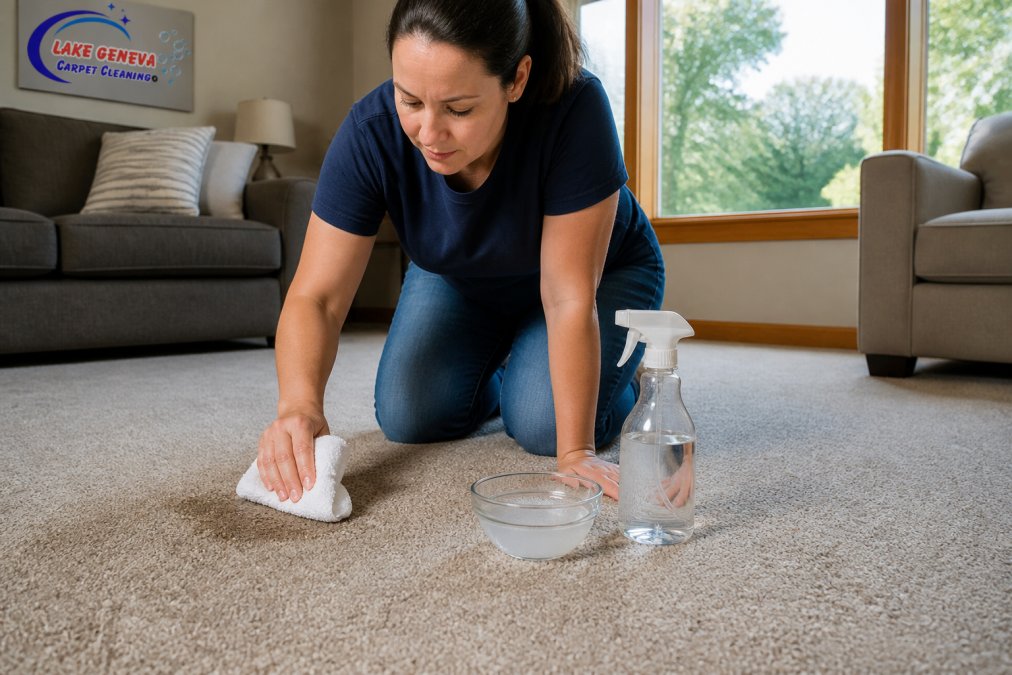
What You’ll Need Before You Start
Gather these before you touch the stain, rushing in with a single rag is how accidents get pushed deeper.
- Clean white towels or paper towels (dyed towels can transfer color)
- A spray bottle with cool water
- An enzyme-based pet stain cleaner formulated for urine
- A small bowl for mixing
- Rubber gloves
- A blacklight or UV flashlight to locate hidden spots
- Plastic wrap (for treating padding underneath)
Mistakes That Push Urine Deeper Into the Padding
Scrubbing is the most common mistake. Rubbing spreads liquid sideways and drives it into the backing. Blot, press, and lift, never scrub.
Using a steam cleaner or hot water on a fresh stain. Heat sets urine’s protein compounds, permanently bonding them to the fiber. Save heat-based extraction for after the stain is neutralized.
Over-wetting the area. Pouring cleaner directly onto the carpet saturates the padding and can wick into the subfloor. Apply solution to your towel or use a light mist.
Using an ammonia-based cleaner. Urine contains ammonia. Adding more of it signals your pet to mark the same spot again.
Skipping the blacklight check. Urine dries clear under normal light. A UV light reveals the full footprint, including the parts you haven’t found yet.
Here’s the sequence that actually works:
- Blot up as much liquid as possible with a clean towel, pressing firmly. Replace the towel as it saturates.
- Flood the spot lightly with cool water to dilute remaining urine, then blot again. Repeat once.
- Apply an enzyme-based cleaner and let it sit for the full dwell time on the label. Enzymes need time to break down uric acid crystals.
- Blot dry, then place a folded towel over the spot and weigh it down overnight to pull moisture from the padding.
- Check with a blacklight after 24 hours. If it still glows, repeat the enzyme treatment.
Enzyme cleaners work by biological action, not chemical strength. If you rush the dwell time, you’re wasting the product. On a set-in stain, some homeowners cover the treated area with plastic wrap to keep it from drying out too fast and let it work for several hours.
Pet Odor Removal Tips That Work on Stubborn Smells
Odor elimination requires reaching the source, not the surface. If you can smell it, the contamination is still there.
A few approaches that help:
- Find every spot first. Use a blacklight after dark. Odor often comes from a spot you never noticed.
- Treat the padding, not just the carpet. If the stain soaked through, lift the carpet edge if possible and treat the padding directly.
- Use an odor neutralizer designed for pet urine, not an air freshener. Neutralizers break down the compounds; fresheners cover them.
- Increase ventilation while treating. Airflow helps the area dry fully, which stops bacteria from reactivating.
- Repeat treatment over several days. One application rarely clears a long-standing odor.
If the smell persists after two or three rounds of home treatment, the contamination has likely reached the subfloor. At that point, surface products can’t reach it.
DIY vs. Professional Pet Stain Removal: Where Each One Wins
Most guides frame this as a simple choice: try it yourself, and call a pro if that fails. That’s too vague to be useful. The real question is whether the contamination is still in the carpet fiber or has already moved into the padding and subfloor, because that determines which approach can work. Here’s a decision framework based on what’s physically happening in the carpet.
The Three Questions That Decide It
1. How long ago did the accident happen?
Fresh accidents (under a few hours) sit mostly in the fiber tips, where blotting plus an enzyme cleaner handles them. Accidents older than 24 hours have wicked through the backing into the padding, and surface methods can’t reach that reservoir.
2. Does the spot glow under a blacklight after you’ve cleaned it?
If it still fluoresces after a proper enzyme treatment and full dry time, uric acid crystals remain. That’s the signal that the contamination is below the surface.
3. Does the odor return on a humid day or after a routine cleaning?
This is the clearest indicator that bacteria and salts are still active in the padding. Humidity rehydrates the residue and the smell comes back. No amount of surface spraying fixes this.
What DIY Actually Does Well
Home treatment is genuinely effective when:
- The accident is fresh and you caught it within minutes
- The spot is small (roughly the size of a dinner plate or smaller)
- The carpet is low-pile or tightly woven and resists deep wicking
- You have a quality enzyme cleaner and the patience to let it dwell for the full time on the label
- You’re treating one or two isolated spots, not a repeated pattern
In these cases, blotting, diluting with cool water, applying an enzyme cleaner, and weighting a towel overnight resolves most of the problem. The key is dwell time, enzymes need hours, not minutes, to break down uric acid crystals.
Where DIY Hits a Hard Ceiling
Home methods fail predictably in these situations:
- The contamination has reached the padding. Consumer sprayers and portable spot cleaners don’t have the suction or water volume to flush the padding and extract the residue. They wet the surface and leave the reservoir intact.
- Multiple pets or repeated accidents in the same area. The contamination layers, and each new accident rehydrates the old residue. You’re treating a fresh spot on top of a saturated pad.
- The odor has spread beyond the visible stain. Urine wicks outward in a pattern that doesn’t match what you see. A blacklight often reveals a footprint two to three times larger than the visible spot.
- The stain has been there for weeks or months. The crystals have fully bonded to the fiber and the bacteria have colonized deeper layers. Home treatment can lighten it but rarely eliminates it.
- Anyone in the home has allergies or respiratory sensitivity. Surface cleaning leaves dander, dust mites, and bacterial residue in the base of the carpet. Deep extraction is the only way to pull those out.
The Depth Difference, Explained
The gap between DIY and professional isn’t effort or product quality. It’s physics.
Truck-mounted hot water extraction delivers heated water and cleaning solution under pressure, then extracts it, along with the suspended contamination, using strong vacuum suction. That reaches the padding and lifts material surface cleaning leaves behind. Portable consumer units and rental machines operate at a fraction of that pressure and suction, which is why they over-wet the carpet without fully flushing the contamination.
A useful way to think about it: DIY removes what’s on the surface. Professional extraction removes what’s underneath. If the problem keeps coming back, the problem is underneath.
If you’ve treated the same spot more than twice and it’s still visible or still smells, stop treating it. Repeated wetting without extraction pushes contamination deeper and can damage the backing. At that point, the job needs equipment that can flush and extract, not more product.
A Practical Rule of Thumb
If the accident is fresh, small, and isolated, DIY. If the stain reappears, the odor returns, or the area is larger than a dinner plate, call a professional. If you’re unsure, a blacklight check after 24 hours will tell you whether the contamination is still there. That single test is more reliable than any product label.
How to Remove Old Dog Pee Stains from Carpet
Old stains need a different approach because the uric acid crystals have fully bonded to the fibers and bacteria have colonized deeper layers.
Start by rehydrating the stain, dry crystals won’t respond to enzyme cleaners. Mist the area lightly with cool water, cover it with a damp towel, and let it sit 15 to 20 minutes to soften the crystals so the enzyme treatment can reach them.
Then apply an enzyme cleaner generously and give it extended dwell time, often several hours. Some homeowners cover the area with plastic wrap to slow evaporation and let the enzymes work longer.
If a brown or yellow ring remains after the stain is neutralized, that’s often a permanent dye stain from the urine’s pH rather than residue. Those rings sometimes lighten with repeated treatment, but a stain that has set for months may not come out fully through home methods. Deep extraction and, in some cases, fiber protection afterward are the realistic options.
Old stains fail at home for one reason: the crystals are locked in the padding, not the carpet surface. Rehydrate first, then treat with enzymes and give them hours, not minutes, to work.
Professional Carpet Cleaning Lake Geneva Homeowners Can Rely On
Some stains need equipment that homeowners simply don’t have. Truck-mounted hot water extraction delivers heated water and cleaning solution under pressure, then extracts it along with the suspended contamination, reaching the padding in a way portable units and consumer machines can’t match.
Lake Geneva Carpet Cleaning has served Wisconsin homeowners for over 32 years as an owner-operated business. That matters for pet stain work because the assessment is done by the person doing the job, not a rotating crew. We use eco-friendly cleaning methods and truck-mounted hot water extraction to address embedded allergens, stubborn pet odors, and the seasonal contaminants that come with lakeside living, including road salt, mud, and sand tracked in from the shore.
For homeowners dealing with recurring pet odors, the difference is depth: surface cleaning addresses what you can see, deep extraction addresses what you can smell.
Safe Cleaning for Kids, Pets, and Indoor Air Quality
“Safe” is one of the most overused words in carpet cleaning marketing. Every provider claims it; few explain what it means in practice. For households with pets, crawling children, or allergy sufferers, it comes down to three things: what’s in the cleaning solution, how thoroughly it’s extracted, and what’s left behind after the carpet dries.
Residue Is the Real Issue
Most cleaning products are designed to lift soil from the fiber. The problem is what happens when they aren’t fully rinsed out: leftover solution leaves a sticky film that acts like a magnet for new dirt, so within a few weeks the carpet looks dirtier than before it was cleaned, a pattern known as rapid re-soiling.
For households with pets and young children, that residue is also a direct contact concern. Crawling children and pets spend far more time in contact with the carpet than adults do, touching and breathing near that film, and in the case of pets, grooming it off their paws.
Hot water extraction is designed to address this by rinsing the solution out along with the soil. The key word is rinsing, not just spraying and vacuuming. A thorough extraction leaves the fiber clean and neutral, not coated.
What “Eco-Friendly” Should Actually Mean
A genuinely eco-friendly approach usually involves:
- pH-balanced or neutral cleaning solutions that don’t leave alkaline residue behind
- No harsh solvents or volatile organic compounds that off-gas into indoor air
- Full extraction and rinsing so the solution doesn’t stay in the carpet
- Appropriate water temperature, hot enough to clean, not so hot it sets protein stains or damages fiber
If you’re evaluating a provider, ask what they use and how they rinse. The answer tells you more than any label.
Indoor Air Quality and the Allergen Load
For allergy sufferers, the stain is often the smaller problem. Carpet acts as a reservoir for pet dander, dust mites, pollen, and the bacteria that colonize urine deposits. Vacuuming removes surface particles, but the base of the carpet and the padding hold a much larger load.
When a pet accident reaches the padding, it creates not just an odor problem but a biological one: bacteria feed on urine’s organic compounds and stay active as long as moisture is present. Deep extraction pulls that material out of the base of the carpet and padding, where allergens accumulate and surface cleaning can’t reach.
A Simple Test After Any Cleaning
Here’s a practical way to check whether a cleaning was actually thorough:
- The feel test. Run your hand over the carpet after it’s fully dry. It should feel soft and neutral, not stiff, tacky, or soapy. Stiffness usually means residue.
- The re-soil test. If the carpet looks dingy again within two to three weeks, the cleaning left residue behind.
- The odor test. Wait for a humid day. If a faint smell returns, the contamination wasn’t fully extracted.
- The blacklight test. After a professional cleaning, treated areas should not fluoresce. If they do, the uric acid crystals are still there.
“Pet-safe” and “non-toxic” on a product label are not regulated terms in the way most people assume. They indicate the product is unlikely to cause acute harm, not that it’s safe to leave residue in the carpet. Rinsing matters as much as the formula.
What This Means for Lake Geneva Households
Lakeside living adds a layer to this. Seasonal humidity keeps carpet damp longer, giving bacteria more time to reactivate, while road salt, sand, and mud tracked in from the shore and winter roads add grit that grinds into fibers and dulls appearance. For homes with pets and children, that combination means the carpet works harder than it would in a drier climate.
Maintenance Tips for Pet Owners in Lake Geneva
Prevention beats treatment every time, and in a lakeside climate it takes a little more attention.
- Blot accidents within minutes. The faster you act, the less reaches the padding.
- Keep a blacklight on hand. Monthly checks catch spots before they become odor sources.
- Place washable mats at entry points. Lake Geneva homes deal with seasonal road salt, sand, and mud, and mats catch most of it.
- Vacuum high-traffic areas twice a week. Regular vacuuming removes the grit that grinds fibers and dulls appearance.
- Schedule deep cleaning on a routine. For homes with pets, that’s often more frequent than for homes without.
- Address humidity. Damp air reactivates odor compounds; ventilation and, where needed, a dehumidifier help.
- Treat stains the same day. Waiting a week turns a spot treatment into a deep extraction.
If you’re searching for pet stain removal near me in the Lake Geneva area, ask any provider how they handle the padding, not just the carpet surface. The answer tells you whether the odor will actually stay gone.
Conclusion
Pet stains come back because the contamination lives below the surface, and surface cleaning can’t reach it. If you’ve treated the same spot more than twice and it’s still there, the urine has reached the padding, a job for equipment homeowners don’t have.
Frequently Asked Questions
Can professional carpet cleaners remove dog urine stains?
Yes, in most cases. Dog urine soaks through the carpet into the padding and sometimes the subfloor, which is why surface cleaning rarely fixes it. Professionals use truck-mounted hot water extraction plus pet urine neutralization products that break down uric acid crystals, the compound responsible for the smell. Deep extraction pulls the residue out instead of spreading it. Older or repeated stains may leave permanent pet-related discoloration even after the odor is gone, so ask for an honest assessment before booking.
Why do pet stains reappear after cleaning?
Stains and odors return when moisture reactivates urine residue left deep in the padding. If a cleaner only treats the surface, the uric acid crystals stay behind. On humid days, after steam cleaning, or when someone spills water, those crystals release odor again and wick a brownish tint back to the top of the fibers. Proper pet stain removal in Lake Geneva means treating the full depth of the carpet, not just what you can see.
How often should I have my carpets professionally cleaned if I have pets?
Most pet owners do well with professional cleaning every 6 to 12 months, and every 3 to 4 months if you have multiple pets, a puppy in training, or someone in the home with allergies. Between visits, vacuum high-traffic areas two to three times a week and blot accidents the same day. Regular deep cleaning protects fiber integrity and keeps pet dander removal and allergen removal under control, which matters most in bedrooms and family rooms.
Is eco-friendly pet stain removal safe for kids and pets?
It can be, when the products are non-toxic, pH-balanced cleaners chosen for pet urine neutralization rather than harsh general-purpose chemicals. Ask what will be used and how long the carpet needs to dry before children or pets return to the room. Eco-friendly products still need proper extraction and drying to work well. If anyone in your home has allergies or asthma, mention it when you book so the cleaning plan accounts for indoor air quality.