
Table of Contents
- Act Immediately: Blotting and Drying Techniques
- Test Your Carpet for Colorfastness Before Cleaning
- Best Enzymatic Cleaner for Pet Urine
- DIY Cleaning Solutions: Vinegar, Baking Soda, and Peroxide
- How Long Does It Take for Pet Urine to Dry
- Removing Dried Pet Urine Stains From Carpet
- Eliminating Deep-Set Odors and Uric Acid Crystals
- Protecting Your Sub-Floor and Carpet Padding
- Prevent Future Pet Accidents on Your Carpet
- When to Call a Professional for Pet Urine Removal
Last Updated: August 15, 2026
Pet urine accidents on carpet aren’t just an inconvenience, they’re a crisis. Once urine soaks into the fibers and backing, the smell lingers, bacteria multiply, and the stain sets in. Most pet owners try surface-level fixes: spraying vinegar, sprinkling baking soda, renting a carpet cleaner. None of it works permanently because they’re not addressing what’s actually happening beneath the surface. To truly remove pet urine from carpet, you need to understand the science, act fast, and use the right approach for your specific situation.
This guide from Lake Geneva Carpet Cleaning covers everything you need to know about removing pet urine from carpet, from immediate damage control to eliminating odors that keep coming back. Whether you’re dealing with a fresh accident or years of accumulated damage, the strategies below work.
Act Immediately: Blotting and Drying Techniques
The first 24 hours determine whether you’ll win this battle or spend months fighting odor. Fresh pet urine hasn’t fully bonded to the carpet fibers yet, which means your window to prevent permanent damage is narrow.
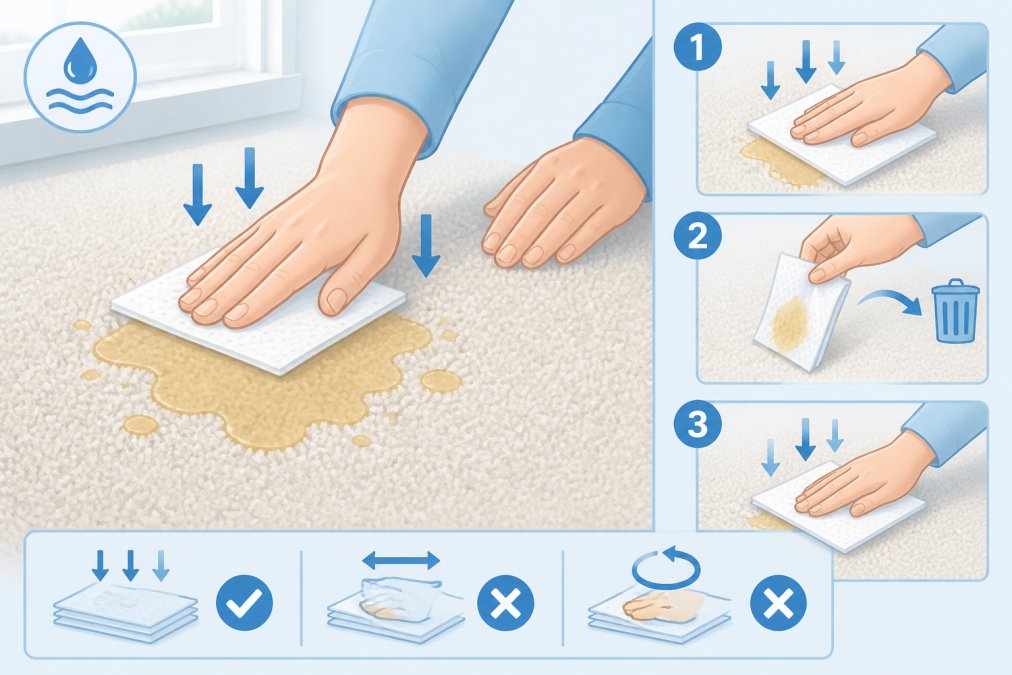
Start by blotting, not rubbing. Rubbing pushes urine deeper into the carpet pile and padding. Instead, use white paper towels or cloth rags to press down firmly on the wet spot. Work from the outside edges toward the center to contain the spread. Change towels frequently, you’re transferring moisture, not spreading it around. Blot for 30 seconds, then move to a fresh section of towel. Repeat until the carpet feels damp rather than soaked.
Next, increase air circulation immediately. Open windows, turn on ceiling fans, and run a portable dehumidifier if you have one. Ventilation prevents moisture from settling into the carpet padding, where it becomes a breeding ground for bacteria and mold. If it’s cold outside, crack a window anyway, the temporary discomfort is worth preventing sub-floor damage.
For fresh accidents, sprinkle baking soda over the blotted area and let it sit for 15 minutes. Baking soda absorbs residual moisture and neutralizes some odor compounds. Vacuum thoroughly afterward. This buys you time while you prepare a deeper cleaning solution.
Test Your Carpet for Colorfastness Before Cleaning
Before you apply any liquid solution to your carpet, you need to know whether your carpet dyes will run. Colorfastness testing takes two minutes and prevents you from trading a urine stain for a bleached spot.
Mix a small amount of your intended cleaning solution (whether DIY or commercial). Apply it to a hidden area of carpet, under a piece of furniture, in a closet, or at the edge of a room. Let it sit for 5 minutes, then blot with a white cloth. If color transfers to the cloth, your carpet isn’t colorfast to that solution. Stop and try a different approach.
For synthetic fibers like polyester and nylon, most diluted cleaning solutions are safe. But for natural fibers like wool or silk, you need to be more cautious. Wool is especially sensitive to acidic solutions and alkaline cleaners. If you’re uncertain about your carpet fiber type, check the manufacturer’s label or contact the installer.
This single test prevents costly mistakes. It’s the difference between removing a stain and creating a permanent mark on your carpet.
Best Enzymatic Cleaner for Pet Urine
Enzymatic cleaners work differently than chemical cleaners. Instead of masking odor or breaking down surface stains, enzymes actually digest the organic compounds in urine, specifically uric acid, which is the culprit behind that persistent ammonia smell.
When you use an enzymatic cleaner, the enzymes bind to urine crystals and break them down into smaller molecules that can be rinsed away. This is why enzymatic cleaners are the gold standard for removing pet urine from carpet. They address the root cause, not just the symptom.
The challenge is that most enzymatic cleaners require the right conditions to work. Enzymes are living organisms (technically, proteins produced by living organisms), and they need moisture, time, and the right pH to function. This means you can’t just spray an enzymatic cleaner and expect instant results. You need to:
- Saturate the affected area thoroughly
- Let it sit for 12-24 hours (check the product instructions, some need less time)
- Keep the area damp during this period
- Avoid using vinegar or other acidic solutions beforehand, as they can kill enzymes
The best enzymatic cleaners for pet urine are those specifically formulated for this problem. Look for products that list "protease" and "amylase" as active ingredients. These enzymes specifically target the proteins and organic matter in urine.
After the enzymatic cleaner has had time to work, extract the moisture using a wet vacuum or by blotting repeatedly. This removes the dissolved urine compounds and the cleaner residue. If you skip this step, the enzymes can’t rinse away and the smell may return.
DIY Cleaning Solutions: Vinegar, Baking Soda, and Peroxide
If you don’t have access to an enzymatic cleaner or prefer a DIY approach, these household solutions can help remove pet urine from carpet, though they work best on fresh stains rather than set-in odors.
Vinegar and baking soda combo: Mix equal parts white distilled vinegar and water in a spray bottle. Spray the affected area until saturated. Sprinkle baking soda over the wet spot. Let it dry completely (this takes 24-48 hours). Vacuum thoroughly. The vinegar’s acidity helps neutralize urine odor, while baking soda absorbs remaining moisture and smell. The downside: vinegar has a strong smell of its own that takes time to dissipate, and this method doesn’t actually break down uric acid crystals.
Hydrogen peroxide solution: Mix one part 3% hydrogen peroxide with one part water. Test for colorfastness first. Spray the area and let sit for 10 minutes. Blot with clean towels. Hydrogen peroxide is a mild oxidizer that breaks down some odor compounds, but it’s weaker than enzymatic cleaners. It works best on light-colored carpets where you can see what you’re treating.
Baking soda alone: Sprinkle baking soda directly on the damp area, let sit overnight, then vacuum. This is the gentlest approach and works well as a maintenance step after using other solutions. Baking soda absorbs odor but doesn’t eliminate uric acid crystals.
The reality: these DIY solutions provide temporary relief. They mask odor or handle surface-level stains, but they don’t penetrate deep into the carpet backing and padding where urine crystals hide. For fresh accidents, they’re fine. For stains older than a few days, you’ll likely need something stronger.
How Long Does It Take for Pet Urine to Dry
Pet urine doesn’t simply evaporate. It bonds with carpet fibers and soaks into padding, where moisture can linger for weeks if not properly treated.
Fresh urine on the surface dries to the touch in 4-8 hours depending on humidity, ventilation, and carpet thickness. But "dry to the touch" doesn’t mean the urine is gone. Moisture deep in the padding can take 7-14 days to evaporate naturally, and during that time, bacteria multiply and odor intensifies.
This is why removing pet urine from carpet quickly matters so much. If you wait more than 24 hours before treating a stain, the urine has already begun bonding to fibers and seeping into the backing. The longer you wait, the deeper it goes and the harder it becomes to remove.
Temperature and humidity affect drying time. In warm, dry conditions with good air circulation, moisture evaporates faster. In cool, humid environments, it lingers. A basement carpet with poor ventilation might take three weeks for deep moisture to dry completely, while an upstairs bedroom with a window open dries in five days.
The takeaway: don’t rely on time and air circulation alone. Actively extract moisture using a wet vacuum, dehumidifier, or professional equipment. This cuts drying time in half and prevents the odor from setting in.
Removing Dried Pet Urine Stains From Carpet
Once pet urine has dried, it becomes exponentially harder to remove. The uric acid crystals have bonded to carpet fibers, and the smell has seeped into the padding and sub-floor. This is why removing dried pet urine stains requires a more aggressive approach.
Start with an enzymatic cleaner designed for set-in stains. These are more concentrated than general-purpose enzymatic products. Saturate the entire stained area, don’t just spray the surface. The solution needs to penetrate through the carpet pile, into the backing, and into the padding below. Use a spray bottle to apply it generously.
Let the enzymatic cleaner sit for 24 hours. Keep the area damp by covering it with plastic or a damp towel. This extends the enzyme’s working time and allows it to break down more uric acid crystals.
After 24 hours, extract the moisture aggressively. Use a wet vacuum if you have one, or rent one from a hardware store. Make multiple passes over the area, extracting as much liquid as possible. The extracted water should be noticeably darker or cloudier than what you put in, that’s the dissolved urine and broken-down crystals leaving the carpet.
If the stain is particularly stubborn or covers a large area, consider whether professional treatment makes sense. Professional equipment applies heat and pressure that home tools can’t match, and professionals understand how to avoid over-saturating the carpet, which can damage the backing.
Eliminating Deep-Set Odors and Uric Acid Crystals
The smell that keeps coming back? That’s uric acid crystals that your previous cleaning attempts missed. These crystals are invisible to the naked eye but extremely persistent. They hide deep in the carpet pile, in the backing, and sometimes in the sub-floor itself.
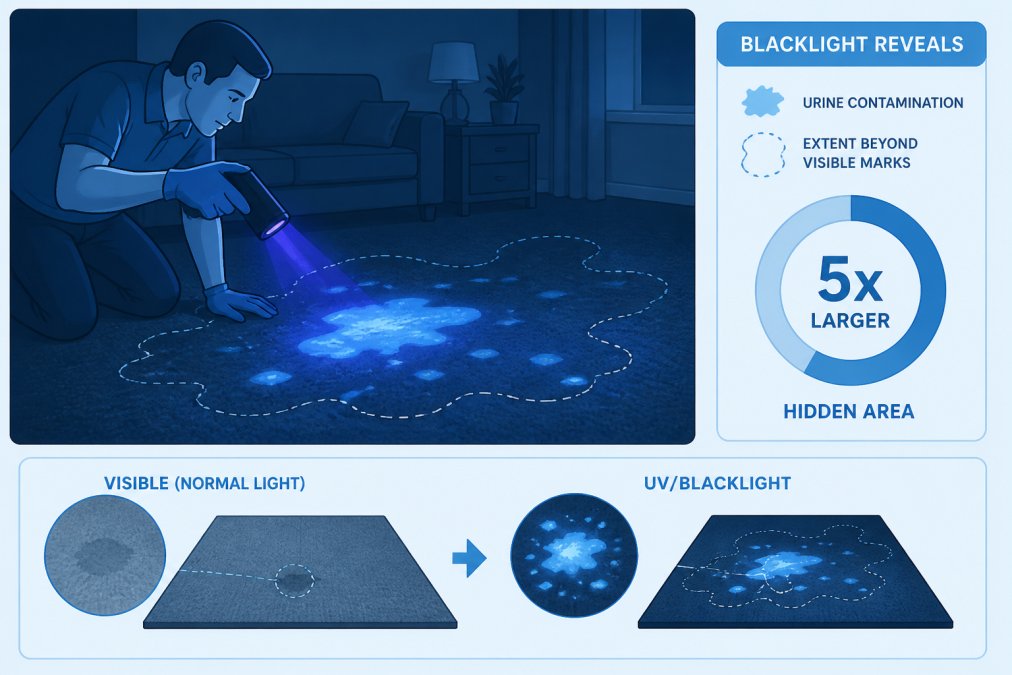
The blacklight method helps identify where these crystals are hiding. Uric acid fluoresces under ultraviolet light, making it visible in a dark room. If you have access to a blacklight (or can borrow one), use it to map the full extent of contamination. You’ll often find that the stain spreads much further than you thought, sometimes several feet beyond the visible mark.
Once you’ve identified all affected areas, treat each one with an enzymatic cleaner. The enzyme protease specifically breaks down the protein bonds in uric acid, which is why enzymatic cleaners are non-negotiable for eliminating deep-set odors. Chemical cleaners and vinegar solutions might mask the smell temporarily, but they don’t destroy the crystals themselves.
For odors that persist even after enzymatic treatment, the problem may be in the sub-floor or padding beneath the carpet. If the urine has soaked through the backing and into the padding or wood sub-floor, you’re dealing with contamination that surface cleaning can’t reach. At this point, you need either professional extraction equipment or padding replacement. Lake Geneva Carpet Cleaning uses truck-mounted hot water extraction technology that applies heat and pressure deep into the carpet structure, reaching contamination that household methods can’t touch.
Odor neutralizers (like activated charcoal or specialized enzyme powders) can help after enzymatic treatment, but they work best as a final step, not a first one. Use them only after you’ve removed the source of the odor.
Protecting Your Sub-Floor and Carpet Padding
Once urine reaches the sub-floor or padding, the damage compounds. Moisture promotes mold growth, wood rot, and structural damage. The padding becomes a permanent source of odor because it’s impossible to fully dry out or clean once saturated.
Prevention is the easiest fix. If you catch a urine accident within the first few hours, aggressive blotting and drying prevent sub-floor saturation. But if you discover an old stain or missed accident, you need to assess the damage.
Press down on the carpet around the stained area. If it feels spongy or soft, the padding has absorbed urine and is likely compromised. Smell the carpet from underneath if possible. If there’s a strong ammonia odor coming from the back, the padding is saturated.
In these cases, removing pet urine from carpet means replacing the padding. You can remove the carpet, pull up the old padding, treat the sub-floor with an enzymatic cleaner or antimicrobial solution, and install new padding. This is a larger project than surface cleaning, but it’s the only way to fully eliminate the odor source.
For minor saturation, you can sometimes save the padding by:
- Removing the carpet from that section
- Lifting the padding and allowing air circulation underneath
- Using a dehumidifier and fans to dry the sub-floor
- Treating the exposed sub-floor with an enzymatic cleaner
- Allowing 5-7 days of drying before re-installing padding and carpet
This approach works only if you catch it early. Once mold has started growing or wood has begun rotting, replacement is the only option.
Prevent Future Pet Accidents on Your Carpet
The best solution is preventing accidents before they happen. But accidents will happen, that’s the reality of pet ownership. The goal is to minimize them and catch them quickly.
Use enzymatic cleaners as a preventative step. After you’ve removed pet urine from carpet, some pets return to the same spot because they can still smell their own urine at a level humans can’t detect. Even after thorough cleaning, trace amounts of uric acid might remain. Using an enzymatic cleaner as a final step breaks down these remaining crystals and removes the scent marker that attracts pets back to that spot.
Consider using pet-resistant carpet for high-risk areas. Synthetic fibers like polypropylene are easier to clean and less prone to permanent staining than natural fibers. If you’re replacing carpet, this is worth the investment.
For pets that repeatedly have accidents in the same area, address the underlying cause. Is your pet getting older and losing bladder control? Are they stressed or anxious? Is the litter box or outdoor access blocked? Behavioral or medical issues need to be solved separately from carpet cleaning.
Waterproof rugs or washable throw rugs in high-traffic pet areas provide an easy-to-clean alternative to permanent carpet. These can be removed, washed, or replaced without damaging the carpet underneath.
Finally, enzyme-based pet odor neutralizers applied monthly to high-risk areas prevent uric acid buildup. These products are designed to break down odor compounds before they accumulate, keeping your carpet fresher longer.
When to Call a Professional for Pet Urine Removal
At some point, DIY cleaning reaches its limits. If you’ve tried enzymatic cleaners, vinegar solutions, and baking soda without success, or if the stain covers a large area or multiple rooms, professional treatment makes sense.
Professional carpet cleaners have equipment and expertise that home tools can’t match. Truck-mounted hot water extraction systems apply heat (typically 200+ degrees) and high-pressure water jets that penetrate deep into carpet backing and padding. This combination breaks down uric acid crystals and extracts moisture far more effectively than a rental machine or household spray bottle.
Professionals also understand the science of pet urine removal. They know which areas of the carpet are most likely to hide contamination. They can assess sub-floor damage and recommend padding replacement if necessary. They have access to commercial-grade enzymatic cleaners that are more concentrated than retail products.
The cost of professional treatment varies based on the area affected and the severity of contamination. Rather than estimate, contact local providers for quotes. Many offer free inspections, which gives you a clear picture of what’s needed before you commit.
For pet owners in the Lake Geneva area dealing with stubborn odors or large-scale contamination, Lake Geneva Carpet Cleaning specializes in removing pet urine from carpet using advanced hot water extraction technology. With over 32 years of experience, their eco-friendly approach removes uric acid crystals and odors without harsh chemicals, which matters if you have children or pets sensitive to cleaning products.
Removing pet urine from carpet is a multi-step process that requires speed, the right tools, and persistence. Fresh accidents respond to immediate blotting and enzymatic treatment. Dried stains need aggressive extraction and extended enzyme contact time. Deep-set odors require identifying uric acid crystals and treating contamination throughout the carpet structure, not just the surface.
The most common mistake pet owners make is waiting too long or relying on surface-level fixes. By the time you realize a stain is permanent, the urine has already bonded to fibers and soaked into padding. This is why acting within the first 24 hours makes such a dramatic difference.
If DIY efforts haven’t solved the problem after two or three attempts, professional help from Lake Geneva Carpet Cleaning eliminates the guesswork. Their truck-mounted hot water extraction removes embedded uric acid crystals and moisture that household methods can’t reach, combined with their 10-day satisfaction guarantee, giving you peace of mind that the odor won’t return.
Frequently Asked Questions
What is the most effective way to remove pet urine from carpet?
Immediate action is critical. Blot fresh urine with paper towels, then apply an enzymatic cleaner designed to break down uric acid crystals. For dried stains, enzymatic cleaners are more effective than vinegar or baking soda alone because they contain specific enzymes that target urine's protein compounds. For stubborn odors that persist after DIY treatment, professional hot water extraction removes urine deep within the carpet padding and backing where odors hide.
How long does it take for pet urine to dry on carpet?
Fresh pet urine typically dries within 3-6 hours depending on humidity, carpet thickness, and ventilation. However, the liquid may penetrate the carpet pile and padding within minutes, making quick blotting essential. Even after the surface appears dry, urine crystals remain in the fibers and backing, continuing to release odor. This is why dried stains require deeper treatment methods than fresh accidents.
Can you completely remove pet urine from carpet?
Yes, but it depends on how quickly you treat it and how deep the saturation goes. Fresh urine can be nearly eliminated with immediate blotting and enzymatic treatment. Dried stains are harder because uric acid crystals bond to carpet fibers and soak into padding. If urine has reached the sub-floor, complete removal may require professional extraction or, in severe cases, carpet replacement. Professional deep cleaning has the best success rate for eliminating both stains and odors permanently.
Is vinegar or baking soda better for pet urine?
Neither is ideal alone. Vinegar's acidity can help neutralize some odors temporarily, while baking soda absorbs moisture and surface smells. However, enzymatic cleaners are superior because they break down the uric acid and proteins that cause persistent odors, something vinegar and baking soda cannot do. For best results, use enzymatic cleaners first, then add baking soda or vinegar as supporting treatments for residual odor.
This article was written using GrandRanker