Table of Contents
- Why Does Your Carpet Smell? How to Identify the Source of the Odor
- The Best Way to Remove Carpet Odors: Surface vs. Deep Cleaning
- How Long to Leave Baking Soda on Carpet (And How to Use It Right)
- How to Clean Carpet with Vinegar to Neutralize Odors
- How to Remove Musty Smell from Carpet Caused by Moisture
- Best Carpet Deodorizer for Pets: Enzyme Cleaners vs. Natural Remedies
- The Best Way to Remove Carpet Odors You Can’t Fix Yourself
- Conclusion
Last Updated: June 9, 2026
Finding the best way to remove carpet odors is a question Lake Geneva Carpet Cleaning hears constantly from homeowners across Lake Geneva, Wisconsin. Carpets trap odors at multiple layers simultaneously, from surface fibers down through the backing and into the padding beneath, which is why a single sprinkle of baking soda often fails. Below, we’ll walk through every major odor source, the right treatment for each, and the situations where DIY methods simply cannot reach deep enough.
Why Does Your Carpet Smell? How to Identify the Source of the Odor
Carpet odor removal starts with correctly diagnosing the source, because the wrong treatment wastes time and money. Odors embedded in carpet fibers behave differently from odors locked into the padding below.
Get close to the carpet and sniff specific zones. Pet urine has a sharp ammonia quality. Mildew produces a flat, earthy mustiness. General dirt and body oil accumulation smells stale and dusty. Use a UV blacklight in a darkened room to locate pet urine deposits invisible to the naked eye, urine fluoresces under UV light, revealing exactly where contamination is concentrated.
Pet Urine and Biological Accidents
Pet urine is the most structurally damaging odor source a carpet faces. Fresh urine flows through carpet fibers, through the backing, and directly into the padding. By the time it dries, uric acid crystals have bonded to fibers at multiple layers. Standard cleaning only addresses the top layer, leaving crystals in the padding to re-activate with humidity. Heat and humidity cause dormant uric acid crystals to off-gas, which is why a carpet that seemed fine in winter suddenly reeks in July.
Mildew, Moisture, and Humidity Buildup
A musty smell almost always indicates moisture that didn’t dry properly, after flooding, after a DIY cleaning that left carpet wet too long, or from high ambient humidity in basements. Wisconsin’s seasonal climate creates real challenges: humid summers and temperature fluctuations create condensation conditions that feed mildew growth at the carpet backing level. Mildew can sometimes be addressed with neutralizing agents before it penetrates deeply; the key variable is how long the moisture has been present.
High-Traffic Areas and General Dirt Accumulation
High-traffic areas accumulate oils from bare feet, tracked-in soil, and airborne particles that settle into carpet fibers over time. This odor is diffuse rather than localized, making it harder to spot-treat. Regular vacuuming slows accumulation but cannot remove oils bonded to synthetic fibers, those require a proper deep clean to lift.
The Best Way to Remove Carpet Odors: Surface vs. Deep Cleaning
The best way to remove carpet odors depends entirely on how deeply the odor has penetrated. Surface-level deodorizing works for fresh, light odors. Deep cleaning is required for anything that has had time to set, migrate into the padding, or develop a biological component. This distinction is the reason so many homeowners repeat the same treatments without lasting results.
Surface-Level Deodorizing: When It Works and When It Doesn’t
Surface deodorizing works well for general staleness, light cooking smells, and odors that haven’t penetrated past the carpet fibers. Baking soda, dry carpet powders like Arm & Hammer Extra Strength Carpet Odor Eliminator, and light vinegar sprays all operate at this level.
The honest limitation: surface treatments cannot reach carpet padding. If an odor source has been present for more than 24-48 hours, it has likely migrated below the fiber level. Applying a surface treatment to a deep odor temporarily masks it, the odor returns within days because the source was never addressed.
Deep Cleaning for Set-In Odors and Carpet Padding Saturation
Carpet padding is typically 3/8 to 1/2 inch of porous foam or fiber that absorbs liquid readily and dries slowly. Once saturated with urine or contaminated water, surface-level cleaning does nothing to it. Deep cleaning with a hot water extraction machine forces solution through the fiber layer and into the backing, addressing moderate padding contamination. For severe saturation, the padding itself often needs replacement. According to EPA guidance on mold and moisture in buildings, materials wet for more than 48 hours showing signs of biological growth should be removed rather than dried in place, the same principle applies to heavily saturated carpet padding.
How Long to Leave Baking Soda on Carpet (And How to Use It Right)
Baking soda should be left on carpet for a minimum of 30 minutes, though overnight produces noticeably better results for moderate odors. It works by absorbing acidic odor molecules into its alkaline structure, a process that takes time.
Here is a step-by-step method that actually works:
- Vacuum the carpet thoroughly first to remove loose debris.
- Sprinkle baking soda generously and evenly, you want visible coverage, not a light dusting.
- Work the powder gently into the fibers with a soft brush to increase contact surface area.
- Leave it for at least 30 minutes; for musty or stale odors, leave it overnight with the room closed.
- Vacuum slowly and thoroughly, making multiple passes in different directions.
- Check for powdery residue by running a dark cloth over the surface, residue left behind can attract moisture.
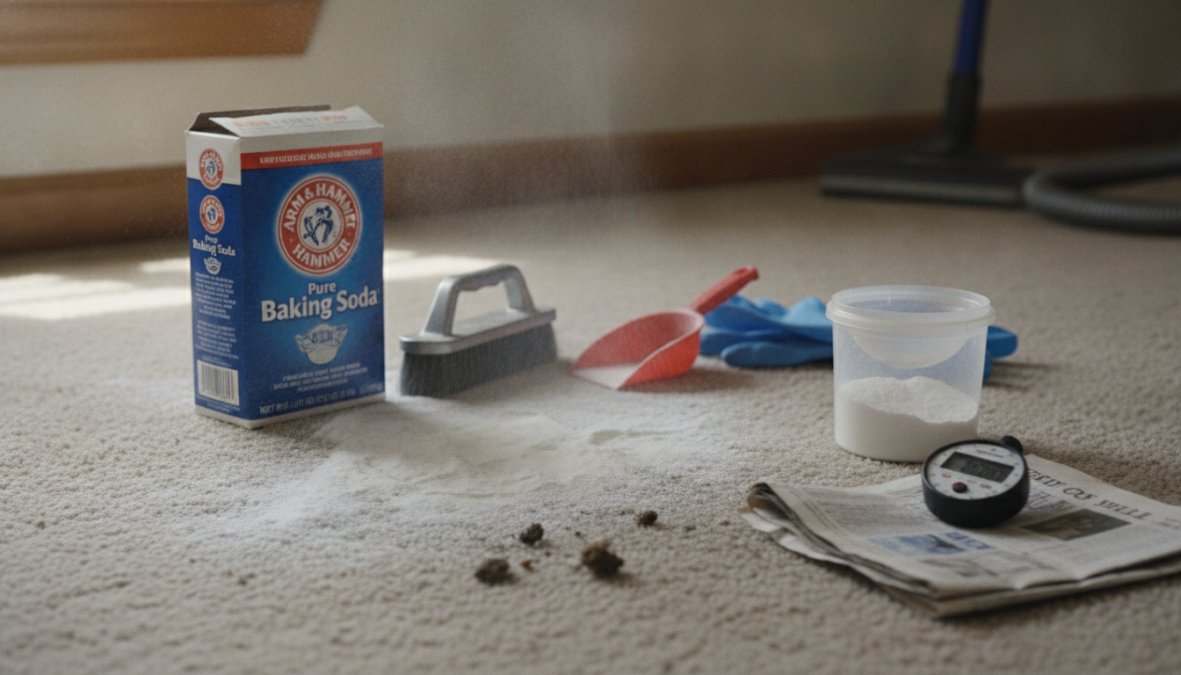
A common mistake is using baking soda as the only treatment for pet urine. Baking soda absorbs odors but does not break down uric acid crystals. For biological odors, it works best as a follow-up after an enzyme-based cleaner has done the primary work.
How to Clean Carpet with Vinegar to Neutralize Odors
White vinegar is an effective odor neutralizer for alkaline-based odors because its acetic acid content chemically neutralizes rather than masks them. Mix one part white vinegar with one part water in a spray bottle, mist the affected area lightly, allow it to dwell for 5-10 minutes, then blot with a clean cloth and air dry. The vinegar smell dissipates as it dries, typically within 30-60 minutes with adequate ventilation.
Material-Specific Safety Warnings: Wool Rugs and Synthetic Carpet
White vinegar is safe for most synthetic carpet types including nylon and polyester. It is not safe for wool rugs, the acetic acid strips the natural lanolin coating and causes permanent fiber degradation. If you have a wool rug, use a pH-neutral cleaner designed for natural fibers instead.
Hydrogen peroxide deserves the same caution. A 3% solution can be effective on light-colored synthetic carpets but carries a real risk of bleaching darker carpets and is not appropriate for wool. Borax should not be used in homes with pets or small children who have direct floor contact, as ingestion carries health risks. Always test any solution in a hidden area before treating a visible section.
How to Remove Musty Smell from Carpet Caused by Moisture
Removing a musty smell requires addressing both the odor and the underlying moisture condition. Treating the odor without resolving the moisture source guarantees the smell returns.
The process follows this sequence:
- Identify and eliminate the moisture source, a dehumidifier, a fixed plumbing leak, or improved ventilation may be necessary before any cleaning has lasting effect.
- Apply a mildew-targeting odor eliminator. OdoBan Odor Eliminator, EPA Safer Choice certified and effective against mildew odors, works well here. Dilute per label instructions.
- Allow the carpet to dry completely before evaluating results, wet carpet always smells worse than dry carpet.
- Follow with baking soda treatment once dry to absorb remaining surface odor.
According to CDC guidelines on mold prevention in homes, controlling indoor humidity below 50% is the most effective long-term strategy for preventing mold and mildew growth on porous materials including carpet.
Post-Cleaning Drying Techniques to Prevent Odor Recurrence
Drying technique is the most underrated factor in carpet odor removal. A carpet that dries slowly after cleaning develops new mildew odors within 24-48 hours, undoing the work entirely.
Effective drying after any wet treatment:
- Run ceiling fans or portable fans directed at the carpet surface continuously until dry.
- Open windows only if outdoor humidity is lower than indoor humidity, in Lake Geneva summers, check before opening.
- Use a dehumidifier in the room to pull moisture from the air and accelerate evaporation.
- Avoid walking on the carpet until fully dry to prevent re-soiling and fiber compression that slows drying.
- Deep-cleaned carpets should dry in 6-12 hours; longer than 12 hours indicates insufficient ventilation.
Best Carpet Deodorizer for Pets: Enzyme Cleaners vs. Natural Remedies
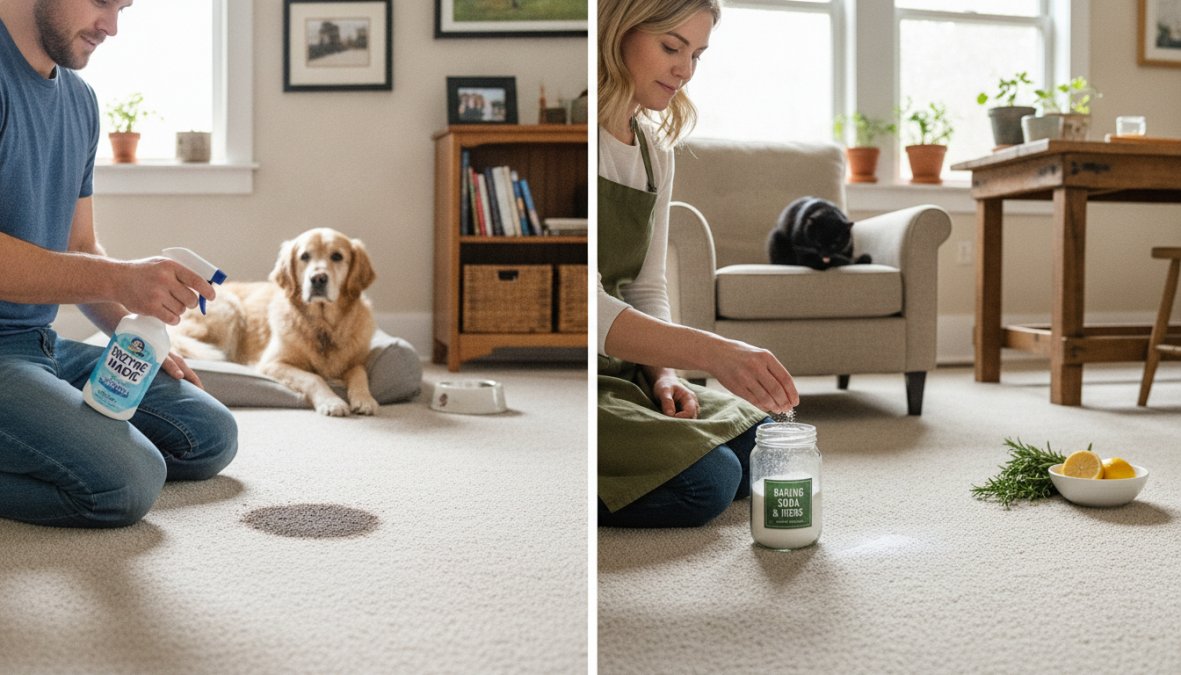
Enzyme-based cleaners are the correct choice for pet urine odors. Natural remedies are not. This is not a close call.
Enzyme cleaners introduce biological catalysts that break down the specific organic compounds in urine, feces, and vomit at a molecular level. Rocco & Roxie Stain & Odor Eliminator uses a bio-enzymatic formula that feeds on ammonia crystals, the primary odor source in dried urine. Both it and Bissell Professional Stain & Odor Remover eliminate the odor source rather than masking it, and deter pets from re-marking because the chemical attractants are removed. Natural remedies like baking soda and vinegar can reduce perceived odor temporarily but cannot break down uric acid crystals, the odor returns.
Product | Type | Best For | Key Strength |
|---|---|---|---|
Rocco & Roxie Eliminator | Bio-enzymatic spray | Pet urine, feces, vomit | Breaks down ammonia crystals |
Bissell Professional | Enzyme-based liquid | General pet accidents | Multi-surface, trusted brand |
OdoBan Odor Eliminator | Concentrated multi-use | Mildew, smoke, pets | Cost-effective, EPA certified |
Nature’s Miracle Shampoo | Bio-enzymatic shampoo | Full-room machine cleaning | Deep odor-locking technology |
Arm & Hammer Powder | Baking soda powder | Light surface deodorizing | Affordable, simple application |
Equipment Rental vs. Purchase for Deep Pet Odor Removal
For one or two isolated pet accidents, a spray-and-blot enzyme treatment is sufficient and equipment rental is unnecessary. For homes with multiple pets, large affected areas, or chronic odor problems, a carpet cleaning machine is worth considering. Rental machines from hardware stores typically cost $30-50 per day; consumer-grade machines like Bissell or Hoover cost more but make sense for households using them multiple times per year.
The honest assessment: consumer rental machines have lower water pressure and weaker extraction than professional truck-mounted equipment, limiting how deeply they clean and how effectively they remove moisture. For severe pet odor saturation, they improve on hand-treatment alone but do not match professional-grade results. Nature’s Miracle Carpet Shampoo is specifically formulated for use in carpet cleaning machines and pairs well with rental equipment for large-area treatment.
The Best Way to Remove Carpet Odors You Can’t Fix Yourself
Some carpet odor problems are beyond DIY resolution. Recognizing this early saves significant time and avoids the frustration of repeated treatments that don’t hold.
Call a professional carpet cleaner when:
- The odor has been present for months or returns within days of every treatment
- Pet urine has saturated an area larger than roughly two square feet, indicating likely padding saturation
- The musty smell persists after the moisture source has been corrected and the carpet has dried
- The carpet is wool, silk, or a delicate natural fiber that cannot safely tolerate home treatments
- You can smell the odor from across the room even after cleaning
Professional truck-mounted hot water extraction operates at temperatures and pressures consumer machines cannot replicate, removing far more moisture for faster drying and less mildew risk. According to Carpet and Rug Institute cleaning standards, hot water extraction is the recommended method for deep cleaning and odor removal in residential carpets, particularly for allergen and biological contaminant removal. For Lake Geneva homeowners searching for professional carpet cleaning near me, ask specifically whether the service uses truck-mounted extraction rather than portable machines.
Persistent carpet odors, especially those caused by pet urine, mildew, or deep fiber saturation, rarely resolve completely with surface-level treatments alone. Lake Geneva Carpet Cleaning has served Wisconsin homeowners for over 32 years using truck-mounted hot water extraction technology that reaches the padding level where most odors actually live. The service is backed by a 10-day satisfaction guarantee and uses eco-friendly methods safe for families and pets. Get started with Lake Geneva Carpet Cleaning and experience the difference between a carpet that smells temporarily better and one that is genuinely clean.
Frequently Asked Questions
What is the best home remedy to remove carpet odors?
The best way to remove carpet odors at home is to use baking soda as a dry odor neutralizer combined with a white vinegar spray for deeper treatment. Sprinkle baking soda liberally over the affected area, let it sit for several hours or overnight, then vacuum thoroughly. For stronger or biological odors like pet urine, follow up with an enzyme-based cleaner, which breaks down the organic compounds causing the smell rather than simply masking it.
Does baking soda really remove carpet odors, and how long should you leave it on?
Yes, baking soda is an effective odor neutralizer for surface-level carpet smells. For best results, leave it on the carpet for a minimum of 30 minutes, though leaving it overnight — up to 8 hours — produces noticeably better results. The longer it sits, the more odor molecules it absorbs from the carpet fibers. Always vacuum thoroughly afterward. Keep in mind that baking soda addresses surface odors but will not reach deep into carpet padding where set-in odors originate.
How can I remove pet urine smell from carpet permanently?
To permanently remove pet urine smell, you need an enzyme-based cleaner rather than a standard air freshener or baking soda alone. Enzyme cleaners like Rocco & Roxie or Bissell Professional break down the ammonia crystals and uric acid in urine at a molecular level. Blot the area first, apply the enzyme cleaner generously, let it dwell for the recommended time, then blot dry. If the urine has saturated the carpet padding beneath the fibers, professional hot water extraction is often the only reliable solution.
When should you hire a professional carpet cleaner for odor removal?
You should call a professional when DIY methods have failed after multiple attempts, when odors return shortly after cleaning, or when the smell is traced to carpet padding saturation — a condition home methods cannot fully address. Musty or mildew odors after flooding, widespread pet accidents, or smoke damage also warrant professional treatment. Professional truck-mounted hot water extraction reaches deep into carpet fibers and padding, removing the contaminants that cause persistent odors rather than temporarily masking them.
Is it safe to use vinegar on all carpet types to remove odors?
White vinegar is safe for most synthetic carpets but should be used with caution on wool rugs and natural fiber carpets. The acidity in vinegar can damage or discolor wool fibers over time. Always dilute white vinegar with water in at least a 1:1 ratio before applying it to any carpet, and test on a hidden area first. For wool rugs or delicate natural fiber carpets, a pH-neutral enzyme cleaner is a safer alternative for odor removal without risking fiber damage.
This article was written using GrandRanker