Table of Contents
- How to Get Cat Urine Out of Carpet: Immediate Steps to Take
- Home Remedies for Cat Urine Smell That Actually Work
- Best Enzymatic Cleaner for Cat Urine: What to Look For
- How to Clean Cat Urine from Carpet Pad and Sub-Floor
- How to Find Cat Urine in Carpet with a Blacklight
- How Can I Get Cat Urine Out of Carpet When the Stain Is Old
- Why Cats Pee Outside the Litter Box and How to Prevent It
- When to Call a Professional Carpet Cleaner in Lake Geneva, WI
Last Updated: June 13, 2026
If you’ve ever walked into a room and been hit by that sharp, unmistakable smell, you already know the urgency. Asking how can i get cat urine out of carpet is one of the most common household crises pet parents face. This guide from Lake Geneva Carpet Cleaning covers every stage of the process, from the first frantic moments after an accident to tackling stains hiding in your carpet for weeks. Here’s what most articles get wrong: they treat all cat urine stains the same. Fresh stains and old stains require completely different approaches, and using the wrong method can permanently set the odor.
Uric acid is why cat urine is so stubbornly persistent. Unlike other components that evaporate or dissolve, uric acid forms crystals that bond to carpet fibers and reactivate with humidity, which is why a stain you thought was gone comes back on a rainy day. Below, we’ll walk you through handling fresh accidents, neutralizing ammonia, treating carpet padding, finding hidden stains with a blacklight, and knowing when to call a professional.
How to Get Cat Urine Out of Carpet: Immediate Steps to Take
Speed is the single most important factor. The longer urine sits, the deeper it penetrates through carpet fibers into the padding and potentially the sub-floor. Acting within the first few minutes dramatically reduces the chance of permanent odor and staining.
The moment you discover a fresh accident, resist the urge to pour water on it. Diluting before blotting spreads urine over a wider area, making cleanup significantly harder.
Supplies You Need Before You Start
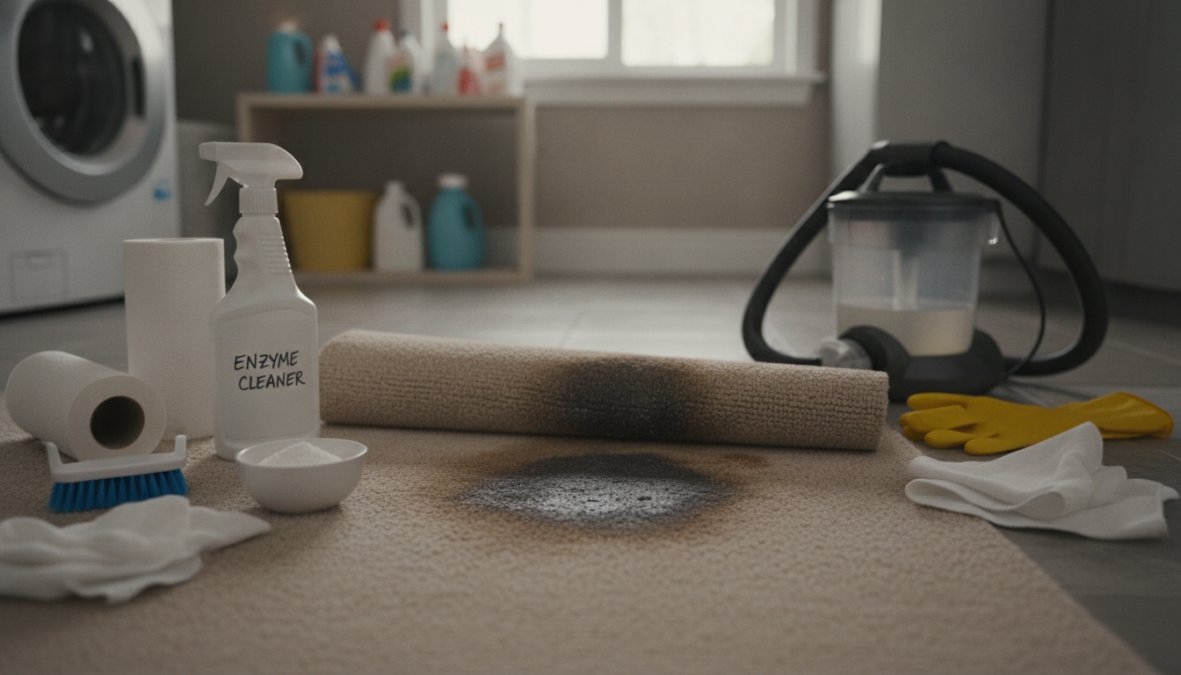
Having the right materials within reach saves critical time. Keep these on hand if you have cats:
- Clean white cloths or paper towels (avoid colored fabrics that can transfer dye)
- Rubber gloves
- Baking soda
- White vinegar (distilled)
- 3% hydrogen peroxide
- Dish soap (clear, unscented)
- A quality enzymatic cleaner formulated for pet urine
- A UV blacklight flashlight
- A portable carpet cleaner or wet/dry vacuum for moisture extraction
White cloths are non-negotiable. Colored towels can bleed dye into wet carpet, creating a second problem on top of the first.
Blotting vs. Scrubbing: Why It Matters
Blotting is the correct technique. Scrubbing pushes urine deeper into carpet fibers and spreads it laterally, contaminating a larger area. Blotting uses downward pressure to draw moisture upward. Work from the outside edge inward, apply firm steady pressure, then lift straight up. Repeat with fresh cloth sections until no more moisture transfers. Once you’ve removed as much liquid as possible, the treatment phase begins.
Never use a steam cleaner on a fresh or untreated cat urine stain. The heat permanently bonds uric acid proteins to carpet fibers, setting the odor in a way that almost nothing can reverse afterward.
Home Remedies for Cat Urine Smell That Actually Work
The right home remedies genuinely work on fresh stains. For stains older than 24 hours, home remedies become significantly less effective and enzymatic cleaners become necessary. That said, many pet parents successfully handle fresh accidents with pantry staples before an enzymatic cleaner arrives.
White Vinegar and Baking Soda Method
White vinegar neutralizes ammonia, the compound responsible for that sharp, eye-watering smell. The process is straightforward but requires patience.
Step 1: After thorough blotting, mix equal parts white vinegar and cool water in a spray bottle.
Step 2: Saturate the stained area so the solution penetrates to roughly the same depth the urine reached.
Step 3: Blot again with clean cloths until most liquid is absorbed.
Step 4: While still slightly damp, sprinkle a generous layer of baking soda over the entire stain to absorb residual moisture and odor.
Step 5: Allow baking soda to sit at least 8 hours or overnight, then vacuum thoroughly.
Before applying any solution, do a fabric test on a hidden area. Some carpets, particularly wool or older dyed fibers, react poorly to acidic solutions.
Hydrogen Peroxide and Dish Soap Solution
This combination works well on light-colored carpets. Mix one cup of 3% hydrogen peroxide with one teaspoon of clear dish soap. Apply to the stained area, work gently into fibers, then blot clean. Do not let hydrogen peroxide sit more than 10 minutes, as prolonged contact can lighten carpet color. Always test colorfastness on a hidden section first.
For maximum odor removal, follow the hydrogen peroxide treatment with a light dusting of baking soda once the area is mostly dry. The baking soda captures remaining volatile compounds that cause odor.
Best Enzymatic Cleaner for Cat Urine: What to Look For
The best enzymatic cleaner for cat urine contains live bacterial cultures alongside the enzymes, not just enzymes alone. The bacteria produce enzymes continuously as they consume uric acid crystals, providing sustained cleaning action that a one-time enzyme application cannot replicate.
Enzymatic cleaners break down uric acid at the molecular level. Standard cleaners mask odor with fragrance. This is why a spot that smells "clean" after a standard cleaner often returns to smelling like cat urine on a humid day, the uric acid crystals are still there, just temporarily suppressed.
What to look for on the label:
- "Enzymatic" or "bio-enzymatic" formulation
- Specifically formulated for cat or pet urine (not just "pet odor")
- No added fragrances or surfactants that can interfere with enzyme activity
- Instructions specifying that the area be kept moist during dwell time
According to the American Kennel Club’s guidance on pet stain removal, enzymatic cleaners require adequate dwell time, typically 10 to 15 minutes or longer, to break down uric acid effectively. Rushing this step is the most common reason enzymatic cleaners appear to fail. Apply generously, cover with a damp cloth to maintain moisture, and allow full dwell time before blotting.
How to Clean Cat Urine from Carpet Pad and Sub-Floor
This is the part most guides skip, and it’s why professional cleaning often becomes necessary for chronic or large-volume accidents. Cat urine wicks through carpet fibers, through the backing, and directly into the padding. Once urine reaches the padding, surface-level cleaning addresses only a fraction of the contamination.
For significant saturation, you have two realistic options:
Option 1: Saturate and extract. Apply enzymatic cleaner in a volume matching the estimated urine penetration depth. Use a portable carpet cleaner or wet/dry vacuum to extract the liquid. Repeat two to three times. This works for moderate contamination.
Option 2: Remove and replace the padding. For heavy, repeated soiling in the same area, saturated foam padding must be cut out and replaced. Before installing new padding, treat the sub-floor with enzymatic cleaner and allow it to dry completely. If the sub-floor is wood, seal it with an oil-based primer after cleaning to lock in remaining odor compounds.
According to the Environmental Protection Agency’s guidance on indoor air quality, pet urine contamination in flooring materials can contribute to persistent indoor air quality issues when not fully addressed at the source.
How to Find Cat Urine in Carpet with a Blacklight
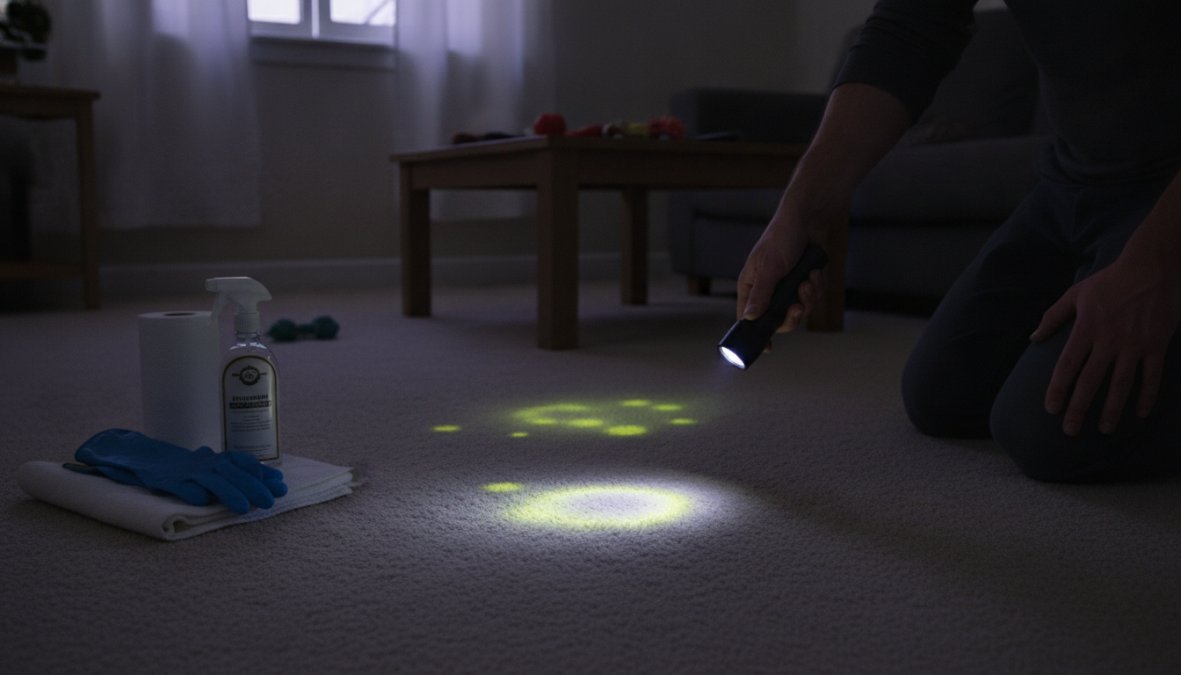
How to find cat urine in carpet with a blacklight is simpler than most people expect. Urine fluoresces under ultraviolet light because of the phosphorous compounds it contains. A UV blacklight flashlight reveals stains completely invisible under normal lighting, particularly valuable for identifying old dried stains and confirming a treated area is fully clean.
How to use a blacklight effectively:
- Wait until the room is fully dark. Even moderate ambient light washes out fluorescence.
- Use a blacklight with a wavelength between 365nm and 385nm for best results.
- Hold the light 6 to 12 inches above the carpet surface and move slowly.
- Mark each glowing spot with painter’s tape so you can find them when the lights come back on.
- Note that some cleaning products also fluoresce. Fresh urine glows yellow-green; older stains may appear dull or brownish.
A blacklight inspection before any cleaning begins gives you a complete map of contamination. Treating only visible or smellable areas while missing hidden spots is why odor problems persist even after thorough cleaning efforts.
How Can I Get Cat Urine Out of Carpet When the Stain Is Old
Old stains are a genuinely different problem. Dried urine has completed its crystallization process, uric acid is firmly bonded to carpet fibers, and the ammonia has largely dissipated, which is why old stains often smell musty rather than sharp. Rehydrating the stain is the first necessary step.
Apply warm water to soften the dried crystals, blot up as much moisture as possible, then immediately apply a generous amount of enzymatic cleaner. For old stains, extend dwell time to 30 minutes or longer and keep the area moist throughout by covering with plastic wrap or a damp cloth. Repeat the enzymatic treatment two to three times over consecutive days for best results.
Material-Specific Advice for Stubborn Stains
Not all carpets respond the same way, and treatment should account for fiber type.
Wool carpet: Wool is protein-based like urine. Enzymatic cleaners that digest protein can damage wool fibers. Use a wool-safe enzymatic cleaner or contact a professional. Avoid hydrogen peroxide entirely on wool.
Synthetic carpet (nylon, polyester, olefin): Most standard enzymatic cleaners are safe. These fibers are more resistant to both staining and cleaning solutions, making them the most forgiving for DIY treatment.
Berber or loop-pile carpet: The looped construction traps urine more deeply and makes extraction harder. A portable carpet cleaner with suction is particularly important for these styles.
Area rugs: Many area rugs, especially hand-knotted or natural fiber rugs, require professional cleaning. Dyes can bleed when exposed to acidic or oxidizing solutions.
Why Cats Pee Outside the Litter Box and How to Prevent It
Solving the cleaning problem without addressing the behavioral cause is treating a symptom. Cats urinate outside the litter box for a small set of reasons, most of which are addressable.
Medical causes come first. A cat that suddenly starts missing the litter box may have a urinary tract infection, kidney disease, diabetes, or arthritis. A veterinary visit is the right first step for any sudden change in litter box behavior.
Litter box issues are the most common non-medical cause. Common problems include too few boxes (the guideline is one per cat plus one), infrequent cleaning, covered boxes that trap odor, disliked litter type, or an exposed location that feels unsafe.
Territory marking is distinct from inappropriate elimination. Scent marking typically involves small amounts of urine sprayed vertically on walls or furniture. According to the American Society for the Prevention of Cruelty to Animals on cat behavior, spaying or neutering reduces or eliminates marking behavior in the majority of cats.
Stress and anxiety triggered by changes in household routine, new pets, or new people are also common causes.
When to Call a Professional Carpet Cleaner in Lake Geneva, WI
DIY methods have real limits. Knowing when to stop and call a professional saves both carpet and money.
Call a professional when:
- The same area has been soiled repeatedly over months
- Odor persists after two or three rounds of enzymatic treatment
- The carpet padding is visibly saturated or the sub-floor is involved
- The carpet is wool, silk, or a high-value area rug
- The blacklight reveals contamination across a large portion of a room
For Lake Geneva homeowners and the surrounding Wisconsin area, professional treatment with truck-mounted hot water extraction reaches depths that portable consumer machines cannot. This technology flushes urine compounds from deep within carpet fibers and padding with heat and pressure, then extracts them completely rather than pushing them further down. Embedded pet odors and associated bacteria affect the air your family breathes daily, not just the smell you notice walking in.
If you’re searching for a professional carpet cleaner near me in the Lake Geneva area, the difference between standard cleaning and genuine odor elimination comes down to equipment, chemistry, and experience.
Pet urine contamination in carpet is one of the most persistent household problems because most cleaning approaches address the surface while the real source sits deeper in the padding and sub-floor. Lake Geneva Carpet Cleaning has spent over 32 years helping Wisconsin homeowners solve exactly this problem, using truck-mounted hot water extraction technology and eco-friendly cleaning methods that reach contamination at every depth. With a 10-day satisfaction guarantee and meticulous attention to every job, the team at Lake Geneva Carpet Cleaning delivers results that DIY methods simply cannot replicate. Contact Lake Geneva Carpet Cleaning and get your home back to genuinely clean, not just temporarily odor-free.
Frequently Asked Questions
What is the best cleaner for cat urine in carpet?
An enzymatic cleaner is widely considered the most effective option for cat urine in carpet. These cleaners contain biological enzymes that break down uric acid crystals, the compound responsible for the lingering ammonia odor. Unlike vinegar or baking soda alone, enzymatic cleaners target the odor at its source rather than masking it. Look for a product labeled specifically for pet urine, and always do a colorfastness test on a hidden area of carpet before applying it broadly.
Does vinegar remove cat urine smell from carpet?
White vinegar can help neutralize cat urine odor because its acidity counteracts the alkaline ammonia compounds in urine. It works best on fresh stains when applied after blotting up as much moisture as possible. However, vinegar alone may not fully eliminate the smell, especially on older or deeper stains. For best results, follow the vinegar treatment with a baking soda application, let it dry completely, then vacuum. Pair with an enzymatic cleaner for stubborn or set-in odors.
How do you get old dried cat urine out of carpet?
Old dried cat urine is harder to remove because uric acid crystals have bonded to carpet fibers and potentially soaked into the padding. Start by using a UV blacklight to locate all affected areas. Re-wet the stain with warm water to reactivate the crystals, then apply an enzymatic cleaner generously and let it dwell for 10-15 minutes. Cover with a damp towel to slow evaporation. For stains that have reached the carpet pad or sub-floor, professional hot water extraction may be necessary to fully eliminate the odor.
Why does cat urine smell linger even after cleaning?
Cat urine odor lingers because uric acid crystals are not water-soluble and are not broken down by most standard household cleaners. When humidity rises, these crystals reactivate and release that distinctive ammonia smell again. Scrubbing can also spread the urine deeper into carpet fibers and padding, making the problem worse. Using the wrong cleaner, or not allowing an enzymatic cleaner enough dwell time, leaves residue behind. If the urine has penetrated the carpet pad or sub-floor, surface cleaning alone will never fully resolve the odor.
How can I find hidden cat urine spots in my carpet?
A UV blacklight flashlight is the most reliable tool for finding hidden cat urine in carpet. Urine contains phosphors that fluoresce under ultraviolet light, making spots glow yellow-green in a darkened room. Turn off all lights, close the blinds, and slowly scan the carpet from a low angle. Mark each spot with a piece of tape or sticky note before turning the lights back on so you know exactly where to treat. This method also helps confirm whether a previous cleaning was fully successful.
This article was written using GrandRanker