
Table of Contents
- What Is Professional Carpet Protection and How Does It Work?
- Why Entryways Face Unique Carpet Challenges
- How Long Does Carpet Protector Last in High-Traffic Areas?
- Best Ways to Protect Carpet in High-Traffic Entryways
- DIY vs. Professional Carpet Stain Protection: Pros and Cons
- Cost-Benefit Analysis: Is Professional Protection Worth the Investment?
- Common Misconceptions About Carpet Stain Guards
- Environmental and Health Safety Considerations
- Conclusion
Last Updated: August 14, 2026
What Is Professional Carpet Protection and How Does It Work?
Professional carpet protection is a chemical treatment that creates a hydrophobic barrier on carpet fibers, repelling liquids and preventing soil from bonding to the surface. The treatment coats individual fibers with a fluorochemical sealant that reduces liquid surface tension, causing spills to bead up rather than absorb.
When you spill liquid on protected carpet, it sits on the surface momentarily, giving you time to blot it away before penetration. Without protection, the same spill wicks into fibers and padding within seconds. The barrier also prevents soil from gripping fibers, so dirt remains on the surface where vacuuming removes it easily.
Professional-grade sealants differ significantly from consumer products. Professional applications use commercial-strength formulations that bond more effectively to synthetic fibers like nylon and polyester, applied with specialized equipment ensuring even coverage. DIY sprays often leave uneven protection and miss critical areas. Think of it this way: untreated carpet fibers are like a sponge; treated fibers are like glass, one absorbs, the other sheds.
Why Entryways Face Unique Carpet Challenges
Entryways experience concentrated wear and soil accumulation far exceeding other home areas. High-traffic zones see repeated foot traffic grinding soil, moisture, and seasonal contaminants deeper into fibers.
In winter regions, road salt, sand, and moisture tracked on shoes create a harsh chemical environment that degrades untreated fibers faster. Warmer months bring dust, pollen, and organic debris. Constant moisture cycling, wet from rain or snow, then dry from indoor heating, causes fiber degradation and accelerates wear.
Entryway carpet also faces friction stress other areas don’t. Repetitive bending and flexing under foot traffic causes fibers to lose resilience, and embedded soil acts as an abrasive, reducing carpet longevity dramatically. Many homeowners notice entryway carpet looks dingy within 2-3 years while bedroom carpet remains pristine.
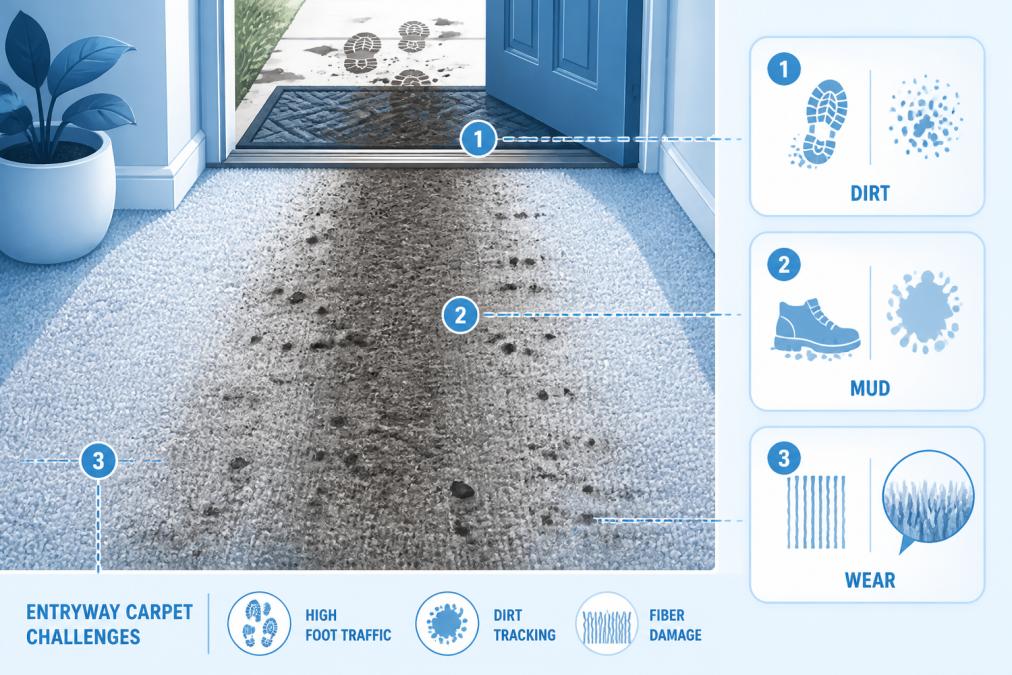
Since entryways are functional necessities you can’t avoid, the only viable strategy is making the carpet itself more resistant to inevitable abuse.
How Long Does Carpet Protector Last in High-Traffic Areas?
Professional carpet protection longevity depends on application quality, foot traffic volume, cleaning frequency, fiber type, and regional climate.
Baseline Protection Lifespan by Fiber Type
Most professional-grade protectors remain effective 6-12 months in typical residential entryways:
- Nylon entryways: 9-12 months. Nylon’s synthetic structure holds sealants exceptionally well.
- Polyester entryways: 6-8 months. Polyester’s inherent hydrophobic nature means sealants bond less tenaciously.
- Wool entryways: 4-6 months. Wool’s absorbent nature limits sealant durability.
- Olefin entryways: 8-10 months, though rarely used in entryways due to crushing issues.
Commercial settings see faster degradation, sometimes 3-6 months, due to 10-20 times higher foot traffic.
Environmental Factors That Accelerate Degradation
Regional climate dramatically impacts protection durability. Winter weather and salt exposure accelerate degradation significantly. Salt is hygroscopic, absorbing and holding moisture. When salt-laden snow melts on shoes and reaches entryway carpet, it creates persistent moisture cycling that stresses the sealant. In northern climates, expect 6-9 months of protection instead of 9-12. Modern professional sealants are more salt-resistant than older formulations, but the effect remains measurable.
High humidity and moisture exposure prevent sealants from fully curing and maintaining hydrophobic properties. In humid climates, protection may degrade to 50% effectiveness within 8-10 months. Conversely, arid regions see longer protection lifespan, often 12-15 months, because dry air helps sealants cure completely and remain stable.
Cleaning Method and Frequency
Frequent hot water extraction cleaning, while necessary for soil removal, strips protective coating faster than dry methods. If you deep clean every 2-3 months, expect protection to degrade within 6-8 months. If you deep clean every 6-12 months, protection typically lasts the full 9-12 month window.
Dry cleaning methods are gentler on sealants, extending protection by 2-4 months compared to hot water extraction, though they’re less effective at removing embedded soil. Vacuuming 2-3 times weekly requires less aggressive deep cleaning, extending protection lifespan.
Foot Traffic Volume
High-traffic entryways with 50+ daily footfalls experience faster wear than lightly used areas. Each footfall creates friction wearing away the sealant layer. Very high-traffic scenarios (100+ daily footfalls) may see protection last only 6-8 months.
The Protection Degradation Curve
Protection degrades gradually over time:
- Months 1-3: Full protection. Spills bead up immediately.
- Months 4-6: 75-85% protection. Spills still bead up; soil resistance remains strong.
- Months 7-9: 50-70% protection. Spills take longer to bead; some liquids absorb if not cleaned within 30-60 seconds.
- Months 10-12: 25-50% protection. Spills absorb more readily; staining risk increases.
- Month 13+: Minimal protection. Carpet behaves like unprotected carpet.
You’re not choosing between "protected indefinitely" or "unprotected." You’re choosing between a protection strategy requiring annual maintenance and no strategy. Annual reapplication paired with professional cleaning on a 6-12 month cycle maintains entryway carpet in acceptable condition for 5-7 years.
Best Ways to Protect Carpet in High-Traffic Entryways
Chemical Barriers and Hydrophobic Sealants
Chemical protection through hydrophobic sealants remains the most effective method for reducing stain severity and extending carpet life. These treatments create a molecular barrier preventing liquid penetration and soil bonding.
Professional sealants work through chemical bonding with carpet fibers. Fluorochemical compounds attach to the fiber surface, creating a water- and oil-repellent layer that becomes part of the fiber itself, lasting longer than spray-on consumer products.
Professionals apply sealants after deep cleaning, when fibers are clean and open. The treatment is sprayed evenly across the entire surface, then allowed to cure for 24-48 hours. Proper saturation is critical; under-application leaves gaps, while over-application can cause stiff, discolored fibers.
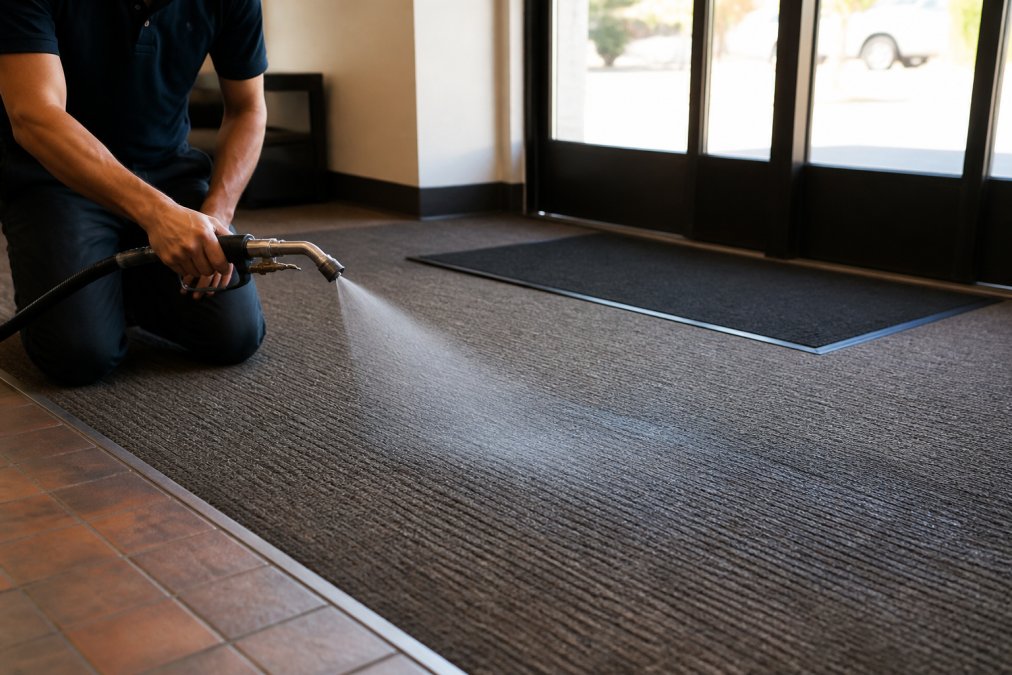
Protected carpet is stain-resistant, not stain-proof. The protection buys time to clean spills before they set but doesn’t eliminate the need for prompt action.
Fiber-Type Considerations for Entryway Protection
Not all carpet fibers respond equally to professional protection.
Nylon carpet is the most common entryway choice and responds exceptionally well to hydrophobic sealants. Nylon’s synthetic structure bonds readily with fluorochemical treatments, providing 9-12 months of protection in high-traffic entryways.
Polyester carpet is budget-friendly but presents challenges in entryways. Polyester is hydrophobic by nature, meaning sealants bond less effectively than to nylon. Protection typically lasts 6-8 months. Expect more frequent reapplication or consider upgrading to nylon if replacement is an option.
Wool and natural fiber carpets are less common in entryways due to cost and moisture sensitivity. Wool is absorbent by nature, and professional sealants last only 4-6 months in high-traffic areas. Specialized formulations may be required to avoid fiber damage.
Olefin (polypropylene) carpet is stain-resistant by default but rarely used in entryways because it crushes easily under foot traffic.
The practical takeaway: nylon entryways are ideal for professional protection. Polyester requires more frequent reapplication. Wool requires fiber-specific formulations.
Physical Barriers and Preventative Maintenance
Beyond chemical treatment, physical barriers and preventative maintenance reduce soil reaching your entryway carpet.
Entryway matting is the first line of defense. A high-quality entrance mat placed outside and inside the doorway captures soil, moisture, and salt before reaching carpet, removing 80% of incoming soil. Use a coarse outdoor mat (coir or rubber) outside to scrape large debris and an absorbent indoor mat (microfiber or cotton blend) inside to capture residual moisture. This two-mat system is far more effective than a single mat.
Shoe removal policies or designated mudroom areas prevent wet boots and work shoes that track the most soil. Even partial compliance reduces entryway wear significantly.
Regular vacuuming is critical. Entryways should be vacuumed 2-3 times per week, or daily in multi-occupant households. This removes surface soil before it gets ground into fibers. Use a vacuum with strong suction and motorized brush roll; upright or hybrid models outperform canister vacuums.
Spot cleaning spills within minutes prevents most permanent stains. Keep cleaning supplies near the entryway to encourage immediate response. Blot rather than rub; rubbing pushes liquid deeper into fibers.
Seasonal deep cleaning is especially important in winter regions. After winter, schedule professional cleaning to remove accumulated salt, sand, and moisture. Before winter, a fall cleaning removes summer dust and prepares carpet for moisture-heavy months.
Professional cleaning on a 6-12 month cycle removes embedded soil that vacuuming can’t reach. Pair professional cleaning with protection reapplication for maximum effectiveness.
DIY vs. Professional Carpet Stain Protection: Pros and Cons
Many homeowners consider DIY carpet protection products as alternatives to professional application.
| Approach | Best For | Key Consideration |
|---|---|---|
| Professional application | High-traffic entryways, long-term investment | Requires professional service, 24-48 hour cure time |
| DIY spray products | Small areas, budget-conscious, immediate application | Uneven coverage, shorter durability, labor-intensive |
| No protection + frequent cleaning | Renters, short-term occupancy | Higher maintenance, faster fiber degradation |
| Physical barriers only | Budget-conscious, immediate results | Requires discipline, doesn’t prevent all staining |
DIY Carpet Protector Pros:
- Lower upfront cost
- Immediate application without scheduling
- Works on small problem areas
- Suitable for renters
DIY Carpet Protector Cons:
- Uneven application coverage leaves gaps
- Consumer-grade formulations are weaker than professional sealants
- Durability is typically 2-4 months versus 6-12 months for professional
- Requires significant labor and proper technique
- Risk of over-application causing stiff, discolored fibers
Professional Protection Pros:
- Even, thorough coverage across entire areas
- Commercial-strength formulations provide longer-lasting protection
- Applied by trained technicians understanding fiber compatibility
- Typically paired with professional cleaning
- Better value over multi-year timeframe despite higher upfront cost
- Warranty or satisfaction guarantees often included
Professional Protection Cons:
- Higher initial investment
- Requires scheduling and 24-48 hour cure time
- Overkill for renters or short-term occupancy
- Requires professional reapplication for continued protection
DIY products work better than nothing but don’t match professional results. The math often favors professional service from the start if you plan to stay in your home more than 3-4 years.
Cost-Benefit Analysis: Is Professional Protection Worth the Investment?
The decision hinges on how long you plan to stay in your home, how much you value your entryway carpet’s appearance, and your maintenance spending tolerance.
Untreated entryway carpet typically requires replacement within 5-7 years due to wear and staining. Professional protection paired with regular maintenance can extend that timeline to 8-12 years or longer, effectively adding years of useful life.
The break-even calculation is straightforward: if carpet replacement costs significantly more than annual professional protection and cleaning combined, protection is economically rational. For most homeowners, this math favors protection.
Beyond economics, protected carpet means fewer permanent stains, fewer cleaning emergencies, and more confidence when guests visit. Protection applied to new carpet is more cost-effective than applied to aged carpet. New fibers absorb and hold protective treatment more effectively. The ideal time to apply protection is within 30 days of new carpet installation.
Professional protection requires ongoing maintenance discipline. Pair it with regular vacuuming, prompt spill response, and periodic professional cleaning for full benefit.
Common Misconceptions About Carpet Stain Guards
**Misconception 1: "Stain guard makes carpet completely stain-proof."
Reality: Protected carpet is stain-resistant, not stain-proof. The protection prevents immediate absorption and gives you time to respond, but untreated spills sitting for hours will stain protected carpet. The protection buys a window of opportunity, not immunity.
**Misconception 2: "Once applied, protection lasts forever."
Reality: Professional protection degrades over time. In high-traffic entryways, expect 6-12 months of effective protection. Reapplication is necessary to maintain consistent protection.
**Misconception 3: "Stain guard prevents all dirt from sticking to carpet."
Reality: The protection prevents soil from bonding chemically to fibers but doesn’t prevent dirt from sitting on the surface. Dirt still accumulates on protected carpet; it’s just easier to remove through vacuuming.
**Misconception 4: "Protection means you can skip vacuuming and cleaning."
Reality: Protection reduces maintenance burden but doesn’t eliminate it. Protected carpet still requires regular vacuuming and periodic professional cleaning. What changes is frequency and intensity, not necessity.
**Misconception 5: "All carpet protection products are the same."
Reality: Professional-grade sealants differ significantly from consumer spray products in formulation strength, application method, and durability. Professional treatments are objectively superior, the difference between 3 months and 12 months of protection.
**Misconception 6: "You should protect every room equally."
Reality: Protection is most valuable in high-traffic areas like entryways, hallways, and living rooms. Bedrooms and closets see minimal traffic and soil exposure, so protection there offers less value.
Environmental and Health Safety Considerations
Modern professional carpet protectors are significantly safer than older formulations. Most professional-grade protectors use fluorochemical compounds regulated by the EPA and evaluated for safety in household settings. The coating is inert once cured, meaning it doesn’t off-gas or leach chemicals after the initial 24-48 hour cure period.
During application and curing, proper ventilation is important. Professional technicians ensure adequate airflow, and homeowners should keep windows open and avoid treated areas during curing. After curing, treated carpet is safe for children and pets.
Some newer protectors use alternative formulations without fluorochemical compounds, marketed as "green" or "eco-friendly." These alternatives often use silicone-based or water-based treatments. The trade-off is typically shorter durability, 3-4 months instead of 6-12 months. The environmental benefit of shorter-lasting protection is debatable since more frequent reapplication is needed.
For households with chemical sensitivities, discussing specific product options with your carpet protection provider is worthwhile. Most professionals can accommodate requests for specific formulations, though options may be limited.
The environmental impact of carpet replacement far exceeds protection application. Extending carpet life by 3-5 years through protection means one less carpet in a landfill, a meaningful environmental benefit. From a lifecycle perspective, protection is the more environmentally responsible choice.
Professional carpet protection is genuinely worth the investment for entryways if you plan to stay in your home long-term and want to extend your carpet’s useful life. The decision becomes clear when comparing protection and maintenance costs against premature carpet replacement. Lake Geneva Carpet Cleaning offers professional carpet protection using state-of-the-art, truck-mounted hot water extraction technology paired with commercial-grade sealants. With over 32 years of experience serving Wisconsin homeowners, they understand the specific challenges entryways face and apply protection methods suited to the region’s climate. Their team ensures thorough coverage and proper curing, maximizing protection effectiveness. If you’re considering professional protection for your entryway, getting a quote from Lake Geneva Carpet Cleaning and asking about their 10-day satisfaction guarantee can help you understand the investment and expected results for your specific carpet.
Frequently Asked Questions
How to protect a carpeted entryway from dirt and stains?
Professional carpet protection combines chemical barriers with preventative maintenance. A professional-grade sealant creates a hydrophobic barrier that repels spills and prevents soil filtration into carpet fibers. Pair this with physical barriers like entry mats, regular vacuuming, and prompt spot cleaning. Professional application ensures even coverage and proper fiber saturation, which DIY methods often miss. For entryways specifically, the combination of chemical protection and routine maintenance provides the most effective defense against the unique soil challenges these areas face.
How long does carpet protector last in entryways?
Professional carpet protector typically lasts 1 to 3 years in entryways, depending on foot traffic volume and maintenance frequency. High-traffic areas experience faster wear patterns, meaning entryways may require reapplication sooner than other rooms. Regular vacuuming and prompt spot cleaning can extend the protective barrier's effectiveness. Professional-grade sealants maintain better resilience than DIY options, but entryway soil and moisture wicking from outdoor contaminants accelerate degradation. Most homeowners reapply protection every 12 to 24 months for optimal stain resistance in these critical zones.
Is professional carpet protection worth it compared to DIY methods?
Professional carpet protection offers superior results for entryways. Professional-grade sealants provide deeper chemical bonding with synthetic fibers and better friction resistance than consumer products. Professionals ensure even application and proper fiber saturation, while DIY applications often leave gaps and uneven coverage. Professional protection lasts longer and performs better against the heavy soil loads entryways experience. However, DIY protection costs less upfront. For entryways specifically, where foot traffic and soil filtration are constant challenges, professional application typically delivers better long-term value despite higher initial cost.
Does carpet protector prevent permanent staining in high-traffic areas?
Professional carpet protection significantly reduces permanent staining by creating a hydrophobic barrier that prevents liquids from bonding to carpet fibers. However, it does not guarantee permanent stain prevention. Immediate spot cleaning remains essential, as the protective barrier only delays absorption. The longer you wait to clean a spill, the more likely it will penetrate the sealant and cause permanent discoloration. Professional application combined with a regular carpet cleaning cycle provides the best defense against wear patterns and discoloration in high-traffic entryways. The protection works best as part of a comprehensive maintenance strategy, not as a standalone solution.
This article was written using GrandRanker