
Table of Contents
- What Is Carpet Fiber Protection and How Does It Work?
- Key Benefits of Carpet Fiber Protection
- Does Carpet Protection Prevent All Stains?
- How Long Does Carpet Protector Last and When to Reapply?
- DIY Carpet Protection vs Professional Application: Which Works Better?
- Carpet Protection Warranty Requirements and Coverage
- Is Carpet Fiber Protection Worth It? The Real Cost-Benefit Analysis
- Chemical Safety, VOCs, and Indoor Air Quality Considerations
Is Carpet Fiber Protection Worth It? A 2026 Analysis
Last Updated: June 26, 2026
What Is Carpet Fiber Protection and How Does It Work?
Carpet fiber protection is a chemical coating applied to carpet fibers that creates a hydrophobic and oleophobic barrier, repelling water-based and oil-based stains before they penetrate the fiber structure. The protective coating works by surrounding each fiber with a molecular shield. When a spill occurs, the liquid sits on top of the treated fiber rather than being absorbed, giving you a critical window of 10 to 15 minutes to blot the spill before it sets permanently.
Understanding Protective Coatings
Protective coatings operate on surface tension. Untreated carpet fibers are naturally absorbent; the protective coating increases surface tension, causing liquids to bead up rather than spread. The most common protective coatings include Scotchgard (fluorochemical-based), Teflon treatments, and newer plant-based alternatives. The coating typically lasts 6 to 12 months under normal household traffic, though this varies based on foot traffic intensity and cleaning frequency.
Professional applicators use specialized equipment to ensure even coverage. DIY products rely on spray bottles or aerosol cans, which often result in uneven application and reduced effectiveness. The difference in coverage quality directly impacts how long the protection lasts and how well it performs against various stain types.
Common Carpet Protector Brands
Scotchgard, made by 3M, remains the industry standard and is often applied at the point of manufacture on new carpets. Teflon-based treatments (branded as DuPont Teflon) offer similar performance with slightly different chemical properties. Each brand has different reapplication schedules and performance claims. Scotchgard claims protection against most common household stains but requires professional reapplication every 12 to 18 months for optimal performance.
Key Benefits of Carpet Fiber Protection
The primary benefit of carpet protection is straightforward: stain resistance. When protection works as intended, spills that would normally create permanent stains become temporary inconveniences. This translates directly into longer carpet life and reduced replacement costs. Protected carpets also require less aggressive cleaning to remove surface dirt, which means gentler cleaning methods and reduced fiber damage over time.
Stain Resistance and Spill Absorption
Protected carpet fibers resist both water-based stains (juice, coffee, wine) and oil-based stains (grease, makeup, pet accidents). When a spill hits treated carpet, the liquid beads up on the surface rather than spreading into the fiber structure. An unprotected carpet requires immediate blotting within seconds to prevent permanent staining. Protected carpet gives you 10 to 15 minutes of working time, a practical advantage that justifies the cost for households with children or pets.
However, protection is not absolute. Certain stains, particularly those from acidic substances like vinegar or bleach, or protein-based stains from blood or egg, can still set permanently even on protected carpet. The protection reduces the risk but doesn’t eliminate it entirely.
Blot spills immediately even on protected carpet. The faster you remove liquid, the less likely it is to penetrate the protective coating and reach the fiber.
Extending Carpet Longevity and Wear Resistance
Protected carpet experiences less friction damage during regular vacuuming and foot traffic. The protective coating acts as a buffer between foot traffic and the fiber itself, reducing the mechanical wear that causes carpet to look dull and matted over time. Carpet longevity typically extends by 2 to 4 years with proper protection and maintenance. An unprotected carpet in a busy household might last 8 to 10 years before showing significant wear, while the same carpet with protection often lasts 10 to 14 years.
The wear resistance benefit compounds with professional cleaning. Protected carpet responds better to the cleaning process, allowing cleaning solutions to work more effectively on soil and stains while minimizing fiber damage from the extraction process.
Does Carpet Protection Prevent All Stains?
No. Carpet protection significantly reduces stain risk but doesn’t eliminate it. Acidic substances like vinegar, lemon juice, and some cleaning products can damage the protective coating itself, allowing stains to set beneath. Protein-based stains from blood, egg, or biological matter sometimes penetrate protection because of their chemical composition. Dyes in certain foods, particularly red wine and berries, can set so quickly that even protected carpet doesn’t provide enough time to prevent staining.
The protection also becomes less effective over time. As the coating wears from foot traffic and cleaning, its stain-resistance properties diminish. This is why reapplication is necessary every 12 to 18 months.
Never assume protection is permanent. Reapplication is required annually or every 18 months depending on traffic. Skipping reapplication leaves your carpet unprotected without you realizing it.
How Long Does Carpet Protector Last and When to Reapply?
The lifespan of carpet protection varies based on the type of protective coating, the intensity of foot traffic, and cleaning frequency. Most professional-grade protections last 12 to 18 months under normal household conditions. High-traffic areas like entryways and hallways may require reapplication as soon as 9 to 12 months.
Signs that protection is wearing out include water no longer beading on the carpet surface, stains setting more quickly than previously, and increased difficulty removing fresh spills. The cost of reapplication is typically 40 to 60 percent of the original application cost, making it an ongoing expense rather than a one-time investment. Over a 10-year period, you might reapply protection 6 to 8 times, which compounds the total cost significantly.
| Protection Timeline | Lifespan | Traffic Level | Reapplication Cost |
|---|---|---|---|
| Initial application | 12-18 months | Normal household | 40-60% of original |
| First reapplication | 12-18 months | Normal household | Same as above |
| High-traffic areas | 9-12 months | Heavy use | Same as above |
| Light-use rooms | 18-24 months | Minimal traffic | Same as above |
DIY Carpet Protection vs Professional Application: Which Works Better?
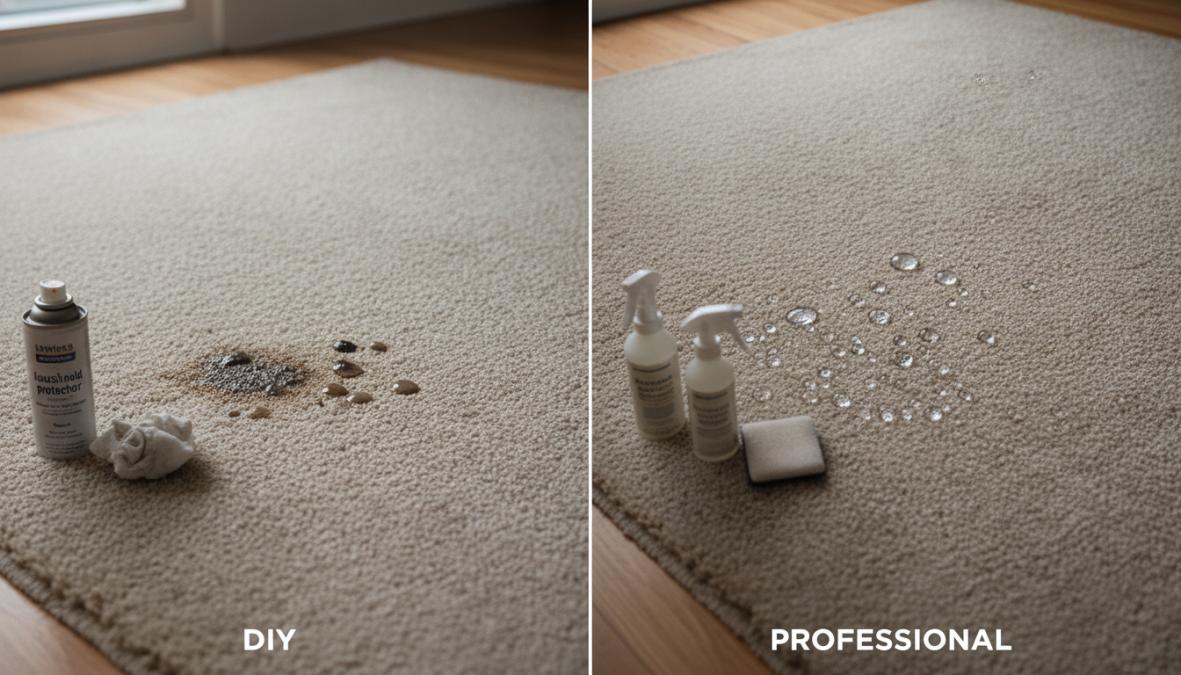
The difference between DIY and professional application is substantial. DIY products available at retail stores cost significantly less upfront but deliver inconsistent results. Professional application ensures even coverage, proper saturation, and optimal performance.
DIY Product Efficacy and Application Challenges
DIY carpet protectors come in spray bottles and aerosol cans. Even coverage is nearly impossible to achieve with a spray bottle. Most DIY applications result in oversaturated areas and undersaturated areas, creating inconsistent protection. Undersaturated areas provide little to no stain resistance, while oversaturated areas can leave residue that affects the carpet’s feel and appearance.
Retail-grade protectors often contain lower concentrations of active protective compounds compared to professional-grade products. They’re formulated to be safer for consumer use, which means reduced effectiveness. Application challenges extend to saturation depth, professional equipment uses pressure and heat to drive the protective coating deep into the carpet pile, while DIY spray applications only coat the surface fibers.
DIY carpet protection lasts 6 to 9 months on average, roughly half the lifespan of professional application. If you want protection that actually lasts, professional application is the better choice.
Professional Application Advantages
Professional carpet protection uses truck-mounted equipment or portable machines that deliver consistent, controlled application. Professionals adjust spray pressure, saturation levels, and drying time based on carpet type and fiber composition. They understand carpet construction and select the appropriate product and application method for your specific carpet.
Professional equipment heats the protective coating to the optimal temperature before application, which improves penetration and adhesion. Professional applications often include a satisfaction guarantee, if the protection fails prematurely or doesn’t perform as expected, the company will reapply at no charge or refund the cost. DIY products typically come with no recourse if they underperform.
Carpet Protection Warranty Requirements and Coverage
Many carpet manufacturers require protective coating application as a condition of certain warranty coverage. Some manufacturers include protection in their standard warranty, meaning your new carpet comes pre-treated. Others offer protection as an optional add-on at purchase. A few manufacturers require protection as a condition of honoring stain-related warranty claims.
Check your carpet warranty documentation carefully. The warranty may specify which brands of protection are acceptable, typically Scotchgard or Teflon treatments. Using non-approved protectors might void warranty coverage. The warranty may also require professional application through authorized dealers, which eliminates the DIY option entirely.
Warranty coverage for stains is typically limited even with protection. Most warranties cover manufacturing defects, not stains from spills or accidents. Protection helps you avoid stains, but it doesn’t guarantee warranty coverage if staining does occur.
Is Carpet Fiber Protection Worth It? The Real Cost-Benefit Analysis
Whether protection is worth it depends on your specific situation, carpet investment, household composition, and risk tolerance.
When Protection Makes Financial Sense
Protection is worth it when your carpet investment is substantial and your household has high spill risk. Expensive carpet installations, particularly those using natural fibers like wool or high-quality synthetics, benefit from protection because the cost of replacement is high. Households with children and pets have inherently higher spill risk, and the practical benefit of protection, having 10 to 15 minutes to address spills instead of seconds, is genuinely valuable.
Protection makes sense when you plan to stay in your home long enough to realize the extended lifespan benefit. If you’ll be in your home for 10 or more years, the 2 to 4 year lifespan extension from protection justifies the cost.
When It May Not Be Worth the Investment
Protection is less compelling when your carpet cost is modest and your household has low spill risk. If you’ve chosen durable, affordable carpet that you’re comfortable replacing every 8 to 10 years anyway, protection’s extended lifespan benefit is minimal. Households without children or pets have lower spill risk, and the practical benefit of protection diminishes.
Protection is also less necessary if you have professional carpet cleaning on a regular schedule. Renters should typically skip protection, as the benefit accrues over years and most rental agreements prohibit tenants from applying treatments to carpet.
Carpet protection is best for homeowners with substantial carpet investments, households with children or pets, and those planning to stay in their homes long-term. It’s less necessary for renters, single-occupant households, or those with modest carpet installations.
Chemical Safety, VOCs, and Indoor Air Quality Considerations
Protective coatings involve chemical application, and understanding the safety profile of these chemicals is important. Volatile organic compounds (VOCs) in some protective coatings can affect indoor air quality, particularly in the hours and days immediately following application. Fluorochemical-based protectors like Scotchgard contain compounds that release VOCs during application and curing.
Newer plant-based protective coatings have emerged as lower-VOC alternatives. These products use botanical compounds rather than fluorochemicals to create protective barriers. They’re generally considered safer for indoor air quality, though they may not last as long as fluorochemical-based options.
For households with members who have respiratory sensitivities, asthma, or chemical sensitivities, the VOC concerns are more significant. In these cases, either choosing plant-based protectors or skipping protection entirely might be the better choice. Professional application from experienced companies includes proper ventilation and safety protocols that minimize VOC exposure.
Deciding whether carpet fiber protection is worth it ultimately comes down to your specific circumstances: your carpet investment, household composition, traffic patterns, and long-term plans. For homeowners with significant carpet investments and high spill risk, protection provides genuine value through extended lifespan and stain resistance. For others, the ongoing reapplication costs and chemical concerns may outweigh the benefits.
If you’ve determined that protection aligns with your needs, professional application is the superior choice over DIY products. The extended lifespan, better performance, and quality control justify the higher upfront cost.
Frequently Asked Questions
How long does carpet protector last after application?
Most carpet protectors last 1-3 years with normal household traffic and regular vacuuming. Durability depends on foot traffic intensity, cleaning frequency, and whether the product was professionally applied or DIY. High-traffic areas wear faster. Professional-grade protectors typically outlast consumer products. Reapplication is recommended when water no longer beads on carpet fibers during spot tests.
Does carpet fiber protection prevent all stains?
No. Carpet protectors create a hydrophobic and oleophobic barrier that repels water-based and oil-based spills, giving you time to blot before absorption. However, they cannot prevent permanent stains from acidic liquids, dyes, or extremely hot substances. The protection works best on synthetic carpet fibers like nylon and polyester. Quick action after spills remains essential for best results.
Is professional carpet protection better than DIY products?
Professional application typically delivers superior results because trained technicians ensure complete, even coverage of carpet fibers and understand proper drying times. Professional-grade formulations are often stronger than consumer products. DIY application risks uneven coverage and reduced efficacy. However, professional application costs more. For budget-conscious homeowners willing to accept slightly lower performance, quality DIY products offer reasonable protection.
Will carpet protection void my carpet warranty?
Not necessarily, but it depends on your warranty terms. Some manufacturers require specific protector brands (like Scotchgard or Teflon) to maintain coverage, while others void warranties if unauthorized products are applied. Always review your carpet warranty documentation before applying any protector. Professional cleaners familiar with warranty requirements can guide you. When in doubt, contact your carpet manufacturer directly.
Is carpet fiber protection worth the extra cost?
It depends on your situation. Protection is worth the investment if you have high-traffic areas, children, pets, light-colored carpet, or plan to keep your carpet 5+ years. It's less essential for dark, low-traffic carpets or if you're replacing carpet soon. Consider your lifestyle, budget, and how long you plan to stay in your home. A cost-benefit analysis comparing protection cost against potential professional cleaning or early replacement can help guide your decision.
This article was written using GrandRanker