Table of Contents
- How Often to Clean Carpets: The Baseline Rules
- How Often to Vacuum Carpets for Best Results
- Signs Your Carpet Needs Deep Cleaning Right Now
- Carpet Cleaning Schedule for Pet Owners
- Professional Carpet Cleaning Frequency: What Experts Recommend
- Factors That Influence How Often Carpets Need Cleaning
- Building a Carpet Maintenance Schedule That Actually Works
- Conclusion: Keep Your Carpets Cleaner, Longer
Last Updated: May 17, 2026
Knowing how often to clean carpets is one of those questions that sounds simple until you actually dig into it. The team at Lake Geneva Carpet Cleaning has spent over 32 years answering this exact question for Wisconsin homeowners, and the honest answer is: it depends on more variables than most guides acknowledge. Most people under-clean their carpets by a significant margin, and the consequences show up not just in appearance but in indoor air quality, carpet lifespan, and even warranty validity. Below, we’ll walk through every factor that should shape your cleaning schedule, including two angles most guides completely skip: carpet fiber type and manufacturer warranty requirements.
How Often to Clean Carpets: The Baseline Rules
The standard recommendation for how often to clean carpets is once every 12 to 18 months for a professional deep clean, combined with weekly vacuuming for most households. That baseline assumes a household of two adults with no pets, no children, and moderate foot traffic. It is a starting point, not a universal answer.
Carpet cleaning frequency is the rate at which a carpet should receive both routine maintenance (vacuuming, spot cleaning) and professional deep cleaning based on household conditions, carpet type, and manufacturer guidelines.
Here is where most guides get it wrong: they treat the 12-month recommendation as gospel for everyone. A household with two dogs, three kids, and a mudroom that sees daily use needs professional cleaning every four to six months. A retired couple with a carpeted guest room that sees traffic twice a year needs cleaning far less often.
General Frequency Guidelines by Household Type
| Household Type | Vacuuming Frequency | Professional Cleaning |
|---|---|---|
| Single adult, no pets | Every 7-10 days | Every 18 months |
| Couple, no pets | Weekly | Every 12-18 months |
| Family with children | Twice weekly | Every 6-12 months |
| Pet owner (1-2 pets) | 2-3 times weekly | Every 6-9 months |
| Multiple pets or allergies | 3-4 times weekly | Every 3-6 months |
| High-traffic commercial | Daily | Every 3-6 months |
These ranges reflect practical experience, not arbitrary guidelines. The more biological material entering your carpet (pet dander, tracked soil, food debris), the faster bacteria and allergens accumulate in carpet fibers.
Carpet Type Specificity: Does Your Fiber Change the Schedule?
The fiber your carpet is made from changes both how often it needs cleaning and which methods are safe to use.
Nylon: The most durable synthetic fiber. Nylon handles hot water extraction well and typically tolerates more frequent professional cleaning without degrading. Households with heavy foot traffic benefit from choosing nylon precisely because it holds up to regular sanitization.
Polyester: Resistant to water-based stains but prone to oil-based soil accumulation. Polyester carpets often look clean longer but can harbor debris deep in the pile. Clean every 12 months minimum, even if the surface looks fine.
Wool: Natural fiber that requires gentler cleaning methods. Over-cleaning wool carpets can cause shrinkage or color bleeding. Stick to professional cleaning every 12 to 18 months and use only wool-safe solutions for spot cleaning.
Berber/Loop pile: Soil accumulation hides easily in the loop structure. These carpets often need cleaning more frequently than they appear to, because debris settles deep before becoming visible.
Check your carpet’s fiber content tag before scheduling any cleaning. Applying the wrong cleaning method to wool or delicate blends can void your warranty and permanently damage the pile structure.
How Often to Vacuum Carpets for Best Results
Vacuuming is the single highest-leverage maintenance action between professional cleanings, and most households do it too infrequently and with the wrong technique. The right frequency is not one-size-fits-all, it depends on carpet fiber type, foot traffic zone, and the type of vacuum being used.
Vacuuming Frequency by Zone and Household Type
Rather than applying one schedule to your entire home, treat each zone based on its actual traffic load:
| Zone | Household Type | Recommended Frequency |
|---|---|---|
| Entryways and hallways | Any | 3-4 times per week |
| Living room / family room | Family with children or pets | 3 times per week |
| Living room / family room | Adults only, no pets | 1-2 times per week |
| Bedrooms | Any | Once per week |
| Guest rooms | Low use | Every 10-14 days |
| Home office | Single occupant | Once per week |
This zone-based approach matters because entryways and hallways accumulate soil at a rate that can be four to five times higher than a bedroom. Applying a single weekly schedule to both zones means your high-traffic areas are chronically under-vacuumed while you spend unnecessary time on low-traffic rooms.
The Re-Soiling Problem: Why Technique Matters as Much as Frequency
One of the least-discussed vacuuming problems is re-soiling, a cycle where improper vacuuming technique or the wrong equipment actually accelerates how quickly carpet looks dirty again. This happens through two mechanisms:
Residue left by low-quality vacuum filters. Vacuums without true HEPA filtration exhaust fine particulates back into the air, where they resettle into carpet fibers within hours. A vacuum that captures particles down to 0.3 microns (the HEPA standard) removes allergens and fine dust permanently from the carpet environment rather than recirculating them.
Over-wetting from steam-attachment vacuums. Some combination vacuum-steam units leave moisture in carpet fibers that attracts and binds soil faster than dry fibers do. For routine vacuuming, dry suction is the correct tool. Steam and hot water extraction belong to the deep-cleaning category, not the maintenance category.
Vacuuming Technique by Carpet Fiber Type
The fiber your carpet is made from changes how you should vacuum, not just how often:
High-pile and shag carpets: Use a vacuum with an adjustable head height and turn off or raise the beater bar. Aggressive beater bars on high-pile carpet can break fibers and accelerate matting. Make slow, overlapping passes to allow suction to reach the base of long fibers.
Berber and loop-pile carpets: Avoid vacuums with rotating brush rolls that can catch and pull loops, causing snags and permanent damage. A suction-only setting or a vacuum with a gentle brush roll is the correct choice. Vacuum in the direction of the loop, not against it.
Wool carpets: Use low suction settings and a soft brush attachment. Wool fibers are more delicate than synthetics and can pill or shed with aggressive vacuuming. Wool also holds fine dust deep in the pile, so slow, deliberate passes are more effective than fast coverage.
Nylon and polyester (cut pile): These are the most forgiving fiber types for vacuuming. Standard upright vacuums with beater bars work well. Vacuum in multiple directions, north-south and east-west, to lift fibers and dislodge soil from all angles.
Vacuuming vs. Deep Cleaning: What Each Actually Does
These two processes address completely different problems. Understanding the distinction prevents a common and costly mistake: assuming that frequent vacuuming eliminates the need for professional deep cleaning.
Vacuuming removes loose surface debris, pet hair, dust, and lightweight particles from the upper portion of carpet fibers. A vacuum with a true HEPA filter also captures fine allergens, dust mite waste, pollen, pet dander, that would otherwise recirculate into your indoor air with each pass.
Deep cleaning (hot water extraction) penetrates to the base of carpet fibers and into the carpet padding. It removes bacteria, compacted soil accumulation, oily residues, embedded pet dander, and odors that vacuuming physically cannot reach. The hot water and extraction pressure break the bond between oily soil and carpet fibers, a bond that suction alone cannot overcome.
The mechanism distinction is important: vacuuming is a dry, surface-level particle removal process. Deep cleaning is a chemical and mechanical process that addresses the soil fraction that has bonded to fibers through oils, moisture, and time. These are not interchangeable tools.
Think of vacuuming as daily maintenance and deep cleaning as a reset. Skipping deep cleaning because you vacuum regularly is like skipping dental cleanings because you brush your teeth. The tools serve different purposes and address different categories of buildup.
According to the Carpet and Rug Institute’s care guidelines, professional hot water extraction is the most effective method for removing embedded soils from residential carpet, and no amount of surface vacuuming replicates its results.
If your vacuum leaves visible lines or tracks in the carpet pile that do not brush out, your beater bar height is set too low for your carpet type. Adjust the head height until the vacuum glides with moderate resistance, enough contact to agitate fibers, not so much that it drags and compresses them.
Avoid vacuuming fresh spills or wet areas. Wet soil is pushed deeper into the pile by vacuum suction and beater bar action, compounding the stain rather than removing it. Blot wet spills first, allow the area to dry, then vacuum once dry.
Signs Your Carpet Needs Deep Cleaning Right Now
Some carpets need attention before the scheduled cleaning date arrives. Waiting for the calendar when these signals appear is a mistake that compounds damage.
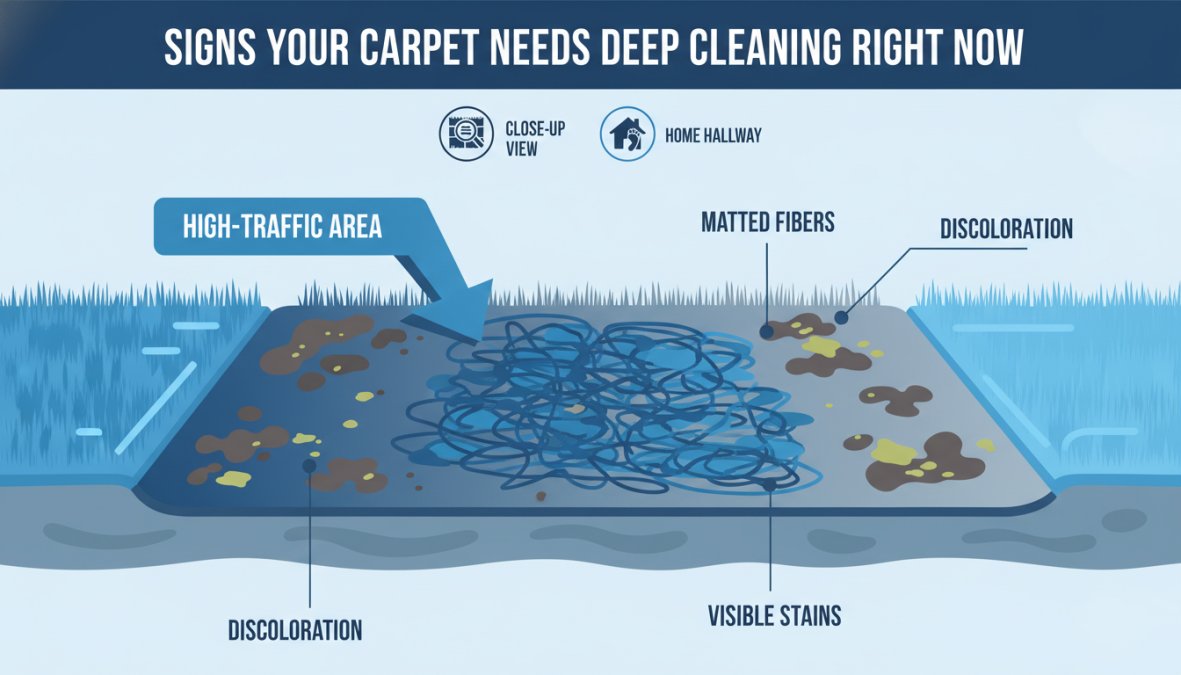
Watch for these indicators:
- Persistent odors that return within hours of vacuuming. This signals bacteria or mold growth in the carpet padding, not just surface debris.
- Visible traffic lanes where carpet fibers are noticeably darker or matted compared to less-used areas. This indicates compacted soil accumulation that vacuuming can no longer address.
- Allergy symptoms worsening indoors. If household members experience increased sneezing, eye irritation, or respiratory discomfort at home, embedded allergens are a likely cause.
- Stains reappearing after spot cleaning. This phenomenon, called wicking, happens when stains in the carpet padding migrate back up through the fibers after surface drying.
- Carpet fibers feel stiff or crunchy. Texture changes indicate soil and residue buildup at the fiber base.
- Visible discoloration in low-traffic areas. If even rarely-used sections look dull or dingy, the carpet has accumulated enough airborne pollutants to need a full reset.
Ignoring wicking stains is a common mistake that leads to permanent discoloration. The stain source is in the padding, and surface cleaning only masks it temporarily. A professional extraction that reaches the padding is the only lasting fix.
Carpet Cleaning Schedule for Pet Owners
Pet owners operate under a completely different set of rules. The carpet cleaning schedule for pet owners needs to account for pet dander, tracked-in outdoor debris, urine accidents, and the accelerated bacterial growth that organic material causes in carpet fibers.
How Pet Dander, Odors, and Stains Affect Cleaning Frequency
Pet dander is a persistent allergen that settles deep into carpet fibers and becomes airborne again with foot traffic. Households with one or two pets should plan for professional cleaning every six to nine months. Homes with multiple pets, or with pets that spend significant time outdoors, should schedule cleaning every three to six months.
Pet urine is the most damaging substance a carpet encounters. Urine penetrates through carpet fibers into the padding and, if left untreated, into the subfloor. The ammonia compounds in urine create persistent odors that intensify in warm weather. Standard cleaning methods treat the surface; only professional hot water extraction with enzymatic treatment reaches the padding where the odor source lives.
For spot cleaning pet accidents between professional visits:
- Blot (never rub) the area immediately with a clean white cloth.
- Apply a pet-specific enzymatic cleaner, not a general carpet shampoo.
- Allow the cleaner to dwell for the manufacturer’s recommended time.
- Blot dry and place a weighted cloth over the area to pull moisture from the padding.
- Schedule a professional cleaning sooner than planned if accidents are frequent.
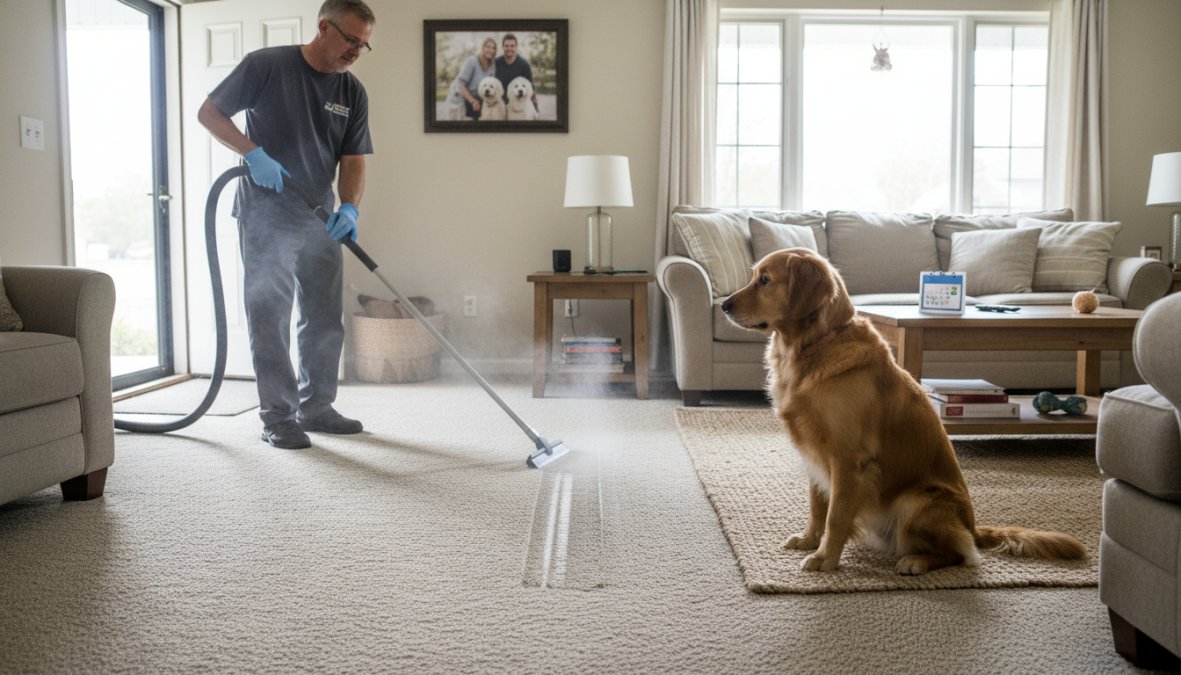
As documented in EPA guidance on indoor air quality and pet allergens, pet dander is one of the most common indoor allergens and accumulates in soft surfaces including carpet, upholstery, and bedding.
Professional Carpet Cleaning Frequency: What Experts Recommend
Professional carpet cleaning is not optional maintenance for most households, it is the mechanism that removes what vacuuming and spot cleaning physically cannot. The professional carpet cleaning frequency that makes sense for your home depends on the household factors covered above, but the floor (no pun intended) is once per year for even the lowest-traffic environments.
Carpet Warranty Requirements and Manufacturer Guidelines
This is the angle most carpet cleaning guides skip entirely, and it matters more than most homeowners realize.
Many carpet manufacturers, including major brands sold through national flooring retailers, include professional cleaning requirements in their warranty terms. Failing to document regular professional cleaning, typically once every 12 to 18 months using hot water extraction specifically, can void the warranty on a carpet that costs several thousand dollars to replace.
This is not fine print that rarely applies. Warranty claims for premature wear, fiber breakdown, or backing separation are among the most common carpet warranty disputes, and cleaning history is one of the first things manufacturers request when evaluating a claim.
Before assuming your cleaning schedule is adequate, check your carpet’s warranty documentation for:
- Required cleaning frequency, often stated as a minimum annual professional cleaning, sometimes every 18 months for low-traffic installations
- Approved cleaning methods, many warranties specify hot water extraction (also called steam cleaning) as the only accepted method
- Prohibited methods, some warranties are voided if dry-cleaning compounds, bonnet cleaning, or consumer rental machines are used
- Certification requirements, certain manufacturers require cleaning by an IICRC-certified technician specifically, not just any professional service
- Documentation requirements, some manufacturers require itemized receipts showing the cleaning method used, the date, and the company name
Keep every cleaning receipt in a folder with your carpet’s purchase documentation. This is practical advice that most homeowners only wish they had followed after a warranty claim is denied.
If you purchased carpet with a manufacturer’s warranty and have been using a rental machine for annual cleaning, check your warranty terms immediately. Rental machine use is explicitly excluded from approved cleaning methods in many residential carpet warranties. Undocumented or non-compliant cleaning history is one of the most common reasons warranty claims are denied.
Rental Machine vs. Professional: A True Cost-Benefit Breakdown
Rental carpet cleaning machines are widely available at grocery stores, hardware chains, and home improvement retailers, and they appear to offer significant cost savings over professional cleaning. The reality is more complicated, and for most households, the apparent savings are offset by real costs that are easy to overlook.
Equipment capability differences
The core issue is water pressure and extraction power. Truck-mounted professional equipment operates at water pressure and temperature levels that portable rental units cannot replicate. Higher water temperature improves the breakdown of oily soil and kills bacteria more effectively. Stronger extraction removes more moisture from the carpet after cleaning, which directly affects drying time and mold risk.
Rental machines leave significantly more residual moisture in carpet fibers than truck-mounted professional equipment. Carpets cleaned with rental machines typically require 12 to 24 hours to dry fully under normal indoor conditions. Carpets cleaned with truck-mounted hot water extraction typically dry in 4 to 8 hours. That drying time difference is not just an inconvenience, extended moisture in carpet fibers and padding is the primary condition for mold and mildew growth.
The re-soiling problem with rental machines
Rental machines also tend to leave cleaning solution residue in carpet fibers when the extraction power is insufficient to fully rinse the carpet. Soap and surfactant residue left in fibers acts as a soil magnet, it attracts and binds airborne dust and tracked-in debris faster than clean fibers do. Many homeowners notice that carpets cleaned with rental machines look dirty again within weeks, not months. This is the residue re-soiling cycle, and it is a direct consequence of under-powered extraction.
Practical cost comparison
A rental machine typically costs in the range of $40 to $75 per day, plus the cost of cleaning solution (often sold separately by the machine supplier). For an average home, a full cleaning run may require multiple solution refills, and the process takes most of a day including furniture moving, cleaning passes, and waiting for drying.
Professional cleaning costs more upfront for a single visit. However, when you account for the following factors, the long-term cost picture shifts:
- Rental cleaning that leaves residue may require re-cleaning sooner, effectively doubling the frequency and cost
- Inadequate moisture extraction that leads to mold remediation costs far more than any cleaning service
- Rental machine use that voids a carpet warranty eliminates the protection on a flooring investment that may have cost thousands of dollars
- Professional cleaning that satisfies warranty requirements preserves the full value of that warranty for the life of the carpet
When rental machines are appropriate
Rental machines are a reasonable tool for light surface refreshing between professional visits, addressing a localized spill area, freshening a low-traffic room before a gathering, or maintaining a rental property between tenants when professional scheduling is not practical. As a direct replacement for professional hot water extraction when it comes to allergen removal, odor elimination, deep soil extraction, or warranty compliance, they fall short on every technical measure that matters.
Rental machines are useful for light surface refreshing between professional visits. They are not a substitute for professional hot water extraction when it comes to allergen removal, odor elimination, or warranty compliance. For households with active warranties, using a rental machine as your primary annual cleaning method may be silently voiding coverage you paid for at purchase.
How to Evaluate a Professional Carpet Cleaning Company
Not all professional cleaning services deliver equivalent results. When selecting a provider, look for:
- IICRC certification, The Institute of Inspection Cleaning and Restoration Certification sets the industry standard for cleaning methods and technician training. Certification indicates the technician has been trained on proper hot water extraction technique, fiber-specific chemistry, and moisture management.
- Truck-mounted equipment, Ask specifically whether the company uses truck-mounted or portable equipment. Truck-mounted systems deliver the pressure and extraction power that portable units cannot match.
- Method transparency, A reputable company will tell you exactly what cleaning method they use, what solutions they apply, and approximate drying times before you book.
- Warranty-compliant documentation, Ask whether they provide itemized receipts that include the cleaning method used. This documentation is what you need to support a future warranty claim.
The Institute of Inspection Cleaning and Restoration Certification’s residential cleaning standards provides the industry benchmark for professional cleaning methods and frequency guidelines that most reputable cleaning companies follow.
Factors That Influence How Often Carpets Need Cleaning
The 12-month baseline exists because it works for an average household. Most households are not average.
Foot Traffic, Children, and Indoor Air Quality
High-traffic areas accumulate soil at a rate that low-traffic zones simply do not. Entryways, hallways, and living rooms in active households can accumulate as much debris in three months as a guest room accumulates in two years. Treating these zones with the same cleaning schedule is inefficient and leads to premature carpet wear.
Children introduce a specific category of carpet challenge: food debris, tracked-in outdoor soil, and craft materials that create both staining and bacterial growth conditions. Homes with young children should plan for professional cleaning every six months and maintain a strict no-shoes policy to reduce the soil load entering carpet fibers.
Indoor air quality connects directly to carpet condition. Carpets act as a filter for airborne pollutants, trapping dust mites, bacteria, and seasonal contaminants. This filtering function is beneficial until the carpet reaches saturation, at which point it begins releasing trapped pollutants back into the air with each footstep. Regular professional cleaning resets this filtration capacity.
According to the American Lung Association’s guidance on indoor air quality, carpets that are not regularly cleaned can become significant sources of indoor air pollutants, particularly in homes with pets or allergy sufferers.
Environmental Impact of Cleaning Solutions
Not all carpet cleaning solutions are created equal, and the environmental impact of your choice extends beyond the carpet itself.
Conventional carpet shampoos often contain surfactants, synthetic fragrances, and solvents that leave residue in carpet fibers and eventually enter wastewater systems. For households with children or pets who spend time on the floor, the chemical residue question is also a direct health consideration.
Eco-friendly cleaning solutions use plant-derived surfactants and avoid synthetic fragrances and harsh solvents. They biodegrade more readily and leave less residue in carpet fibers, which actually reduces re-soiling rates compared to conventional cleaners. The practical tradeoff is that some eco-friendly formulations require longer dwell times to achieve equivalent soil removal.
Hot water extraction with properly diluted, eco-friendly solutions is the approach that balances cleaning effectiveness, environmental responsibility, and indoor safety. It is the method Lake Geneva Carpet Cleaning uses specifically because it delivers thorough results without leaving chemical residues that compromise indoor air quality after cleaning.
Building a Carpet Maintenance Schedule That Actually Works
A carpet maintenance schedule is only useful if it accounts for your actual household conditions rather than a generic average. Here is a practical framework for building one:
Step 1: Assess your household category. Use the table from the baseline rules section to identify your cleaning tier. Be honest about pet activity, foot traffic, and allergy concerns.
Step 2: Check your carpet warranty. Pull the warranty documentation and note the required professional cleaning frequency and approved methods. This becomes your minimum schedule, not your target.
Step 3: Set vacuuming frequency by zone. High-traffic areas (entryways, hallways, living rooms) need vacuuming two to three times per week. Low-traffic areas (guest rooms, formal dining) need vacuuming weekly or every ten days.
Step 4: Schedule professional cleanings in advance. Book professional cleaning appointments at the start of the year rather than reactively. This prevents the common pattern of delaying cleaning until visible damage has occurred.
Step 5: Establish spot-cleaning protocols. Keep a pet-safe enzymatic cleaner and clean white cloths accessible. Address spills and accidents within minutes, not hours.
Step 6: Reassess annually. Household conditions change. A new pet, a new baby, or a change in foot traffic patterns should trigger a schedule review.
Schedule your professional carpet cleaning for late spring or early fall in Lake Geneva, Wisconsin. These timing windows avoid the peak humidity of summer (which slows drying) and the tracked-in salt and grit of winter that accelerates fiber wear.
The most common mistake homeowners make is treating carpet cleaning as a reactive task rather than a scheduled one. Carpets that are cleaned on a proactive schedule consistently last longer, look better between cleanings, and maintain better indoor air quality than those cleaned only when visible problems appear.
For Lake Geneva households specifically, Wisconsin’s seasonal patterns add a layer of consideration. Winter brings road salt and ice-melt chemicals tracked indoors on shoes and pet paws. These compounds are abrasive to carpet fibers and corrosive to carpet backing if left in place. A professional cleaning at the end of winter is worth scheduling as a fixed annual event regardless of how clean the carpet appears.
The Institute of Inspection Cleaning and Restoration Certification’s residential cleaning standards provides the industry benchmark for professional cleaning methods and frequency guidelines that most reputable cleaning companies follow.
Maintaining a consistent carpet cleaning schedule is straightforward in principle but easy to deprioritize in practice, especially when carpets look acceptable on the surface. Lake Geneva Carpet Cleaning brings over 32 years of experience, truck-mounted hot water extraction technology, and eco-friendly cleaning solutions to every job, removing the embedded allergens, pet odors, and seasonal contaminants that surface cleaning cannot reach. With a 10-day satisfaction guarantee and a reputation built on meticulous attention to detail, Lake Geneva Carpet Cleaning is the practical choice for Wisconsin homeowners who want cleaner carpets and healthier indoor air. Schedule your cleaning near Lake Geneva today and experience the difference that professional extraction delivers.
Frequently Asked Questions
How often should you professionally clean carpets with pets?
If you have one or more pets, a professional carpet cleaning frequency of every 3 to 6 months is generally recommended. Pets introduce pet dander, odors, bacteria, and allergens deep into carpet fibers that regular vacuuming cannot fully remove. High-shedding breeds or pets with accidents may require cleaning closer to every 3 months. Hot water extraction is particularly effective at sanitizing carpet padding and eliminating embedded pet odors at the source.
Does vacuuming count as carpet cleaning?
Vacuuming is an essential part of carpet maintenance, but it does not replace deep cleaning. Vacuuming removes surface debris, dust mites, and loose soil from the top layer of carpet fibers. Deep cleaning methods like hot water extraction or steam cleaning penetrate the carpet padding to remove embedded allergens, bacteria, pollutants, and stains that a vacuum cannot reach. Think of vacuuming as routine upkeep and deep cleaning as the periodic reset your carpet needs.
What happens if you don't clean your carpets regularly?
Skipping regular carpet cleaning allows soil accumulation, bacteria, dust mites, and allergens to build up deep in carpet fibers, degrading indoor air quality and potentially triggering respiratory issues. Over time, embedded debris acts like sandpaper on carpet fibers, shortening carpet life significantly. Odors become harder to remove, stains set permanently, and carpet padding can harbor moisture and mold. Neglecting a cleaning schedule can also void your carpet's manufacturer warranty.
How do I know if my carpet needs cleaning?
Key signs your carpet needs deep cleaning include persistent odors that don't go away after vacuuming, visible stains or discoloration, matted or flattened carpet fibers in high-traffic areas, increased allergy symptoms indoors, and a dull or dingy appearance even after spot cleaning. If you notice your carpet looks darker in frequently walked paths or smells musty, it's time to schedule a professional cleaning rather than rely on surface-level carpet shampoo or rental machine treatments.
Can you clean carpets too often?
Over-cleaning is rarely a problem for professional hot water extraction, which is gentle on carpet fibers when done correctly. However, excessive use of harsh carpet shampoo or rental machines that leave behind residue can attract more soil over time and degrade fibers if done too frequently. For most households, professional cleaning every 6 to 12 months is ideal. High-traffic homes with pets or children may clean every 3 to 6 months without risk of damage when using proper methods.
This article was written using GrandRanker