Table of Contents
- Why Indoor Air Quality Matters More Than You Think
- Signs of Poor Indoor Air Quality You Shouldn’t Ignore
- How to Improve Indoor Air Quality: 10 Actionable Steps
- Step 1: Prioritize Source Control First
- Step 2: Boost Ventilation and Air Exchange Rate
- Step 3: Upgrade Your HVAC Filtration and Schedule Maintenance
- Step 4: Control Humidity to Stop Mold Spores
- Step 5: Deep-Clean Carpets and Soft Furnishings Regularly
- Step 6: Test for Radon and Carbon Monoxide
- Step 7: Reduce VOCs and Off-Gassing Sources
- Best Air Purifiers for Home Use and How to Choose One
- Natural Ways to Clean Indoor Air Without Chemicals
- Indoor Air Quality Testing Kits and Smart Monitors
- How to Improve Indoor Air Quality in Special Situations
- Conclusion
Last Updated: May 13, 2026
Knowing how to improve indoor air quality is one of the most overlooked aspects of home health, yet the air inside your home can be significantly more polluted than the air outside. This guide from Lake Geneva Carpet Cleaning covers 10 proven, actionable steps to reduce airborne contaminants, control humidity, and create a genuinely healthier living environment. Below, we’ll show you exactly how to address everything from HVAC filtration to radon testing, wildfire smoke preparedness, and smart home monitoring. The strategies here are ranked by impact, so you get the highest-return actions first.
According to EPA guidance on indoor air quality, indoor air pollutants are among the top environmental health risks facing Americans today. Most people spend the majority of their time indoors, which means the quality of that air compounds over years. Poor indoor air quality (IAQ) is linked to respiratory symptoms, worsened asthma triggers, and long-term health consequences that most homeowners never connect back to their home environment.
Here’s what most guides get wrong: they treat IAQ as a single-fix problem. Buy an air purifier, call it done. The reality is that improving indoor air quality requires a layered approach: source control first, then ventilation, then filtration. Skip the sequence and you’re just masking the problem.
Why Indoor Air Quality Matters More Than You Think
Indoor air quality is the condition of the air within and around buildings as it relates to the health and comfort of occupants. Poor IAQ develops when pollutants accumulate faster than ventilation can remove them, creating concentrations that affect breathing, cognition, and long-term health.
The sources are everywhere and often invisible. Volatile organic compounds (VOCs) off-gas from furniture, paint, and cleaning products. Mold spores thrive behind walls and under carpets. Particulate matter (PM2.5) from cooking, candles, and outdoor air infiltration settles into soft furnishings. Carbon monoxide from faulty appliances and radon seeping through foundations add invisible but serious risks.
What makes this particularly frustrating is that modern homes are built tighter than ever. Better insulation and weather sealing reduce the natural air exchange rate, trapping airborne contaminants inside. Older homes had drafts that inadvertently helped. Newer homes need deliberate ventilation strategies to compensate.
The throughline running through every section of this guide: removing the source of pollution is always more effective than filtering the result.
Signs of Poor Indoor Air Quality You Shouldn’t Ignore
Physical Symptoms That Point to Airborne Contaminants
Persistent respiratory symptoms that improve when you leave the house are the clearest signal that your indoor air quality needs attention. If household members experience frequent headaches, eye irritation, throat dryness, or worsened asthma triggers without an obvious cause, the air itself is the most logical suspect.
Carbon monoxide exposure produces symptoms that mimic flu without fever. Radon has no symptoms at all until long-term damage accumulates. VOC exposure often presents as fatigue, dizziness, or difficulty concentrating, symptoms many people attribute to stress or poor sleep. The pattern to watch for: symptoms that clear up on weekends away or during vacations.
Never dismiss carbon monoxide symptoms as a minor illness. Headache, nausea, and confusion in multiple household members simultaneously is a medical emergency. Leave the building immediately and call 911.
Environmental Clues Inside Your Home
Beyond physical symptoms, your home itself gives visual and sensory signals. Condensation on windows, a persistent musty odor, visible mold near vents or in corners, and excessive dust accumulation shortly after cleaning all point to underlying IAQ problems.
Condensation signals humidity control failure. Musty odors indicate mold spores are actively circulating. Rapid dust buildup suggests your HVAC filtration is inadequate or your air circulation patterns are trapping particulate matter in certain rooms. Each of these is a diagnostic clue, not just a cosmetic issue.
How to Improve Indoor Air Quality: 10 Actionable Steps
Improving your home’s air quality follows a specific sequence. The steps below are ordered by priority: addressing the source first, then controlling the environment, then filtering what remains.
Step 1: Prioritize Source Control First
Source control is the single most effective strategy for improving indoor air quality, and it costs nothing. Removing or reducing the origin of a pollutant eliminates the problem at the root rather than managing the symptom downstream.
Practical source control actions include:
- Stop using aerosol sprays, synthetic air fresheners, and scented candles, which are significant VOC sources
- Ventilate during and after cooking, painting, or using adhesives
- Remove shoes at the door to prevent tracking in pesticides, particulate matter, and allergens
- Store chemicals, paints, and solvents in sealed containers outside the living space
- Choose low-VOC or zero-VOC paints and building materials when renovating
The common mistake is skipping this step entirely and jumping straight to air purifiers. An air purifier running against an active VOC source is a losing battle.
Step 2: Boost Ventilation and Air Exchange Rate
The air exchange rate measures how frequently indoor air is replaced with fresh outdoor air. Low exchange rates allow pollutants to accumulate to harmful concentrations, particularly in well-sealed modern homes.
Open windows strategically when outdoor air quality is good. Use exhaust fans in kitchens and bathrooms consistently, not just when steam is visible. If your home has a heat recovery ventilator (HRV) or energy recovery ventilator (ERV), ensure it’s running on schedule. These systems bring in fresh air while recovering thermal energy, making them efficient solutions for tight homes.
A common mistake is ventilating during wildfire events or high-pollen days. Check your local air quality index before opening windows. On poor outdoor air days, rely on filtration instead.
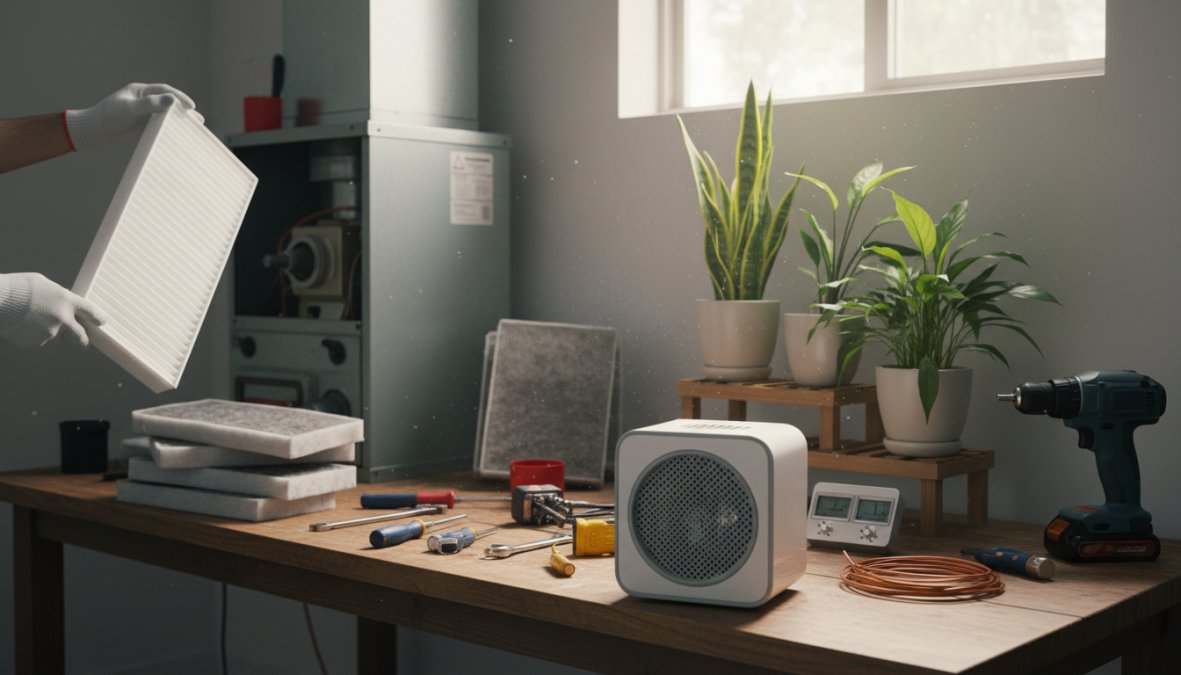
Step 3: Upgrade Your HVAC Filtration and Schedule Maintenance
HVAC maintenance is non-negotiable for sustained IAQ improvement. A clogged or low-rated filter recirculates airborne particles rather than capturing them, and a neglected system can itself become a source of mold spores and biological contaminants.
Filter selection matters. Standard fiberglass filters capture large particles but miss PM2.5 and smaller allergens. Upgrading to a MERV-11 or MERV-13 rated filter significantly improves particulate matter capture without restricting airflow excessively. True HEPA filters offer the highest filtration efficiency for standalone units.
HVAC maintenance schedule to follow:
- Replace filters every 60-90 days (monthly if you have pets)
- Schedule professional duct cleaning every 3-5 years
- Inspect and clean evaporator coils annually
- Check condensate drain lines for mold growth each spring
Step 4: Control Humidity to Stop Mold Spores
Humidity control is the most direct way to prevent mold spore proliferation. Mold requires moisture to grow; eliminate the moisture and you eliminate the conditions for mold. Target indoor relative humidity between 30% and 50% year-round.
Use a hygrometer (available for under $20) to measure humidity in different rooms. Bathrooms, basements, and crawl spaces are the highest-risk zones. Run dehumidifiers in these areas during humid months. Fix plumbing leaks immediately since even minor moisture behind walls creates mold conditions within 24-48 hours.
Run bathroom exhaust fans for at least 20 minutes after showering, not just during. The residual moisture on surfaces continues evaporating long after the steam dissipates.
Step 5: Deep-Clean Carpets and Soft Furnishings Regularly
Carpets and upholstered furniture act as reservoirs for allergens, mold spores, pet dander, dust mites, and tracked-in particulate matter. Regular vacuuming with a HEPA-filtered vacuum removes surface accumulation, but embedded contaminants require professional extraction.
This is where Lake Geneva Carpet Cleaning’s approach makes a measurable difference. Using truck-mounted hot water extraction technology, the process reaches deep into carpet fibers to remove allergens, pet odors, and seasonal contaminants that surface cleaning leaves behind. With over 32 years of experience serving Wisconsin homeowners, the team understands how carpet condition directly affects the air you breathe. A professionally cleaned carpet doesn’t just look better; it removes the biological material that continues off-gassing and circulating through your HVAC system between cleanings.
Vacuum high-traffic areas twice weekly. Schedule professional hot water extraction at least once per year, or twice annually if you have pets or allergy sufferers in the household.
Step 6: Test for Radon and Carbon Monoxide
Radon is a naturally occurring radioactive gas that seeps through foundations and accumulates in lower floors. It has no odor, color, or taste, and it’s the second leading cause of lung cancer after smoking according to EPA radon risk information. Testing is the only way to know your exposure level.
Carbon monoxide (CO) requires active monitoring with certified detectors on every floor and near sleeping areas. Replace CO detectors every 5-7 years; the sensors degrade over time even if the unit appears functional.
For radon, short-term test kits are available at hardware stores and provide results within 48-96 hours. Long-term kits (90 days) give more accurate readings. If results exceed 4 pCi/L, consult a certified radon mitigation contractor.
Step 7: Reduce VOCs and Off-Gassing Sources
Volatile organic compounds are emitted by hundreds of household products: paints, varnishes, cleaning supplies, air fresheners, furniture made with pressed wood, and new flooring. Off-gassing is highest when products are new and decreases over time, but some materials continue releasing VOCs for years.
Practical VOC reduction steps:
- Air out new furniture, mattresses, and rugs outdoors for 24-72 hours before bringing them inside
- Choose cleaning products labeled "low-VOC" or fragrance-free
- Store leftover paint and solvents in a garage or shed, not inside living spaces
- Increase ventilation for 48-72 hours after any painting or flooring installation
- Look for the EPA’s Indoor airPLUS label when purchasing new construction or renovation materials
Best Air Purifiers for Home Use and How to Choose One
The best air purifiers for home use combine HEPA filtration with activated carbon to address both particulate matter and gaseous pollutants simultaneously. Choosing a unit based on room size is the most common mistake: an undersized purifier running continuously in a large room achieves far less than a properly sized unit cycling air 4-5 times per hour.
Key selection criteria:
| Feature | What to Look For | Why It Matters |
|---|---|---|
| Filter type | True HEPA (not "HEPA-type") | Captures 99.97% of particles 0.3 microns and larger |
| CADR rating | Matches room square footage | Ensures adequate air changes per hour |
| Carbon filter | Activated carbon layer included | Removes VOCs and odors, not just particles |
| Noise level | Under 50dB on low setting | Allows overnight operation without disruption |
| Filter cost | Check annual replacement cost | Some units have cheap upfront prices but expensive filters |
HEPA Filter vs. Activated Carbon: What You Actually Need
A HEPA filter captures airborne particles including dust, pollen, mold spores, pet dander, and PM2.5. Activated carbon adsorbs gaseous pollutants including VOCs, formaldehyde, and odors. These are fundamentally different mechanisms addressing different types of contaminants.
For most homes, you need both. A HEPA-only unit does nothing for chemical off-gassing. A carbon-only unit does nothing for particulate allergens. Units combining both layers cost more upfront but address the full spectrum of indoor air pollutants. For rooms with known chemical sources (new furniture, recent renovation), prioritize a substantial carbon bed rather than a thin carbon layer that saturates quickly.
Natural Ways to Clean Indoor Air Without Chemicals
Several non-chemical approaches meaningfully improve air circulation and reduce airborne contaminants without introducing new pollutants.
Houseplants are often overstated as air cleaners. The research on plant-based air purification suggests you’d need an impractical number of plants to match even a modest air purifier in a typical room. That said, plants do contribute to humidity regulation and psychological wellbeing, and certain species (pothos, snake plants, peace lilies) have demonstrated some capacity to absorb specific VOCs in controlled settings. Think of them as a supplement, not a solution.
More effective natural strategies:
- Open windows cross-ventilate on low-pollution days to flush stale air
- Use beeswax candles instead of paraffin (significantly lower VOC output)
- Maintain consistent air circulation with ceiling fans to prevent particulate matter from settling
- Bring outdoor air in through timed ventilation during early morning hours when urban pollution is typically lowest
- Keep indoor plants watered appropriately: overwatered soil grows mold
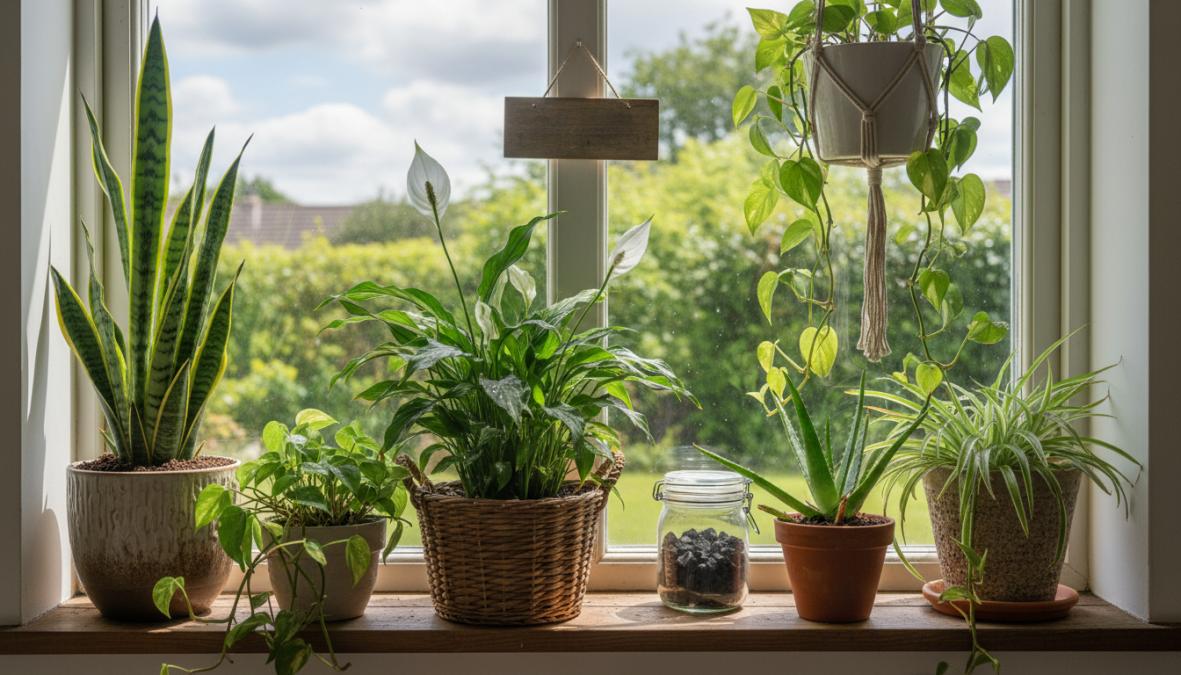
Natural methods work best as complements to mechanical filtration and source control, not replacements. The most effective “natural” strategy is consistent ventilation with clean outdoor air.
Indoor Air Quality Testing Kits and Smart Monitors
Air quality testing kits and smart monitors serve different purposes. Testing kits (for radon, mold, VOCs) provide a one-time snapshot of specific pollutants. Smart monitors provide continuous, real-time data on PM2.5, CO2, VOCs, humidity, and temperature.
For most homeowners, an indoor air quality monitor is the higher-value investment because it reveals patterns: spikes during cooking, humidity surges after showering, VOC increases when certain products are used. This behavioral data is what drives lasting improvement. Popular monitor categories include standalone devices that connect to smartphone apps and provide historical trend data.
When selecting an air quality testing kit, match the test to your specific concern. Radon kits are inexpensive and worth doing in any home, particularly those with basements. Mold testing kits are useful when you suspect mold but can’t locate a visible source. VOC tests provide a baseline reading before and after renovation projects.
According to EPA’s guide to air quality monitors, consumer-grade monitors vary significantly in accuracy, particularly for PM2.5 readings. Cross-reference readings against your local air quality index to calibrate your device’s accuracy.
How to Improve Indoor Air Quality in Special Situations
Renters and Apartments: What You Can Actually Control
Renters face genuine constraints: they can’t install whole-home ventilation systems, replace HVAC filters they can’t access, or seal radon entry points. But the controllable factors still account for a significant share of IAQ improvement.
What renters can do:
- Run portable HEPA air purifiers in bedrooms and main living areas
- Request HVAC filter replacement from landlords in writing (document the request)
- Use bathroom and kitchen exhaust fans consistently
- Test for radon using a short-term kit and share results with the landlord if levels are elevated
- Control humidity with a portable dehumidifier in damp rooms
- Avoid synthetic fragrances, aerosols, and high-VOC cleaning products
The thing nobody tells renters: your lease may actually require landlords to maintain adequate ventilation. Review your lease terms and local housing codes before assuming you have no recourse.
Wildfire Smoke Preparedness and DIY Filtration
Wildfire smoke is a concentrated source of PM2.5 and toxic gases that overwhelms standard home filtration during active events. Preparedness requires action before smoke arrives, not during.
The Corsi-Rosenthal Box is a proven DIY air filtration solution built from four MERV-13 furnace filters taped around a box fan. It costs under $50 to build, delivers performance comparable to commercial air purifiers costing hundreds more, and can be assembled in under 30 minutes. Instructions are available through UC Davis research on DIY air filtration.
During wildfire events:
- Close all windows and doors
- Set HVAC to recirculate (not fresh air intake)
- Run Corsi-Rosenthal Box or HEPA purifiers continuously
- Seal gaps under doors with towels if smoke odor is detectable inside
- Avoid activities that add indoor pollution (cooking on gas, burning candles)
Smart Home Integration for Ongoing IAQ Monitoring
Smart home integration turns IAQ monitoring from a periodic check into a continuous feedback loop. Modern smart monitors connect to platforms like Apple HomeKit, Google Home, and Amazon Alexa, triggering automations based on air quality readings.
Practical automations to set up:
- Trigger an exhaust fan when CO2 levels rise above a set threshold
- Receive a smartphone notification when PM2.5 spikes (indicating a pollution event)
- Automate HVAC fan cycles based on VOC readings
- Log humidity data to identify rooms with persistent moisture problems
The real value of smart monitoring is pattern recognition over time. A single reading tells you little. Weeks of data reveal which activities, times of day, and weather conditions drive your worst air quality, giving you a precise target for intervention.
Improving indoor air quality is an ongoing process, not a one-time project, and soft furnishings like carpets are often the most overlooked reservoir of allergens and contaminants in any home. Lake Geneva Carpet Cleaning has served Wisconsin homeowners for over 32 years, using truck-mounted hot water extraction technology to remove embedded allergens, pet odors, and seasonal contaminants that standard vacuuming leaves behind. Their eco-friendly methods and 10-day satisfaction guarantee make professional cleaning a low-risk, high-impact step in any serious IAQ improvement plan. Contact Lake Geneva Carpet Cleaning to schedule a deep clean and address one of the most significant sources of indoor air pollution in your home.
Frequently Asked Questions
What is the fastest way to improve indoor air quality?
The fastest single action is to open windows and increase ventilation, which immediately dilutes indoor pollutants by raising the air exchange rate. Pair that with running an air purifier equipped with a HEPA filter to capture particulate matter and allergens quickly. For persistent issues, source control, removing or sealing the pollution source, delivers the most lasting improvement. Vacuuming carpets and soft furnishings also provides rapid allergen reduction, especially for asthma triggers like pet dander and dust mites.
What are the signs of poor indoor air quality I should watch for?
Common signs of poor indoor air quality include persistent respiratory symptoms like coughing, sneezing, or congestion that improve when you leave home, unexplained headaches, eye irritation, and fatigue. Environmental clues include visible mold growth, musty odors hinting at mold spores, condensation on windows indicating high humidity, and stale or stuffy air suggesting low ventilation. If multiple household members experience similar symptoms indoors, poor IAQ is a likely cause worth investigating with an air quality monitor or testing kit.
Do air purifiers actually improve indoor air quality?
Yes, air purifiers with true HEPA filters are proven to capture airborne particles as small as PM2.5, including dust, mold spores, pollen, and pet dander. Models with activated carbon layers also reduce volatile organic compounds (VOCs) and odors from off-gassing materials. However, air purifiers work best as part of a broader strategy, they supplement, not replace, source control, proper ventilation, and HVAC maintenance. Choosing the right CADR rating for your room size is critical to getting real results.
How can I test my indoor air quality at home?
You have several options for indoor air quality testing. Consumer IAQ monitors provide real-time readings for PM2.5, VOCs, humidity, and CO2. Dedicated radon test kits, both short-term and long-term, are inexpensive and widely available. Carbon monoxide detectors are essential safety devices that double as basic air quality monitors. For a comprehensive assessment, professional air quality testing covers a broader range of airborne contaminants including mold spores and specific chemical pollutants, which DIY indoor air quality testing kits may not fully capture.
Can cleaning my carpets really improve indoor air quality?
Absolutely. Carpets act as a reservoir for dust, pet dander, mold spores, pollen, and other allergens that accumulate deep in the fibers. Regular vacuuming removes surface debris, but professional hot water extraction cleaning reaches embedded contaminants that surface cleaning misses. For households with asthma triggers or allergy sufferers, periodic deep carpet cleaning is one of the most impactful steps you can take for allergen reduction and overall IAQ improvement, especially in high-traffic rooms where particulate matter builds up fastest.
This article was written using GrandRanker