Table of Contents
- Is Commercial Carpet Cleaning Worth the Cost? A Cost-Benefit Analysis
- Factors Affecting Commercial Carpet Cleaning Costs
- Commercial Carpet Cleaning Frequency: Finding the Right Schedule
- Commercial Carpet Cleaning Cost Per Square Foot: What to Expect
- DIY vs Professional Carpet Cleaning for Offices: Which Delivers ROI?
- Health Benefits and Indoor Air Quality Impact
- Extending Carpet Lifespan and Protecting Manufacturer Warranties
- Professional vs. DIY: When Professional Service Makes Financial Sense
Is Commercial Carpet Cleaning Worth the Cost?
Last Updated: June 27, 2026
When managing a commercial facility in Lake Geneva, Wisconsin, the question of whether professional carpet cleaning delivers real value hinges on one critical insight: compare the cost of professional cleaning against the cost of replacing carpet early, not against doing nothing. This guide examines the financial and operational case for professional service.
Factors Affecting Commercial Carpet Cleaning Costs
The price for commercial carpet cleaning varies dramatically based on several concrete variables.
Square footage is the primary cost driver. Most commercial cleaners quote per square foot or per room. Larger facilities spread labor and equipment costs across more area, reducing per-square-foot rates through economies of scale.
High-traffic areas create a secondary cost layer. Hallways, entryways, and break rooms accumulate deeper soil loads and require longer dwell times for cleaning solutions and multiple extraction passes. A main corridor might need two or three passes versus one for moderate-traffic rooms.
Equipment and labor costs vary by service type. Deep cleaning using hot water extraction, the gold standard for commercial spaces, demands truck-mounted systems, trained technicians, and longer on-site time. Professional-grade equipment extracts moisture more efficiently than rental machines, reducing drying time and business disruption.
Seasonal factors matter too. Winter in Wisconsin brings road salt and moisture into facilities, increasing soil load and demand for cleaning services.
Commercial Carpet Cleaning Frequency: Finding the Right Schedule
How often you clean commercial carpet depends on foot traffic, business type, and cleanliness standards. There’s a threshold where skipping cleaning becomes more expensive than scheduling it.
Light-traffic offices (under 50 employees) benefit from annual professional deep cleaning with monthly or quarterly spot cleaning for high-traffic zones. Medium-traffic facilities (50-200 employees) should schedule deep cleaning twice yearly with monthly spot maintenance. High-traffic spaces (retail, hospitality, healthcare) need quarterly deep cleaning plus weekly or bi-weekly spot work.
Preventative maintenance is where frequency decisions pay off. Dirt breaks down carpet’s structural integrity; stains set deeper over time. A facility cleaning quarterly might replace carpet every 5-7 years; one cleaning annually might replace every 3-4 years. Professional deep cleaning extends carpet lifespan by years, making the cost-benefit case clear.
Commercial Carpet Cleaning Cost Per Square Foot: What to Expect
Standard deep cleaning with hot water extraction runs at a moderate per-square-foot rate in the Lake Geneva area. Spot cleaning costs less; specialized work (pet odor removal, allergen treatment) adds surcharges.
Volume matters significantly. A 2,000-square-foot office costs more per square foot than a 10,000-square-foot facility because fixed costs spread across fewer square feet. Larger properties negotiate better rates.
Cost per square foot also reflects service quality. Professional services employ state-of-the-art truck-mounted hot water extraction technology that removes deeper soil, allergens, and odors, a difference visible in carpet longevity and indoor air quality.
DIY vs Professional Carpet Cleaning for Offices: Which Delivers ROI?
The DIY versus professional choice hinges on labor cost, equipment effectiveness, and what happens when cleaning goes wrong.
Rental equipment vs. truck-mounted systems:
Commercial rental machines operate at 120-140°F and 500-800 PSI. Professional truck-mounted systems heat water to 200-220°F and apply 1,200-1,500+ PSI. This difference matters because soil removal increases exponentially with temperature and pressure.
Extraction power is critical. Rental machines pull 50-70% of applied water back out; professional systems extract 85-95%. This means:
- Drying time: Rental equipment leaves carpet damp for 18-48 hours. Professional extraction dries carpet in 2-4 hours.
- Mold risk: Slow-drying carpet creates conditions for microbial growth within 24-48 hours. Professional extraction minimizes this risk.
- Residue: Incomplete extraction leaves cleaning solution residue that attracts soil faster, making carpet look dirty again within 2-3 weeks.
Labor and operational costs:
Rental DIY seems cheaper upfront but accumulates quickly:
- Rental fee: $75-150
- Cleaning solution: $30-60
- Travel time: 1-2 hours of staff time
- Cleaning operation: 4-8 hours
- Drying disruption: 24-48 hours of reduced facility usability
For a 5,000-square-foot office, total labor cost (at $25-35/hour) reaches $200-400. Add rental and solution, and you’re at $350-600. Professional deep cleaning for the same space typically costs $400-700 but includes truck-mounted equipment, trained technicians, faster drying (2-4 hours), insurance coverage, and minimal operational disruption.
Liability and damage risk:
Rental equipment operated by untrained staff creates liability exposure. Over-wetting, incorrect cleaning solutions, improper technique, and unattended equipment can cause water damage or carpet damage. Professional cleaners carry general liability and equipment insurance; your business insurance may not cover damage from rented equipment operated by non-professionals.
The ROI calculation:
For commercial facilities, the financial case for professional service strengthens when accounting for:
- Carpet replacement cost avoidance: Commercial carpet costs $3-8 per square foot installed. A 5,000-square-foot office represents $15,000-40,000 in replacement cost. Professional cleaning extends carpet life by 2-3 years compared to DIY-only approaches.
- Warranty protection: Most commercial carpet warranties require professional cleaning at specified intervals. DIY rental cleaning often voids warranty coverage. If carpet fails prematurely without proof of professional maintenance, the manufacturer won’t cover replacement.
- Productivity impact: Employees working on damp carpet experience discomfort and reduced focus. Fast-drying professional cleaning minimizes disruption.
- Consistency: Professional cleaners follow standardized protocols. Results are predictable; rental DIY results vary based on operator skill.
Health Benefits and Indoor Air Quality Impact
Commercial carpet accumulates allergens, dust mites, bacteria, and odors that affect employee health and productivity, impacts with measurable financial consequences.
What accumulates in commercial carpet:
- Dust mites and allergens: A single gram of carpet dust can contain 100-1,000 dust mites. Standard vacuuming removes surface dust but leaves 80-90% of dust mites and allergen particles embedded below the pile surface.
- Bacteria and pathogens: High-traffic commercial spaces see constant foot traffic from multiple people. Bacteria colonize carpet fibers and can persist for weeks. Professional deep cleaning with hot water extraction kills bacteria through heat and removes them through extraction.
- Volatile organic compounds and odors: Carpet fibers trap odor-causing compounds from spills, food residue, and microbial growth. Deep extraction removes the source; surface cleaning does not.
- Mold spores: In humid climates or after water exposure, mold colonizes carpet. Professional cleaning with rapid drying prevents mold establishment.
Health outcomes in commercial settings:
Employees spend 8+ hours daily in commercial spaces. Poor indoor air quality directly affects health:
- Respiratory and allergy symptoms: Employees report fewer allergy and asthma symptoms after professional carpet cleaning. The effect is measurable within days.
- Absenteeism: Poor indoor air quality correlates with increased sick days. Research shows improved indoor air quality reduced sick days by 1-2 per employee annually. For a 100-person office, that’s 100-200 fewer sick days, significant productivity gain.
- Cognitive function: Workers in spaces with improved air quality showed 101% improvement in cognitive function scores. While carpet cleaning is one of many air quality factors, it’s a controllable one.
- Client perception: Clients and visitors notice carpet cleanliness and smell. Professional cleaning maintains a professional appearance and neutral odor environment.
Measuring health ROI:
If professional cleaning reduces sick days by 1-2 per employee annually, a 50-person office saves 50-100 sick days. At $24/hour average, that’s $1,200-2,400 in productivity recovery per year.
Extending Carpet Lifespan and Protecting Manufacturer Warranties
Most commercial carpet comes with manufacturer warranties requiring professional cleaning as a condition of coverage. Skipping professional maintenance can void your warranty entirely.
Warranty language typically specifies cleaning frequency and method. Using only rental equipment or DIY approaches often violates warranty terms. If carpet fails prematurely without proof of professional maintenance, the manufacturer won’t cover replacement.
Professional cleaning also prevents soil accumulation that causes premature wear. Dirt acts like sandpaper on carpet fibers, breaking them down with every footstep. Clean carpet experiences less mechanical wear and maintains appearance longer.
A carpet lasting 7 years instead of 5 because of consistent professional cleaning saves the cost of cleaning many times over.
Cleaning Frequency | Typical Carpet Lifespan | Warranty Status | Replacement Cost Risk |
|---|---|---|---|
None (vacuuming only) | 3-4 years | Likely voided | High |
Annual professional | 5-6 years | Protected | Moderate |
Quarterly professional | 7-9 years | Protected | Low |
Monthly + quarterly deep | 8-10+ years | Protected | Low |
Professional vs. DIY: When Professional Service Makes Financial Sense
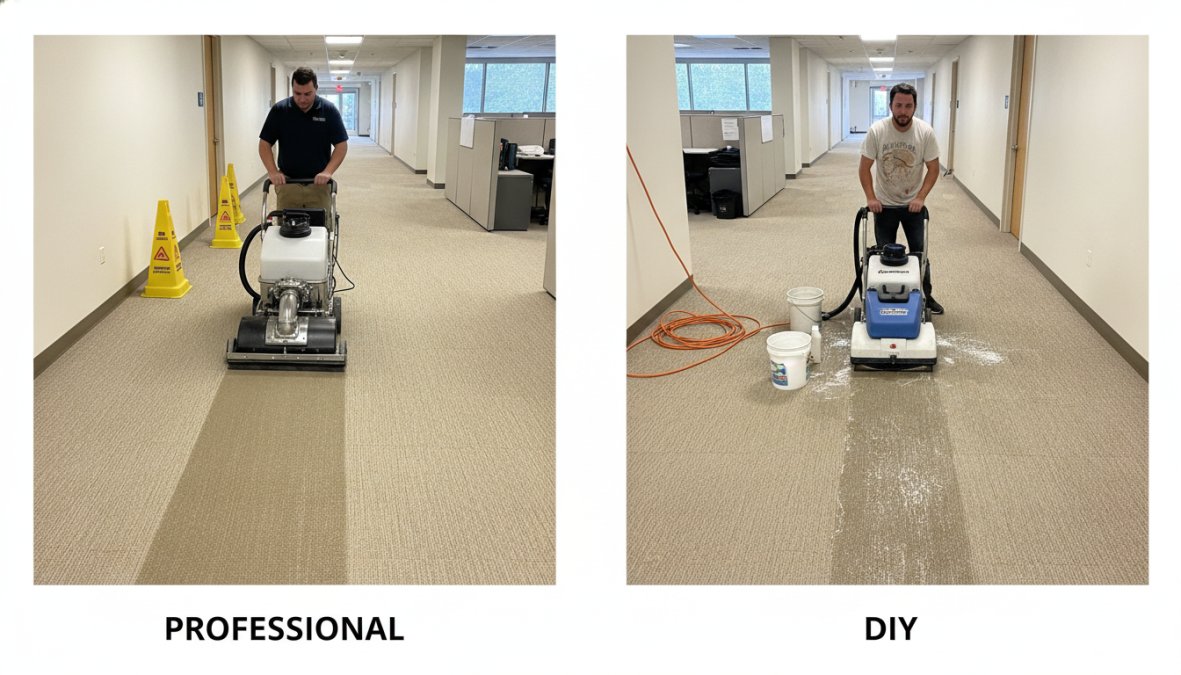
Professional cleaning makes financial sense in almost every commercial scenario when accounting for carpet replacement costs, warranty protection, and liability.
For facilities under 2,000 square feet with light traffic, annual professional deep cleaning plus quarterly spot cleaning justifies itself through warranty protection alone. Carpet costs thousands to replace; protecting that investment costs hundreds annually.
For medium facilities (2,000-5,000 square feet) with moderate to high traffic, the ROI is clear. Professional cleaning prevents premature wear, extends lifespan by years, and maintains indoor air quality.
For large commercial spaces (5,000+ square feet), professional cleaning becomes operationally essential. The scale of carpet, traffic patterns, and liability exposure make DIY approaches impractical.
The financial case strengthens when factoring in health benefits, productivity impacts, and the risk of water damage from rental equipment. A facility skipping professional cleaning to save a few hundred dollars annually often faces unexpected carpet replacement costs in the thousands, years ahead of schedule.
Deciding whether to invest in professional commercial carpet cleaning comes down to understanding the true cost of deferred maintenance. When factoring in carpet replacement timelines, warranty protection, indoor air quality, and employee health, the math strongly favors regular professional service. Lake Geneva Carpet Cleaning brings over 32 years of experience serving Wisconsin commercial facilities with state-of-the-art truck-mounted hot water extraction technology and eco-friendly cleaning methods. For commercial facilities in Lake Geneva and the surrounding region, professional carpet cleaning is asset protection that pays dividends year after year.
Frequently Asked Questions
How often should commercial carpets be professionally cleaned?
Most commercial facilities benefit from professional cleaning every 6-12 months, depending on foot traffic and soil levels. High-traffic areas in offices may need quarterly deep cleaning through hot water extraction, while lower-traffic zones can extend to annual service. Regular preventative maintenance prevents dirt accumulation and extends carpet lifespan significantly.
What is the average commercial carpet cleaning cost per square foot?
Professional commercial carpet cleaning typically ranges based on facility size, soil condition, and cleaning method. Truck-mounted extraction provides the deepest clean and best ROI for larger commercial spaces. Pricing varies by region and service provider, but economies of scale apply—larger square footage often reduces per-unit costs, making the investment more cost-effective overall.
Does professional carpet cleaning extend the life of commercial carpets?
Yes. Professional deep cleaning removes embedded dirt and allergens that wear carpet fibers prematurely. Hot water extraction eliminates soil that causes deterioration, and regular maintenance prevents the need for early replacement. Many manufacturers require professional cleaning to maintain warranty coverage, making it a financially sound investment that protects your flooring asset.
Is DIY rental equipment effective for commercial office spaces?
DIY rental machines provide only surface cleaning compared to professional truck-mounted extraction systems. They leave moisture and residue, promoting mold and re-soiling. For commercial facilities, the labor time, equipment rental costs, and incomplete results typically make professional service more cost-effective. Professional service delivers superior stain removal and sanitization that DIY cannot match.
How does professional carpet cleaning improve indoor air quality in offices?
Professional cleaning removes allergens, germs, and contaminants trapped in carpet fibers that impact IAQ. Hot water extraction eliminates dust mites, pet odors, and seasonal allergens more effectively than surface cleaning. Improved indoor air quality reduces employee health issues and absenteeism, contributing to the overall ROI of commercial carpet maintenance investments.
This article was written using GrandRanker