
Table of Contents
- How Cooking Creates Indoor Air Pollution
- Pollutants Released During Cooking
- Cooking Smoke Health Effects: Short-Term and Long-Term Risks
- How Long Cooking Smoke Stays Indoors
- Range Hood Ventilation Effectiveness
- How to Reduce Cooking Fumes in Your Home
- Cooking Methods and Fuel Types: Which Create More Pollution
- Protecting Vulnerable Populations from Cooking Emissions
- Measuring Indoor Air Quality and Identifying Problem Areas
- Frequently Asked Questions
Last Updated: October 6, 2026
How Cooking Creates Indoor Air Pollution
Cooking releases pollutants into your home’s air, and the impact of cooking fumes on indoor air quality is significant and often underestimated by homeowners.
Heating food, especially at high temperatures, triggers chemical reactions: oils break down, proteins char, and natural gas burns. These processes release particles and gases that linger in your kitchen and spread through your home, concentrating in an enclosed space with limited air exchange.
Homeowners often don’t connect indoor air quality problems to cooking habits. They notice dust, lingering odors, or worsening allergies without realizing the kitchen is the source, yet cooking is one of the most significant sources of indoor air pollution in homes.
The problem intensifies when ventilation is poor. Many older Wisconsin homes lack adequate kitchen exhaust, and even newer homes sometimes have hoods that recirculate air rather than venting it outside, keeping pollutants indoors.
Gas stoves produce more indoor air pollution than electric stoves because combustion adds nitrogen dioxide and carbon monoxide to the mix. If you have a gas range, ventilation becomes even more critical.
Pollutants Released During Cooking
Fine Particulate Matter and Combustion Byproducts
Cooking releases fine particulate matter, particles so small they stay suspended for hours, from oils, butter, and meat fats that vaporize or burn. Frying, sautéing, or broiling generates ultrafine particles that penetrate deep into your lungs.
Fine particulate matter, or PM2.5 (particles 2.5 micrometers or smaller), is particularly harmful. Your respiratory system can’t filter particles this small, so they bypass your nose and throat and lodge in your lungs, contributing over time to respiratory and cardiovascular problems.
Combustion byproducts appear when you use gas stoves. Burning natural gas produces nitrogen oxides and carbon monoxide, colorless, odorless gases you can’t detect without monitoring equipment. A study of homes with gas appliances found that unvented cooking can raise indoor nitrogen dioxide levels substantially during meal preparation.
Gas stoves without proper ventilation can produce indoor nitrogen dioxide levels that exceed outdoor air quality standards. This happens regularly during cooking, not just occasionally. The cumulative exposure matters.
Volatile Organic Compounds and Gas Emissions
Volatile organic compounds, or VOCs, are organic chemicals that evaporate at room temperature. Cooking releases dozens of them, oils release limonene, proteins release aldehydes, and these compounds are respiratory irritants, not just odors.
Heated cooking oils break down into smaller molecules, some of which become secondary organic aerosols when VOCs react with indoor ozone, creating new particles even more irritating to your lungs than the original VOCs.
The type of cooking oil matters. Oils with lower smoke points release more VOCs at lower temperatures. Heating oil beyond its smoke point accelerates VOC release. This is why frying produces more indoor air pollution than boiling or steaming.
Cooking Smoke Health Effects: Short-Term and Long-Term Risks
Immediate Respiratory Symptoms
Short-term exposure to cooking fumes triggers immediate symptoms: eye and throat irritation and coughing during or shortly after cooking. If your eyes water or your throat feels scratchy while cooking, you’re feeling the direct effects of inhaling cooking smoke and particulate matter.
People with asthma, allergies, or COPD are most vulnerable, cooking triggers bronchial constriction, increased mucus, and difficulty breathing. Even healthy people can develop temporary respiratory inflammation from repeated exposure to high concentrations of cooking fumes.
Children and older adults are also more susceptible because their respiratory systems are still developing or have declined with age. A child regularly breathing cooking fumes experiences repeated inflammatory episodes that may affect lung development.
Chronic Health Risks and Cardiovascular Impact
Long-term exposure to cooking fumes contributes to serious conditions. Chronic inhalation of fine particulate matter and combustion byproducts increases COPD risk even in people who’ve never smoked, causing persistent lung inflammation and airway obstruction.
Fine particulate matter also crosses from your lungs into your bloodstream, triggering systemic inflammation and oxidative stress that contribute to atherosclerosis, heart disease, and stroke. Research on household air pollution found that cooking-related indoor air pollution significantly increases cardiovascular risk, especially in people with existing heart disease.
The impact accumulates over years: someone cooking daily in a poorly ventilated kitchen experiences thousands of hours of elevated pollution, with measurable effects on heart rate variability, blood pressure, and inflammatory markers.
How Long Cooking Smoke Stays Indoors
Cooking smoke doesn’t disappear when you finish cooking. Small particles settle slowly because their low mass lets air resistance keep them floating, so even after you leave the kitchen, particles are still being inhaled in your living room and bedroom.
The exact duration depends on air exchange rate, how quickly outdoor air replaces indoor air. A typical home without mechanical ventilation exchanges air roughly once per hour, so cooking particles persist for several hours; in well-sealed, energy-efficient homes, they linger even longer.
Some particles settle on surfaces, accumulating as cooking residue on cabinets, walls, and flooring. This residue contains the same harmful compounds as airborne particles and can become airborne again when touched or disturbed by air movement.
The impact of cooking fumes on indoor air extends far beyond your cooking time. Particles remain in circulation for hours, and settled residue can re-suspend when disturbed. This is why single cooking events have lingering effects.
Range Hood Ventilation Effectiveness
What Makes a Range Hood Effective
An effective range hood removes cooking fumes before they spread. The key word is “removes,” not “recirculates.” Many hoods filter air and blow it back into the kitchen, reducing smoke and odor but leaving gases like nitrogen dioxide and carbon monoxide behind and capturing only some fine particles. True ventilation means ducting fumes outdoors.
Capture efficiency depends on three things working together: hood size relative to the cooking surface, fan airflow, and duct configuration. A hood should overhang the burners on all sides so rising fumes are drawn in rather than drifting past the edges; one mounted too high or narrower than the stove captures only a fraction of what it should.
Airflow is measured in cubic feet per minute (CFM). Most residential hoods move a few hundred CFM, and higher airflow means better capture, but only if the duct can carry it. A powerful fan choked by a narrow or winding duct moves far less air than its rating suggests; short, straight runs with few bends perform best, since every elbow adds resistance. A backdraft damper at the wall or roof cap keeps outdoor air from flowing back in when the fan is off.
Makeup air matters more than most homeowners realize. A hood moving several hundred CFM pulls air out of the house, and that air has to come from somewhere. In a tightly sealed home, the fan can struggle against the pressure difference and may pull exhaust from a water heater or furnace flue back inside. If your hood seems weak at full power, have it checked.
Turn the hood on a few minutes before you start cooking, not when the pan starts smoking. Fumes begin rising the moment heat hits oil, and a hood that is already running catches them at the source instead of chasing them across the room.
Ventilation Without External Ducting
Plenty of homes can’t run a duct outside. Apartments, condos, rentals, and many older Lake Geneva-area houses have no path through the wall or roof, and landlords are often unwilling to add one. If that’s your situation, you’re not out of options, you just have to combine approaches.
Recirculating hoods are a starting point, not a finish line. They trap grease and larger particles but let combustion gases and the smallest particles pass through, treat them as smoke-and-odor reducers, not air-quality solutions.
Window ventilation is the most underused tool. Cracking a window opposite the stove creates cross-ventilation: fresh air enters one opening and polluted air exits another. Even a few inches helps, and in cold Wisconsin weather you may only need it open during cooking and a short while after. A box fan blowing outward in a window accelerates the exchange considerably.
Portable air cleaners with HEPA filters capture fine particles effectively, and some include a carbon layer that helps with odors and certain gases. Know the limits: HEPA doesn’t remove carbon monoxide or nitrogen dioxide, and carbon filters vary widely in how much gas they absorb. Place a unit near the kitchen, run it during and after cooking, and change filters on schedule, a loaded filter moves less air.
If your building has a shared or central ventilation system, find out how it works. Some multifamily buildings run continuous exhaust that dilutes cooking fumes; others do nothing for individual units. Ask your building manager whether you’re already getting help or need to compensate on your own.
Never use a gas or charcoal grill, or a portable fuel-burning appliance, indoors as a substitute for a range hood. Burning fuel in an enclosed space produces carbon monoxide, which is odorless and can reach dangerous levels quickly.
Matching the Fix to Your Home
A few rules of thumb help you decide where to put your effort:
- If you have a ducted hood that vents outside, your priority is maintenance: clean or replace the grease filter regularly, check that the damper opens freely, and confirm the duct is not blocked.
- If you have a recirculating hood, add window ventilation and a portable air cleaner, and lean on lower-pollution cooking methods.
- If you have no hood at all, window ventilation plus a portable air cleaner is your baseline, and cooking method choices matter even more.
- If you rent, focus on the options you control, window use, a portable air cleaner, and cooking habits, and ask your landlord about hood maintenance if one exists.
No single measure eliminates cooking fumes. The goal is to stack modest improvements so particles and gases are captured, diluted, or filtered before settling into your living space.
How to Reduce Cooking Fumes in Your Home
Immediate Actions During and After Cooking
Start with ventilation. Turn on your range hood before you begin cooking, not after, and keep it running at least 15 minutes afterward to clear residual fumes.
Open windows to create cross-ventilation. Even in winter, cracking a window opposite your kitchen lets outdoor air in and indoor pollution out, with the temperature difference driving movement naturally. This matters most if you don’t have a ducted range hood.
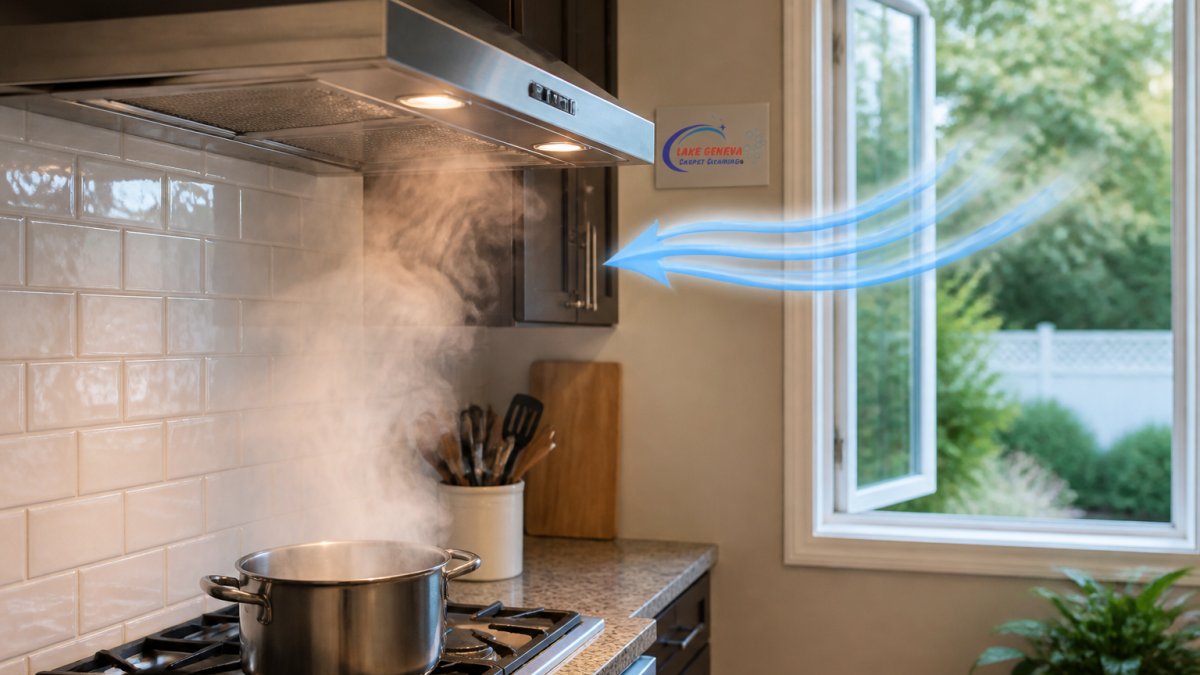
Avoid high-heat cooking when possible, frying releases more pollutants than boiling or steaming. If you do fry, keep the burner moderate, use an oil with a higher smoke point, and cover pans to contain vapors.
After cooking, wipe down surfaces. Residue settles on countertops, stovetops, and cabinets, and removing it prevents particles from re-suspending later. Use a damp cloth rather than dry wiping, which stirs up settled particles.
Long-Term Strategies for Better Air Quality
Evaluate your range hood. If it recirculates, consider upgrading to a ducted model where your home allows, the air quality improvement is substantial. If external ducting isn’t feasible, add a portable HEPA air purifier in the kitchen and run it during and after cooking.
Maintain your range hood regularly. Grease-clogged filters cut airflow significantly, so clean or replace them monthly if you cook often, and check ductwork for blockages. A hood that looks fine but has reduced airflow isn’t protecting your home.
Improve overall home ventilation. Energy-efficient homes are well-sealed and trap indoor pollutants; a heat recovery ventilator provides continuous fresh air exchange without excessive energy loss. Even modest ventilation improvements help.
Adjust cooking habits. Steam, boil, and slow-cook more often, these release fewer fumes than frying or broiling. When you do use high heat, run ventilation at full capacity.
Monitor your home’s air quality. If you notice lingering odors, dust accumulation, or worsening allergies, cooking pollution may be the cause, and addressing ventilation often improves these problems noticeably.
Cooking Methods and Fuel Types: Which Create More Pollution
Gas stoves produce more indoor air pollution than electric stoves. Burning natural gas releases nitrogen oxides and carbon monoxide in addition to particulate matter, while electric stoves release only particles from the food itself.
Induction cooktops produce the least pollution because they generate no combustion byproducts and heat food more efficiently, producing less vaporization, though few homes have them, and they require compatible cookware.
Cooking methods vary in pollution intensity. Frying produces the most VOCs and particulate matter because oil vaporizes extensively at high heat. Broiling and grilling produce combustion byproducts and charring compounds. Boiling and steaming produce minimal pollution because water absorbs the heat.
The impact of cooking fumes on indoor air depends partly on what you cook. Fatty foods release more VOCs than lean foods, meat produces more combustion byproducts than vegetables, and toasted spices release aromatic compounds that are actually VOCs.
Protecting Vulnerable Populations from Cooking Emissions
Children, older adults, and people with respiratory or cardiovascular disease face higher risks from cooking fumes because their bodies handle the inflammatory stress of particulate matter and gases less well.
Children spend more time indoors and are more likely to be in kitchens during or shortly after cooking. Their developing lungs are more susceptible to inflammation and damage from repeated exposure.
Older adults often have reduced lung function and existing cardiovascular disease, so cooking fumes trigger more severe symptoms. Someone with mild asthma might barely notice cooking smoke, while someone with moderate asthma may struggle to breathe.
People with existing heart disease are at particular risk from fine particulate matter, which triggers inflammatory responses that raise heart attack and stroke risk. If someone in your home has cardiac disease, managing cooking pollution becomes a health priority.
Pregnant women should also minimize exposure, since research on household air pollution suggests fine particulate matter during pregnancy may affect fetal development and birth outcomes.
To protect vulnerable people, improve ventilation, adjust cooking methods, and use air purifiers in the rooms they use most. If someone in your home has asthma or heart disease, discuss cooking-related air quality with their healthcare provider.
Measuring Indoor Air Quality and Identifying Problem Areas
You can’t see fine particulate matter or nitrogen dioxide, so observation alone won’t tell you whether your kitchen has a problem. Measurement turns a vague worry into something you can act on, the trick is knowing what the numbers mean and what they can’t tell you.
What Monitors Can and Cannot Tell You
Consumer-grade air quality monitors generally fall into a few categories:
- Particulate monitors report PM2.5, fine particles 2.5 micrometers or smaller, usually in micrograms per cubic meter (µg/m³). These are most useful for cooking because frying, broiling, and searing generate large amounts of PM2.5.
- Carbon dioxide (CO2) monitors don’t measure a cooking pollutant directly; they proxy how well your home exchanges air. Since people exhale CO2, rising levels suggest stale, poorly ventilated air, meaning cooking fumes are lingering too. Indoor CO2 above roughly 1,000 parts per million (ppm) suggests inadequate ventilation.
- Combination monitors add VOC and sometimes nitrogen dioxide sensors. VOC readings are usually a relative index rather than a precise concentration, so treat them as trend indicators, not exact measurements.
What monitors can’t do matters just as much. Low-cost particle sensors are affected by humidity, steam, and aerosols and can drift without calibration. One sensor in one room doesn’t represent your whole home, and no consumer monitor measures carbon monoxide as accurately as a dedicated CO alarm, those alarms are a separate, essential safety device.
How to Interpret What You See
Instead of chasing a single “good” number, use your monitor to compare conditions:
- Baseline vs. cooking. Note your PM2.5 reading before cooking, then watch it during and after. A sharp spike during frying means the kitchen is generating particles faster than they’re being removed.
- Hood on vs. hood off. Cook a similar meal twice, once with the hood running, once without, and compare how high the reading climbs and how fast it returns to baseline. This is the clearest test of whether your ventilation works.
- Time to recover. After cooking stops, how long until the reading falls back toward baseline? A slow decline points to poor air exchange; a quick return means ventilation is doing its job.
- Room-to-room spread. Move the monitor to a bedroom or living room an hour after cooking. If levels there are still elevated, fumes are migrating through the house, not staying in the kitchen.
Patterns worth acting on: readings that spike far above baseline and stay elevated for hours, CO2 climbing past roughly 1,000 ppm during normal activity, or symptoms like headaches, eye irritation, and coughing that track with cooking times. Any of these suggest your ventilation isn’t keeping up.
Use your monitor to compare, not to judge. The most valuable reading is the difference between your kitchen with the hood on and the same kitchen with it off. That gap tells you whether your ventilation is earning its keep.
When to Bring In a Professional
A consumer monitor is a screening tool, not a diagnostic instrument. If readings stay elevated despite running your hood, opening windows, and using a portable air cleaner, get a professional assessment. A qualified indoor air quality consultant or HVAC technician can measure combustion gases precisely, confirm your hood actually vents outdoors, check the duct for blockages or leaks, and test for backdrafting that could pull combustion byproducts inside.
That assessment is especially worth considering if anyone in your household has asthma, heart disease, or another condition sensitive to fine particles and combustion gases, or if you have a gas range and no externally vented hood, the combination that produces the highest sustained exposures.
Finally, remember that air quality is only part of the picture. Cooking residue also settles onto surfaces, cabinets, counters, and especially carpets and upholstery, where it can be stirred back into the air by foot traffic and daily activity. If your monitor shows that particles linger long after meals, the soft surfaces in your home may be holding onto them. Professional deep cleaning removes that accumulated residue in a way routine vacuuming cannot, which is one more lever you can pull to keep your indoor air cleaner between meals.
Frequently Asked Questions
Are cooking fumes harmful to your health?
Yes. Cooking fumes release fine particulate matter, nitrogen dioxide, carbon monoxide, and volatile organic compounds that can trigger respiratory symptoms, worsen asthma, and over time increase risk of heart disease and stroke. Even short-term exposure can cause coughing, wheezing, and eye irritation, especially in children and people with existing lung conditions. Long-term exposure from daily cooking without proper ventilation accumulates oxidative stress in the body and inflammation in the respiratory and cardiovascular systems.
How can I reduce cooking fumes in my home?
Use your range hood or exhaust fan every time you cook, running it for at least 15 minutes after you finish. Open windows to increase air exchange and dilute pollutant concentration. Cook at lower temperatures when possible, avoid prolonged high-heat methods like charring or deep frying, and switch to electric or induction cooking if feasible, gas stoves release more nitrogen oxides. Clean or replace range hood filters regularly so they work efficiently, and consider portable air purifiers with HEPA filters in kitchens without external ventilation.
How long do cooking fumes stay in the air?
Fine particulate matter and ultrafine particles from cooking can linger for hours to days depending on air exchange rates and ventilation. Without active ventilation, PM2.5 can remain at elevated levels for 2-4 hours after cooking stops. With a properly functioning range hood vented to the outside, most airborne particles are removed within 30-60 minutes. Volatile organic compounds and nitrogen dioxide disperse more slowly and can persist longer, especially in poorly ventilated spaces. Opening windows accelerates removal significantly.
Does a range hood remove smoke and cooking particles effectively?
A range hood vented to the outside removes 50-90% of cooking particles and smoke when used correctly, depending on its capture efficiency and airflow rate. Recirculating hoods that filter and return air to the kitchen are less effective, they capture some particles but release gases back into the home. For maximum effectiveness, the hood should be used during and after cooking, filters kept clean, and the duct system clear of obstructions. Homes without external venting options benefit from portable HEPA air purifiers as a supplementary measure.