
Table of Contents
- Why Basement Air Quality Matters for Your Home
- Basement Humidity Control: The First Step
- Identifying Signs of Mold in Basement Spaces
- Improve Ventilation and Air Circulation
- Address Foundation Issues and Seepage
- Install Air Filtration and Purification Systems
- Professional Carpet Cleaning for Basements
- Reduce Dust and Allergens Through Cleaning
- Monitor Air Quality and Maintain Long-Term Health
- Frequently Asked Questions
Last Updated: October 2, 2026
Why Basement Air Quality Matters for Your Home
Poor basement air quality affects your entire home. Moisture, mold spores, and dust settle in basements and spread upstairs through air circulation, creating musty odors, triggering allergies, and damaging your property over time.
The good news: learning how to improve air quality in a basement involves straightforward steps. Most problems start with humidity and poor ventilation. This guide walks you through practical solutions.
The fastest way to spot a basement air quality problem is to trust your nose. A musty smell means moisture is present, even if you can’t see mold yet. Act quickly, moisture problems worsen fast in basements.
Basement Humidity Control: The First Step
Humidity is the root cause of most basement air problems. High moisture creates the perfect environment for mold spores to grow and musty odors to develop. Controlling humidity stops these issues before they start.
Measure Your Humidity Levels
Start by measuring your basement’s humidity with a hygrometer. You want to keep levels between 30% and 50%; anything above 60% invites mold growth. Place it in the center of your basement, away from direct airflow, and check it daily for a week to establish your baseline.
High humidity often shows up as:
- Condensation on windows and pipes
- Damp walls or floors
- A clammy feeling in the air
- Visible water stains
Install or Upgrade Your Dehumidifier
A dehumidifier removes excess moisture from the air and is one of the most effective tools for improving air quality in a basement. Choose a unit sized for your basement’s square footage, small units work for spaces under 500 square feet, while larger basements need industrial-strength units.
Where to place your dehumidifier matters:
- Center of the room for even moisture removal
- Away from walls or corners
- On a level surface with good airflow around it
- Near a drain or with a hose for continuous operation
Empty the tank regularly or connect a drain hose for continuous operation, as a full tank stops the unit from working.
A dehumidifier alone won’t solve basement air quality problems, but it’s the essential first step. Without controlling humidity, ventilation and air filtration systems work much harder and less effectively.
Identifying Signs of Mold in Basement Spaces
Mold grows wherever moisture and organic material meet. Spotting mold early prevents it from spreading.
Spot Visual Mold Growth
Mold appears as black, green, or white spots on surfaces, often in corners, along seams, or where water has pooled. Visible growth is just the tip of the problem.
Common places to find mold in basements:
- Foundation walls and corners
- Around basement windows
- Under or around pipes
- On concrete floors near drains
- Inside crawl spaces
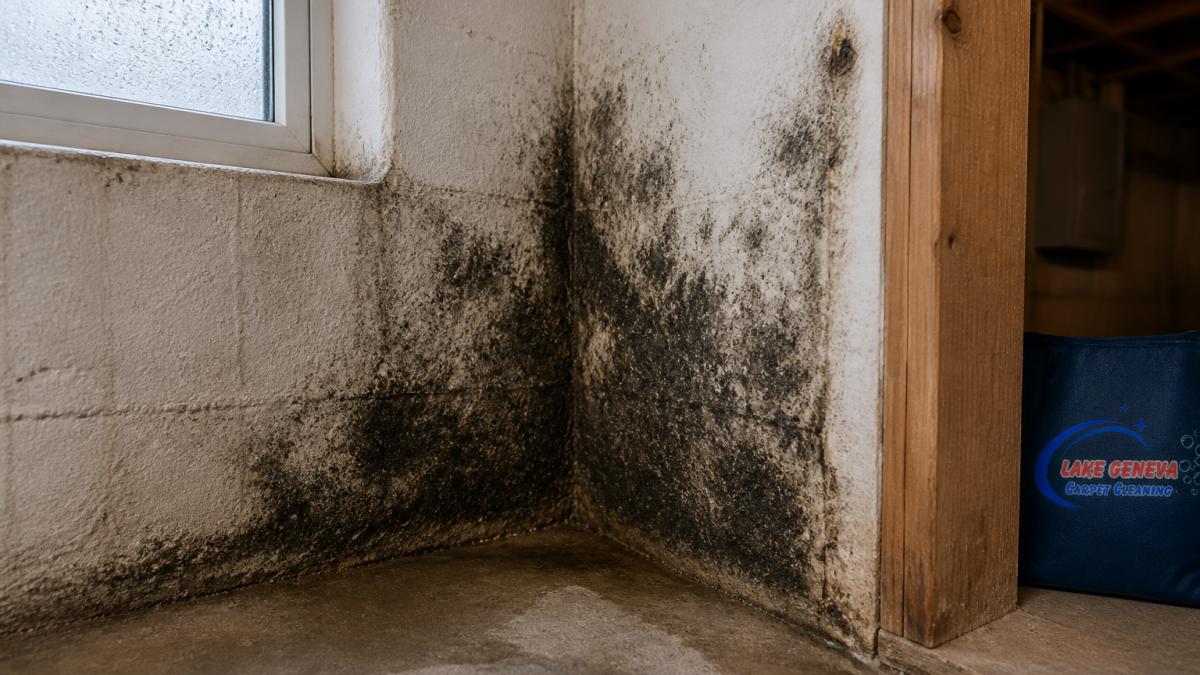
If you see mold, the area has been wet for days or weeks. Act fast to dry it out and stop it from spreading. Small patches can be cleaned with store-bought cleaners, but large areas need professional help.
Recognize Musty Odors and Mold Spores
A musty smell means mold is present, even if you can’t see it. Mold spores travel through air and settle on surfaces throughout your home. The odor often worsens after rain or in humid weather, indicating moisture is the trigger. Improving humidity control directly reduces these odors.
Improve Ventilation and Air Circulation
Stagnant air traps moisture and allows mold spores to settle. Moving air dries surfaces and pushes contaminants out. Ventilation and air circulation are critical to maintaining good basement air quality.
Add Exhaust Fans and Air Exchange
An exhaust fan removes damp air from your basement and pushes it outside, creating a direct path for moisture to escape. Install fans near the dampest areas, basement windows, sump pumps, condensation corners, and laundry areas. Run them for at least 2-4 hours daily, longer during humid months.
Your HVAC system also plays a role; ensure return air vents in your basement aren’t blocked by clutter or furniture.
Open Windows and Use Fans Strategically
On dry, cooler days, opening basement windows lets fresh air in naturally. Never open windows on hot, humid days, you’ll pull in moisture and worsen the problem. Portable fans help move air around your basement; point them toward windows to push moist air out. Simple rule: if it’s humid outside, keep windows closed; if it’s dry, open them up.
Improper ventilation can trap moisture instead of removing it. If your basement feels wetter after running fans or opening windows, stop immediately. You may be pulling in humid outdoor air. Switch back to a dehumidifier and exhaust fans.
Address Foundation Issues and Seepage
Water seeping through foundation cracks or walls is the biggest humidity culprit. Even small seepage adds constant moisture to your basement air. Cracks and gaps also allow radon gas to enter your basement, a colorless, odorless radioactive gas that poses serious health risks.
Identify Water Seepage and Structural Vulnerabilities
Signs of foundation seepage include:
- Water stains on walls or floors
- Efflorescence (white mineral deposits on concrete)
- Visible cracks in foundation walls
- Puddles after rain or snowmelt
- Damp spots that appear seasonally
Small cracks can be sealed with concrete patching compounds; larger seepage problems need professional waterproofing. Foundation integrity directly affects how to improve air quality in a basement. Many basements in the Lake Geneva area sit close to groundwater due to the region’s high water table and glacial geology, increasing seepage risk. The Wisconsin Department of Natural Resources notes that southeastern Wisconsin has elevated radon potential in many areas, making foundation sealing important.
Test for Radon Gas
Radon enters basements through foundation cracks, gaps around pipes, and unsealed sump pump openings. The EPA recommends testing every home for radon, especially basements where people spend significant time. Radon is the second leading cause of lung cancer after smoking. Purchase a radon test kit, place it in your basement for 2-7 days, and mail it to a lab for analysis. If your level is 4 picocuries per liter (pCi/L) or higher, the EPA recommends mitigation, which typically involves installing a vent pipe system that draws radon from below the foundation and vents it safely above the roofline. Retest every 2 years to confirm your system is working.
Use Smart Monitoring to Track Moisture and Air Quality Trends
Smart hygrometers and air quality sensors give you real-time data on basement conditions and alert you when humidity spikes or air quality drops. These devices track relative humidity, temperature, particulate matter, and radon levels. Some smart systems integrate with your HVAC system, automatically increasing fan speed or triggering exhaust fans when humidity exceeds your target. For homeowners concerned about radon, advanced monitors include radon sensors that provide ongoing tracking.
Foundation sealing and radon mitigation are investments in both air quality and health. Smart monitoring transforms basement air management from reactive (responding to musty smells) to proactive (preventing problems before they start). Together, these steps address the root causes of poor basement air quality that moisture control and ventilation alone cannot solve.
Install Air Filtration and Purification Systems
Once you’ve controlled humidity and ventilation, air filtration removes particles that remain. Filtration systems capture dust, allergens, mold spores, and other airborne contaminants. Filtration alone is not a substitute for moisture control, a purifier running in a damp basement will clog quickly and lose effectiveness.
Upgrade Your HVAC System Filters
Your home’s HVAC system is your first line of defense. Standard fiberglass filters (MERV 4-6) trap large particles but miss allergens and mold spores. Upgrading to a high-efficiency filter (MERV 11 or higher) dramatically improves air quality in a basement. Higher MERV filters restrict airflow slightly, so check your system’s specifications before upgrading, older systems may not handle MERV 13 filters without strain.
Change filters every 3 months during high-use seasons (spring and summer when humidity and pollen are high). In winter, every 6 months is usually sufficient. A clogged filter reduces airflow and defeats the purpose of upgrading.
If your basement has its own return air vent (common in finished basements), make sure it’s not blocked by furniture or storage. Blocked vents force your HVAC system to pull air from other parts of the house, reducing basement air exchange.
Add Standalone Air Purifiers for Targeted Coverage
Standalone air purifiers add extra protection in specific zones. They’re especially useful in finished basements, bedrooms in basements, or areas where you spend significant time.
Common purifier technologies:
- HEPA filters: Trap particles as small as 0.3 microns (dust mites, pollen, mold spores, pet dander)
- Activated carbon filters: Remove odors, volatile organic compounds (VOCs), and some chemical off-gassing
- UV-C light: Kills mold spores and bacteria (works best when air passes directly through the light)
- Ionizers: Release negative ions that attract and settle particles (less effective than HEPA alone)
For basement use, HEPA + activated carbon is the most effective combination. The HEPA filter handles particulates, and the carbon removes musty odors that linger even after humidity control.
Size and Position Purifiers Correctly
Air purifier effectiveness depends on matching the unit’s clean air delivery rate (CADR) to your room size. A purifier rated for 500 square feet won’t adequately clean a 1,200-square-foot basement.
Calculate the air changes per hour (ACH) your purifier delivers:
- Divide the purifier’s CADR (in cubic feet per minute, or CFM) by your room’s volume
- Multiply by 60 to get ACH
- Aim for at least 4-5 ACH for effective filtration
Example: A basement is 1,000 square feet with 8-foot ceilings (8,000 cubic feet). A purifier with 300 CFM delivers (300 ÷ 8,000) × 60 = 2.25 ACH, too low. You’d need a 400+ CFM unit for adequate coverage.
Placement matters:
- Position purifiers in the center of the room or near the dampest area
- Keep them away from walls and corners where air circulation is poor
- Avoid placing them directly next to dehumidifiers (they’ll fight each other)
- Ensure at least 12 inches of clearance on all sides for proper airflow
- Run purifiers continuously or at least 8 hours daily for best results
Understand When Filtration Works and When It Fails
Air filtration is most effective when humidity is controlled. Here’s why: mold spores and dust settle faster in humid air. A purifier can’t capture particles that have already landed on surfaces. If your basement humidity is above 60%, particles settle before the purifier can filter them. Your dehumidifier must work first.
Similarly, if your basement has active water seepage or musty odors that worsen over time, filtration alone won’t solve the problem. You must address the moisture source first. A purifier running in a wet basement is like bailing water from a boat with a hole in the hull, you’re treating the symptom, not the cause.
Filtration works best as a final layer:
- Control humidity with a dehumidifier (target: 30-50% RH)
- Improve ventilation with exhaust fans and air exchange
- Seal foundation cracks and address seepage
- Add air filtration to capture remaining particles
This sequence ensures your purifier runs efficiently and delivers measurable improvements in air quality.
Homeowners with finished basements, bedrooms, or living spaces who want to reduce allergens and odors after addressing moisture and ventilation. Filtration is most effective when layered on top of humidity control, not as a standalone solution.
Professional Carpet Cleaning for Basements
Carpets in basements absorb moisture, trap allergens, and harbor mold spores. Regular cleaning removes embedded contaminants that vacuuming misses. Professional cleaning is one of the most effective ways to improve indoor air quality.
Deep cleaning extracts allergens, dust mites, pet odors, and bacteria from carpet fibers and padding. This directly improves the air you breathe. Lake Geneva Carpet Cleaning uses hot water extraction technology that reaches deep into carpet and padding, removing contaminants.
Basement carpets need more frequent cleaning than upstairs:
- Every 6-12 months if humidity is high
- After any water damage or seepage
- If you notice musty odors in the carpet
- When allergies or respiratory issues worsen
Clean carpets are healthier carpets. They don’t trap moisture as easily, and they don’t harbor mold spores or allergens. If your basement carpet smells musty or feels damp, professional cleaning should be part of your air quality improvement plan.
Homeowners with basement carpets who want to eliminate musty odors and allergens without replacing the carpet. Professional deep cleaning restores air quality and extends carpet life.
Reduce Dust and Allergens Through Cleaning
Dust and allergens settle in basements just like in any other room. Regular cleaning removes these particles and improves air quality in a basement. A clean basement is a healthier basement.
Clean Surfaces and Remove Particulate Matter
Dust accumulates on every surface. Wipe down basement shelves, pipes, and corners with a damp cloth weekly. Damp cloths trap dust instead of stirring it into the air. Vacuum floors with a HEPA filter to capture fine particles.
Focus on:
- Shelves and storage areas
- Window sills and frames
- Exposed pipes and ducts
- Concrete floors and corners
Don’t neglect air vents and returns. Dust blocks airflow and reduces ventilation effectiveness. Clean or replace filters monthly during high-use seasons.
Address Pet Odors and Allergen Buildup
Pet accidents and dander create stubborn odors and allergen buildup in basements. Store-bought spot cleaners mask odors but don’t remove them completely. The smell returns because the source, bacteria and urine salts deep in the carpet, remains.
Professional deep cleaning removes pet odors at the source. Hot water extraction penetrates carpet fibers and padding, lifting out the contaminants that cause odors and allergen problems. This is especially important if your basement is a pet area or if pets spend time downstairs.
If you have pets in your basement:
- Clean accidents immediately with enzyme cleaners
- Schedule professional cleaning every 6 months
- Use air purifiers to reduce dander and odors
- Improve ventilation to move contaminated air out
Monitor Air Quality and Maintain Long-Term Health
Improving air quality in a basement isn’t a one-time fix. It requires ongoing monitoring and maintenance. A seasonal approach keeps your basement healthy year-round.
Track Humidity and Air Quality Index
Use a hygrometer to check humidity weekly. Keep a simple log of readings. This helps you spot trends and know when to adjust your dehumidifier or ventilation.
Air quality index (AQI) monitors track particulate matter and other contaminants. Many smartphones have free AQI apps that show outdoor air quality. On high-pollution days, keep basement windows closed to avoid pulling in poor air.
Create a Seasonal Maintenance Schedule
Spring brings rain and snowmelt. Increase dehumidifier use and check for new seepage. Run exhaust fans more often.
Summer humidity peaks. Run dehumidifiers and fans continuously. Open windows only on dry mornings.
Fall is ideal for waterproofing work and foundation repairs. Prepare your basement for winter moisture.
Winter snow and ice melt create seepage. Keep dehumidifiers running and monitor basement dampness.
A simple maintenance checklist keeps you on track:
- Check hygrometer readings weekly
- Empty or drain dehumidifier tanks
- Change HVAC filters every 3 months
- Clean air vents and exhaust fans monthly
- Schedule professional carpet cleaning twice yearly
- Inspect foundation for new cracks or seepage
Improving air quality in a basement takes effort, but the payoff is huge. Better air means fewer allergies, less mold, and a healthier home. Start with humidity control and ventilation, these are your foundation. Then add filtration and professional cleaning to remove embedded contaminants.
Lake Geneva Carpet Cleaning specializes in deep cleaning basements and removing allergens, odors, and contaminants that affect your indoor air quality. Our truck-mounted hot water extraction technology reaches deep into carpet and padding, pulling out the dirt, mold spores, and pet odors. With over 32 years of experience serving homeowners throughout Wisconsin, we understand how basement moisture and contamination affect your whole home. Contact us for a free quote and let our team help you breathe easier.
Frequently Asked Questions
What are the most common signs of poor indoor air quality in a basement?
Poor basement air quality often shows itself through musty odors, visible mold growth, condensation on windows, and increased dust accumulation. You might also notice your allergies worsen when you spend time downstairs, or family members develop respiratory symptoms. High humidity levels (above 60% relative humidity) and a damp feeling in the air are strong indicators that your basement needs attention to improve air quality.
How does basement humidity control help improve overall air quality?
Controlling humidity is essential because excess moisture creates the ideal environment for mold spores and dust mites to thrive. When relative humidity stays between 30-50%, you reduce mold growth, allergen buildup, and musty odors. A dehumidifier removes moisture from the air, which stops condensation from forming on surfaces and prevents seepage-related dampness from becoming a breeding ground for airborne contaminants and allergens.
Can air purifiers effectively improve air quality in basements?
Air purifiers and air scrubbers work best when paired with humidity control and ventilation. They remove particulate matter and airborne contaminants from the air, which helps reduce allergens and dust. However, if your basement has high humidity or active mold growth, an air purifier alone won’t solve the problem. Address the root causes, moisture, poor air circulation, and contaminated surfaces, first, then use air filtration as a supporting tool.
How often should I have my basement carpet professionally cleaned to maintain air quality?
Professional carpet cleaning removes deep-seated allergens, dust mites, pet odors, and bacteria that regular vacuuming cannot reach. For basements with heavy use or pet activity, annual or semi-annual cleaning helps maintain air quality and prevents odor and allergen buildup. Between professional cleanings, vacuum regularly and address spills immediately to prevent moisture from creating conditions that harm indoor air quality.