Table of Contents
- Why Professional Carpet Cleaning Matters for Office Spaces
- Commercial Carpet Cleaning Methods That Actually Work
- How Often Should You Clean Commercial Office Carpets
- Managing High-Traffic Areas and Stain Prevention
- How to Remove Stains From Commercial Carpet
- Indoor Air Quality and Health Benefits
- Carpet Material Compatibility and Fiber Protection
- ROI and Cost-Effectiveness of Regular Maintenance
- What to Expect From Professional Carpet Cleaning
- Conclusion
Last Updated: August 10, 2026
Why Professional Carpet Cleaning Matters for Office Spaces
A clean carpet improves appearance, employee health, client perceptions, and flooring longevity. Yet many facility managers treat carpet maintenance as an afterthought, vacuuming occasionally and hoping stains disappear on their own.
Professional carpet cleaning addresses embedded dirt, allergens, and bacteria that surface cleaning can’t reach. Regular vacuuming removes loose debris but leaves contaminants trapped deep in carpet fibers and padding. Over time, these accumulate and create an unhealthy environment.
The difference between professionally cleaned and neglected carpet shows immediately. Traffic lanes become visible, stains set permanently, and odors develop. Indoor air quality suffers when carpets harbor dust mites, allergens, and bacteria. Employees with allergies or respiratory sensitivities notice improvement within days of professional cleaning.
The EPA’s guidance on indoor air quality emphasizes that carpet maintenance is key to maintaining healthy working spaces. Facility managers in Lake Geneva and surrounding areas who invest in regular professional cleaning report fewer health complaints and higher employee satisfaction.
[Professional carpet cleaning for commercial office spaces](/commercial-carpet-cleaning-delavan-wi-the-definitive-business-guide/) isn’t a luxury, it’s essential maintenance that protects your investment, supports employee health, and maintains a professional appearance.
Commercial Carpet Cleaning Methods That Actually Work
Understanding cleaning methods helps you choose the right approach for your office’s specific needs. Two methods dominate the commercial cleaning industry, each with distinct advantages.
Hot Water Extraction Technology
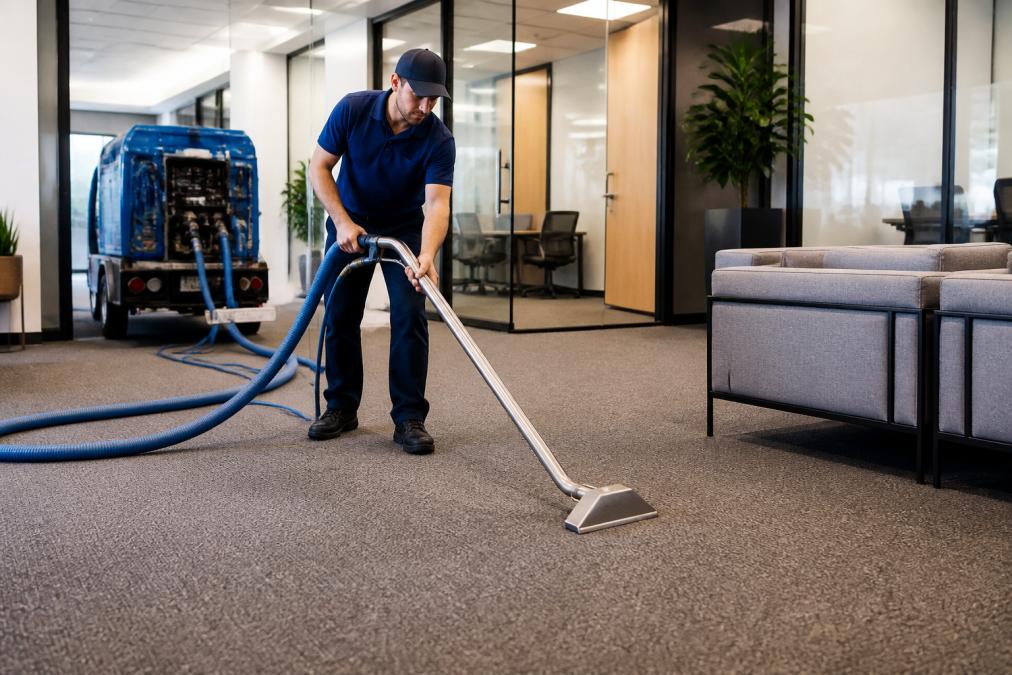
Hot water extraction, often called steam cleaning, is the gold standard for deep cleaning commercial carpets. This method uses heated water injected under pressure into the carpet, breaking down soil and contaminants, then extracting the dirty water back out.
Truck-mounted systems used by professional services deliver superior power compared to portable units. Equipment stays outside the building, reducing noise and disruption. Water temperature and pressure are precisely controlled, preventing damage while maximizing effectiveness.
Hot water extraction works exceptionally well for high-traffic areas and deep stain removal. It penetrates carpet backing and padding, reaching allergens and bacteria that vacuuming leaves behind. Most commercial-grade carpets are designed for this method, and manufacturers often recommend it for warranty compliance.
The main drawback is drying time. Properly executed hot water extraction leaves carpet damp for several hours, potentially disrupting workflow. However, modern extraction equipment reduces dry time to 4-8 hours in many cases.
Low-Moisture Extraction Systems
Low-moisture extraction uses less water and specialized equipment to clean carpet with minimal drying time. These systems spray cleaning solution, agitate fibers with rotating brushes, then extract moisture. Carpet is ready for foot traffic within 1-2 hours.
This method works well for maintenance cleaning and spot treatment, particularly useful in offices that can’t afford extended downtime. The trade-off is depth, low-moisture systems don’t penetrate as deeply as hot water extraction, making them less effective for heavily soiled carpets or stubborn stains.
Low-moisture extraction is gentler on delicate fibers and works for materials sensitive to excess water. If your office has specialty carpeting or area rugs, this method may be preferable.
The best approach often combines both methods. Use low-moisture extraction for routine maintenance and spot cleaning, then schedule hot water extraction quarterly or semi-annually for deep cleaning.
For commercial offices in Lake Geneva with moderate to high foot traffic, pairing quarterly hot water extraction with monthly low-moisture spot cleaning maintains appearance and extends carpet life significantly.
How Often Should You Clean Commercial Office Carpets
Cleaning frequency depends on foot traffic, carpet type, and soil accumulation. Industry standards provide a useful framework.
High-traffic commercial spaces like lobbies, conference rooms, and hallways should receive professional cleaning every 6-8 weeks. These areas accumulate soil quickly, and regular cleaning prevents dirt from becoming embedded.
Moderate-traffic areas such as individual offices and break rooms typically need professional cleaning every 3-4 months. Low-traffic areas like storage rooms can extend to every 6 months or annually.
Between professional cleanings, maintain carpets with regular vacuuming, daily in high-traffic zones and 2-3 times weekly in moderate areas. Immediate spot treatment of spills prevents stains from setting, reducing the need for intensive stain removal later.
The frequency you choose should reflect your office’s specific conditions. Offices near Lake Geneva with seasonal moisture from weather changes may need more frequent cleaning than those in drier climates.
Managing High-Traffic Areas and Stain Prevention
High-traffic areas develop visible wear patterns quickly. Hallways, entryways, and common areas show soil accumulation and traffic lanes where foot traffic compresses carpet fibers.
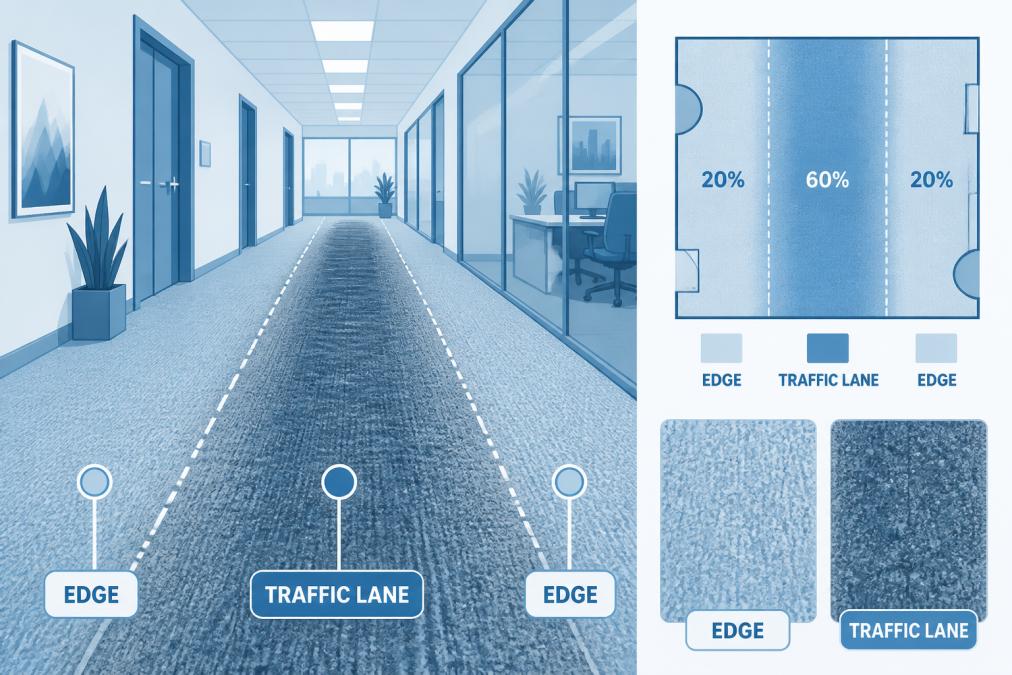
Traffic lane cleaning targets heavily-used pathways with spot treatment and localized deep cleaning. Rather than cleaning the entire carpet, technicians focus on areas that accumulate the most soil. This approach is efficient and cost-effective.
Preventative maintenance in high-traffic zones includes:
- Placing entrance mats to capture soil before it reaches carpet
- Using carpet protectors on vulnerable areas
- Scheduling spot treatment immediately after spills
- Implementing regular vacuuming protocols focused on traffic lanes
Stain prevention starts at the source. Most spills become permanent stains when left untreated. Train office staff to report spills immediately so professional spot treatment can happen before soil sets into fibers. Quick action dramatically improves the chances of complete stain removal.
For offices in Lake Geneva, seasonal contaminants like road salt, mud, and sand tracked in during winter months create additional cleaning challenges. Entrance mats and regular vacuuming in high-traffic zones minimize this soil accumulation.
Delaying spot treatment on spills is the most common reason stains become permanent. What could be removed in 24 hours becomes nearly impossible to remove after a week of foot traffic and drying.
How to Remove Stains From Commercial Carpet
Stain removal strategy depends on stain type, carpet material, and how long the stain has been present. Different stains require different approaches.
Spot Treatment vs. Deep Cleaning
Spot treatment addresses individual stains using targeted cleaning solutions applied directly to the affected area. This method works best on fresh stains that haven’t penetrated deep into carpet fibers. Professional spot treatment uses commercial-grade solutions and equipment that household cleaners can’t match.
The key to successful spot treatment is speed. Treating a stain within hours of occurrence prevents it from setting into carpet fibers and backing.
Deep cleaning becomes necessary when stains have set or when multiple stains are scattered across the carpet. For stubborn stains, professional services use specialized techniques like hot water extraction with pre-treatment solutions or enzymatic treatments that break down organic matter.
The commercial carpet cleaning process for stain removal typically involves:
- Inspection to identify stain type and carpet material
- Pre-treatment with appropriate cleaning solution
- Agitation to break down soil particles
- Extraction to remove cleaning solution and loosened contaminants
- Post-treatment inspection to verify stain removal
Some stains never fully disappear, particularly if they’ve been present for years or involve permanent dyes. Professional technicians can assess whether a stain is removable or if it’s a permanent discoloration.
Indoor Air Quality and Health Benefits
Carpet that harbors dust mites, allergens, and bacteria directly impacts air quality and employee health. While carpet adds comfort and sound absorption to offices, it also traps contaminants that vacuuming alone cannot remove.
Professional carpet cleaning significantly improves indoor air quality by removing dust mites and their allergens, pet dander and odors, mold spores and mildew, bacteria and pathogens, and volatile organic compounds trapped in fibers.
Employees with allergies or asthma notice improvement almost immediately after professional cleaning. Respiratory symptoms decrease, and overall comfort increases. This translates to fewer sick days and higher productivity.
The carpet sanitization process used by professional cleaners goes beyond standard cleaning. Hot water extraction at proper temperatures kills many bacteria and pathogens, reducing the microbial load in carpet. Some services use additional sanitizing treatments for offices with heightened health concerns.
Regular professional cleaning maintains these air quality benefits over time. Without periodic deep cleaning, contaminants reaccumulate within weeks.
For offices in Lake Geneva where seasonal humidity and moisture create conditions favorable to mold and mildew growth, professional cleaning with proper drying prevents these issues from developing.
Carpet Material Compatibility and Fiber Protection
Not all carpets are the same, and different materials require different cleaning approaches. Using the wrong method or cleaning solution can damage carpet fibers, void warranties, or cause permanent discoloration.
Nylon Carpets
Nylon is the most common commercial carpet fiber. It is durable, resilient, and responds well to hot water extraction at temperatures between 200-220°F. However, nylon is susceptible to permanent yellowing if exposed to alkaline cleaning solutions with pH above 10. Most nylon carpet warranties explicitly require hot water extraction as the approved cleaning method. Professional cleaners use pH-neutral or slightly acidic rinses (pH 6-7) after extraction to prevent residue buildup and yellowing.
Polyester Carpets
Polyester is softer than nylon and naturally stain-resistant. However, polyester fibers are heat-sensitive and prone to matting if subjected to aggressive agitation or water temperatures above 180°F. Low-moisture extraction or encapsulation cleaning is often preferred for polyester. Facility managers should confirm their polyester carpet’s specific cleaning recommendations in the manufacturer’s documentation.
Wool Carpets
Wool is a premium natural fiber found in high-end commercial spaces. It is naturally flame-resistant and durable. However, wool requires specialized care: it is sensitive to alkaline solutions, which cause permanent felting and shrinkage, and to high heat. Professional cleaners experienced with wool use pH-neutral or slightly acidic solutions, water temperatures no higher than 160°F, and minimal agitation. Many wool carpet warranties require certification from the Woolsafe Organization.
Polypropylene (Olefin) Carpets
Polypropylene is budget-friendly and moisture-resistant. However, polypropylene fibers are prone to matting and crushing under aggressive cleaning. The fiber does not recover quickly from compression, so traffic lanes become visible faster. Professional cleaning should use gentle agitation and avoid excessive heat. Low-moisture extraction is often more suitable than hot water extraction for polypropylene.
Fiber Protection and Warranty Compliance
After professional cleaning, carpet fiber protection treatments create a hydrophobic barrier that resists soil and stain penetration. These treatments typically last 12-18 months and are most effective on nylon and polyester.
Always request that your cleaning service verify carpet fiber type and review the manufacturer’s care instructions before treatment. Professional cleaners maintain documentation of the cleaning method, solutions used, and any treatments applied, this record is essential if a warranty claim becomes necessary.
Request a fiber identification test from your cleaning service before your first professional cleaning. Knowing your exact carpet material and its warranty requirements prevents damage and ensures compliance with manufacturer specifications.
ROI and Cost-Effectiveness of Regular Maintenance
Professional carpet cleaning is a capital-preservation investment. Understanding the financial case for regular cleaning helps facility managers justify the expense and make data-driven decisions about maintenance budgets.
Carpet Replacement Cost vs. Maintenance Cost
Commercial carpet replacement typically costs $3-$12 per square foot installed. For a 10,000-square-foot office, replacement ranges from $30,000 to $120,000. In contrast, professional deep cleaning costs $0.15-$0.50 per square foot, or $1,500-$5,000 for the same space. A single replacement cycle costs 6-80 times more than a professional cleaning visit.
Regular professional cleaning extends carpet life by 2-3 years compared to neglected carpet. This extension alone justifies the investment: even if you spend $2,000 per quarter on professional cleaning ($8,000 annually), delaying replacement by 2-3 years saves $30,000-$120,000 in capital expenditure.
Preventative Maintenance vs. Reactive Cleaning
Facility managers often face a choice: invest in regular preventative cleaning or wait until carpets become visibly soiled and then pay for intensive restoration cleaning. Reactive cleaning costs more per square foot because heavily soiled carpet requires longer dwell times and multiple treatment passes. A carpet that could be maintained for $0.25 per square foot quarterly may cost $1.00+ per square foot to restore after 12 months of neglect.
Preventative maintenance also reduces the risk of permanent stains. Spills treated within 24 hours have a 90%+ success rate for complete removal. The same spill left untreated for a week has a 40-60% success rate, and stains older than a month are often permanent.
Health and Productivity Benefits
While harder to quantify in dollars, the health impact of regular carpet cleaning reduces absenteeism and improves productivity. Employees with allergies or asthma report fewer respiratory symptoms in offices with professionally cleaned carpets. Reduced absenteeism translates to direct cost savings. If regular professional cleaning reduces sick days by even 1-2 days per employee annually across a 100-person office, the productivity gain far exceeds the annual cleaning budget.
Client Perception and Lease Renewal
For offices that lease space, carpet condition directly impacts renewal negotiations. Well-maintained carpet suggests responsible tenancy and may result in more favorable renewal terms. Conversely, stained or worn carpet signals poor facility management and may trigger demands for replacement costs or justify higher renewal rates.
Calculating Your Specific ROI
To determine the financial case for your office:
- Estimate your carpet replacement cost: (square footage) × (cost per square foot, typically $3-$12)
- Estimate annual professional cleaning cost: (square footage) × (cost per square foot, typically $0.15-$0.50) × (frequency, typically 4-12 times annually)
- Calculate payback period: (replacement cost) ÷ (annual cleaning cost) = years until cleaning investment breaks even
For most commercial offices, the payback period is 2-4 years. Any carpet life extension beyond that period is pure savings.
Documentation for Facilities Managers
Maintain records of all professional cleaning visits, including date, method used, areas treated, and any stain removal work performed. This documentation provides evidence of responsible carpet maintenance if disputes arise with landlords or during lease negotiations, and it creates a baseline for assessing whether your current cleaning frequency is adequate.
Regular professional carpet cleaning is not an expense, it is a capital preservation strategy that delays replacement by 2-3 years and typically pays for itself within 2-4 years through extended carpet life alone. The health and productivity benefits provide additional ROI that facility managers often underestimate.
What to Expect From Professional Carpet Cleaning
Understanding the professional carpet cleaning process helps you prepare your office and set realistic expectations for results and timelines.
A professional cleaning visit typically begins with inspection. Technicians assess carpet condition, identify problem areas, and note any special concerns like delicate materials or existing damage.
Pre-treatment comes next. For heavily soiled carpets or stubborn stains, technicians apply cleaning solutions and allow them to dwell, breaking down soil and contaminants.
The actual cleaning follows, using the appropriate method for your carpet type and condition. Whether hot water extraction or low-moisture cleaning, the process involves applying cleaning solution, agitation, and extraction.
Post-treatment inspection ensures results meet professional standards. Any areas needing additional attention receive spot treatment. Final extraction removes excess moisture.
Drying time varies by cleaning method. Hot water extraction typically requires 4-8 hours for complete drying, while low-moisture methods dry within 1-2 hours. Air circulation and humidity affect drying speed.
Professional services provide realistic timelines and guidance on foot traffic restrictions during drying. Most recommend avoiding heavy use until carpet is completely dry to prevent re-soiling.
Results are typically visible immediately after cleaning. Carpets appear brighter, stains are removed or significantly reduced, and odors diminish. In some cases, results continue improving as carpet fibers dry completely.
Regular professional carpet cleaning for commercial office spaces is essential maintenance, not optional expense. The combination of improved appearance, extended carpet life, better indoor air quality, and employee health benefits creates clear value. Lake Geneva Carpet Cleaning brings 32 years of experience and state-of-the-art equipment to commercial carpet cleaning, using eco-friendly methods that deliver deep cleaning without harsh chemicals. Their truck-mounted hot water extraction technology removes embedded allergens and contaminants while their meticulous attention to detail ensures your office carpets look professional and perform optimally. Contact Lake Geneva Carpet Cleaning for a professional cleaning assessment to establish a maintenance schedule that protects your investment and keeps your office environment healthy.
Frequently Asked Questions
How often should commercial office carpets be professionally cleaned?
Most offices benefit from professional cleaning every 3 to 6 months, depending on foot traffic and usage patterns. High-traffic areas like entryways and hallways may need cleaning every 2 to 3 months, while less-used spaces can extend to 6 to 12 months. Regular cleaning prevents dirt accumulation, maintains appearance, and extends carpet lifespan. Your facility manager should adjust frequency based on visible soiling and business needs.
What is the best method for carpet cleaning for commercial office spaces?
Hot water extraction, also called steam cleaning, is the industry standard for commercial spaces. This method uses high-temperature water and extraction equipment to remove embedded dirt, allergens, and stains from carpet fibers and padding. Low-moisture extraction systems are also effective for offices that need faster drying times. Both methods work well; the choice depends on your carpet material, drying time tolerance, and specific cleaning goals.
How long does it take for office carpets to dry after professional cleaning?
Drying time varies by method and conditions. Hot water extraction typically requires 4 to 8 hours, while low-moisture systems may dry in 1 to 3 hours. Air circulation, humidity, and carpet thickness affect drying speed. Professional cleaners use fans and dehumidifiers to speed up the process. Faster-drying methods are ideal if your office needs to remain fully operational during or immediately after cleaning.
Does professional carpet cleaning improve indoor air quality in offices?
Yes. Professional cleaning removes dust mites, allergens, bacteria, and trapped particles that regular vacuuming cannot reach. Deep cleaning extracts contaminants from carpet fibers and padding, reducing airborne particles and odors. This is especially important for offices with employees who have allergies or respiratory sensitivities. Improved air quality creates a healthier workspace and can reduce sick days and increase productivity.
This article was written using GrandRanker