Table of Contents
- Why a Commercial Carpet Maintenance Plan Benefits Your Bottom Line
- How a Maintenance Plan Prolongs Carpet Lifespan and Fiber Integrity
- Protecting Indoor Air Quality and Respiratory Health
- Commercial Carpet Cleaning Frequency: How Often Is Enough?
- Commercial Carpet Cleaning Best Practices: Methods That Work
- Carpet Maintenance Schedule Template: Building Your Plan Step by Step
- The True Commercial Carpet Maintenance Plan Benefits: ROI Calculation Framework
- Conclusion
Last Updated: June 2, 2026
Understanding the commercial carpet maintenance plan benefits available to your facility is one of the most overlooked decisions in commercial property management. At Lake Geneva Carpet Cleaning, we have spent over 32 years watching businesses in Lake Geneva, Wisconsin pay far more to replace carpets than they ever would have spent on structured preventative maintenance. Below, we’ll show you exactly how a planned approach to carpet care protects your investment, your indoor air quality, and your professional image, and we’ll give you a practical framework to build your own schedule today.
A commercial carpet maintenance plan is a structured, recurring program that combines daily vacuuming, periodic spot cleaning, interim encapsulation treatments, and scheduled deep cleaning using hot water extraction, calibrated to your facility’s specific soil load and traffic patterns.
Most guides frame this as a cost. The better frame is asset management.
Why a Commercial Carpet Maintenance Plan Benefits Your Bottom Line
Commercial carpet represents a significant capital investment for any facility, and treating it as a depreciating asset rather than a managed one is where most businesses lose money.
Asset Management and Investment Protection
The core argument for a maintenance plan is simple: carpets that are cleaned on a schedule last significantly longer than carpets that are cleaned reactively. Abrasion from embedded grit and salt is the primary cause of fiber damage in commercial environments. Once grit works into the carpet backing, each footstep acts like sandpaper against the fiber structure. No amount of deep cleaning reverses that damage. Prevention is the only option.
Carpet manufacturers, including those certified by the Carpet and Rug Institute’s commercial carpet standards, typically require documented proof of regular professional cleaning to honor extended warranties. Skipping scheduled maintenance does not just shorten carpet life. It voids the warranty entirely.
For multi-tenant buildings, this matters even more. Landlords who cannot demonstrate a maintenance history face accelerated replacement cycles that compound across multiple floors and common areas.
Professional Image and Appearance Management
Traffic lanes are the first thing clients notice when they walk into your building. Carpet in high-traffic areas accumulates soil load at a rate that daily vacuuming alone cannot address. Appearance demand, the standard used by facility management professionals to measure how clean a carpet must look given its location and visitor exposure, is highest in lobbies, corridors, and conference rooms.
A maintenance plan sets cleaning frequency based on appearance demand rather than guesswork. That distinction is what separates businesses whose carpets look professionally maintained from those whose carpets look perpetually tired.
Professional image is not just about aesthetics. Clients and tenants form judgments about operational competence based on the condition of shared spaces. Carpet condition is one of the most visible signals.
How a Maintenance Plan Prolongs Carpet Lifespan and Fiber Integrity
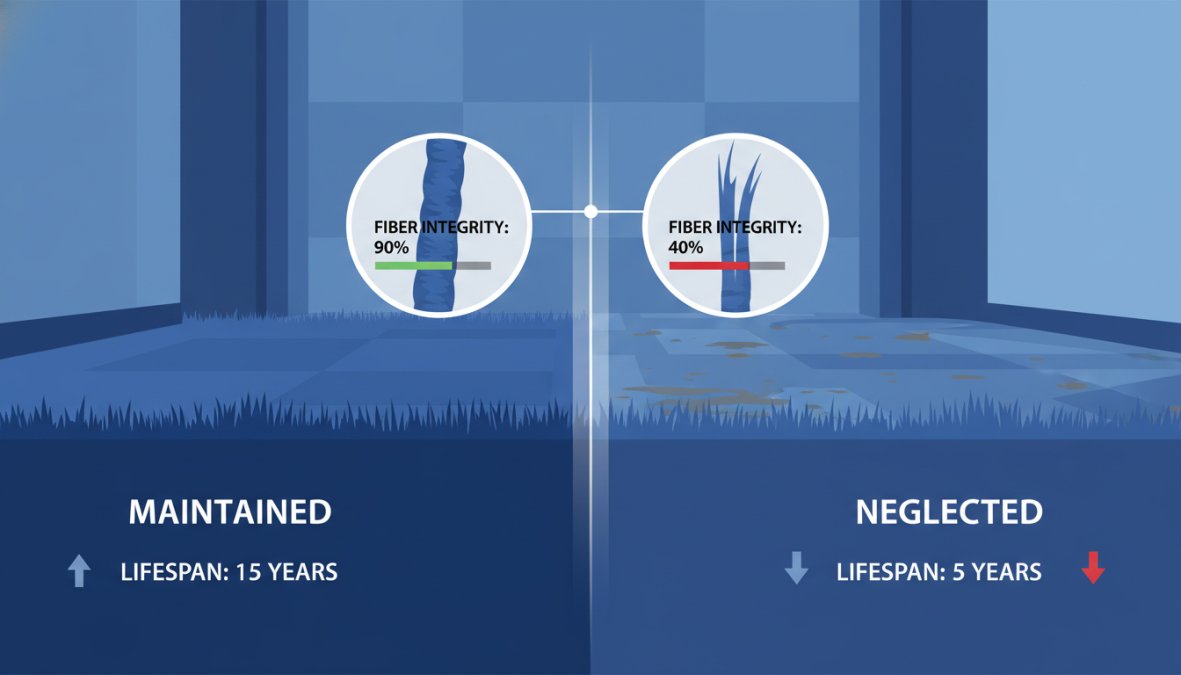
Fiber damage is largely invisible until it is irreversible. That is the central problem with reactive cleaning.
When soil particles embed below the surface pile, they sever individual fiber strands through repeated compression. The carpet does not look dirty yet, but the structural integrity is already degrading. A maintenance plan intervenes before that threshold is crossed.
Understanding Carpet Fiber Science: Abrasion and Soil Load
Commercial-grade carpet is typically constructed from nylon, polypropylene, or polyester fibers, each with different stain resistance and abrasion tolerance profiles. Nylon is the most durable and responds best to hot water extraction. Polypropylene resists moisture but holds oily soils tenaciously, making encapsulation system treatments particularly effective for interim maintenance.
Soil load accumulates in predictable patterns. Entry points collect tracked-in grit and salt during Wisconsin winters. Cafeteria adjacencies accumulate food-based soils that accelerate microbial growth. Understanding where your facility’s soil load concentrates allows you to allocate cleaning resources efficiently rather than treating every zone identically.
According to guidance from the Institute of Inspection, Cleaning and Restoration Certification, commercial carpets in high-traffic areas should receive interim cleaning every one to three months, with hot water extraction deep cleaning at least twice per year.
The Role of Carpet Backing and Wicking in Long-Term Wear
Wicking is one of the most misunderstood failure modes in commercial carpet maintenance. It occurs when moisture from a deep cleaning or spill migrates down through the pile to the carpet backing, dissolves soil trapped there, and then draws that soil back to the surface as the carpet dries. The result is a stain that reappears days after cleaning.
Wicking is not a cleaning failure. It is a symptom of deferred maintenance. When soil is allowed to accumulate in the backing layer over months or years, no single cleaning event can fully remove it. Regular interim treatments prevent soil from reaching the backing in the first place, eliminating the wicking cycle before it starts.
Applying excess moisture during spot cleaning accelerates wicking. Always blot, never saturate, and use products appropriate for your carpet fiber type. Saturating the backing without proper extraction equipment creates conditions for mold growth within 24 to 48 hours.
Protecting Indoor Air Quality and Respiratory Health
Commercial carpet functions as a passive air filter, trapping airborne pollutants, allergens, dust mites, and biological contaminants within its fiber structure. This is actually beneficial, up to the point where the carpet reaches saturation and begins releasing those pollutants back into the breathing zone with each footstep.
A maintenance plan manages that saturation threshold. Facilities without a plan eventually reach a point where their carpet is actively degrading indoor air quality rather than improving it. For businesses with employees or customers who have respiratory sensitivities, this is not a theoretical risk.
The EPA’s guidance on indoor air quality in commercial buildings identifies carpet as a significant reservoir for particulate matter, volatile organic compounds (VOCs), and biological allergens. Regular vacuuming with HEPA-equipped equipment removes surface-level pollutants. Deep cleaning with hot water extraction removes embedded contaminants that vacuuming cannot reach.
The Saturation Threshold: What Happens When Carpet Fails as a Filter
The mechanism matters here because it explains why frequency is not optional. Carpet fiber traps particulate matter in the spaces between individual fiber strands and within the pile structure. At low-to-moderate soil loads, this trapping effect keeps particles out of the breathing zone, the air column from floor level to approximately five feet, where occupants actually inhale.
As soil load increases toward saturation, two failure modes occur simultaneously:
- Re-entrainment: Foot traffic agitates the pile and dislodges previously trapped particles back into the breathing zone. A saturated carpet actively pumps contaminants into the air with every step.
- Microbial amplification: Organic soils, food particles, skin cells, tracked-in biological matter, provide a growth substrate for bacteria and mold when moisture is present. Once microbial colonies establish in the carpet backing, routine cleaning cannot fully eliminate them without specialized treatment.
Regular interim cleaning prevents the carpet from reaching either failure threshold. This is the mechanism behind the air quality benefit, not a general improvement in cleanliness, but a specific prevention of two distinct contamination pathways.
Green Cleaning Standards and LEED Certification: What Facility Managers Need to Know
This is where most carpet maintenance guides stop short, and where modern commercial facility managers increasingly need specifics.
Green cleaning in commercial carpet maintenance is no longer a preference, it is a procurement requirement for a growing share of commercial tenants, particularly corporate clients with published environmental, social, and governance (ESG) commitments, healthcare-adjacent facilities, and any building pursuing or maintaining LEED certification.
LEED and Indoor Environmental Quality Credits
The LEED rating system, administered by the U.S. Green Building Council, includes Indoor Environmental Quality (IEQ) credits that directly intersect with carpet maintenance practices. Specifically:
- IEQ Credit: Low-Emitting Materials, Cleaning chemistry used in carpet maintenance can contribute to or undermine this credit. Products that off-gas VOCs after application, including some solvent-based spotters and certain encapsulation chemistries, can elevate indoor VOC concentrations and jeopardize IEQ credit compliance.
- IEQ Credit: Green Cleaning, LEED for Operations and Maintenance (LEED O+M) includes a green cleaning credit that requires facilities to use cleaning products meeting recognized third-party certification standards and to document their cleaning program.
For facilities pursuing or maintaining LEED O+M certification, the carpet maintenance plan is not a discretionary program, it is a documented component of certification compliance.
Green Seal and EPA Safer Choice Certification
Two certification programs are the recognized benchmarks for cleaning chemistry in commercial carpet maintenance:
- Green Seal GS-37 covers commercial cleaning products and requires that certified products meet standards for human health safety, biodegradability, and restricted ingredient lists that exclude many common VOC-generating solvents. Green Seal’s commercial cleaning product standards
- EPA Safer Choice certification indicates that a product’s ingredients have been evaluated for environmental and human health impact. Many encapsulation chemistry formulations now carry Safer Choice certification, making them compatible with green cleaning program requirements.
When evaluating a commercial carpet cleaning provider, ask specifically whether their chemistry carries Green Seal GS-37 or EPA Safer Choice certification. A provider who cannot answer this question is not equipped to support a facility with green cleaning obligations.
VOC Reduction in Practice
VOC exposure from cleaning products is a specific concern in commercial environments because cleaning typically occurs during or just before occupied hours. Residual VOCs from cleaning chemistry can persist in the indoor air environment for hours after application, particularly in facilities with limited ventilation.
Low-VOC encapsulation chemistry and hot water extraction, which physically removes chemistry residue along with soils rather than leaving it to dry in place, are the two practices that most directly reduce post-cleaning VOC exposure. Facilities with HVAC systems that cannot be ramped up during cleaning windows should prioritize chemistry with the lowest residual VOC profile available.
CRI Seal of Approval: Equipment and Chemistry Together
The Carpet and Rug Institute’s Seal of Approval program independently tests both cleaning equipment and cleaning chemistry for effectiveness and fiber safety. Products and equipment carrying the CRI Seal of Approval have been verified to clean effectively without damaging fiber integrity, leaving harmful residues, or accelerating re-soiling through sticky residue buildup. For facility managers building a documented green cleaning program, CRI Seal of Approval provides a defensible, independently verified benchmark that complements Green Seal or EPA Safer Choice chemistry certification.
When building your carpet maintenance plan documentation for LEED O+M compliance or tenant ESG reporting, request a product data sheet and safety data sheet (SDS) from your cleaning provider for every chemistry used. Retain these alongside your service records. Auditors reviewing green cleaning compliance will ask for both the cleaning log and the product documentation.
Healthier Indoor Environments and Operational Benefits
Facilities that invest in documented air quality management through structured carpet maintenance report measurable operational benefits, though specific figures vary by industry and building type. The most consistently cited outcomes among facility management practitioners are reduced occupant complaints related to dust and odor, lower incidence of respiratory-related absenteeism in densely occupied spaces, and higher scores on occupant satisfaction surveys, particularly in buildings where tenants have visibility into the facility’s cleaning program.
For healthcare-adjacent facilities, assisted living communities, and educational buildings, the indoor air quality argument for a structured carpet maintenance plan is not supplementary, it is the primary justification, and it should be documented and communicated to occupants as part of the facility’s health and safety program.
Commercial Carpet Cleaning Frequency: How Often Is Enough?
Commercial carpet cleaning frequency depends on four variables: foot traffic volume, soil type, carpet fiber, and appearance demand standards for the specific location. There is no universal answer, but there is a reliable framework.
Traffic Lane Assessment and Appearance Demand Levels
Facility management professionals use appearance demand levels to classify zones within a building. A practical classification looks like this:
| Zone Type | Daily Traffic | Vacuuming Frequency | Interim Cleaning | Deep Cleaning |
|---|---|---|---|---|
| Light traffic (private offices) | Under 50 people | 2-3x per week | Every 6 months | Annually |
| Medium traffic (corridors) | 50-200 people | Daily | Every 3 months | Twice yearly |
| Heavy traffic (lobbies, entries) | 200+ people | Daily | Monthly | Quarterly |
| Specialty zones (food service adj.) | Variable | Daily | Monthly | Quarterly |
The table above is a starting point. Facilities near Lake Geneva’s lakefront with high seasonal visitor volume during summer months will push lobby and entry zones toward the heavy-traffic schedule for roughly four to five months of the year, then scale back during slower periods.
Map your building’s traffic lanes at the start of each season. Wisconsin’s winter brings road salt and grit that dramatically increases soil load at entry points from November through March. Adjust your interim cleaning frequency upward during those months specifically.
Commercial Carpet Cleaning Best Practices: Methods That Work
The method matters as much as the frequency. Choosing the wrong cleaning approach for your carpet type and soil load produces diminishing returns regardless of how often you clean.
Hot Water Extraction vs. Encapsulation System: Choosing the Right Method
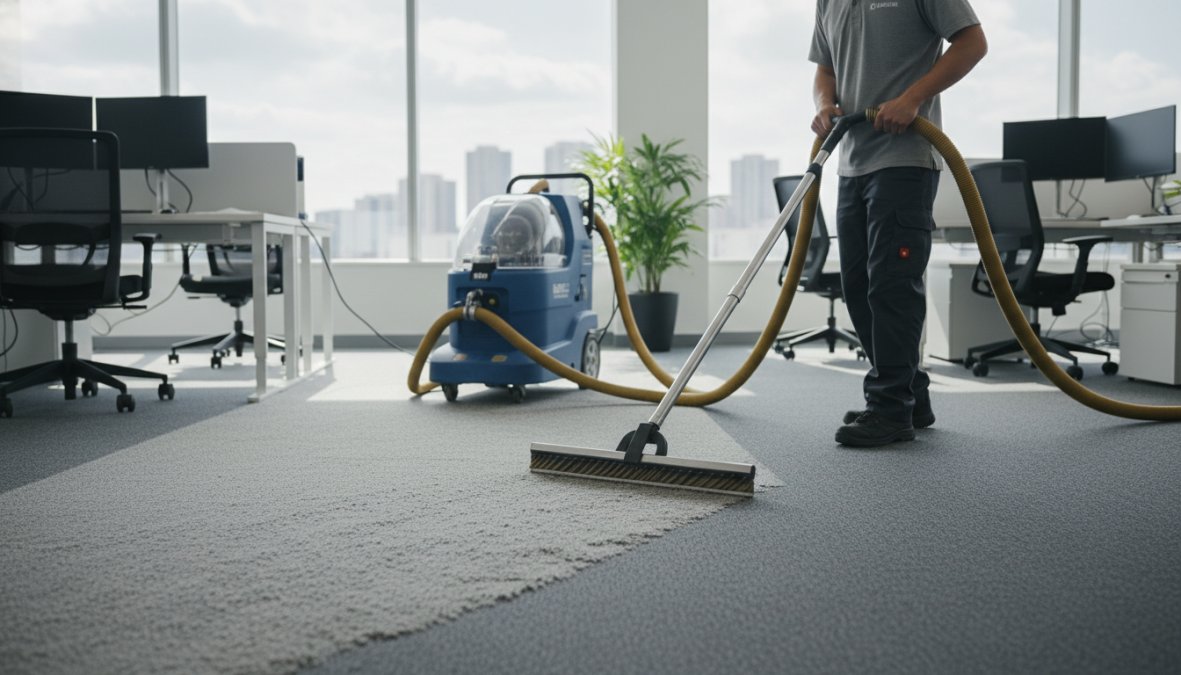
Hot water extraction is the deep cleaning standard for commercial carpet. The process injects heated water and cleaning solution under pressure into the carpet pile, then extracts it along with dissolved soils and contaminants. Truck-mounted systems, like those used by Lake Geneva Carpet Cleaning, generate higher water temperatures and stronger extraction than portable units, producing a deeper clean and faster drying times.
Encapsulation system cleaning is the preferred method for interim maintenance. A polymer solution is applied to the carpet, crystallizes around soil particles, and is then removed by vacuuming. Encapsulation does not require the drying time that hot water extraction does, making it practical for facilities that cannot close areas for extended periods.
The most effective maintenance programs combine both: encapsulation for monthly or quarterly interim cleaning, and hot water extraction for semi-annual or annual deep cleaning. Relying solely on encapsulation allows deep-seated soils to accumulate over time. Relying solely on hot water extraction misses the interim soil load that drives fiber damage between deep cleaning cycles.
Sustainability and Green Cleaning Standards
Green cleaning is no longer a niche preference. Many commercial tenants and corporate clients now require documented evidence of sustainable cleaning practices as part of lease agreements and vendor qualifications.
For carpet maintenance, sustainable practice means using cleaning chemistry certified by organizations like Green Seal’s commercial cleaning product standards, minimizing water consumption through efficient extraction equipment, and avoiding products that leave residue that attracts re-soiling. Encapsulation chemistry has improved significantly and many current formulations meet green certification standards.
CRI (Carpet and Rug Institute) certification for cleaning equipment and chemistry provides a reliable benchmark. Products and equipment carrying the CRI Seal of Approval have been independently tested to clean effectively without damaging fiber integrity or leaving harmful residues.
Carpet Maintenance Schedule Template: Building Your Plan Step by Step
A carpet maintenance schedule template gives facility managers a repeatable framework rather than a reactive response to visible soiling. Here is a practical template you can adapt immediately.
Commercial Carpet Maintenance Schedule Template
- Daily: Vacuum all high-traffic areas and entry points using HEPA-equipped equipment. Address spills immediately with appropriate spot cleaning products.
- Weekly: Vacuum medium-traffic zones (corridors, conference rooms). Inspect traffic lanes for early signs of soiling or fiber damage.
- Monthly (heavy-traffic zones): Encapsulation system interim cleaning for lobbies, entries, and food-service-adjacent areas.
- Quarterly (medium-traffic zones): Encapsulation interim cleaning for corridors and common areas.
- Semi-annually: Hot water extraction deep cleaning for all carpeted areas. Document cleaning dates and methods for warranty compliance.
- Annually: Full facility carpet inspection. Assess fiber integrity, identify areas approaching end of life, and update appearance demand classifications for the coming year.
- Seasonally (Wisconsin-specific): Increase entry-point cleaning frequency from November through March to address grit and salt tracked in from exterior surfaces.
Integration with Facility Management Software
Most modern facility management platforms support preventative maintenance scheduling for flooring assets alongside HVAC, plumbing, and electrical systems. Integrating your carpet maintenance schedule template into your facility management software creates automatic work order generation, vendor scheduling, and documentation of completed services.
This matters for two reasons. First, it removes the human error of relying on memory or manual calendars. Second, it creates the documented maintenance history that carpet manufacturers require for warranty claims and that commercial property managers need for asset valuation reports.
If your facility uses platforms like IBM Maximo, ServiceNow Facilities Management, or simpler tools like UpKeep, carpet maintenance tasks can be templated once and recur automatically. Attach service reports from each cleaning visit to the work order record. Over time, this builds an auditable maintenance history that protects your warranty coverage and supports capital planning decisions.
The True Commercial Carpet Maintenance Plan Benefits: ROI Calculation Framework
The strongest argument for a maintenance plan is financial, and it is one most service-provider guides never quantify clearly. The section below gives you a step-by-step formula you can populate with your own facility’s numbers today, not directional language, but an actual calculation you can put in front of a facilities director or CFO.
The Cost of Neglect vs. Planned Preventative Maintenance
Step 1: Establish your replacement cost baseline.
Calculate the total installed cost of your commercial carpet per square foot. This figure must include three components that are routinely underestimated:
- Material cost: Commercial-grade broadloom or carpet tile, typically ranging from moderate to premium grades depending on traffic classification.
- Labor and installation: Professional installation in occupied commercial buildings often carries a premium over residential work due to furniture moving, phased installation to keep areas operational, and adhesive or tackstrip requirements.
- Business disruption cost: This is the figure most facilities budgets omit entirely. Estimate the number of hours your facility or specific zones will be inaccessible during installation, multiply by the hourly cost of displaced staff productivity or lost revenue for customer-facing areas. For a retail lobby or hotel corridor, this number can rival the material cost itself.
Add all three to get your true replacement cost per square foot (TRC/sf).
Step 2: Estimate useful life under each scenario.
Commercial carpet manufacturers, including major producers whose products carry CRI (Carpet and Rug Institute) certification, typically structure warranties around documented maintenance compliance. A commonly cited pattern in the industry is:
- Maintained carpet (documented professional cleaning per manufacturer schedule): 10 to 15 years of serviceable life before appearance or structural failure requires replacement.
- Unmaintained carpet (reactive cleaning only, no documented schedule): Fiber abrasion and backing degradation commonly force replacement in 5 to 7 years in medium-to-heavy commercial traffic environments.
Use conservative figures: 12 years maintained vs. 6 years unmaintained. Adjust based on your actual traffic classification.
Step 3: Calculate annualized replacement cost under each scenario.
This is the core formula:
Annualized Replacement Cost = TRC/sf ÷ Useful Life (years)
Example using placeholder values you replace with your own:
| Scenario | TRC/sf (your number) | Useful Life | Annualized Replacement Cost/sf |
|---|---|---|---|
| No maintenance plan | [TRC/sf] | 6 years | TRC/sf ÷ 6 |
| With maintenance plan | [TRC/sf] | 12 years | TRC/sf ÷ 12 |
The annualized replacement cost under the maintained scenario is, by definition, half that of the unmaintained scenario before you add a single dollar of cleaning cost. That is the baseline advantage.
Step 4: Add your annual maintenance plan cost.
Obtain a quote for your facility’s full annual maintenance program, daily vacuuming labor, interim encapsulation treatments, and semi-annual hot water extraction deep cleaning. Divide by your total carpeted square footage to get annual maintenance cost per square foot (AMC/sf).
Your total annual cost under the maintenance plan is:
(TRC/sf ÷ 12) + AMC/sf
Your total annual cost without a maintenance plan is:
TRC/sf ÷ 6
In most commercial scenarios, the maintenance plan total remains lower than the unmaintained replacement cost alone, meaning the cleaning program pays for itself purely through extended asset life, before any indirect savings are counted.
Step 5: Add the indirect cost savings.
Three indirect categories belong in a complete analysis, even if you assign them conservative values:
- Warranty protection value: If your carpet carries a manufacturer warranty that requires documented professional cleaning, the warranty represents a real financial backstop against premature failure. Voiding it by skipping maintenance eliminates that protection. Assign a value equal to the pro-rated remaining warranty coverage on your current carpet.
- Tenant and occupant retention: In multi-tenant commercial buildings, visible carpet deterioration is a documented driver of lease non-renewal. Facilities managers who track tenant satisfaction surveys consistently find that common-area appearance ranks among the top five factors in renewal decisions. Even a single lease renewal attributable to maintained appearance can represent a return that dwarfs years of cleaning costs.
- Liability and indoor air quality risk reduction: Carpets that have reached saturation point, where embedded biological contaminants are actively re-releasing into the breathing zone, create potential liability exposure in facilities subject to OSHA indoor air quality guidance or tenant lease clauses requiring habitable conditions. Quantifying this is facility-specific, but it belongs in the analysis.
Step 6: Calculate your break-even point.
If your maintenance plan cost per square foot per year is higher than the annualized replacement savings, calculate the break-even year:
Break-even year = AMC/sf ÷ (Annualized savings/sf)
Most facilities find the break-even point falls well within the first two to three years of a structured program, after which every additional year of extended carpet life is net positive return.
The ROI calculation for a commercial carpet maintenance plan almost always favors planned maintenance over reactive cleaning. The variable is not whether maintenance pays off, it is how much it pays off given your specific facility size, carpet grade, and true replacement cost including business disruption. Run the formula with your own numbers before your next budget cycle.
Applying the Framework to Capital Planning
Facility managers who integrate this calculation into annual capital planning gain a second advantage: the ability to forecast replacement cycles accurately. When you know your carpet’s annualized cost under a maintained scenario, you can project the replacement year with reasonable confidence and budget accordingly, rather than facing an emergency replacement request when carpet failure becomes undeniable.
This is the difference between carpet as a reactive expense and carpet as a managed asset with a predictable cost curve. The maintenance plan does not just save money on cleaning. It transforms an unpredictable capital expenditure into a forecastable line item.
Frequently Asked Questions
What is included in a commercial carpet maintenance plan?
A commercial carpet maintenance plan typically includes a defined vacuuming frequency schedule, spot cleaning protocols for spills and stains, periodic interim cleaning using methods like encapsulation, and scheduled deep cleaning via hot water extraction. It also outlines traffic lane assessments, product specifications aligned with carpet manufacturers' guidelines, and documentation for facility management records. The plan is tailored to your building's soil load, foot traffic, and appearance demand standards.
How often should commercial carpets be professionally cleaned?
Commercial carpet cleaning frequency depends on traffic volume and appearance demand. Low-traffic areas may need professional deep cleaning once or twice per year, while high-traffic areas such as lobbies, corridors, and multi-tenant buildings may require professional cleaning every one to three months. CRI (Carpet and Rug Institute) guidelines recommend adjusting your maintenance schedule based on soil load and vacuuming frequency to protect fiber integrity and stain resistance between professional visits.
Does a commercial carpet maintenance plan actually extend carpet lifespan?
Yes. One of the most significant commercial carpet maintenance plan benefits is prolonging carpet lifespan. Grit and salt act like sandpaper on carpet fibers, causing abrasion that breaks down fiber integrity over time. Regular vacuuming removes loose soil before it embeds, while scheduled hot water extraction pulls out deep-seated pollutants that damage carpet backing. Preventative maintenance can meaningfully delay replacement, protecting your carpet investment and reducing long-term facility costs.
How does carpet cleanliness affect indoor air quality in a commercial space?
Commercial-grade carpet acts as a passive air filter, trapping pollutants, allergens, and particulates that would otherwise circulate through the air. When carpets become saturated with soil load, they release these contaminants back into the breathing zone, negatively affecting respiratory health. A structured maintenance plan that includes regular vacuuming and deep cleaning via hot water extraction keeps pollutant levels manageable, supporting a healthier indoor environment for employees and visitors alike.
What are the cost benefits of regular carpet maintenance versus replacement?
The cost of neglect far exceeds the cost of a planned preventative maintenance program. Commercial carpet replacement involves material costs, labor, business disruption, and disposal fees. A consistent maintenance schedule, including routine vacuuming, spot cleaning, and periodic professional deep cleaning, extends the usable life of your carpet investment significantly. When calculating ROI, factor in avoided replacement costs, reduced sick days from better indoor air quality, and the professional image maintained for clients and staff.
This article was written using GrandRanker