Table of Contents
- Why Safe Carpet Cleaning for Kids Matters More Than You Think
- Hidden Chemicals in Carpet Cleaners You Should Avoid
- Non-Toxic Carpet Cleaner for Babies: What to Look For
- DIY Natural Carpet Cleaner Recipes That Are Safe for Kids
- How to Clean Carpet Stains With Kids in the House
- Is Steam Cleaning Carpet Safe for Infants? What Parents Need to Know
- Post-Cleaning Safety Protocols and Allergy-Specific Routines
- Safe Carpet Cleaning for Kids in Lake Geneva: Professional vs. DIY
- Conclusion
Last Updated: May 30, 2026
Safe carpet cleaning for kids is one of those topics where the stakes are higher than most parents realize. At Lake Geneva Carpet Cleaning, we’ve spent over 32 years helping Wisconsin families create healthier home environments, and the questions we hear most often involve what’s actually safe when children are crawling, playing, and pressing their faces into carpet fibers. Below, we’ll show you exactly how to clean your carpets without exposing your kids to harmful chemical residue, which DIY recipes actually work, and what post-cleaning protocols most guides skip entirely.
Here’s what most guides get wrong: they focus on removing visible stains while ignoring the invisible chemical load that standard cleaners leave behind. Carpet fibers trap volatile organic compounds, allergens, dust mites, and bacteria. For crawling infants who spend hours with their hands and faces inches from the floor, that chemical residue is not a minor concern.
Why Safe Carpet Cleaning for Kids Matters More Than You Think
Carpet is not a passive surface. It acts as a reservoir for everything that enters your home: outdoor soil, pet dander, tracked-in pesticides, dust mites, and bacteria. Children are uniquely vulnerable to this environment because they spend more time at floor level than adults and have developing respiratory and immune systems.
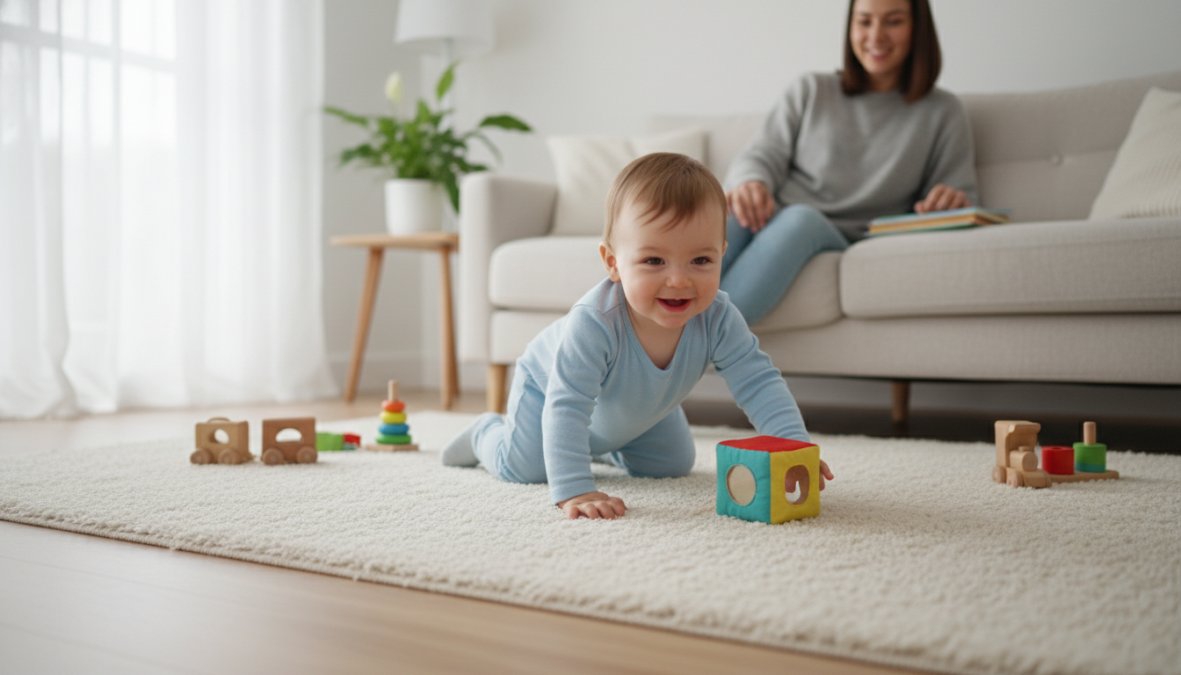
The indoor air quality problem compounds this. Carpet fibers release trapped particles back into the air during foot traffic and play activity. For crawling infants, this means direct skin contact with whatever has settled into the pile, including residues from cleaning products applied weeks earlier.
How Carpets Affect Indoor Air Quality and Crawling Infants
Indoor air quality is the measure of air contaminants within a home that affect occupant health and comfort. According to the U.S. Environmental Protection Agency’s indoor air quality guidance, indoor air can be two to five times more polluted than outdoor air, and carpets are a primary contributor to that problem.
For crawling infants, the risk profile is distinct. Their breathing zone sits between 6 and 24 inches from the floor, which is exactly where settled particles and off-gassing chemicals concentrate. Skin sensitivity at this age means even low-level contact with synthetic fragrances or chemical residue can trigger reactions. A child who is not yet walking spends the majority of waking hours in direct contact with carpet fibers, making the cleanliness and chemical load of that surface a genuine health variable.
Never assume a carpet is safe because it looks clean. Chemical residue from conventional cleaners can persist in carpet fibers for weeks after application, long after any visible stain or foam has disappeared.
Hidden Chemicals in Carpet Cleaners You Should Avoid
Most commercial carpet cleaners are formulated for performance, not for safety around children. The cleaning industry is not required to disclose every ingredient on product labels under a single unified standard, which means parents are often making purchasing decisions without complete information. The result is that many households apply products containing compounds that would never be approved for direct skin contact, then allow children to play on treated surfaces hours later.
Understanding why specific chemicals are dangerous, not just which ones to avoid, gives you a framework for evaluating any product, including new formulations that haven’t been flagged yet.
The Worst Offenders: Ammonia, Bleach, Phthalates, Synthetic Fragrances, and Beyond
Ammonia is a respiratory irritant that off-gasses after application. The mechanism matters here: ammonia reacts with moisture in the airways to form ammonium hydroxide, which irritates mucous membranes. In children with developing respiratory systems, even low-concentration vapor exposure can trigger bronchospasm and worsen existing asthma. Ammonia also degrades nylon and wool carpet fibers over time, which releases additional particulate into the air.
Bleach (sodium hypochlorite) is corrosive at concentrations found in consumer products. The specific risk in carpet use is that bleach residue does not fully neutralize on fiber surfaces. When a child’s damp skin contacts residual bleach, common with crawling infants whose hands and knees press against the pile, it can cause contact dermatitis. A secondary hazard: bleach reacts with ammonia-based cleaners to produce chloramine gas, which is why mixing cleaning products is genuinely dangerous, not just a precaution.
Phthalates appear in many synthetic fragrance formulations and are classified as endocrine disruptors by multiple regulatory bodies, including the European Chemicals Agency. The mechanism is competitive binding: phthalate metabolites mimic or block hormone signals at receptor sites. Children are disproportionately affected because their endocrine systems are actively developing, and the dose-response relationship for endocrine disruptors is not always linear, meaning low-level chronic exposure can produce effects that high-dose acute exposure does not.
Synthetic fragrances are legally classified as trade secrets in many jurisdictions, which allows manufacturers to list dozens of undisclosed compounds under the single word "fragrance" on a label. Many fragrance compounds are volatile organic compounds (VOCs) that off-gas at room temperature. For children spending hours at floor level, this creates a sustained low-level inhalation exposure that accumulates over time.
Perchloroethylene (PERC) is a solvent used in some dry-cleaning and specialty carpet spot treatments. It is classified as a probable human carcinogen by the International Agency for Research on Cancer. While less common in consumer retail products, it appears in some professional-grade spot removers. Any product listing "tetrachloroethylene" on the label is the same compound under its chemical name.
Naphthalene is found in some moth-repellent carpet treatments and certain deodorizing products. It is a volatile compound that off-gasses readily and is classified as a possible human carcinogen. Children are more susceptible to naphthalene toxicity than adults because of differences in metabolic enzyme activity.
Optical brighteners are synthetic chemicals added to cleaning products to make surfaces appear whiter under UV light. They do not biodegrade readily and accumulate in carpet fibers. While not acutely toxic, they are a marker of a product that prioritizes appearance over safety, and they can cause skin sensitization with repeated contact.
How to Read a Carpet Cleaner Label: A Practical Framework
Because full ingredient disclosure is not universally required, label reading requires a specific approach rather than a quick scan.
Step 1: Check for the word "fragrance" or "parfum." Either word without a qualifying statement like "from essential oils" or "fragrance-free" is a red flag. It signals undisclosed synthetic compounds.
Step 2: Look for the EPA Safer Choice seal. This program requires manufacturers to disclose all ingredients to the EPA for safety review. Products carrying this seal have been evaluated at the ingredient level, not just for cleaning performance.
Step 3: Search the product on the Environmental Working Group’s (EWG) Healthy Cleaning database. The EWG assigns letter grades based on ingredient transparency and hazard data. Products rated A or B are appropriate for homes with young children. Products rated D or F should not be used on surfaces where children have contact.
Step 4: Reject any product that lists "caution," "warning," or "danger" signal words alongside instructions to keep children away during application. These signal words correspond to specific toxicity thresholds under EPA labeling requirements. A product that requires children to leave the room during use is not appropriate for carpet that children will contact hours later.
Step 5: Verify pH neutrality for any product used on carpet. Highly alkaline products (pH above 10) can leave a residue that continues to irritate skin on contact. Highly acidic products (pH below 4) can damage fiber structure and create a rough surface that traps more particulate. A pH between 6 and 8 is appropriate for child-contact surfaces.
The absence of a warning label does not mean a product is child-safe. Many conventional carpet cleaners are formulated to be safe for adults at normal exposure levels, not for infants who will have prolonged skin contact with treated fibers. Always verify ingredients independently rather than relying on marketing language like “gentle,” “natural,” or “family-safe.”
The EPA Safer Choice product search at epa.gov/saferchoice allows you to filter specifically for carpet and rug care products that have passed ingredient-level safety review. This is the most reliable single resource for identifying genuinely child-safe commercial cleaners without requiring you to decode every ingredient on a label.
Non-Toxic Carpet Cleaner for Babies: What to Look For
A non-toxic carpet cleaner for babies is a cleaning product formulated without volatile organic compounds, synthetic fragrances, bleach, ammonia, or phthalates, and that uses plant-based or biodegradable active ingredients to lift soil and stains from carpet fibers.
The key certifications to look for are EPA Safer Choice, MADE SAFE, or EWG Verified. These indicate third-party review of ingredient safety. Beyond certification, the most important characteristics are a neutral or near-neutral pH, which protects carpet fibers and reduces residue, and biodegradable surfactants derived from plant-based sources rather than petroleum.
Comparison Table: Cleaning Product Types at a Glance
| Product Type | Key Ingredients | Child-Safe? | Best For |
|---|---|---|---|
| Conventional store cleaner | Ammonia, synthetic fragrance | No | General stains, no kids |
| Plant-based formula | Biodegradable surfactants | Yes | Everyday maintenance |
| Baking soda + vinegar DIY | Natural acids, alkaline | Yes | Odor and light stains |
| Enzyme cleaner | Biological enzymes | Yes (check label) | Pet stains, protein stains |
| Professional hot water extraction | pH-neutral solutions | Yes (when specified) | Deep cleaning |
| Encapsulation method | Polymer crystals | Varies | Low-moisture maintenance |
The encapsulation method deserves a note: it uses polymer crystals to surround soil particles, which are then vacuumed away. It is a low-moisture approach that reduces drying time, but the safety profile depends entirely on the specific encapsulation chemistry used. Always verify that the product is free of volatile organic compounds before using it in a child’s space.
DIY Natural Carpet Cleaner Recipes That Are Safe for Kids
DIY natural carpet cleaner recipes are among the most practical tools for parents who want immediate control over what goes on their floors. The ingredients are transparent, the cost is low, and the safety profile is well understood.
General Purpose Cleaner:
- Mix 1 cup warm water with 1 teaspoon dish soap (fragrance-free, plant-based)
- Add 1 tablespoon white vinegar
- Apply to stain with a clean cloth, blotting rather than rubbing
- Rinse with plain cold water and blot dry
Odor Neutralizer:
- Sprinkle baking soda generously over the affected area
- Let it sit for 15-30 minutes (longer for strong odors)
- Vacuum thoroughly using a HEPA vacuum
- Repeat if needed before applying any liquid cleaner
Enzyme-Style Stain Remover (for protein stains like milk or food):
- Mix 1 cup warm water with 2 tablespoons hydrogen peroxide (3% solution)
- Add 1 tablespoon fragrance-free dish soap
- Test on an inconspicuous area first
- Apply, let sit 5 minutes, blot with clean cloth
A common mistake with DIY recipes is over-wetting the carpet. Excess moisture penetrates the backing and padding, creating conditions for mold growth. Use the minimum liquid necessary and always blot dry thoroughly.
The most effective DIY approach for safe carpet cleaning combines baking soda for odor control, a plant-based soap solution for stains, and a HEPA vacuum for particle removal. No single step does the full job.
How to Clean Carpet Stains With Kids in the House
Cleaning carpet stains with kids in the house requires a different workflow than standard stain removal, because the goal is not just effectiveness but also minimizing children’s exposure during and after the cleaning process.
The sequence matters more than the product. Act on stains immediately while they are still wet, because dried stains require stronger chemistry to remove. Blot, never scrub. Scrubbing spreads the stain laterally and drives it deeper into carpet fibers.
Step-by-step stain removal protocol for homes with children:
- Remove solid material with a spoon or dull knife
- Blot liquid with a clean white cloth, working from the outside edge inward
- Apply your child-safe cleaning solution sparingly
- Let it dwell for 3-5 minutes
- Blot again with a fresh cloth until the stain transfers
- Rinse the area with cold water
- Blot dry and place a clean towel weighted down over the spot for 30 minutes
- Vacuum once fully dry using a HEPA vacuum
Keep children out of the treated area until it is completely dry. Even non-toxic solutions can leave a slightly slippery surface when wet, and residual moisture creates an environment where bacteria can proliferate.
Is Steam Cleaning Carpet Safe for Infants? What Parents Need to Know
Steam cleaning carpet is safe for infants when performed correctly, but the answer depends on which method you are using, what cleaning solution is loaded into the machine, and how long you wait before allowing children back onto the surface. The term "steam cleaning" is used loosely in the consumer market and covers two meaningfully different technologies, and one frequently overlooked third option that introduces a safety risk most guides ignore entirely.
Hot Water Extraction vs. Portable Steam Cleaners: Key Differences
Hot water extraction is the method used by professional carpet cleaning services. It injects heated water and a cleaning solution deep into carpet fibers under pressure, then extracts the water along with dissolved soil, bacteria, allergens, and chemical residue. The water temperature in professional truck-mounted equipment typically reaches levels that kill dust mites and bacteria without requiring additional chemical sanitization agents. The extraction step is what separates this method from surface-only approaches: it physically removes the contaminants rather than redistributing them.
Portable consumer steam cleaners operate at lower temperatures and pressure, and their extraction capability is limited. They are better suited for surface sanitization than deep cleaning. For homes with infants, the distinction matters: a portable unit may reduce bacteria on the surface while leaving allergens and soil deeper in the pile untouched. The steam itself is safe, water vapor leaves no chemical residue, but the cleaning depth limitation means it is a maintenance tool, not a substitute for periodic deep extraction.
| Feature | Hot Water Extraction | Portable Steam Cleaner |
|---|---|---|
| Cleaning depth | Deep (fiber to backing) | Surface only |
| Water temperature | High (professional grade) | Moderate |
| Allergen removal | Effective | Limited |
| Drying time | 4-8 hours | 1-3 hours |
| Chemical requirement | Minimal with proper equipment | None |
| Child safety post-clean | High (when dry) | Moderate |
Rental Machine Safety: The Hidden Contamination Risk Most Parents Overlook
Rental carpet cleaning machines represent a popular middle-ground option between professional services and portable consumer units. They offer extraction depth that portable steam cleaners cannot match, at a fraction of the cost of professional cleaning. For parents who are budget-conscious and want to deep-clean before a new baby arrives or after a significant spill, they seem like a practical solution.
They carry a safety risk that almost no cleaning guide addresses: rental machines are shared equipment with an unknown chemical history.
Here is the specific mechanism of concern. A rental machine’s internal system, the solution tank, the pump lines, the hose assembly, and the brush head, retains residue from every cleaning solution the previous renter loaded into it. Rental facilities clean the exterior of machines between uses and may rinse tanks, but the internal lines and pump components are rarely fully flushed to the standard required to eliminate chemical cross-contamination. When you load your child-safe, non-toxic cleaning solution into a machine that previously held a conventional cleaner containing ammonia, synthetic fragrance compounds, or optical brighteners, those residues are mobilized by your solution and distributed into your carpet.
You have no visibility into what was used before you. The rental facility may not know either, because renters are not required to disclose what cleaning products they use with the machine.
This is not a theoretical risk. It is a predictable consequence of how rental equipment is maintained and used at scale. For families with crawling infants or children with chemical sensitivities, it is a meaningful variable that changes the risk profile of rental machine cleaning.
The pre-use decontamination protocol for rental carpet cleaning machines:
If you choose to use a rental machine in a home with young children, complete the following steps before loading any cleaning solution or beginning work on your carpet.
Inspect the tank visually. Look for residue, discoloration, or foam remnants from previous cleaning solutions. If the tank shows visible residue, wipe it down with a clean damp cloth before proceeding.
Flush the system with plain hot water, twice. Fill the clean water tank with plain hot water (no solution added). Run the machine over a section of old towel or a utility area, not your carpet, until the tank is empty. The water expelled in the first flush will carry residue from the internal lines. Discard it. Repeat the flush a second time with fresh plain water. The second flush should run clear.
Inspect the brush head and hose connections. Remove the brush head if the design allows and rinse it under hot running water. Check the hose connection points for visible residue or buildup. Wipe accessible surfaces with a damp cloth.
Load only your verified child-safe cleaning solution. Do not use the cleaning tablets, pods, or solution bottles provided with or sold alongside the rental unit unless you have verified their complete ingredient list against the standards described in the previous section. Most rental-supplied solutions are conventional commercial formulas.
Run a test pass on an inconspicuous area first. After loading your solution, run the machine over a small hidden section of carpet. Blot the extracted water with a clean white cloth. If the cloth picks up an unexpected color, foam, or odor, stop and flush the system again before proceeding.
Never skip the pre-use flush on a rental machine if children will be using the cleaned carpet. The few minutes this step requires are the only way to reduce cross-contamination risk from the machine’s previous use. There is no way to know what the previous renter used, and some conventional carpet cleaning solutions contain compounds that persist in machine components through a standard rinse.
Post-rental cleaning considerations:
Beyond the machine itself, rental cleaning introduces a drying-time variable that matters for infant safety. Rental machines typically do not match the extraction power of truck-mounted professional equipment, which means carpets cleaned with rental machines retain more moisture after the process is complete. Higher residual moisture extends the drying window and creates conditions where bacteria and mold can proliferate in the carpet backing and padding.
For homes with infants, plan for a minimum 6-8 hour drying window after rental machine cleaning, with windows open and fans running. Press a clean white cloth firmly to the carpet surface before allowing children back on it. If the cloth picks up any moisture, the carpet is not ready.
Rental machines can be a safe option for deep cleaning in homes with young children, but only if you complete a full pre-use flush protocol, use your own verified non-toxic solution, and allow adequate drying time before children return to the surface. Skipping the flush and using the rental facility’s provided solution eliminates the safety advantage of choosing a child-safe product in the first place.
Post-Cleaning Safety Protocols and Allergy-Specific Routines
Post-cleaning safety protocols are the steps taken after carpet cleaning to ensure the space is safe for children before they return to floor-level activity. This is the section most cleaning guides skip, and it is where many well-intentioned parents inadvertently create the problem they were trying to prevent.
How Long to Keep Kids Off the Carpet After Cleaning
Keep children off cleaned carpet for a minimum of 4-6 hours after professional hot water extraction, or until the carpet is completely dry to the touch. Moisture accelerates bacterial growth and can cause chemical residue to become more bioavailable on the surface. Open windows and run fans to reduce drying time.
For DIY cleaning with non-toxic solutions, the drying window is shorter, typically 1-2 hours for small treated areas. The rule holds regardless of method: no foot traffic, and certainly no crawling infants, until the carpet is dry.
Post-cleaning checklist:
- Open windows for ventilation during and after cleaning
- Run ceiling fans or portable fans to accelerate drying
- Check carpet dryness by pressing a clean white cloth firmly to the surface
- Run a HEPA vacuum over the dry carpet before allowing children back
- Wait an additional hour after vacuuming before allowing crawling infants on the surface
Allergy-Specific Carpet Cleaning Routine for Sensitive Children
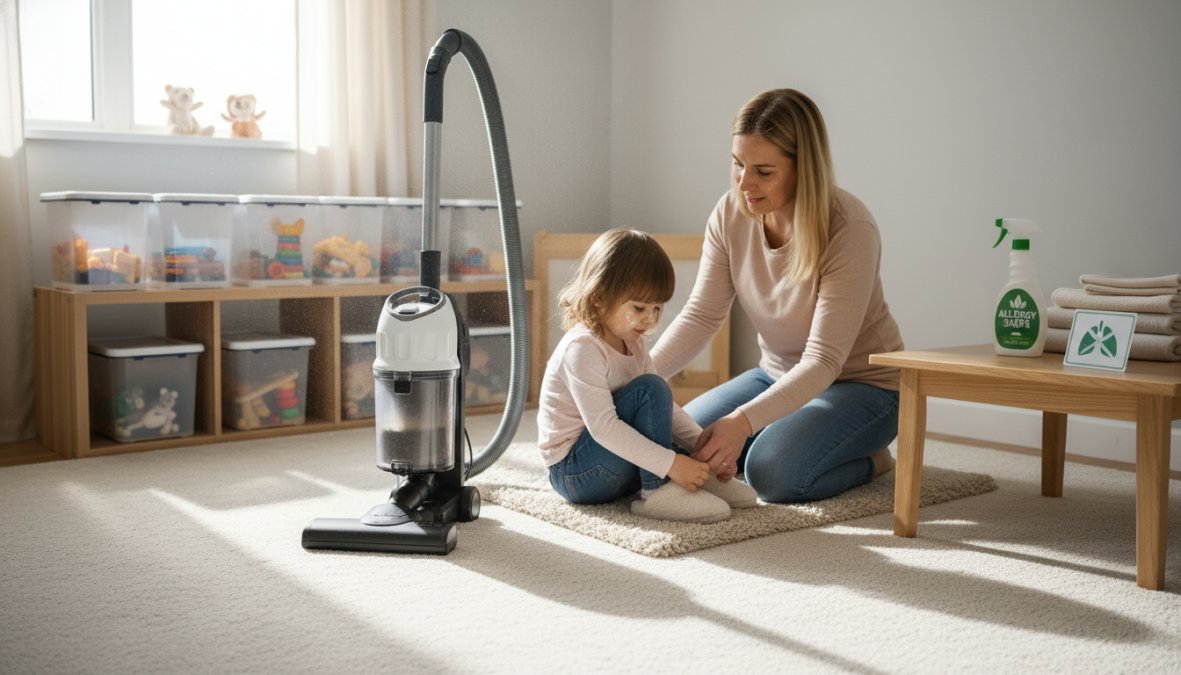
Children with allergies or asthma require a more rigorous carpet maintenance schedule than the standard recommendation. The primary targets are dust mites, pet dander, and mold spores, all of which accumulate in carpet fibers and become airborne during activity.
According to the Asthma and Allergy Foundation of America’s guidance on indoor allergens, dust mites are among the most common indoor allergy triggers, and carpets are their primary habitat in most homes.
Allergy-specific carpet cleaning routine:
- Vacuum with a HEPA vacuum at least twice weekly (not once, which is the standard recommendation)
- Use a pH-neutral, fragrance-free cleaner for any spot treatments
- Schedule professional deep cleaning every 3-4 months rather than the standard 6-12 months
- Maintain indoor humidity below 50% to inhibit dust mite reproduction
- Avoid carpet deodorizing powders, which leave fine particulate residue that aggravates respiratory conditions
- Wash area rugs monthly in hot water when the care label permits
The HEPA vacuum specification is not optional for allergy households. Standard vacuum filters allow fine particles to pass through the exhaust, redistributing allergens rather than capturing them. A true HEPA filter captures particles down to 0.3 microns, which includes dust mite fecal matter, mold spores, and pet dander.
Safe Carpet Cleaning for Kids in Lake Geneva: Professional vs. DIY
For families in Lake Geneva and the surrounding Wisconsin region, the choice between professional and DIY carpet cleaning comes down to cleaning depth, chemical control, and frequency. Both approaches have a legitimate role in a comprehensive carpet maintenance strategy.
DIY cleaning with non-toxic, plant-based formulas handles day-to-day stain removal and odor control effectively. It gives parents complete control over what goes on the floor and can be done immediately when spills happen. The limitation is depth: DIY methods do not reach the lower layers of carpet pile or the backing, where allergens, bacteria, and embedded soil accumulate over time.
Professional hot water extraction reaches those deeper layers. The high-temperature water kills dust mites and bacteria without requiring harsh chemical sanitization agents. For families with crawling infants or children with allergies, professional deep cleaning two to four times per year is a meaningful health investment, not just an aesthetic one.
The honest trade-off: professional cleaning requires planning, a drying period, and cost. DIY is immediate, low-cost, and fully transparent in terms of what you are applying. The two approaches are complementary, not competing.
As documented in EPA guidance on carpet care and indoor air quality, regular professional cleaning combined with frequent vacuuming using HEPA filtration produces measurably better indoor air quality outcomes than either approach alone.
For parents searching for carpet cleaning near me in the Lake Geneva area, the key questions to ask any professional service are: what cleaning solutions do you use, are they non-toxic and child-safe, and how long should I keep children off the carpet after cleaning. A reputable service will answer all three without hesitation.
The Carpet and Rug Institute’s cleaning standards and certification program provides a useful benchmark for evaluating professional carpet cleaning services, including criteria for solution safety and extraction effectiveness.
Keeping carpets genuinely safe for children requires more than choosing a gentle-looking product off a store shelf. It means understanding chemical residue, drying protocols, allergen-specific routines, and the real difference between surface cleaning and deep extraction. Lake Geneva Carpet Cleaning brings over 32 years of experience to exactly this problem, using truck-mounted hot water extraction technology with eco-friendly, non-toxic solutions that are safe for families with young children, backed by a 10-day satisfaction guarantee. If your home in Lake Geneva, Wisconsin has children crawling on carpets that haven’t had a professional deep clean recently, contact Lake Geneva Carpet Cleaning and get the healthier home environment your family deserves.
Frequently Asked Questions
Is professional carpet cleaning safe for babies?
Yes, professional carpet cleaning is generally safe for babies when the service uses non-toxic, child-safe, and eco-friendly solutions. Methods like hot water extraction remove allergens, bacteria, and dust mites deep within carpet fibers without leaving harmful chemical residue. Always ask your provider about the specific products used, confirm they are biodegradable and pH-neutral, and keep infants off the carpet until it is fully dry, typically 4 to 8 hours after cleaning.
What carpet cleaning solutions are non-toxic for children?
Non-toxic carpet cleaners for babies and children typically use plant-based formulas free of ammonia, bleach, phthalates, and synthetic fragrances. Look for products labeled child-safe, pet-safe, and biodegradable. pH-neutral cleaners are a strong choice because they clean effectively without harsh chemical residue. DIY options like diluted white vinegar, baking soda, and castile soap are also commonly used for light stain removal and routine carpet maintenance.
How long should you keep kids off the carpet after cleaning?
As a general rule, keep children off cleaned carpet for at least 4 to 8 hours, or until the carpet is completely dry to the touch. Hot water extraction methods may require longer drying times depending on humidity and ventilation. Open windows, run fans, or use a dehumidifier to speed drying. Even with non-toxic products, damp carpet can harbor bacteria and mold if children walk on it too soon, which can affect indoor air quality and trigger respiratory irritation.
Are there natural ways to clean carpets that are safe for kids?
Yes. Several DIY natural carpet cleaner recipes work well for families with children. A mixture of baking soda and a few drops of essential oil can deodorize carpet fibers safely. White vinegar diluted with water handles many common stains without harsh chemicals. For deeper cleaning, a solution of warm water, mild castile soap, and a small amount of hydrogen peroxide tackles tougher spots. Always test any solution on an inconspicuous area first and ensure good ventilation during and after cleaning.
What chemicals should I avoid in carpet cleaners if I have kids?
Avoid carpet cleaners containing ammonia, bleach, phthalates, volatile organic compounds (VOCs), and synthetic fragrances. These ingredients can cause respiratory irritation, skin sensitivity, and other health concerns, especially in crawling infants who have close contact with carpet fibers. Optical brighteners and formaldehyde-releasing preservatives are also worth avoiding. Always read product labels carefully and choose formulas that are explicitly marketed as non-toxic, plant-based, and free of these common harmful ingredients.
This article was written using GrandRanker