Table of Contents
- What to Look for in Commercial Carpet Cleaning Services Near Me
- Commercial Carpet Cleaning Methods Explained
- Commercial Carpet Cleaning Cost Per Square Foot: What to Expect
- How Often Should Office Carpets Be Cleaned?
- Commercial Carpet Cleaning Checklist: Prepare Your Facility
- Health Benefits: Allergen Removal, Odor Treatment, and Mold Remediation
- Commercial Carpet Maintenance ROI: Protect Your Flooring Investment
- Why Local Commercial Carpet Cleaning Services Near Me Beat National Franchises
Last Updated: June 5, 2026
Searching for commercial carpet cleaning services near me is one of the most common requests facility managers in Lake Geneva, Wisconsin make every year, and for good reason: the wrong provider can leave carpets wetter, dirtier, and more damaged than before. At Lake Geneva Carpet Cleaning, we’ve spent over 32 years working with commercial clients across Wisconsin, and the questions we hear most often aren’t about price. They’re about trust, method, and results. Below, we’ll show you exactly how to evaluate commercial carpet cleaners, what methods work for high-traffic office environments, and how to calculate the real return on your cleaning investment.
What to Look for in Commercial Carpet Cleaning Services Near Me
The best commercial carpet cleaning services near me share three qualities: certified technicians, verifiable methods, and a written satisfaction guarantee. Anything short of that is a gamble with your flooring investment.
IICRC Certification and Professional Technicians
IICRC certification is the industry’s gold standard. The Institute of Inspection, Cleaning and Restoration Certification sets the technical standards that separate trained professionals from unqualified operators. Certified professionals understand fiber types, soil loading, dye stability, and pH chemistry, an uncertified technician applying the wrong agent to wool-blend carpet can cause permanent dye bleeding, void manufacturer warranties, and leave you with an unfixable problem.
According to IICRC’s official certification standards and scope, certified firms must follow documented cleaning protocols and maintain ongoing education requirements. Beyond certification, owner-operated businesses offer stronger accountability than national franchise networks, which assign whoever is available.
Ask for the technician’s IICRC certificate number before booking. Any legitimate professional can provide it in under a minute. If they hesitate, that’s your answer.
Eco-Friendly Solutions and Green Cleaning Standards
Green cleaning is now a procurement requirement for many commercial facilities, particularly those pursuing LEED certification or operating in healthcare-adjacent environments. Genuinely eco-friendly solutions are residue-free, pH-balanced, and carry third-party certifications like EPA Safer Choice or Green Seal GS-37. Conventional surfactants leave sticky residues that accelerate re-soiling, compressing your cleaning cycle and increasing annual costs. Chem-Dry’s Hot Carbonating Extraction process, for example, uses significantly less water than traditional steam cleaning, reducing drying time and minimizing mold risk.
Commercial Carpet Cleaning Methods Explained
Method selection should be driven by carpet construction, soil type, traffic volume, and acceptable downtime, not by what the cleaner happens to own. Choosing the wrong method is the single most common mistake commercial buyers make.
 technician in uniform operating a truck-mounted hot water extraction machine on a large open-plan commercial office carpet, steam rising visibly from the carpet surface under bright fluorescent lighting](https://cdn.grandranker.com/articles/commercial-carpet-cleaning-services-near-me-2026-guide-content-1-1780623972.jpg)
Hot Water Extraction and Steam Cleaning
Hot water extraction is the most thorough deep cleaning method available. It injects heated water and cleaning solution into carpet fibers under pressure, then immediately extracts the water along with dissolved soils, allergens, and biological contaminants. Truck-mounted systems maintain consistent water temperature and extraction vacuum that portable machines cannot replicate, for commercial environments with embedded soils, truck-mounted extraction actually restores carpet appearance rather than just refreshing the surface. Drying time typically runs four to six hours; scheduling after business hours eliminates disruption.
Bonnet Cleaning and Encapsulation for High-Traffic Areas
Bonnet cleaning uses a rotating pad to absorb surface soils quickly, with minimal drying time, useful for interim maintenance in retail corridors and lobbies. Encapsulation is more advanced: the cleaning agent crystallizes around soil particles as it dries, then vacuums away cleanly, leaving no sticky residue. Neither method replaces hot water extraction for periodic deep cleaning. Many commercial programs combine monthly encapsulation with quarterly extraction, balancing appearance maintenance against deep sanitization.
Commercial Carpet Cleaning Cost Per Square Foot: What to Expect
Commercial carpet cleaning cost per square foot varies based on method, soil level, facility type, and service frequency.
| Method | Typical Use Case | Relative Cost | Drying Time |
|---|---|---|---|
| Hot Water Extraction | Deep cleaning, quarterly cycle | Higher per visit | 4-6 hours |
| Encapsulation | Interim maintenance | Moderate | 30-60 minutes |
| Bonnet Cleaning | Surface refresh, high-traffic areas | Lower per visit | 1-2 hours |
| Dry Compound | Immediate re-use required | Moderate | Minimal |
Pricing is almost always custom-quoted based on square footage, soil loading, and access logistics. Request an on-site assessment rather than a phone quote, any provider willing to quote a large facility without a site visit is guessing, and those guesses rarely favor the client when the invoice arrives.
Avoid providers who quote unusually low per-square-foot rates without a site visit. Low-ball quotes often exclude soil surcharges, furniture moving, or stain treatment, added back as line items after the job is complete.
How Often Should Office Carpets Be Cleaned?
Office carpets should be professionally deep cleaned every three to six months, with interim maintenance every four to eight weeks in high-traffic areas. Most commercial carpet manufacturers specify minimum cleaning frequencies in their warranty documentation, many require hot water extraction at least annually to maintain coverage.
A practical framework:
- Low-traffic offices (under 50 daily occupants): deep clean every six months, interim maintenance quarterly
- Medium-traffic facilities (50-150 daily occupants): deep clean quarterly, interim maintenance every six weeks
- High-traffic retail or public spaces (150+ daily occupants): deep clean every eight to twelve weeks, interim maintenance monthly
According to Carpet and Rug Institute’s commercial maintenance guidelines, consistent maintenance programs extend commercial carpet lifespan significantly compared to reactive-only cleaning approaches.
Commercial Carpet Cleaning Checklist: Prepare Your Facility
Pre-cleaning preparation is something most guides skip, and skipping it is why many commercial cleaning jobs underperform.
Pre-Cleaning Preparation Checklist:
- Remove or elevate all furniture that can be moved from cleaning zones
- Identify and pre-treat visible stains at least 15 minutes before technician arrival
- Vacuum all areas to be cleaned (removes dry soil that extraction cannot lift efficiently)
- Notify building occupants of cleaning schedule and expected drying times
- Secure access to freight elevators or loading docks for truck-mounted equipment
- Mark any areas with known moisture sensitivity or recent water damage
- Confirm power access points for any supplemental portable equipment
- Remove or protect electrical cables and cords at floor level
- Identify carpet seams and transitions that may require special handling
- Confirm ventilation availability to accelerate drying after hot water extraction
Facilities that complete this checklist consistently see better results. The technician can focus on cleaning rather than logistics, and adequate airflow accelerates drying.
Health Benefits: Allergen Removal, Odor Treatment, and Mold Remediation
Commercial carpets are the largest air filter in any office building. Every foot that crosses the threshold deposits particulates, biological material, and chemical residues into carpet fibers, creating a reservoir for allergens, bacteria, and odor-causing compounds that conventional vacuuming cannot reach.
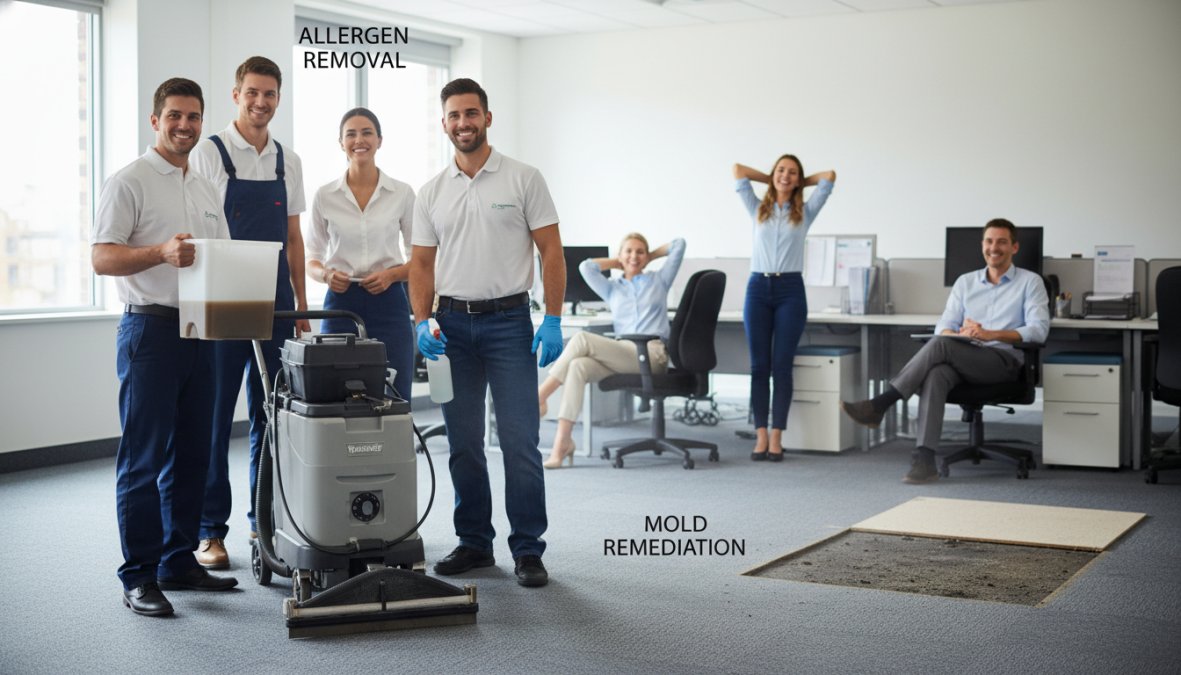
Hot water extraction addresses this at the fiber level, physically removing allergen particles, dust mite debris, and microbial contamination that surface cleaning leaves behind. Pet odor treatment requires enzymatic chemistry, not fragrance masking. Enzymatic cleaners break down uric acid crystals that cause persistent odor; fragrance treatments only suppress it temporarily.
Mold remediation is a separate category requiring specific protocols. The EPA’s mold remediation guidelines for commercial buildings recommend containment and controlled removal rather than cleaning in place for significant mold contamination. A qualified commercial carpet cleaner will identify the boundary between cleanable moisture damage and mold requiring specialist intervention.
Allergen removal through professional hot water extraction goes beyond appearance. It directly reduces airborne irritants in your facility, affecting employee health, absenteeism, and overall air quality scores.
Commercial Carpet Maintenance ROI: Protect Your Flooring Investment
Most facility managers think about carpet cleaning as a cost. The more accurate framing is that professional maintenance is insurance against premature replacement. Commercial carpet replacement is one of the most disruptive and expensive flooring projects a facility can undertake, materials, installation, furniture relocation, and business disruption all compound the cost. A maintained carpet lasting ten years instead of six represents years of deferred capital expenditure; the annual cost of a professional cleaning program is a fraction of one replacement cycle.
Facility managers also overlook brand perception: client-facing offices with visibly soiled carpets communicate neglect, while clean flooring signals operational standards that extend beyond the carpet itself.
Stain-Specific Solutions for Office and Retail Environments
Generic cleaning approaches fail on specific stain categories. Office and retail environments produce predictable staining challenges requiring targeted chemistry.
Common commercial stains and the correct approach:
- Coffee and tea: Tannin-based stains respond to alkaline pre-treatment. Avoid acid-based spotters, which can set stains permanently.
- Ink (ballpoint and printer): Solvent-based spotters dissolve ink polymers. Water-based cleaning alone redistributes ink without removing it.
- Grease and oil (food service areas): Alkaline degreasers emulsify lipid-based soils. Pre-treatment dwell time of five to ten minutes is critical before extraction.
- Blood and protein stains: Cold water and enzymatic chemistry only. Hot water denatures protein, permanently bonding it to fibers.
- Red dye (wine, juice, candy): Requires specialized red dye removers with careful pH management. Aggressive scrubbing spreads the stain before chemistry has time to work.
- Rust: Acidic rust removers specifically formulated for carpet. Standard spotters are ineffective and can oxidize adjacent fibers.
Stain protection coatings applied after deep cleaning significantly reduce future spill penetration. Fluorochemical protectors give staff time to blot spills before they become stains; reapplication after every deep cleaning cycle is standard practice for high-value commercial carpet.
Why Local Commercial Carpet Cleaning Services Near Me Beat National Franchises
National franchise networks offer brand recognition and standardized processes. What they rarely offer is accountability at the individual job level, the technician who cleans your office today may not be the same person next quarter, and franchise quality varies dramatically by location.
Local commercial carpet cleaning services near me operate differently. The owner’s reputation is tied directly to every job, with no corporate buffer between a complaint and the person responsible for fixing it. Lake Geneva Carpet Cleaning has built its reputation across Lake Geneva and the surrounding Wisconsin region on exactly this model. As an owner-operated business with over 32 years of commercial experience, every job carries the owner’s direct accountability, truck-mounted equipment maintained to the same standard on every visit, not calibrated to franchise minimums, and a 10-day satisfaction guarantee that a franchise location is rarely empowered to offer without corporate approval.
According to Building Owners and Managers Association’s facility maintenance best practices, vendor accountability and consistent technician assignment are among the top factors facility managers cite when evaluating cleaning service providers.
Facility managers who treat carpet maintenance as a reactive expense consistently face earlier replacement cycles, higher allergen loads, and visible wear that affects how clients perceive their business. Lake Geneva Carpet Cleaning brings over 32 years of owner-operated experience, truck-mounted hot water extraction, eco-friendly solutions, and a 10-day satisfaction guarantee to every commercial job in the area. Contact Lake Geneva Carpet Cleaning to schedule a site assessment and get a transparent quote for your facility’s commercial carpet cleaning needs.
Frequently Asked Questions
How often should commercial carpets be professionally cleaned?
Most commercial facilities benefit from professional deep cleaning every 3 to 6 months, depending on foot traffic. High-traffic areas like lobbies, hallways, and retail floors may need attention every 6 to 8 weeks. Low-traffic offices can often go 6 to 12 months between full cleanings. Spot treatments and interim maintenance between deep-cleaning appointments help extend carpet lifespan and keep business operations running smoothly without visible soiling.
How much do commercial carpet cleaning services cost per square foot?
Commercial carpet cleaning cost per square foot typically ranges from $0.15 to $0.50, depending on the cleaning method, soil level, facility size, and geographic location. Hot water extraction and steam cleaning tend to cost more than encapsulation or bonnet cleaning but deliver a deeper clean. Larger facilities often benefit from volume pricing. Always request an on-site assessment or instant quote for accurate commercial carpet cleaning pricing specific to your space.
What methods do professional commercial carpet cleaners use?
Professional commercial carpet cleaners use several methods depending on carpet type and soil level. Hot water extraction (steam cleaning) is the most thorough, flushing deep contaminants from carpet fibers and is recommended by most manufacturers. Encapsulation uses crystallizing detergents for faster drying with less water. Bonnet cleaning is a surface maintenance method suited for interim care. IICRC-certified technicians assess your facility and recommend the best commercial carpet cleaning method for your specific needs.
Does commercial carpet cleaning effectively remove stains and pet odors?
Yes. Professional commercial carpet cleaning services use specialized pre-treatments and enzyme-based solutions to break down stubborn stains, pet odor treatment compounds, and embedded contaminants that standard vacuuming cannot reach. Truck-mounted hot water extraction systems operate at high temperatures, which sanitizes carpet fibers and eliminates odor-causing bacteria at the source. For best results, stains should be treated as quickly as possible, and a residue-free cleaning process ensures the carpet does not re-soil rapidly after service.
What is the difference between residential and commercial carpet cleaning?
Commercial carpet cleaning services near me are designed to handle larger square footage, denser foot traffic, and tougher soiling than residential cleaning. Commercial-grade equipment, such as truck-mounted hot water extraction systems, operates at higher pressure and temperature. Commercial technicians also address industry-specific challenges like oil-based stains in restaurants, allergen removal in medical offices, and rapid drying to minimize disruption to business operations. Scheduling flexibility, including after-hours and emergency services, is another key distinction from residential cleaning.
This article was written using GrandRanker