Table of Contents
- Cleaning vs. Sanitizing vs. Disinfecting: Why the Difference Matters for Carpets
- Tools and Equipment You Need Before You Start
- The Best Way to Sanitize Carpets at Home: 5 Methods Compared
- Natural Carpet Deodorizer and Sanitizer: Baking Soda, Vinegar, and Hydrogen Peroxide
- How to Disinfect Carpet After Pet Accidents: A Step-by-Step Protocol
- Best Carpet Sanitizing Solution for Steam Cleaners: Top Picks Reviewed
- Safety Protocols for Homes with Pets and Infants
- How Long Does It Take for Carpet to Dry After Cleaning, and Why It Matters
Last Updated: June 8, 2026
Soft surfaces like carpets harbor far more biological contamination than most homeowners realize, and finding the best way to sanitize carpets at home is one of the most practical things you can do for your family’s health. This guide from Lake Geneva Carpet Cleaning covers every method worth knowing, from high-temperature steam to EPA-registered disinfectants to natural alternatives, so you can choose the right approach for your situation.
Most guides treat cleaning and sanitizing as the same thing. They are not. Skipping that distinction leads to carpets that look clean but still carry bacterial contamination, allergens, and pathogens affecting indoor air quality every day.
Cleaning vs. Sanitizing vs. Disinfecting: Why the Difference Matters for Carpets
Cleaning removes visible dirt and debris but doesn’t reduce microbial levels. Sanitizing reduces bacteria to levels considered safe by public health standards. Disinfecting kills a broader pathogen spectrum, including viruses, using EPA-registered formulas with specific dwell time requirements.
For homes with healthy adults, sanitizing is sufficient for routine maintenance. Disinfection is warranted after illness, communicable disease exposure, or significant pet accidents. This distinction also protects your carpet warranty: many manufacturers warn that harsh disinfectants used without proper dilution cause fiber damage and void coverage.
According to EPA guidance on registered disinfectants for soft surfaces, products used for disinfection must carry an EPA registration number and specify efficacy against the target pathogen. Not every spray labeled "antibacterial" meets that standard.
Using full-strength disinfectant on carpet pile without proper dilution can cause permanent fiber damage, accelerate resoiling, and leave chemical residue that irritates skin and airways, especially for infants and pets.
Tools and Equipment You Need Before You Start
Minimum equipment for any sanitization method:
- A vacuum with strong filtration (HEPA-rated is ideal for allergen removal)
- Clean white microfiber cloths or towels
- A soft-bristle brush for working product into carpet pile
- A spray bottle for applying liquid solutions
- Adequate ventilation (open windows or fans running)
For steam cleaning:
- A dedicated steam cleaner (the Dupray Neat Steam Cleaner produces superheated steam up to 275°F, sufficient for pathogen reduction on soft surfaces)
- Distilled water to prevent mineral buildup
For wet extraction:
- An upright carpet cleaner such as the Bissell Big Green Professional or Rug Doctor Mighty Pro X3
- A CRI Seal of Approval-certified cleaning solution
- Fans or a dehumidifier for post-sanitization drying
One overlooked item: a moisture meter. Leaving carpet too wet after treatment creates exactly the conditions that support microbial growth, defeating the purpose of sanitizing.
Vacuuming and Loose Soil Removal: The Non-Negotiable First Step
Vacuuming before any wet treatment is not optional. Applying liquid sanitizers or steam to soil-loaded carpet creates a slurry that embeds deeper into fibers and dramatically increases resoiling.
- Vacuum slowly in overlapping passes, covering each area at least twice
- Use a crevice tool along baseboards where debris accumulates
- For area rugs, flip and vacuum the back before treating the front
- Empty the bag or canister before starting so suction stays strong
If your vacuum lacks a sealed HEPA system, run an air purifier in the room during and after cleaning to capture fine particles exhausted back into the air.
The Best Way to Sanitize Carpets at Home: 5 Methods Compared
The best method depends on contamination type, carpet fiber, and how much moisture the installation can tolerate. No single method wins across every scenario.
| Method | Best For | Drying Time | Chemical Use | Fiber Risk |
|---|---|---|---|---|
| Steam cleaning | General sanitizing, allergens | 2-4 hours | None | Low if brief contact |
| EPA disinfectant spray | Post-illness, high pathogen load | 30-60 min | Yes | Medium (dilution critical) |
| Wet extraction | Deep cleaning, heavy soil | 4-8 hours | Optional | Low with proper extraction |
| Dry powder | Delicate fibers, quick refresh | None | Minimal | Very low |
| Natural alternatives | Odor, light bacterial load | 1-3 hours | No | Very low |
Steam Cleaning with High-Temperature Vapor
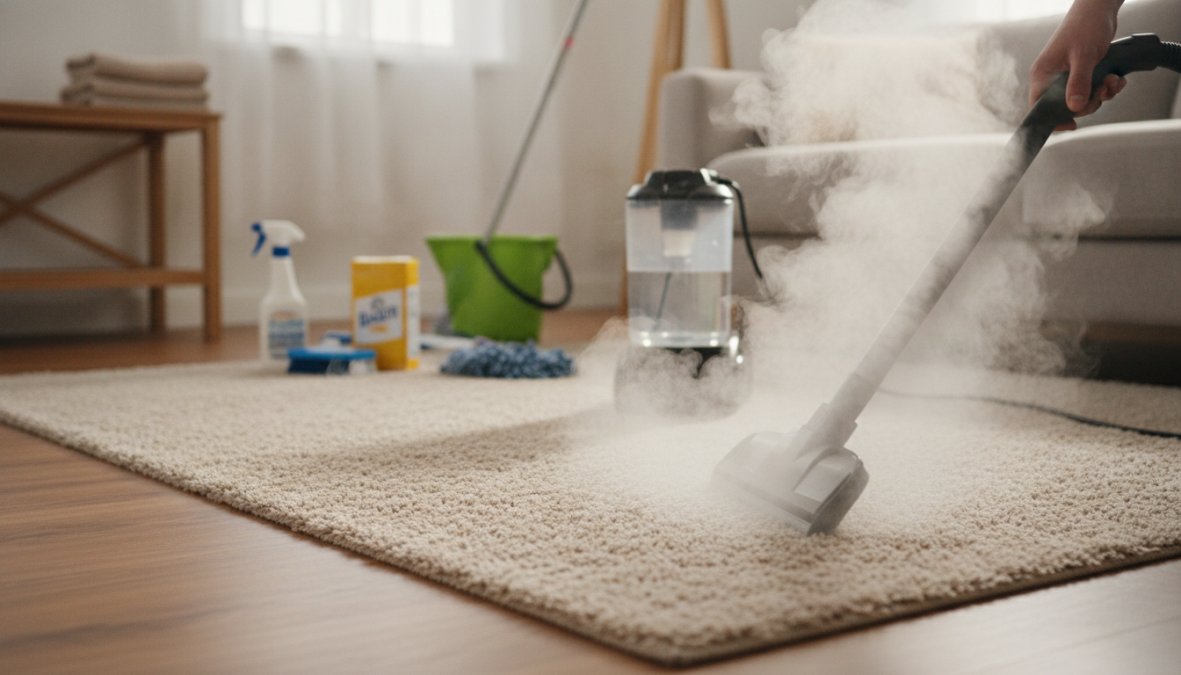
High-temperature steam is the most effective chemical-free sanitization method for most residential carpets. Vapor above 212°F kills a broad range of bacteria and dust mites on contact without leaving chemical residue that could affect pets, infants, or sensitive individuals.
The Dupray Neat Steam Cleaner reaches up to 275°F and is a strong choice for chemical-free pathogen reduction. Its limitation: it doesn’t extract water like a carpet washer, so it works best on carpets that tolerate brief moisture exposure and dry quickly.
How to steam clean carpet correctly:
- Vacuum thoroughly first
- Fill the tank with distilled water
- Move the steam head slowly, allowing 5-7 seconds of contact per section
- Work in overlapping rows toward the room exit
- Allow the carpet to dry completely before foot traffic resumes
For wall-to-wall carpet in humid Wisconsin summers, run a dehumidifier after steam cleaning. High ambient humidity dramatically slows drying and creates conditions that support microbial growth if moisture lingers in the carpet backing.
EPA-Registered Disinfectants vs. Natural Alternatives
EPA-registered disinfectants are the only products that legally claim to disinfect soft surfaces. OdoBan Disinfectant and Odor Eliminator is a well-regarded option: EPA-registered, effective against bacteria and viruses when used as directed, and concentrated enough to be cost-effective for whole-room treatments. The critical detail is dilution, full strength leaves residue that attracts soil and irritates airways.
Natural alternatives like distilled white vinegar, baking soda, and hydrogen peroxide (3% solution) sanitize at a lower level but are safer for homes with young children and pets. Hydrogen peroxide has documented antibacterial properties and is generally safe on synthetic fibers, though spot-testing on wool or natural fiber rugs is essential.
The honest comparison: EPA-registered disinfectants win on pathogen reduction for communicable disease situations. Natural alternatives are entirely adequate for routine odor control and light bacterial contamination.
Dry Powder Sanitizing for Delicate Fibers
Dry powder products like Capture Carpet & Rug Dry Cleaner solve a specific problem: sanitizing without introducing moisture, critical for wool area rugs, antique rugs, or moisture-sensitive installations. Sprinkle the powder over the carpet, work it into the pile with a soft-bristle brush, allow the labeled dwell time, then vacuum thoroughly. No drying time required. The trade-off: dry powder cannot address deep-set liquid stains or significant bacterial contamination in the carpet backing.
Natural Carpet Deodorizer and Sanitizer: Baking Soda, Vinegar, and Hydrogen Peroxide
Natural options have genuine merit beyond budget appeal. Baking soda absorbs odors rather than masking them, applied generously to dry carpet, left 15-30 minutes, then vacuumed, it reliably neutralizes everyday odors without residue or fiber risk. Distilled white vinegar diluted 1:1 with water functions as a mild sanitizer; its acidity disrupts bacterial cell membranes, though it doesn’t meet registered disinfectant thresholds. Hydrogen peroxide at 3% is the most effective of the three but carries a real bleaching risk on darker fibers, always test in a hidden area first.
A practical combination protocol for routine home sanitizing:
- Sprinkle baking soda, let sit 20 minutes, vacuum
- Mist lightly with diluted white vinegar solution
- Blot dry, do not saturate
- Allow to air dry fully before foot traffic
This won’t replace an EPA-registered disinfectant after serious contamination, but for weekly or monthly maintenance it’s effective, inexpensive, and safe for the whole household.
How to Disinfect Carpet After Pet Accidents: A Step-by-Step Protocol
Speed is essential. The longer urine or feces remains in carpet fibers, the deeper it penetrates into the backing and subfloor, and the harder it becomes to eliminate odor and bacterial contamination.
Step-by-step protocol:
- Blot (do not rub) as much liquid as possible using clean white towels, working from the outside inward
- Apply an enzyme-based cleaner such as Bissell Professional Pet Urine Eliminator + Oxy directly to the affected area, enzyme formulas break down organic compounds at the molecular level, actually eliminating odor rather than masking it
- Allow the enzyme cleaner to dwell for the labeled time (typically 10-15 minutes)
- Blot again to extract the cleaner and dissolved waste
- Apply a light mist of diluted OdoBan or another EPA-registered disinfectant if bacterial contamination is a concern
- Allow full chemical dwell time, then blot dry
- Sprinkle baking soda over the area once nearly dry, leave 30 minutes, vacuum
 supplies arranged on a cream-colored carpet: an enzyme spray bottle, a pile of white folded towels, a small bowl of baking soda, and a soft-bristle brush, suggesting a pet stain cleanup in natural window light](https://cdn.grandranker.com/articles/best-way-to-sanitize-carpets-at-home-a-2026-guide-content-2-1780883383.jpg)
Cats and dogs detect residual odor far below the human threshold, which is why they re-mark the same spots repeatedly. Enzyme cleaners that fully break down uric acid crystals are the only reliable solution to this cycle.
Best Carpet Sanitizing Solution for Steam Cleaners: Top Picks Reviewed
Bissell Professional Pet Urine Eliminator + Oxy is the top choice for homes with pets. Its OXY technology lifts deep-set biological stains while the enzyme formula eliminates odors. Requires proper dilution to avoid residue buildup, but used correctly it’s among the most effective options for recurring pet accident areas.
OdoBan Disinfectant and Odor Eliminator is the better choice when disinfection is the priority. EPA-registered and highly concentrated (one gallon makes up to 32 gallons of solution), it’s effective against bacteria and viruses. It’s not a soil-removing shampoo, so it works best as a second-pass sanitizing step after a cleaning solution has already been used.
For general deep cleaning without a specific contamination concern, use a CRI Seal of Approval-certified solution appropriate for your carpet type. The Carpet and Rug Institute’s certified products database lists solutions tested to clean effectively without causing fiber damage or accelerating resoiling.
Safety Protocols for Homes with Pets and Infants
Standard carpet disinfection products are formulated for adult exposure levels. Infants spend significant time in direct contact with carpet pile; pets lick their paws after walking on treated surfaces. Both groups are more vulnerable to residual chemical exposure.
Safe sanitization practices for households with pets and infants:
- Allow full drying before permitting pets or children back into treated areas (minimum 2-4 hours, longer in humid conditions)
- Prefer steam cleaning or natural alternatives for routine sanitization in rooms where infants play
- Ventilate thoroughly during and after EPA-registered disinfectant application
- Check labels for pet and child safety warnings, some quaternary ammonium compounds are toxic to cats even at diluted concentrations
- For area rugs in nurseries or play rooms, dry powder or baking soda treatments are the lowest-risk options
According to the American Academy of Pediatrics’ guidance on household chemical safety, reducing children’s exposure to cleaning product residues on soft surfaces meaningfully reduces overall chemical exposure in the home.
For homes with infants or cats, steam cleaning is the safest routine sanitization method. It achieves genuine pathogen reduction without any chemical residue, and the only input is distilled water.
How Long Does It Take for Carpet to Dry After Cleaning, and Why It Matters
Drying time depends on method, ambient humidity, airflow, and carpet fiber density. General estimates:
- Steam cleaning only: 1-3 hours
- Wet extraction with a consumer machine: 4-8 hours
- Professional truck-mounted extraction: 1-3 hours
- Natural liquid treatments (vinegar, hydrogen peroxide): 1-2 hours
In Lake Geneva, Wisconsin, where summer humidity regularly runs high, expect times at the longer end without active air movement. Carpet that stays damp beyond 24 hours creates conditions that actively support microbial growth in the backing and pad, you can sanitize surface fibers perfectly and still end up with mold developing underneath.
Post-Sanitization Drying Techniques to Prevent Microbial Growth
Practical drying techniques:
- Cross-ventilate the room. Open windows on opposite sides to create airflow across the carpet, the single most effective low-effort technique.
- Run ceiling fans on high. Accelerates evaporation significantly compared to still air.
- Deploy a dehumidifier. Particularly important in Wisconsin’s humid summers; removes moisture from the air so carpet releases it faster.
- Use box fans at floor level. Positioning a fan to blow across the carpet surface accelerates surface drying noticeably.
- Avoid walking on damp carpet. Foot traffic presses moisture deeper into the pile and backing, slowing drying and reintroducing soil.
As documented in the Institute of Inspection Cleaning and Restoration Certification’s carpet cleaning guidelines, carpet that remains damp beyond 24 hours after cleaning is at elevated risk for mold colonization in the backing material, requiring remediation far more involved than the original cleaning.
Material-Specific Sanitization: What Changes Based on Carpet Type
Nylon and polyester (most common residential carpets): Tolerant of most sanitization methods including wet extraction, steam, and diluted EPA disinfectants. These fibers resist moisture damage and dry relatively quickly.
Wool: Sensitive to high-alkalinity cleaners, hot water, and prolonged moisture. Dry powder sanitizing is the safest option. If wet treatment is necessary, use a wool-safe, pH-neutral solution and extract moisture immediately and thoroughly.
Berber (looped pile): Steam cleaning works well, but aggressive scrubbing can snag and distort the loops. Use a soft-bristle brush only.
Area rugs with natural fiber backing (jute, sisal): Highly moisture-sensitive backings can deteriorate or develop mold quickly if saturated. Surface treatment with dry powder or light steam is preferred; for serious contamination, professional cleaning is the safer choice.
Deep-down carpet contamination, persistent pet odors, and post-illness sanitization are situations where DIY methods reach their limits. Lake Geneva Carpet Cleaning has served Wisconsin homeowners for over 32 years using truck-mounted hot water extraction technology that achieves drying times and extraction depths consumer machines cannot replicate. With eco-friendly cleaning methods, a 10-day satisfaction guarantee, and an owner-operated commitment to meticulous attention to detail, it’s the most reliable option for Lake Geneva area residents who need genuine results rather than surface-level cleaning. Contact Lake Geneva Carpet Cleaning when the job calls for professional-grade sanitization near me.
Frequently Asked Questions
Can you sanitize carpet without a steam cleaner?
Yes. The best way to sanitize carpets at home without a steam cleaner is to use an EPA-registered disinfectant spray like OdoBan, allowing proper chemical dwell time before blotting. Baking soda and distilled white vinegar can also reduce bacterial contamination and neutralize odors on soft surfaces. For a dry option, products like Capture Carpet Dry Cleaner absorb allergens without any moisture. Always vacuum thoroughly first to remove loose soil before applying any sanitizing solution.
Does baking soda and vinegar actually sanitize carpet?
Baking soda and distilled white vinegar work as natural deodorizers and can reduce some surface bacteria, but they do not meet the EPA standard for disinfection or sanitization. They are best used as a natural carpet deodorizer and sanitizer for routine freshening or mild odor control. For true pathogen reduction, especially after illness or pet accidents, an EPA-registered disinfectant or high-temperature steam cleaner is a more reliable choice.
How long does it take for carpet to dry after cleaning, and how can I speed it up?
Carpet drying time after cleaning typically ranges from 6 to 24 hours depending on the method used, humidity levels, and carpet pile depth. Steam cleaning and hot water extraction leave more moisture, while dry powder methods require no drying at all. To speed drying and prevent microbial growth, run ceiling fans, open windows for cross-ventilation, use a dehumidifier, and avoid walking on the carpet until it is fully dry. Professional truck-mounted extraction systems generally reduce drying time significantly.
How often should you sanitize your carpets at home?
For most households, a deep sanitization every 6 to 12 months is a reasonable baseline. Homes with pets, young children, allergy sufferers, or high foot traffic may benefit from sanitizing every 3 to 4 months. After an illness, a communicable disease exposure, or a significant pet accident, immediate spot treatment followed by a full sanitization is recommended. Regular vacuuming with good vacuum filtration between deep cleans helps control allergen removal and loose soil buildup.
Is professional carpet cleaning more effective than DIY sanitizing at home?
Professional cleaning using truck-mounted hot water extraction delivers higher water temperatures, stronger suction, and faster drying than most consumer-grade rental or DIY equipment. This results in better pathogen reduction and allergen removal, especially in wall-to-wall carpet and deep carpet pile. That said, quality rental machines like the Rug Doctor Mighty Pro X3 or Bissell Big Green can produce strong results for routine sanitization. For heavily soiled carpets, post-illness disinfection, or warranty-sensitive materials, professional service is generally the more reliable option.
What carpet sanitizing solution is safe to use in a steam cleaner?
The best carpet sanitizing solution for steam cleaners depends on the machine type. Dedicated carpet washers like the Bissell Big Green work well with enzyme-based formulas such as Bissell Professional Pet Urine Eliminator + Oxy. For chemical-free vapor steam cleaners like the Dupray Neat, plain distilled water is recommended, the high-temperature steam itself handles sanitization. Always check your machine's manual and your carpet warranty before adding any solution, as some chemicals can cause fiber damage or void CRI Seal of Approval coverage.
This article was written using GrandRanker