Table of Contents
- Why Carpet Cleaning Services for Small Offices Are a Business Essential
- Commercial Carpet Cleaning Methods Explained
- How Often to Clean Office Carpets: Building Your Maintenance Schedule
- Office Carpet Maintenance Tips That Extend Carpet Lifespan
- Commercial Carpet Cleaning Cost: What Small Offices Should Budget
- Sustainability, Green Cleaning Standards, and Facility Management Integration
- How to Choose Carpet Cleaning Services for Small Offices in Lake Geneva, WI
- Conclusion
Last Updated: June 3, 2026
Carpet cleaning services for small offices are one of the most overlooked line items in a small business budget, right up until a client walks in and notices the stains. At Lake Geneva Carpet Cleaning, we have spent over 32 years watching offices in Lake Geneva, Wisconsin make the same mistake: treating carpet care as a reactive expense rather than a planned investment. Below, we break down how to build a maintenance program that protects your carpet, air quality, and professional image, including a practical ROI framework most guides never provide.
Why Carpet Cleaning Services for Small Offices Are a Business Essential
Office carpet is a working asset, not a decorative choice. Commercial-grade carpet absorbs foot traffic, traps airborne pollutants, and takes on grit and salt year-round. In a Wisconsin climate where road salt and mud are seasonal realities, soil load builds faster than most facility managers expect.
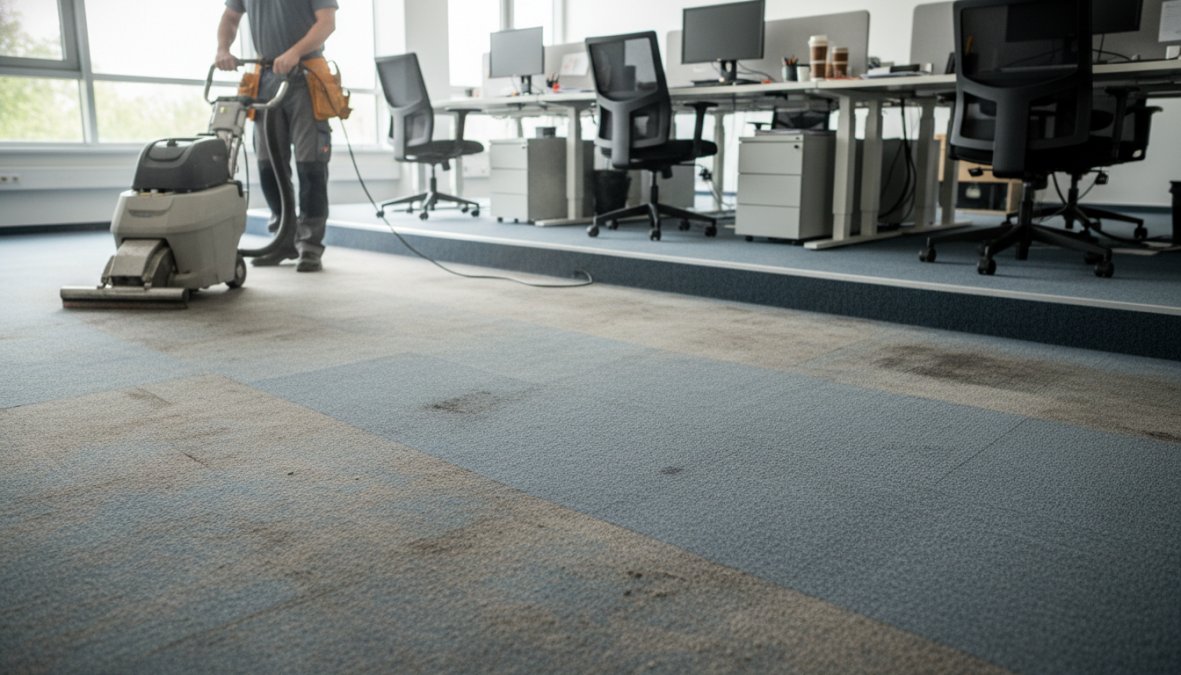
The business case rests on three pillars: carpet is a depreciating asset and neglect accelerates that depreciation; carpet fiber acts as a reservoir for allergens and fine particulate matter affecting air quality; and appearance directly shapes how clients and prospective employees perceive your business the moment they walk in.
Protecting Indoor Air Quality and Respiratory Health
Indoor air quality is directly tied to carpet condition. Carpet fibers trap dust mites, mold spores, volatile organic compounds, and fine particulate matter. When foot traffic disturbs those fibers, trapped pollutants become airborne again.
According to U.S. Environmental Protection Agency’s indoor air quality resources, indoor air can carry pollutant concentrations several times higher than outdoor air, particularly in buildings with limited ventilation. Hot water extraction, performed at the correct temperature and extraction rate, removes embedded contaminants that surface vacuuming cannot reach, breaking the cycle of accumulation before it affects employee health.
Appearance Management and Professional Image
Clients form impressions quickly. Worn traffic lanes, visible staining, and faint odor communicate something specific about how a business operates. The carpet in your reception area and conference room is part of your brand environment.
The practical fix is straightforward: schedule professional cleaning before appearance degradation becomes noticeable, not after. Proactive maintenance keeps carpet looking consistent rather than cycling between "just cleaned" and "clearly overdue."
Commercial Carpet Cleaning Methods Explained
The method your cleaning provider uses determines how deeply embedded soil is removed, how long drying takes, and whether the process risks damaging carpet backing or fiber structure. Choosing the wrong method is one of the most common and costly mistakes small offices make.
Hot Water Extraction vs. Encapsulation System
Hot water extraction injects heated water and cleaning solution deep into carpet fibers under pressure, then immediately extracts the solution along with dissolved soil using high-powered suction. The Carpet and Rug Institute’s cleaning standards recognizes it as the most effective method for deep soil removal in commercial settings.
Encapsulation applies a cleaning agent that surrounds soil particles and crystallizes as it dries; the crystals are then vacuumed away. It dries within one to two hours, making it practical for offices that cannot afford extended downtime, and works well as an interim maintenance method between deep extractions.
The honest answer: use hot water extraction for quarterly or semi-annual deep cleaning, and encapsulation for monthly interim maintenance in high-traffic areas. Using encapsulation exclusively builds residue over time and causes wicking, where soil from the backing migrates back to the surface as the carpet dries.
Carpet Fiber Science: Why Method Matters for Your Specific Carpet
Most commercial carpet is nylon or solution-dyed olefin. Nylon is resilient, responds well to hot water extraction, and holds stain resistance treatments effectively. Olefin has natural stain resistance but attracts oily soils. Wool requires lower-temperature cleaning to avoid shrinkage. The carpet backing matters equally, aggressive over-wetting can delaminate the secondary backing, causing permanent structural damage. An experienced technician adjusts water temperature, dwell time, and extraction speed for your specific carpet construction.
Ask your cleaning provider which specific method they use for your carpet type before booking. A provider who gives a one-size-fits-all answer without asking about your carpet construction is a red flag.
How Often to Clean Office Carpets: Building Your Maintenance Schedule
The right cleaning frequency depends on foot traffic volume, entry area configuration, and whether food or beverages are consumed in carpeted spaces. A single-occupant private office has different needs than a ten-person shared workspace with a carpeted break room.
Vacuuming Frequency and Daily Spot Cleaning
Vacuuming is the foundation of any carpet maintenance program. For most small offices, daily vacuuming of high-traffic areas, entry zones, corridors, and reception, is the minimum standard recommended by carpet manufacturers. Once grit and salt particles reach the base of the pile, foot traffic grinds them against the fiber, causing abrasion that permanently dulls appearance and weakens fiber integrity.
Daily spot cleaning matters equally. Spills treated within minutes are almost always removable; spills left overnight frequently become permanent stains. Keep a commercial spot cleaner and clean white cloths accessible, and establish a simple protocol: blot, do not rub, work from the outside of the stain inward.
A practical maintenance schedule for a small office:
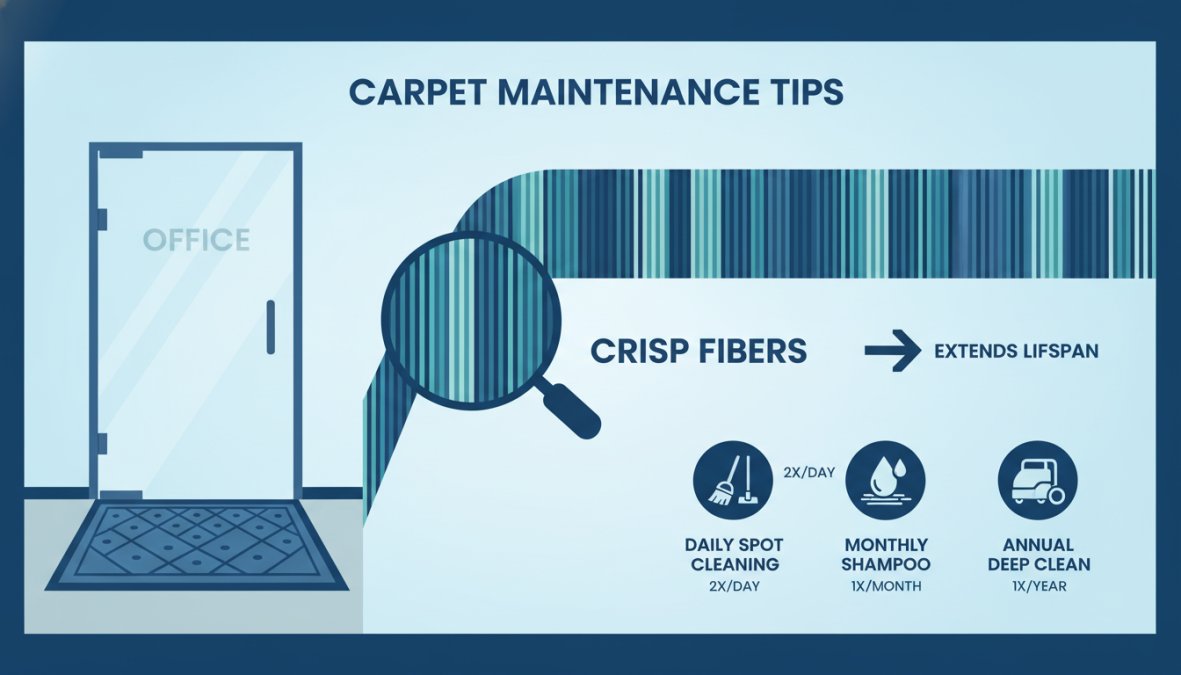
- Daily: Vacuum traffic lanes and entry areas, address spills immediately
- Weekly: Full office vacuum including under desks and along walls
- Monthly: Encapsulation cleaning of high-traffic zones if soil load is heavy
- Quarterly: Hot water extraction deep clean for the full office
- Annually: Full restorative extraction plus inspection of carpet backing and seams
The single most protective thing a small office can do for its carpet investment is vacuum daily and treat spills immediately. Professional deep cleaning extends carpet life, but it cannot undo years of abrasion from unremoved dry soil.
Office Carpet Maintenance Tips That Extend Carpet Lifespan
Prolonging carpet lifespan comes down to reducing soil entry, managing what does enter, and scheduling cleaning before damage accumulates.
- Install quality entry matting. Matting covering the first six to eight feet of entry significantly reduces the soil load on interior carpet.
- Enforce a no-food policy in carpeted areas or accept that those areas will require more frequent professional cleaning.
- Rotate furniture periodically to distribute traffic wear rather than concentrating it in fixed lanes.
- Apply carpet protector after each professional cleaning to restore factory-applied stain resistance that cleaning removes over time.
- Address wicking promptly. If a stain reappears after cleaning, it is wicking from the backing and requires targeted re-treatment, not just surface re-cleaning.
- Document your cleaning history. Carpet manufacturers often require proof of regular professional cleaning to honor warranty claims.
Skipping professional [cleaning for](/carpet-cleaning-for-allergy-relief/) more than twelve months in a high-traffic office does not just affect appearance. Abrasive soil particles actively cut carpet fibers with every footstep, causing permanent fiber damage that no amount of future cleaning can reverse.
Commercial Carpet Cleaning Cost: What Small Offices Should Budget
Commercial carpet cleaning cost varies based on square footage, soil level, method used, and local market rates. Many small offices in the Lake Geneva, Wisconsin area have a few hundred square feet of carpeted space, keeping per-visit costs manageable when cleaning is scheduled proactively. The more important question is not what a single cleaning costs, but what a planned maintenance program costs compared to premature replacement.
ROI Calculation Framework: The Cost of Neglect vs. Planned Maintenance
Step 1: Establish your carpet replacement cost.
Measure total carpeted square footage and get a quote for commercial-grade replacement including materials, labor, and business disruption.
Step 2: Estimate carpet lifespan under each scenario.
Well-maintained commercial carpet commonly lasts significantly longer than neglected carpet. A planned maintenance program can extend useful carpet life by several years.
Step 3: Calculate annual maintenance cost.
Add up the cost of quarterly hot water extraction plus monthly or bi-monthly encapsulation for high-traffic zones.
Step 4: Compare annualized costs.
Divide replacement cost by expected lifespan under each scenario. If planned maintenance extends lifespan by three to four years, the annualized cost of the carpet drops substantially.
| Scenario | Estimated Carpet Lifespan | Annual Cost of Carpet (Annualized) |
|---|---|---|
| No regular cleaning | 4-5 years | Higher annualized cost |
| Reactive cleaning only | 5-7 years | Moderate annualized cost |
| Planned maintenance program | 8-12 years | Lowest annualized cost |
According to facility management guidance from IFMA, the International Facility Management Association, proactive asset maintenance programs reduce total lifecycle costs compared to reactive maintenance strategies across commercial flooring categories.
Sustainability, Green Cleaning Standards, and Facility Management Integration
Green cleaning standards are no longer a niche concern. Many tenants, employees, and clients now expect cleaning practices that minimize chemical exposure and environmental impact. The Green Seal certification standards for commercial cleaning products provide a credible third-party benchmark for evaluating a provider’s chemistry. When evaluating carpet cleaning services for small offices, ask whether their solutions carry Green Seal or comparable certification.
Hot water extraction paired with low-residue certified chemistry is inherently sustainable, it relies primarily on heat and mechanical action rather than heavy chemical loads, and the extraction process removes cleaning solution residue from the carpet.
From a facility management perspective, integrating carpet cleaning into a broader maintenance schedule prevents ad hoc scheduling and forgotten cleanings. Simple approaches work well: a shared calendar entry for quarterly cleaning reminders, a maintenance log stored with other facility records, and a standing relationship with a trusted provider who knows your carpet type and history. Documented cleaning schedules also support carpet warranty claims, which many small business owners discover they need only after a problem arises.
How to Choose Carpet Cleaning Services for Small Offices in Lake Geneva, WI
Finding reliable carpet cleaning services for small offices near me in the Lake Geneva area comes down to criteria that separate professional operators from general cleaning companies.
What to look for:
- Experience with commercial carpet specifically. Ask whether the provider regularly services office spaces and understands commercial versus residential carpet construction.
- Truck-mounted equipment. Truck-mounted systems generate significantly more heat and suction than portable units, producing a deeper clean and faster drying times.
- Knowledge of fiber types. A provider who asks about your carpet before quoting is more credible than one who prices by square foot without any questions.
- Satisfaction guarantee. A written guarantee signals confidence in the work and gives you recourse if results fall short.
- Local reputation and verifiable reviews. In a market the size of Lake Geneva, Wisconsin, consistent reviews carry real weight.
- Eco-friendly cleaning options. If indoor air quality is a priority, confirm the provider uses certified low-toxicity solutions.
Lake Geneva Carpet Cleaning meets all of these criteria as an owner-operated business with over 32 years of commercial and residential cleaning experience in the region. The company uses truck-mounted hot water extraction technology, eco-friendly cleaning methods, and backs every job with a 10-day satisfaction guarantee.
Small offices that treat carpet maintenance as an afterthought consistently pay more over time through premature replacement, degraded indoor air quality, and a workspace that does not look professionally maintained. Lake Geneva Carpet Cleaning offers truck-mounted hot water extraction, eco-friendly cleaning chemistry, and a 10-day satisfaction guarantee backed by over 32 years of experience serving businesses across Lake Geneva, Wisconsin. Get started with Lake Geneva Carpet Cleaning and protect your carpet investment with a maintenance schedule built around your office’s actual traffic patterns and fiber type.
Frequently Asked Questions
How often should small offices have their carpets professionally cleaned?
Most small offices benefit from professional deep cleaning every 6 to 12 months, depending on foot traffic and soil load. High-traffic areas like reception zones and traffic lanes may need attention every 3 to 6 months. Daily vacuuming and prompt spot cleaning between professional visits are essential. Carpet manufacturers and the CRI (Carpet and Rug Institute) generally recommend at least one professional extraction cleaning per year to maintain warranty coverage and fiber integrity.
What is the average cost of commercial carpet cleaning for a small office?
Commercial carpet cleaning cost for small offices typically varies based on square footage, soil load, and the method used. Hot water extraction tends to cost more than an encapsulation system but delivers a deeper clean. Most providers offer quote-based pricing, so getting two or three estimates is advisable. Planned preventative maintenance contracts often cost less per visit than one-time emergency cleanings, making them a smarter investment for ongoing asset management.
What methods do professional carpet cleaners use for commercial spaces?
The two most common commercial carpet cleaning methods are hot water extraction and the encapsulation system. Hot water extraction injects heated water and cleaning solution deep into carpet backing, then extracts it along with embedded pollutants, grit, and allergens. Encapsulation uses a crystallizing polymer that surrounds soil particles so they can be vacuumed away, ideal for interim maintenance between deep cleans. The right method depends on carpet fiber science, appearance demand, and how quickly the office needs to return to normal use.
Does professional carpet cleaning remove allergens and improve indoor air quality?
Yes. Carpet fibers trap pollutants, dust mites, grit and salt, and other allergens that standard vacuuming cannot fully remove. Over time, foot traffic grinds these particles deeper, causing fiber damage and releasing contaminants into the air. Professional carpet cleaning services for small offices, especially truck-mounted hot water extraction, flush out embedded allergens and significantly improve indoor air quality, which supports respiratory health for everyone working in the space.
How long does it take for office carpets to dry after professional cleaning?
Drying time depends on the cleaning method, ventilation, and humidity. Hot water extraction typically results in carpets that are dry within 6 to 12 hours when good airflow is present. Encapsulation systems dry much faster, often within 1 to 2 hours, making them popular for offices that cannot afford long downtime. Scheduling cleaning after business hours or on weekends minimizes disruption. Proper air circulation with fans or open windows speeds the process significantly.
This article was written using GrandRanker