
Last Updated: November 25, 2026
Quick Summary
Commercial carpet maintenance for busy offices is a routine of daily, weekly and periodic care that keeps carpet looking good and lasting longer. Heavy foot traffic grinds dirt into fibers, so daily vacuuming of entryways and walkways is the most useful habit. Professional extraction then removes deeper soil on a schedule matched to your traffic level.
- Vacuum entryways, hallways and main walkways every day, and twice on heavy days.
- Blot spills the same day, working from the outside in so the stain does not spread.
- Post a written checklist with daily, weekly, monthly and quarterly tasks near the janitor closet.
- Heavy traffic (50 to 100 crossings per hour) usually calls for professional extraction every 3 to 6 months.
- Schedule deep cleaning for evenings or weekends and block off wet areas until the carpet is dry.
Table of Contents
- How Commercial Carpet Maintenance for Busy Offices Works
- Step 1: Set Up Daily Vacuuming for High-Traffic Zones
- Step 2: Treat Spills and Spots the Same Day
- Step 3: Build an Office Carpet Maintenance Checklist
- How to Clean High-Traffic Carpet Areas Without Disrupting Staff
- Commercial Carpet Cleaning Frequency by Traffic Level
- Commercial Carpet Drying Time and Scheduling Around Business Hours
- Seasonal Maintenance for Lake Geneva Offices
- Schedule Your Office Carpet Maintenance Plan With Us
- Frequently Asked Questions
How Commercial Carpet Maintenance for Busy Offices Works
Commercial carpet maintenance for busy offices is a routine of daily, weekly and periodic care that keeps carpet looking good and lasting longer. Heavy foot traffic grinds dirt into the fibers, so the right routine matters more in an office than in a home. At Lake Geneva Carpet Cleaning, we have spent 32 years helping business owners keep their floors presentable.
Below, we walk through seven practical steps you can put to work this week. You’ll get a daily vacuuming routine, a plan for spills, a checklist you can post in the break room, and a schedule that fits around business hours.
Most carpet damage starts at the entrance. Dry soil acts like sandpaper, cutting fibers a little more with every step. Regular removal is the easiest way to slow that wear.
Step 1: Set Up Daily Vacuuming for High-Traffic Zones
Daily vacuuming is the single most useful habit for commercial carpet maintenance for busy offices. Focus on entryways, hallways, and the path between desks and the break room.
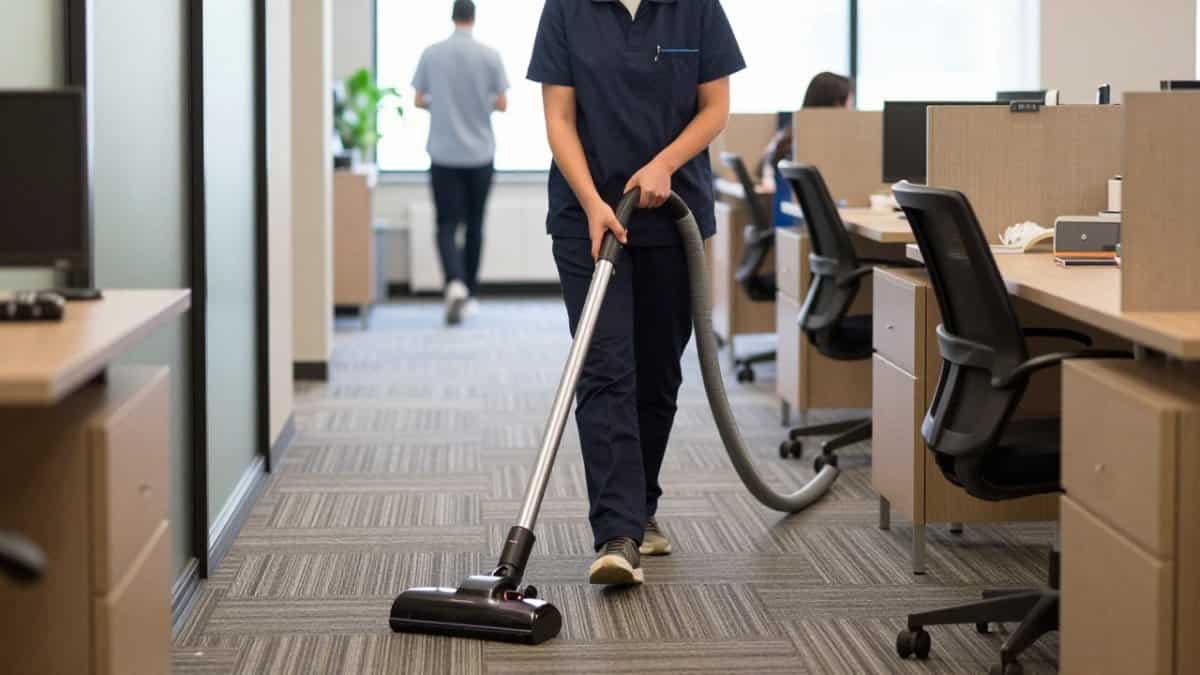
Vacuum the high-traffic lanes at least once a day, and twice on heavy days. Use a vacuum with a working beater bar and a clean filter.
- Vacuum entryways and main walkways every day
- Overlap each pass so no strip gets missed
- Empty the canister or change the bag before it fills
- Check the brush roll for hair and string
If your office has a visible traffic lane, it is a good sign that the carpet needs more frequent care. Our team at Lake Geneva Carpet Cleaning can help you map those zones. You can also read our guide on why carpet traffic lanes turn gray over time to see how daily vacuuming slows that buildup.
Step 2: Treat Spills and Spots the Same Day
Fast action is the difference between a small spot and a permanent stain. Blot spills right away, working from the outside in so the stain does not spread.
Keep a basic spot kit at reception and in the kitchen area. Include clean white cloths, a neutral pH cleaner, and a dry towel. Avoid harsh household products, which can leave residue that attracts new soil.
Watch out: scrubbing a fresh spill hard pushes it deeper into the backing and can fray the fibers. Blot, don’t rub. For a closer look at the method, see our expert guide to cleaning high-traffic carpet areas.
Step 3: Build an Office Carpet Maintenance Checklist
A written checklist keeps the routine from slipping when people get busy. Post it near the janitor closet or the office manager’s desk so everyone can see it.
- Daily: vacuum entryways, hallways, and main walkways
- Daily: blot spills and treat spots as they happen
- Weekly: vacuum all open areas and under desk chairs
- Monthly: check walk-off mats and replace them when worn
- Quarterly: schedule professional cleaning for the whole floor
A checklist also gives you a record. If a stain appears, you can see when it was last treated and act faster.
How to Clean High-Traffic Carpet Areas Without Disrupting Staff
High-traffic carpet areas can be cleaned without shutting the office down. The trick is to work in small sections during quiet hours and let each section dry before people walk on it.
Start with a pre-treatment spray on the worst lanes. Let it sit for the time listed on the label, then agitate gently with a soft brush. Follow with extraction using a clean water rinse to remove the soil and leftover product. Leaving cleaner behind attracts new dirt, so rinse well.
Many offices schedule this work for evenings or weekends. Other offices clean one zone per day so that the rest of the floor stays open. Either way, mark the wet area with cones and keep foot traffic off it.
Our team at Lake Geneva Carpet Cleaning uses this section-by-section method for busy offices, and you can book a professional deep clean with us when your traffic lanes need more than routine care.
Commercial Carpet Cleaning Frequency by Traffic Level
How often you should clean depends on how many people walk across the carpet each day, what they track in, and how well your entrances stop soil at the door. Use the traffic level that fits your space as a starting point, then adjust for the conditions below.
A practical way to estimate traffic is to count the people who cross your main walkway in a typical hour and multiply by the hours the office is open. Our small office carpet cleaning options and maintenance plans explain how service frequency can be matched to a workplace of your size. A private suite with a handful of visitors a day behaves very differently from a lobby that sees a steady stream of clients, deliveries, and staff coming in from a parking lot.
- Light traffic (private offices, small reception areas, fewer than about 20 crossings per hour): professional extraction every 12 to 18 months, with daily vacuuming of entryways and walkways
- Moderate traffic (shared offices, small teams, roughly 20 to 50 crossings per hour): professional extraction every 6 to 12 months, with daily vacuuming and weekly vacuuming of open areas
- Heavy traffic (open floor plans, client-facing lobbies, 50 to 100 crossings per hour): professional extraction every 3 to 6 months, with twice-daily vacuuming of main lanes
- Very heavy traffic (busy front desks, retail-style offices, more than 100 crossings per hour): professional extraction every 3 months or more often, with daily spot treatment and frequent mat changes
Frequency is only part of the picture, and it helps to separate the two jobs. Vacuuming removes dry soil before it grinds into the fibers, so it should happen far more often than extraction. Extraction removes the oily, sticky soil and the deep grit that vacuuming cannot lift. An office that vacuums daily can often stretch the time between deep cleanings, while an office that skips daily vacuuming usually needs professional cleaning sooner than the calendar suggests.
Several conditions should push you toward the shorter end of each range:
- Entrances without adequate matting. If soil reaches the carpet within the first few steps inside the door, the entryway is not doing its job and the whole floor soils faster.
- Parking lots, sidewalks, and landscaping nearby. Grit, pollen, and outdoor dust enter on shoes and settle into the pile.
- Food and beverage traffic. Coffee stations, break rooms, and reception areas where clients are served generate sticky soil that vacuuming alone will not remove.
- Pets or service animals. Hair and dander add to the load and can mat into the pile.
- Older or low-pile carpet. Worn pile holds soil differently and may show traffic lanes sooner, which is a signal to shorten the interval rather than wait.
A common pattern in busy offices is to clean the highest-traffic zones on a shorter cycle than the rest of the floor. The lobby, the main hallway, and the path to the break room may need attention every few months, while private offices and conference rooms can go longer. Splitting the schedule this way keeps the visible areas presentable without over-cleaning the quiet ones.
Watch out: treating the published interval as a fixed rule rather than a starting point is how offices end up with dingy traffic lanes between cleanings. If you can see a gray path where people walk, the schedule is already behind. Pricing depends on the size and condition of your space, so contact us for a free quote and we will help you set an interval that matches your actual traffic.
The table below summarizes how often each traffic level generally calls for professional extraction and daily vacuuming.
| Traffic level | Professional extraction | Daily care |
|---|---|---|
| Light (under ~20 crossings/hour) | Every 12 to 18 months | Vacuum entryways and walkways |
| Moderate (~20 to 50 crossings/hour) | Every 6 to 12 months | Daily vacuuming, weekly open areas |
| Heavy (~50 to 100 crossings/hour) | Every 3 to 6 months | Twice-daily vacuuming of main lanes |
| Very heavy (over 100 crossings/hour) | Every 3 months or more often | Daily spot treatment and frequent mat changes |
Commercial Carpet Drying Time and Scheduling Around Business Hours
Drying time is the main reason offices worry about carpet cleaning. Drying time depends on the carpet type, the amount of water used, and the airflow in the room.
Schedule deep cleaning for evenings or weekends when possible. Run fans and open windows if the weather allows. Set up “wet floor” signs and block off the area until the carpet is dry to the touch.
For offices that cannot close, clean one section at a time. Plan the work so each section has time to dry before the next day’s foot traffic arrives. A clear schedule keeps staff informed and avoids surprises.
Seasonal Maintenance for Lake Geneva Offices
Lake Geneva offices face seasonal soil, and the towns around the lake each bring their own version of it. In winter, snow, slush, and road salt track in on boots and coats. In spring and fall, mud and wet leaves follow. Sand and grit from lakeside properties and nearby streets can also work into the carpet. Offices in Fontana, Williams Bay, and Delavan deal with lakefront moisture and windblown grit, while offices in Burlington, Elkhorn, and East Troy see more agricultural dust and gravel tracked in from surrounding roads. Twin Lakes, Genoa City, Walworth, and Darien offices sit along busy routes where winter road treatment is heavy.
Adjust your routine by season, and treat each change as a trigger to inspect entrances rather than wait for the calendar:
- Winter: Road salt is the biggest threat. Salt dries into a fine white powder that works into the pile and attracts moisture, which can damage backing over time. Add extra walk-off mats at every entrance, vacuum entryways more often, and blot up slush before it dries. Keep a mop and towel at the door so staff can deal with wet footprints during the day.
- Spring: After the thaw, mud and grit that built up over winter get tracked in. Check entrances for caked soil, deep clean high-traffic lanes, and replace mats that stayed wet all winter.
- Summer: Outdoor dust, pollen, and sand from lakeside properties still enter through doors and windows. Keep up with daily vacuuming and watch for sunscreen and insect repellent tracked in from outdoor breaks.
- Fall: Wet leaves and debris collect at entrances before they are tracked inside. Clear them daily, and expect more grit from gravel and unpaved areas around the building.
Seasonal changes often explain why carpets look dingy even with daily care. The fix is to treat the source at the door. A proper matting system, with a scraper mat outside and an absorbent mat inside, stops most soil before it reaches the carpet. During winter, that system needs more frequent cleaning and replacement than it does in summer.
A useful habit is to walk your entrances at the start and end of each season and note what is getting tracked in. If you see white salt residue, gray slush lines, or muddy footprints that reappear after cleaning, the entrance routine needs to change before the carpet does. Our team at Lake Geneva Carpet Cleaning can review your entrances and traffic patterns to recommend a seasonal schedule that fits your building and your business hours.
Schedule Your Office Carpet Maintenance Plan With Us
A solid routine is easier to keep with professional help. Daily vacuuming and spot treatment handle the everyday work, and a scheduled professional cleaning handles the deeper soil that builds up over time. Together, they keep your office looking professional and your carpet lasting longer.
We can set up a cleaning plan that fits your traffic level and your business hours. Pricing depends on the job, so contact us for a free quote and we will review your space and recommend a schedule that works.
Frequently Asked Questions
How often should commercial office carpets be deep cleaned?
Most busy offices benefit from a professional deep clean every few months, with higher-traffic areas such as entryways, hallways and reception zones needing attention more often than private offices. The right interval depends on foot traffic, the carpet fiber, and whether the space sees visitors daily. Pair regular deep cleaning with daily vacuuming and prompt spot treatment so soil does not build up between visits. Pricing depends on the size and condition of the space, so contact Lake Geneva Carpet Cleaning for a free quote tailored to your office.
How long does commercial carpet take to dry after cleaning?
Drying time after hot water extraction depends on the carpet fiber, pad thickness, humidity and airflow in the room. Many office carpets dry within several hours when the space is ventilated, but thick padding can take longer. Scheduling cleanings after business hours or on weekends keeps staff from walking on damp carpet. Ask your provider how long the area will stay out of use so you can plan around it.
What should an office carpet maintenance schedule include?
A practical schedule covers daily vacuuming of high-traffic lanes, same-day spot treatment of spills, weekly checks of entryway walk-off mats, and periodic professional cleaning. Write the schedule as a simple checklist that names who is responsible for each task. Reviewing the schedule every quarter lets you adjust frequency as foot traffic changes. Lake Geneva Carpet Cleaning can help you set up a maintenance plan that fits your office hours.
How can an office keep carpet clean in high-traffic areas?
Place walk-off mats at every entrance to trap dirt before it reaches the carpet, and vacuum those lanes daily. Treat spills quickly with a neutral cleaner and blot rather than rub. Rotating furniture and noting wear patterns helps you spot areas that need extra attention. For a plan built around your space and schedule, contact Lake Geneva Carpet Cleaning for a free quote.