
Last Updated: November 24, 2026
Quick Summary
Preventing pet accidents on new carpet flooring means ruling out medical causes with your vet first, then rebuilding routine with frequent outdoor breaks, supervision, and restricted access. Blot any accident immediately and treat it with an enzymatic cleaner, since fresh fibers and padding soak up urine fast.
- Treat your dog like a puppy again for two to three weeks to rebuild the habit loop.
- A young or newly retrained dog may need a trip outside every two to three hours during the day.
- Pick up the water bowl roughly two hours before bed if nighttime accidents are the issue.
- Patch test any cleaner in a hidden corner and wait 24 hours before spraying a whole room.
- Blot within minutes of an accident, rinse with clean water, then apply an enzymatic cleaner.
Table of Contents
- How to Prevent Pet Accidents on New Carpet Flooring
- Why Is My Dog Peeing on the Carpet All of a Sudden?
- Start With a House-Training Refresher and Consistent Routine
- Frequent Outdoor Bathroom Breaks and Positive Reinforcement
- Supervision, Restricted Access, and Crate Training
- How to Stop Dog From Peeing on Carpet at Night
- What to Spray on Carpet to Stop Dog Peeing
- How to Get Pet Urine Smell Out of Carpet
- Protecting New Carpet in Lake Geneva, Twin Lakes, and Walworth Homes
- Book Professional Pet Stain and Odor Removal
- Frequently Asked Questions
How to Prevent Pet Accidents on New Carpet Flooring
Preventing pet accidents on new carpet flooring starts with one simple truth: a house-trained dog does not forget house training overnight. Something changed, and your job is to find out what. This guide from Lake Geneva Carpet Cleaning covers the medical checks, routine resets, and cleanup steps that protect a fresh installation. We have served homeowners across Lake Geneva, Wisconsin and the surrounding towns for 32 years.
New carpet raises the stakes. Fresh fibers and padding soak up urine fast, and the smell can settle deep. But first, here is what most guides get wrong: they jump straight to cleaners when the real fix is usually routine and supervision. Below, we show you exactly how to handle both.
Why Is My Dog Peeing on the Carpet All of a Sudden?
A sudden change in bathroom habits usually points to a medical issue, a routine disruption, or stress, not stubbornness. A house-trained dog that starts having accidents is telling you something. Do not scold first. Investigate first.
Common triggers include:
- A urinary tract infection or bladder irritation
- A new person, pet, or baby in the home
- A move, remodel, or new flooring itself
- Anxiety from noise, storms, or schedule changes
- Aging-related incontinence
New carpet can confuse some dogs. The texture feels different, and residual smells from the store or install can prompt marking. Watch when and where accidents happen. That pattern tells you more than any guess.
Medical Causes to Rule Out First
Start with your veterinarian. A urinary tract infection, crystals, diabetes, or kidney issues can all cause sudden accidents. So can arthritis, which makes squatting painful. Your vet can rule these out with a simple exam and urine test.
Ask specifically about incontinence and any new medications. Some drugs increase thirst and urination. If your dog is older, ask whether age-related hormone issues could play a role.
Do not skip this step. Behavior training will not fix a medical problem, and you will both get frustrated. According to American Veterinary Medical Association pet health guidance, sudden changes in urination habits warrant a veterinary visit before behavior changes.
Start With a House-Training Refresher and Consistent Routine
Treat your dog like a puppy again for two to three weeks. A house-training refresher works because it rebuilds the habit loop. The key is consistency, not punishment.
Build a simple daily schedule:
- First out first thing in the morning
- Out after every meal
- Out after naps and play
- Out before bed
- Out any time your dog sniffs or circles
Feed at the same times each day. Free-feeding makes predicting bathroom times nearly impossible. Pick up the water bowl a couple of hours before bed if nighttime accidents are the issue, but never restrict water during hot weather.
Take your dog to the same spot outside every time. The scent there tells them this is the bathroom zone. Praise calmly right after they finish. A consistent routine is the backbone of accident prevention.
Frequent Outdoor Bathroom Breaks and Positive Reinforcement
More breaks beat longer breaks. A young or newly retrained dog may need a trip outside every two to three hours during the day. Frequent potty breaks give your dog more chances to succeed, and success is what you want to reward.
Positive reinforcement does the heavy lifting here:
- Reward within seconds of finishing outside
- Use a high-value treat your dog only gets for this
- Keep praise calm, not wild
- Never punish an accident you find later
Punishment teaches a dog to hide accidents, not to stop them. They will sneak behind the couch instead. That makes the problem harder to solve and the carpet harder to save.
Watch for signals: sniffing, circling, whining at the door, or sudden restlessness. Catching the signal and heading outside is a win. Reward-based training builds trust and results faster than correction.
Supervision, Restricted Access, and Crate Training
Supervision is your best accident prevention tool in the first month. If you cannot watch your dog, confine them. It is that simple.
Use these three layers together:
- Supervision: Keep your dog in the same room and watch for signals
- Restricted access: Close doors to carpeted rooms or use baby gates
- Confined space: Use a crate or a small, easy-to-clean area when you are out
Crate training works well when the crate is a calm, positive place. Feed meals in the crate. Add a soft blanket. Never use it as punishment.
A common mistake is giving a new dog full run of the house on day one. That is how repeat marking starts. Ease into freedom room by room as your dog proves reliable. If you are coming from a home with no carpet, expect a short adjustment period.
How to Stop Dog From Peeing on Carpet at Night
Nighttime accidents on new carpet are a timing problem more often than a training problem. A dog that sleeps eight hours without a break is asking a lot of a bladder, especially a young, senior, or newly retrained one. The fix is to shorten the overnight window and shrink the sleeping space so an accident is less likely and easier to catch.
Start with the last two hours of the day. Feed dinner at the same time each evening, and pick up the water bowl roughly two hours before bed unless the weather is hot or your dog is on medication that increases thirst. Then take your dog out right before you turn in, even if they went out an hour earlier. A final empty is the single highest-value step in this routine.
Limit the sleeping area. A crate, a small gated pen, or a closed bedroom keeps your dog from wandering to a far corner of new carpet in the dark. Pair that with a washable bed and a hard floor nearby so a middle-of-the-night accident is quick to contain. New carpet and its padding absorb liquid fast, so the smaller the exposed area, the smaller the damage.
Set one alarm for the middle of the night if your dog is young, senior, or recently retrained. Take them out on leash to the same spot, praise calmly, and put them back to bed. A single scheduled overnight break often helps break the pattern within a week or two. Fade the alarm once you get several dry nights in a row.
Watch out: if your dog is older and the accidents happen while sleeping rather than after waking, that pattern points to incontinence rather than a training lapse. Ask your vet about it before you tighten the routine further, because no schedule fixes a medical cause.
Keep the sleeping area boring. Remove toys and extra blankets that hold odor, and wash bedding weekly. If an accident does happen, blot it immediately and treat it with an enzymatic cleaner before bed the next night, because a lingering scent in the sleeping area invites a repeat.
What to Spray on Carpet to Stop Dog Peeing
An enzymatic cleaner is the right answer, not a cover-up spray. Enzymes break down the uric acid crystals in urine that cause lingering smell. Those crystals are why a spot can smell clean to you but still draw your dog back.
What to reach for:
- An enzymatic pet odor eliminator made for carpet
- Plain water for a final rinse
- Clean white towels for blotting
What to avoid:
- Ammonia-based cleaners, which smell like urine
- Heavy perfumes that mask odor without removing it
- Steam or heat on fresh urine, which can set the stain
A deterrent spray can help mark a boundary, but it will not fix the source. Vinegar and water is a mild option for a light surface refresh, but it does not reach the padding. For real odor removal, enzymes are the tool that works.
Pet-Safe Product Selection and Patch Testing
Always patch test before you spray a whole room. Test in a hidden corner and wait 24 hours. Check for color change, fading, or fiber damage.
Choose products labeled pet-safe and made for the fiber type. Wool, nylon, and polyester react differently. Keep pets and kids off the area until it is fully dry.
Our team at Lake Geneva Carpet Cleaning uses eco-friendly methods, and we can point you toward proven pet-safe cleaning methods that actually work before you buy anything. When in doubt, test small and wait.
How to Get Pet Urine Smell Out of Carpet
Blot first, then treat, then dry fully. Speed matters most with fresh accidents. The longer urine sits, the deeper it reaches into carpet fibers and padding.
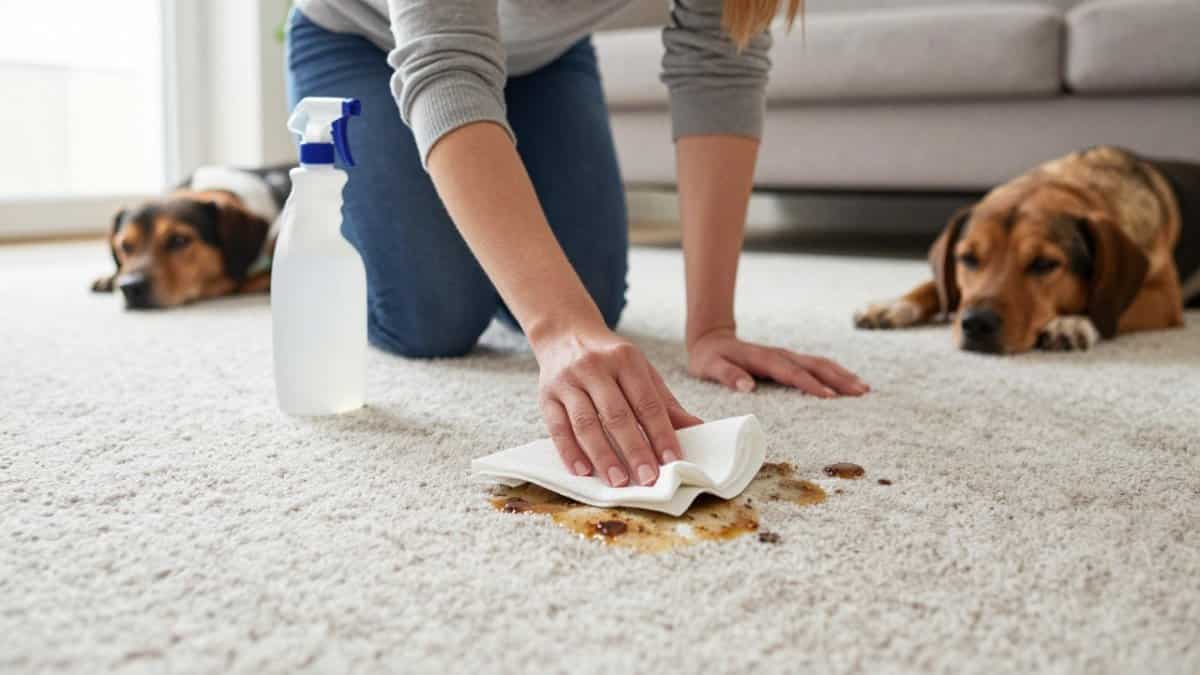
Follow these steps:
- Blot up as much as you can with paper towels, pressing down hard
- Rinse the area with clean water and blot again
- Apply an enzymatic cleaner and let it dwell per the label
- Blot dry and place a clean towel with weight on the spot
- Let the area air dry completely
Never rub. Rubbing pushes urine deeper and frays the fibers. For a full walk-through, see our complete guide to removing pet urine from carpet.
If the smell keeps coming back, the urine reached the padding. Why pet urine smell returns after cleaning explains what causes that lingering odor. That is when surface cleaning stops working.
Carpet and Padding-Specific Cleanup Guidance
New carpet and its padding absorb liquid fast. That is why prompt cleanup matters so much on a fresh install.
- Blot within minutes of an accident
- Treat both the carpet surface and, if soaked, the padding beneath
- Lift a corner to check the backing for dampness
- Dry with airflow, not heat
- Repeat enzyme treatment on any spot that still smells
If a stain or smell survives two rounds, the contamination is likely in the padding. Pulling that out takes professional extraction. This is also where carpet warranties come in. Some manufacturers require professional cleaning to keep coverage valid, so check your warranty terms. Check your warranty terms before you try anything harsh.
Here is the cleanup sequence the article recommends for fresh accidents on new carpet.
| Step | What to do | Note |
|---|---|---|
| 1 | Blot up as much as you can with paper towels | Press down hard |
| 2 | Rinse the area with clean water and blot again | , |
| 3 | Apply an enzymatic cleaner and let it dwell | Follow the label |
| 4 | Blot dry and place a clean towel with weight | , |
| 5 | Let the area air dry completely | Dry with airflow, not heat |
| Never | Rub the spot | Rubbing pushes urine deeper and frays fibers |
| If smell returns | Urine reached the padding | Surface cleaning stops working |
Protecting New Carpet in Lake Geneva, Twin Lakes, and Walworth Homes
Homes around Geneva Lake and the surrounding towns put new carpet through a harder first year than most guides account for. Long winters mean more indoor time for pets, and wet springs mean muddy, sandy paws coming in from lakefront yards and trails. Road salt and grit ride in on paws and work into the pile, and once that grit settles into fresh fibers it acts like sandpaper every time someone walks across it.
Build a seasonal protection plan around the entry points. Place a coarse mat outside and an absorbent mat inside every door your pet uses, and wipe paws at the threshold on wet or snowy days. Keep a towel by the door from late fall through early spring. Vacuum high-traffic paths at least twice a week during mud season, because grit left in the pile dulls the carpet and makes stains set faster.
Give new carpet time to settle before you give pets full access. Carpet can shed slightly in the first weeks after installation, so it is wise to keep pets away from it while it settles. Confine pets to hard-floor areas when you are not home during that window, and ease them back onto carpet room by room as their routine proves reliable.
Watch out: do not seal off a room and forget it. A pet that is suddenly kept away from a familiar carpeted room may mark the boundary or have accidents at the gate. Keep the routine consistent so the restriction reads as normal, not as punishment.
For homeowners in Lake Geneva, Twin Lakes, Genoa City, Walworth, Fontana, Darien, Burlington, Elkhorn, Williams Bay, Delavan, and the East Troy area, we offer stain and odor removal in Lake Geneva, WI with a free quote. If you have a dog or cat, ask about a prevention plan built around your new flooring and the Wisconsin seasons.
Book Professional Pet Stain and Odor Removal
Some accidents are beyond a spray bottle. When urine reaches the padding, the smell comes back no matter how many times you clean the surface. That is not a cleaning failure. It is a depth problem.
If you are tired of pet stains and odors that keep returning, our professional pet stain removal service uses truck-mounted hot water extraction to address odors at the source.
Here is what sets our work apart:
- Over 32 years of experience serving local homeowners
- Owner-operated, with meticulous attention to detail
- Eco-friendly cleaning methods
- Truck-mounted hot water extraction for deep odor removal
- A 10-day satisfaction guarantee
Pricing depends on the job, so contact us for a free quote. We serve Lake Geneva, Twin Lakes, Genoa City, Walworth, Fontana, Darien, Burlington, Elkhorn, Williams Bay, Delavan, and the East Troy area, and we have done it for 32 years.
Your new carpet deserves a fresh start, and so does your pet. If accidents have already left their mark, do not wait for the smell to settle in. Get started with Lake Geneva Carpet Cleaning and protect the carpet you just invested in.
Frequently Asked Questions
What should I do immediately after a pet accident on new carpet?
Blot the area with clean paper towels, pressing down rather than rubbing so urine does not spread into the carpet fibers. Apply a pet-safe enzymatic cleaner, let it dwell as directed, then blot again. Avoid steam or heat, which can set the odor. For a fresh accident on new carpet, quick blotting and an enzymatic treatment protect the padding and reduce repeat marking. If the smell lingers, a professional pet stain and odor removal service can extract residue from deep in the padding.
Do pet-repellent sprays prevent dogs from peeing on carpet?
Deterrent sprays can help, but they work best alongside training, not instead of it. A pet-safe spray applied to a previously soiled spot may discourage repeat marking, and vinegar or rubbing alcohol blends are common homemade options. Always patch-test on an inconspicuous area of new carpet first, since some products can discolor fibers. Pair the spray with frequent outdoor bathroom breaks, supervision, and positive reinforcement so your dog learns where to go.
Why is my dog suddenly peeing on new carpet?
New carpet carries unfamiliar smells, and a house-trained dog may mark it to claim territory. Stress from moving or remodeling, a change in routine, or an underlying medical cause such as a urinary tract infection can also trigger accidents. Rule out health issues with a veterinary evaluation first, then reinforce house training with a consistent schedule, frequent potty breaks, and reward-based training. Cleaning urine residue thoroughly with an enzymatic cleaner removes the scent that invites repeat marking.
When should I contact a veterinarian about repeated pet accidents?
Contact a veterinarian if a house-trained pet starts having frequent accidents, strains to urinate, or shows blood in the urine. Sudden behavior change in an adult dog or cat can signal a medical cause like a urinary tract infection, bladder stones, or kidney issues. A veterinary evaluation rules out health problems before you focus on behavior. If health is cleared, a behavior professional can help with urine marking and repeat accidents, especially in multi-pet households.