Table of Contents
- Understanding Pet Urine Odor: Why It Lingers
- The Chemistry Behind Uric Acid and Odor Compounds
- Wicking: How Pet Urine Travels Through Carpet Layers
- Signs of Pet Urine in Carpet Padding
- Why Surface Cleaning Methods Fail
- Moisture Reactivation and Humidity: The Return of Odors
- How to Remove Pet Urine from Carpet Effectively
- Professional Extraction vs. DIY Approaches
- Protecting Your Health: Bacteria and Allergens in Contaminated Carpet
- Frequently Asked Questions
Last Updated: September 20, 2026
Understanding Pet Urine Odor: Why It Lingers
Pet urine smell returns after cleaning because the odor isn’t just on the surface. It goes deep into carpet fibers, padding, and sometimes the subfloor itself. Even when your carpet looks clean, the smell can come back weeks or months later.
The real issue is that pet urine contains compounds that don’t disappear with standard cleaning methods. These compounds hide in layers you can’t see. Understanding why this happens is the first step to fixing it permanently.
Most homeowners assume the smell is gone once the carpet dries. In reality, the odor molecules are dormant, waiting for the right conditions to reactivate. This is why the problem seems to return out of nowhere.
The Chemistry Behind Uric Acid and Odor Compounds
Uric acid is the main culprit in pet urine that creates lasting odor problems. When your dog or cat has an accident, they leave behind uric acid crystals along with other compounds like urea and urochrome. These chemicals don’t break down easily, especially in carpet fibers.
Uric acid crystals are stubborn. They bond to carpet fibers and padding in a way that regular water-based cleaning can’t fully remove. The ammonia smell you notice comes from bacteria breaking down the urea. As long as uric acid crystals remain in the carpet, bacteria will continue to feed on them and produce odor.
The acidic nature of urine also matters. It can damage carpet fibers and create an environment where bacteria thrive. This is why the problem gets worse over time if left untreated.
Uric acid is the reason pet urine smell returns. It bonds to carpet fibers and resists standard cleaning methods. Only specialized treatments can break down these crystals effectively.
Wicking: How Pet Urine Travels Through Carpet Layers
Wicking is the process where urine moves upward through carpet fibers after the surface dries. You clean the top of the carpet, it dries, and then the smell comes back. This happens because liquid in the carpet padding and subfloor evaporates and carries odor molecules back to the surface.
When your pet has an accident, the urine soaks through the carpet pile and into the padding below. The padding acts like a sponge, holding moisture and urine for days or weeks. As the carpet dries from the top down, moisture from deeper layers wicks upward, bringing odor molecules with it.
This is why spot cleaning often fails. You’re only treating the surface. The real contamination is in the padding, waiting to wick back up. Humidity and temperature changes make wicking worse. Warm, humid days speed up the process.
Homeowners in lake geneva and surrounding areas often notice this problem gets worse in summer months when humidity is high. The moisture in the air reactivates dormant odor compounds.
Signs of Pet Urine in Carpet Padding
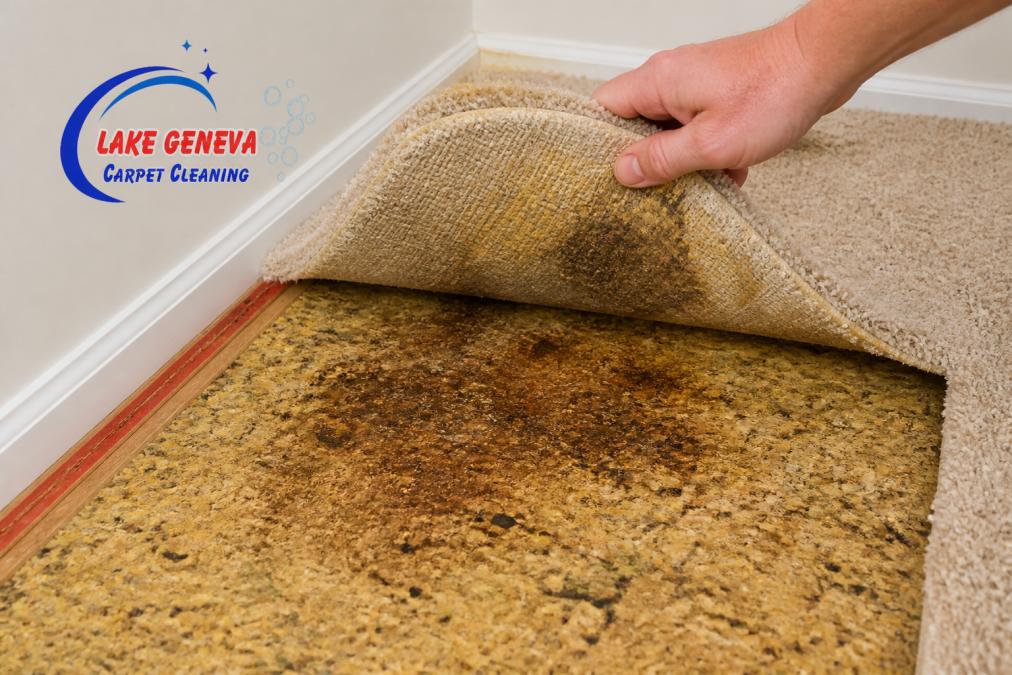
The padding beneath your carpet tells the real story. If you lift a corner of your carpet and the padding underneath is dark, stained, or smells strongly of urine, the contamination has spread deeper than surface cleaning can reach.
Look for these warning signs:
- Discolored padding, Yellow, brown, or dark stains indicate urine saturation
- Wet or damp padding, Even after the carpet feels dry, the padding may still hold moisture
- Visible mold or mildew, Dark spots on padding mean bacteria and fungi are growing
- Musty smell when you lift the carpet, Strong odors from the padding confirm deep contamination
- Carpet that feels spongy, Waterlogged padding underneath creates a soft, unstable feel
If the padding is heavily contaminated, surface cleaning won’t help. The padding may need to be replaced, or the subfloor underneath may require treatment. This is one of the biggest reasons homeowners see the smell return after trying DIY methods.
If the padding is soaked with urine, no amount of surface cleaning will solve the problem. Contaminated padding traps moisture and bacteria. It must be addressed to eliminate odor permanently.
Why Surface Cleaning Methods Fail
Store-bought spot cleaners and rental machines clean only the top layer of carpet. They don’t reach the padding or subfloor where most of the urine has settled. This is why the smell returns within days or weeks.
Surface cleaning methods fail because:
- They don’t use enough heat, Hot water is needed to break down uric acid crystals
- Extraction is shallow, Rental machines don’t pull moisture and urine deep enough
- No enzymatic breakdown, Standard cleaners don’t contain enzymes to break down odor compounds
- Moisture remains trapped, Without proper extraction, water stays in the padding and promotes bacterial growth
- They don’t address the subfloor, If urine has reached the subfloor, surface cleaning is useless
Many homeowners try these methods first because they’re accessible and seem like a quick fix. The problem appears solved for a few days. Then the smell returns, often stronger than before. This cycle repeats until professional treatment is used.
Moisture Reactivation and Humidity: The Return of Odors
Humidity is the enemy of pet urine odor control. Even after cleaning, dormant uric acid crystals and urea compounds can reactivate when moisture returns to the carpet. This is why the smell often comes back after humid weather or when you run a humidifier.
Moisture reactivation happens because:
- Urine compounds don’t fully evaporate, They remain in carpet fibers and padding as crystals
- Humidity brings moisture back, Humid air causes crystals to absorb water and release odor
- Temperature fluctuations trigger wicking, Warm days speed up evaporation from the padding, pushing odor molecules upward
- Wet cleaning without proper drying, If moisture stays in the carpet too long, bacteria multiply and odor intensifies
Homeowners in lake geneva dealing with seasonal humidity changes often see this pattern. Summer months bring higher humidity, which reactivates smells that seemed gone. Winter drying helps temporarily, but the problem returns when conditions change.
This is why drying speed matters. The faster the carpet dries after cleaning, the less time bacteria have to grow and the less chance for wicking to occur.
How to Remove Pet Urine from Carpet Effectively
Removing pet urine requires treating all layers: carpet fibers, padding, and subfloor. Surface cleaning alone won’t work. Here’s what an effective approach includes:
Identify all contaminated areas. Use a blacklight or moisture meter to find urine spots you can’t see. Many accidents go unnoticed until the smell becomes obvious. Finding all affected areas is critical.
Use enzymatic cleaners. These contain proteins that break down uric acid and urea at a molecular level. Enzymatic action is the only way to truly neutralize odor compounds, not just mask them.
Apply deep extraction. Professional-grade equipment pulls moisture, urine, and bacteria from deep in the carpet and padding. This requires hot water and strong suction to be effective.
Treat the padding if needed. If padding is heavily saturated, it may need enzymatic treatment or replacement. Attempting to save contaminated padding often leads to recurring odor problems.
Address the subfloor. If urine has soaked through to the subfloor, it must be sealed or treated to prevent odor from returning through new carpet or padding.
Allow proper drying time. After cleaning, the carpet must dry completely. This prevents moisture reactivation and bacterial growth.
The most common mistake is treating pet urine like a regular stain. It requires specialized enzymatic treatment and deep extraction, not standard carpet cleaning. Treating it like a normal spill is why the smell always comes back.
Professional Extraction vs. DIY Approaches
The gap between professional and DIY results isn’t just about equipment size, it’s about extraction depth, heat delivery, and how different carpet materials respond to treatment. Lake Geneva Carpet Cleaning uses state-of-the-art, truck-mounted hot water extraction technology.
Why truck-mounted systems reach deeper:
Professional truck-mounted extractors generate significant water pressure combined with strong suction strength. This dual force pushes hot water deep into carpet pile, through padding, and into the subfloor, then pulls contaminated moisture back out in a single pass. Other providers’ machines typically deliver less pressure and lift, enough for surface dirt, not enough to saturate and extract urine from the padding layer where most contamination lives.
The difference matters because uric acid crystals bond to fibers at multiple depths. Surface extraction leaves 60-70% of the contamination untouched. When moisture returns to the carpet (from humidity or residual dampness in the padding), those crystals reactivate and the smell returns within days or weeks.
Heat and enzymatic synergy:
Professional systems heat water to high temperatures before injection. This temperature breaks down uric acid crystals and allows enzymatic cleaners to penetrate fiber walls more effectively. Other providers’ machines often deliver water at lower temperatures, which is warm enough to feel hot but insufficient to denature uric acid bonds. Enzymatic cleaners work best in warm conditions; cooler water means slower chemical breakdown and less effective odor elimination.
Additionally, professional technicians apply enzymatic solutions with proper dwell time (allowing the enzyme to sit on contaminated areas for 15-30 minutes before extraction). DIY users typically spray and extract immediately, giving enzymes no time to break down odor compounds at a molecular level.
Material-specific treatment differences:
Synthetic carpets (polyester, nylon) and natural fiber carpets (wool, silk) respond very differently to moisture and enzymatic treatment:
- Synthetic fibers are more resilient to heat and enzymatic cleaners. They can tolerate 200°F+ water without damage. However, they absorb and hold urine more readily than natural fibers, requiring aggressive extraction to remove moisture completely.
- Wool and natural fiber carpets are sensitive to excessive heat and alkaline cleaners. They require gentler enzymatic solutions and lower water temperatures (160-180°F) to avoid fiber damage or color bleeding. Consumer rental machines often lack the precision to adjust temperature and solution strength for material type, leading to over-treatment or under-treatment.
Our team of seasoned professionals understands that a clean carpet does more than just improve appearance; it revitalizes the overall atmosphere of your home, making it a healthier, more inviting space for family and guests alike. Whether tackling tough stains or routine maintenance, Lake Geneva Carpet Cleaning dedicates its resources and expertise to transforming your carpets, effectively breathing new life into the heart of your home. DIY users typically apply the same method to all carpets, which either fails to remove urine from dense synthetics or damages delicate natural fibers.
Drying speed and bacterial control:
Our state-of-the-art, truck-mounted hot water extraction technology ensures a deep clean and significantly enhances indoor air quality. Other providers’ machines may leave carpet damp for longer periods. Every hour of dampness is an hour bacteria multiply in the padding. Slower drying also increases the risk of mold growth, which thrives in warm, moist environments and produces its own musty odor that compounds the urine smell.
Faster drying also prevents wicking. If the padding dries quickly, urine compounds don’t have time to evaporate and travel back to the surface. Slow drying from rental machines creates a perfect environment for wicking to occur repeatedly over several days.
The most overlooked reason DIY methods fail is drying time. Even if other methods extract some of the urine, the remaining contamination plus residual moisture in the padding will reactivate as the carpet slowly dries. Professional extraction removes enough moisture that the remaining dampness dries too quickly for odor reactivation to occur.
Why homeowners see temporary success with rentals:
After cleaning with other methods, the carpet may smell better for a few days. This isn’t because the urine is gone, it’s because the surface is clean and the padding is wet, which temporarily masks odor. As the carpet dries and moisture wicks back up, the smell returns, often stronger than before because bacterial colonies have grown in the damp padding.
This cycle repeats: use other methods, temporary improvement, smell returns, use again. Many homeowners spend more on repeated attempts than a single professional treatment would cost, only to end up with the same problem.
Protecting Your Health: Bacteria and Allergens in Contaminated Carpet
Pet urine contamination is more than an odor problem, it’s an indoor air quality and respiratory health issue that worsens over time and is often overlooked by homeowners focused solely on smell.
How ammonia vapors damage respiratory health:
When bacteria break down urea in pet urine, they produce ammonia gas. In a contaminated carpet, this process happens continuously, releasing ammonia vapors into the air you breathe. Unlike a one-time ammonia exposure (like cleaning with ammonia-based products), carpet contamination creates chronic, low-level ammonia exposure over weeks or months.
Ammonia is a respiratory irritant. At concentrations as low as 25 parts per million (ppm), it irritates mucous membranes in the nose, throat, and lungs. Contaminated carpet in a bedroom or living room can reach 15-40 ppm in the immediate area, especially in poorly ventilated rooms. Homeowners often don’t realize they’re breathing ammonia because the smell becomes familiar and their nose adapts (olfactory adaptation), but their lungs are still being irritated.
Signs of ammonia exposure include:
- Persistent cough or throat irritation
- Watery or burning eyes
- Nasal congestion that doesn’t respond to allergy medication
- Shortness of breath during normal activity
- Worsening asthma symptoms
These symptoms often improve within days of professional urine removal, but homeowners frequently attribute them to allergies or seasonal changes rather than carpet contamination.
Bacterial colonization and infection risk:
Pet urine contains bacteria from the urinary tract. When urine soaks into carpet padding, these bacteria don’t die, they multiply. In a warm, moist environment (which contaminated padding provides), bacterial colonies can double in size every 20 minutes under ideal conditions.
Common bacteria found in pet urine include E. coli and Staphylococcus, which can cause urinary tract infections if transferred to skin or ingested. Homeowners with young children who play on contaminated carpet face higher infection risk. Elderly family members and immunocompromised individuals are at serious risk from prolonged exposure.
Bacterial growth also produces endotoxins, toxic compounds released when bacteria die and break down. Endotoxins trigger inflammatory responses in the lungs and airways, causing symptoms similar to allergic reactions: wheezing, coughing, and chest tightness.
Mold growth and mycotoxin exposure:
Contaminated carpet padding that stays damp for more than 24-48 hours becomes a breeding ground for mold. Mold thrives in the presence of organic matter (urine) and moisture. Common mold species found in water-damaged carpet include Aspergillus, Penicillium, and Stachybotrys.
Mold produces spores and mycotoxins, chemical compounds that are toxic when inhaled. Mycotoxin exposure can cause:
- Chronic cough and bronchitis-like symptoms
- Increased asthma severity
- Allergic reactions (rashes, itching, swelling)
- Neurological symptoms in severe cases (headaches, memory problems, mood changes)
Mold odor (musty smell) often masks urine odor, leading homeowners to think the problem is just dampness rather than a serious mold contamination issue. By the time mold is visible, spore levels in the air are already elevated.
Dust mite and allergen amplification:
Dust mites feed on dead skin cells and thrive in warm, humid environments. Contaminated carpet provides both food (bacteria and organic matter from urine) and ideal humidity. A single dust mite produces 20 fecal pellets per day, and each pellet contains allergens. In heavily contaminated carpet, dust mite populations can be 10-20 times higher than in clean carpet.
Dust mite allergens are a major trigger for asthma and allergic rhinitis. Homeowners with dust mite allergies often notice symptoms worsen significantly in rooms with contaminated carpet, even if they can’t identify the source.
Vulnerable populations:
Certain groups face heightened health risks from contaminated carpet:
- Children under 5: Spend more time on floors, have developing immune systems, and are more susceptible to respiratory infections
- Elderly residents: Have weakened immune systems and are more vulnerable to bacterial and fungal infections
- People with asthma: Ammonia, mold spores, and dust mite allergens are potent asthma triggers
- Immunocompromised individuals: Cancer patients, organ transplant recipients, and people with HIV/AIDS face serious infection risk from bacterial exposure
- Pregnant women: Certain bacteria in urine (like Listeria) can cause miscarriage or birth complications
Why the problem worsens over time:
Unlike a one-time chemical exposure, contaminated carpet creates a self-perpetuating health hazard. Bacteria multiply, mold grows, dust mites increase, and ammonia production continues. Each week of delay allows bacterial and fungal colonies to expand, increasing the concentration of toxins and allergens in the air. What starts as an odor problem becomes a respiratory health crisis if left untreated for months.
If you or family members have developed unexplained respiratory symptoms, persistent cough, or worsening asthma since a pet accident occurred, contaminated carpet may be the cause. Professional urine removal often resolves these symptoms within 1-2 weeks, confirming the carpet was the source.
The importance of prompt professional treatment:
The longer contaminated carpet remains in your home, the greater the health risk and the more extensive the contamination becomes. Professional removal eliminates the source of ammonia, bacteria, mold, and allergens in a single treatment, stopping the cycle of exposure and allowing your home’s air quality to recover.
Frequently Asked Questions
Why does pet urine smell return even after I clean the carpet?
Pet urine odor returns because uric acid crystals and urea compounds penetrate deep into carpet padding and subflooring, where surface cleaning cannot reach them. When humidity increases or moisture reactivates these crystallized compounds, odor molecules are released again. Only extraction methods that remove moisture and contamination from the padding can prevent this reoccurrence.
What are the signs of pet urine in carpet padding?
Look for discolored patches under the carpet, a persistent ammonia smell when you lift the carpet edges, dark stains visible from the back of the carpet, or wet spots that don’t dry quickly. If your carpet feels damp or spongy in certain areas, the padding likely contains urine. Black light inspection can reveal hidden urine spots that aren’t visible to the naked eye.
How do I remove pet urine from carpet permanently?
Permanent removal requires extraction that reaches the padding and subflooring. Use enzymatic cleaners that break down uric acid molecules, apply alkaline treatments to neutralize acidic urine compounds, and extract all moisture thoroughly. For severe contamination, the padding may need replacement. Professional hot water extraction is the most effective method because it forces cleaning solution deep into fibers and padding, then removes all moisture.
Does humidity in Wisconsin homes make pet urine smell worse?
Yes. Humidity causes moisture reactivation, which releases odor molecules trapped in uric acid crystals. Wisconsin’s seasonal humidity and temperature changes trigger this cycle repeatedly. Even after cleaning, if moisture remains in the padding or subflooring, humidity will reactivate the smell. This is why complete moisture extraction and proper drying are essential in our climate.