Table of Contents
- Why Upholstery Cleaning Matters in Lake Geneva Homes
- How to Clean Delicate Upholstery Fabric
- Upholstery Stain Removal Tips That Actually Work
- Upholstery Cleaning Drying Time: What to Expect
- The Professional Cleaning Process, Step by Step
- DIY vs. Professional Upholstery Cleaning
- How Often Should You Schedule Upholstery Cleaning in Lake Geneva?
- What Is Eco-Friendly Upholstery Cleaning?
- Frequently Asked Questions
Last Updated: September 14, 2026
Why Upholstery Cleaning Matters in Lake Geneva Homes
Upholstery cleaning in Lake Geneva is not a cosmetic chore. It is maintenance for the furniture your family touches every day, and for the air they breathe while sitting on it. At Lake Geneva Carpet Cleaning, we have observed that fabric holds what vacuums cannot reach.
A sofa cushion is a sponge with a fabric cover. Every sit deposits body oils, skin cells, and dust; every pet adds dander and hair; every open window on a lake weekend adds pollen and grit. Over months, that mix settles past the surface into the padding, where a household vacuum cannot reach. That is why a couch can look fine and still smell faintly stale.
The fix is periodic deep cleaning, not more vacuuming. Below, we explain what lakeside living does to upholstery, how to treat delicate fabrics, and when to call a professional.
Health Benefits of Clean Upholstery
Clean upholstery reduces the allergens that settle into fabric and stay there. Dust mites, pet dander, and pollen collect in cushions and crevices, and every time someone sits down, some of it lifts back into the air.
For households dealing with allergies, that matters more than the appearance of the furniture. According to the American Lung Association guidance on indoor air quality, common indoor triggers include dust mites and pet dander, both of which concentrate in soft furnishings. Regular professional extraction removes them at the source rather than stirring them up.
There is a practical benefit too: fabric free of grit and oils wears more slowly, so cushions keep their shape and color longer, and lingering odors are removed.
What Lakeside Living Does to Your Furniture
Lake Geneva homes face contaminants inland homes do not: sand tracked in from beach access, road salt and brine from winter sidewalks, and damp lake air that keeps fabric slightly humid for much of the year.
Humidity is the quiet problem: fabric that stays damp between cleanings gives dust mites a friendlier environment and lets odors set deeper into the padding. Salt residue is worse, drying into an abrasive grit that grinds against fibers every time someone sits down, one reason lakeside furniture looks worn before its time.
If you live near the water, plan on cleaning upholstery more often than a typical household.
How to Clean Delicate Upholstery Fabric
Delicate upholstery fabric should be cleaned with the gentlest method that still removes soil: low moisture, mild agents, and a test patch first. Scrubbing and soaking damage delicate weaves, not cleaning itself.
Start by identifying the fabric and its cleaning code. Then work in this order:
- Vacuum both sides of the cushion with a brush attachment to lift loose soil
- Test any cleaner on a hidden area, then wait for it to dry fully before judging the result
- Apply cleaning solution to a white cloth, not directly to the fabric
- Blot, never rub, working from the outside of the stain inward
- Lift excess moisture with a dry towel and let the piece air dry with good ventilation
What most guides miss is the test patch. A cleaner that looks fine while wet can leave a ring or dull the color once dry. Test on the back or underside of a cushion, let it dry completely, then check under good light.
How to Identify the Cleaning Code on Your Furniture
The cleaning code is a single letter on the manufacturer’s tag, usually under the seat cushion or on the frame deck. It tells you which method the fabric tolerates.
| Code | Meaning | Safe Method |
|---|---|---|
| W | Water-based cleaners only | Mild detergent solution, light moisture |
| S | Solvent-based cleaners only | Water-free solvent spot cleaner |
| WS | Water or solvent | Either method, test first |
| X | Vacuum only | No liquid cleaner of any kind |
If the tag is missing, treat the fabric as code S until a professional inspects it. Using water on a solvent-only fabric can cause shrinkage, browning, or water rings that are difficult to reverse.
Fabric-by-Fabric Cleaning Guide
Most upholstery problems come from treating every fabric the same way. Each weave tolerates water, agitation, and heat differently. Here is how the most common Lake Geneva furniture fabrics should be handled.
Microfiber. Microfiber responds well to water-based cleaning but is easy to over-wet. Use a lightly dampened cloth, work in small sections, and blot rather than scrub. Rubbing hard can leave a crushed, shiny look, so keep pressure light and let the fiber air-dry in its natural direction. A soft-bristle brush can lift matted pile once nearly dry.
Leather and faux leather. Leather is not a traditional fabric, and water is its enemy. Wipe with a barely damp cloth and a leather cleaner, dry immediately, then condition to prevent cracking. Never saturate leather, use a brush, or let liquid sit in the seams. Faux leather is more forgiving but still dislikes abrasion and heat.
Velvet and velour. Velvet is a pile fabric, and the pile is what makes it beautiful and fragile. Clean with low moisture and a very soft brush, working with the nap rather than against it. Water rings are common, so clean an entire cushion face at once instead of spot-cleaning a patch. Brush the pile back into place while still slightly damp so it dries in the right direction.
Linen and cotton blends. These natural fibers are generally water-safe but prone to shrinkage and wrinkling. Use minimal moisture, avoid heat, and air-dry away from direct sun. Linen can brown if it stays wet too long, so lift moisture quickly with a dry towel.
Wool and wool blends. Wool is durable but sensitive to heat and agitation. Use cool water, mild agents, and gentle blotting. Hot water can cause wool to felt or shrink, so keep temperatures low and never scrub.
Silk and other luxury weaves. Silk and similar luxury fabrics should generally be left to a professional. Water can leave permanent rings, and even mild cleaners can alter the sheen. If a spill happens, blot immediately with a dry white cloth and stop there.
When to Stop and Call a Professional
Some fabrics and stains are not worth the risk of a home attempt. Stop and call a professional if:
- The cleaning code is S or X and you do not have the right solvent
- The fabric is silk, velvet, or an antique weave
- The stain is ink, wine, dye, or anything you cannot identify
- The piece has been cleaned twice and the mark or odor remains
- The furniture is a family heirloom or has significant replacement value
A professional can test a hidden area, choose the right method for the fiber, and stop before damage happens.
Upholstery Stain Removal Tips That Actually Work
Upholstery stain removal works best when you treat the stain by type, not with one all-purpose product. The wrong approach sets the stain instead of lifting it.
Three rules apply to almost every spill:
- Act within minutes. Fresh stains lift; dried stains bond.
- Blot from the edges toward the center so you do not spread the ring.
- Never rub. Rubbing pushes the substance deeper into the weave and fuzzes the fibers.
For liquid spills, press a clean white towel onto the area and let it absorb. For semi-solids, lift what you can with a dull edge before blotting. For grease, a small amount of mild dish soap in cool water, applied to a cloth, often works on water-safe fabrics.
Using hot water or a household iron on an unknown stain can set it permanently. Heat bonds protein and dye-based stains into the fiber, and no amount of later cleaning will fully lift them.
Pet Stains and Odor Treatment
Pet stains and odor treatment require more than surface cleaning because urine wicks down through the fabric into the cushion foam, where it releases odor for weeks.
That is why the smell comes back: cleaning the cover removes the visible stain but leaves the source in the padding, and the odor returns as soon as humidity rises. Effective treatment means flushing the affected layer, not wiping the top.
For fresh accidents, blot immediately and use an enzyme-based cleaner, which breaks down the uric acid crystals that cause the smell. For older or repeated accidents, the padding usually needs professional extraction that reaches below the fabric surface. If you have fought the same odor for months, the problem is depth, not the product.
Upholstery Cleaning Drying Time: What to Expect
Upholstery cleaning drying time typically runs 4 to 8 hours for professional low-moisture methods, and 12 to 24 hours for heavier extraction or humid conditions. Fabric type, humidity, and airflow all change the number.
A common mistake is judging dryness by touch. The surface can feel dry while the padding underneath is still damp, exactly the condition that encourages mold and musty odor. Press a dry paper towel into the cushion seam; if it comes back cool or damp, the piece is not dry.
Speed drying with these steps:
- Run ceiling fans and a floor fan aimed across the fabric
- Open windows if outdoor humidity is low
- Avoid sitting on the piece until it is fully dry
- Blot any remaining moisture with a clean towel
In a Lake Geneva basement or closed-up lake house, expect the longer end of that range. Damp air slows evaporation, and fabric in a cool room can stay moist well past the point where it feels dry.
The Professional Cleaning Process, Step by Step
Professional upholstery cleaning follows a defined sequence: inspect, pre-treat, agitate, extract, and dry. Skipping steps is what separates a surface wipe-down from a genuine deep clean.
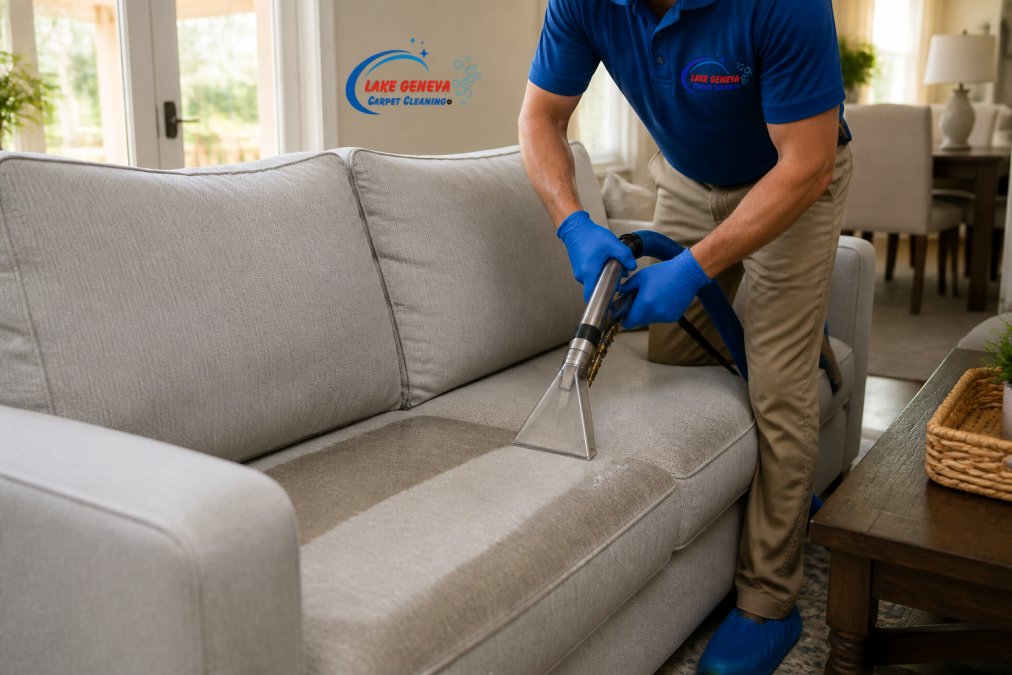
Here is how the process runs in a typical home:
- Inspection. The technician checks fabric type, cleaning code, and any pre-existing damage or fading.
- Pre-treatment. Cleaning solution is applied to break down oils and soil.
- Agitation. Gentle brushing loosens embedded grit from the weave.
- Extraction. Hot water extraction flushes soil and moisture out of the fabric and padding.
- Grooming and drying. Fibers are set in one direction, and airflow is set up to dry the piece evenly.
The extraction step is where results are won or lost. Soil extraction that reaches the padding removes the allergens and odor sources that surface cleaning leaves behind.
Ask what equipment will be used before you book. Truck-mounted hot water extraction generates stronger suction and hotter water than portable units, which means deeper soil removal and faster drying. It is a fair question for any homeowner to ask.
DIY vs. Professional Upholstery Cleaning
DIY upholstery cleaning handles light, surface-level soil well. Professional cleaning is often recommended for deep soil, pet odor, delicate fabrics, and anything you cannot safely test.
Rental machines and store-bought spot cleaners have a real place. For a single fresh spill on a water-safe fabric, a spot cleaner and a clean towel are often all you need. The limits show up when the problem is not on the surface:
- Odor that returns after cleaning points to soil in the padding
- Delicate or code S fabrics can be damaged by water-based DIY methods
- Over-wetting is common with rental equipment and leads to slow drying and mildew risk
- Allergen reduction requires extraction depth that consumer units rarely reach
Why Rental Machines and Store-Bought Spot Cleaners Fall Short
The gap between consumer tools and professional equipment is not about effort. It is about physics. Rental machines and store-bought spot cleaners are built to lift surface soil from a small area, and they are designed to be safe in untrained hands. That design limits how much water they use, how hot it gets, and how much suction they can pull.
Three limits matter most for upholstery:
Water temperature. Hot water extraction relies on heat to break the bond between soil and fiber. Consumer units run cooler, so oils and grease stay bound to the weave. What looks clean after a DIY pass is often just soil that has been redistributed.
Suction and lift. Professional truck-mounted extraction pulls far more moisture out of the padding than a portable unit can. Leftover moisture is the root of slow drying, musty odor, and mildew in the cushion foam.
Residue. Many consumer cleaners leave a sticky residue behind. That residue attracts new dust and oils from the air, which is why some couches look dingy again within a few weeks. Professional rinsing and extraction remove the residue along with the soil.
There is also a fabric-safety issue. Rental machines and store-bought spot cleaners may not be designed around the cleaning code system. Using a water-based product on a solvent-only fabric can shrink, brown, or ring the material in ways that are difficult or impossible to reverse. A professional inspects the code and the fiber before choosing a method.
The Health Angle: What Deep Extraction Removes
Clean upholstery is not just about appearance. It is about what is in the air your family breathes. Dust mites, pet dander, pollen, and mold spores all settle into cushions and crevices, and every time someone sits down, some of that material lifts back into the room.
According to the American Lung Association guidance on indoor air quality, common indoor triggers include dust mites and pet dander, both of which concentrate in soft furnishings. Surface cleaning stirs these particles up. Deep extraction removes them at the source.
For households with allergies, asthma, or young children, that difference is the whole point. A couch that looks clean but still holds allergens may continue to trigger symptoms. A couch that has been extracted to the padding aims to reduce allergens.
A Simple Decision Guide
Use this to decide whether to handle a cleaning yourself or bring in a professional:
| Situation | Best Approach |
|---|---|
| One fresh spill on a water-safe fabric | DIY spot treatment |
| Routine light vacuuming and freshening | DIY with a brush attachment |
| Odor that returns after cleaning | Professional extraction |
| Pet accidents, especially repeated ones | Professional extraction |
| Delicate, code S, or code X fabric | Professional only |
| Allergy or asthma concerns in the home | Professional extraction |
| Commercial or vacation rental seating | Professional on a schedule |
If you have cleaned a piece twice and the stain or smell is still there, the issue is depth, not effort. That is the point where a professional visit saves both time and risk.
How Often Should You Schedule Upholstery Cleaning in Lake Geneva?
Most homes should schedule professional upholstery cleaning every 12 months, with lakeside and pet-owning households moving to every 6 to 9 months. Cleaning frequency depends on use, pets, and how close you are to the water.
Use this as a starting guide:
| Household Situation | Suggested Frequency |
|---|---|
| No pets, low traffic, inland | Every 12 months |
| Pets or young children | Every 6 to 9 months |
| Lakeside home with sand and salt exposure | Every 6 to 9 months |
| Vacation rental or commercial seating | Every 3 to 6 months |
Between professional visits, vacuum upholstery every week or two with a brush attachment, and treat spills the same day. That routine keeps soil from bonding and makes each deep clean more effective.
For local business owners, waiting until seating looks visibly soiled is too late. Customers read a worn, dingy chair as a sign of how the rest of the business is run, and commercial seating takes far more use per month than home furniture.
What Is Eco-Friendly Upholstery Cleaning?
Eco-friendly upholstery cleaning is the use of cleaning agents and methods chosen to limit chemical exposure for people and pets while still removing soil effectively. It is not a single product; it is a set of choices about what goes on your fabric and what stays in your home.
The practical questions to ask any provider:
- What cleaning agents are used, and are they safe around children and pets once dry?
- How much moisture is left behind, since over-wetting is its own problem?
- Is the method low-residue, so fabric does not attract new soil quickly?
Low-residue cleaning matters more than most people realize. Sticky cleaner left in the fabric grabs dust and oils from the air, which is why some couches look dingy again within weeks. Rinsing thoroughly and extracting properly solve that problem at the source.
The two things that can influence how long a cleaning lasts are extraction depth and residue left behind. Ask about both before you book any provider.
Frequently Asked Questions
How often should I have my upholstery professionally cleaned in Lake Geneva?
Most homes benefit from professional upholstery cleaning every 12 to 18 months, but households with pets, children, or allergy sufferers may need it every 6 to 12 months. Lakeside homes exposed to road salt, sand, and humidity often need more frequent deep cleaning. Regular upholstery maintenance also extends the lifespan of your furniture and keeps indoor air quality higher between visits.
Can professional upholstery cleaning remove pet odors and allergens?
Yes. Hot water extraction reaches deep into padding and fabric fibers where vacuuming cannot, pulling out embedded pet dander, dust mites, and odor-causing residue. For pet stain removal, technicians often apply enzyme-based pretreatments before extraction. This combination addresses the source of the odor rather than masking it, and it is one of the biggest health benefits of clean upholstery for allergy sufferers.
How long does it take for upholstery to dry after a professional cleaning?
Upholstery drying time typically ranges from 4 to 8 hours with proper ventilation, though humidity and fabric thickness can extend it. Professional extraction removes most of the moisture during cleaning, so drying time is much shorter than with rental machines or store-bought spot cleaners. Running fans or opening windows speeds things up, and most furniture is ready for normal use the same day.
What are the best methods for cleaning delicate upholstery fabrics?
Delicate fabrics like silk, velvet, and some blends require low-moisture or dry cleaning methods rather than heavy saturation. Always check the cleaning code tag first, test any product on a hidden area, and avoid scrubbing, which can distort fibers. For fabrics labeled S or W, a professional can match the right upholstery cleaning process to the material.