Table of Contents
- Why Upholstery Stain Removal Fails (and How to Get It Right)
- Step 1: Identify Your Upholstery Fabric and Care Code
- Step 2: Gather the Right Tools for Upholstery Spot Cleaning
- Step 3: Test for Colorfastness Before You Start
- Step 4: The Correct Blotting Technique for Fresh Stains
- Removing Set-In Stains from Upholstery: A Different Approach
- Upholstery Spot Cleaning Best Practices for Pet Owners
- Common Upholstery Stain Removal Mistakes to Avoid
- When to Choose Professional Upholstery Cleaning in Lake Geneva
- Conclusion: Restore Your Upholstery with the Right Care
- Frequently Asked Questions
Last Updated: September 8, 2026
Why Upholstery Stain Removal Fails (and How to Get It Right)
Most upholstery stain removal attempts fail for one simple reason: the wrong technique applied at the wrong time. Rubbing a fresh spill with a paper towel or grabbing the nearest all-purpose spray often pushes the stain deeper into the fibers, turning a minor spot into a permanent mark. At Lake Geneva Carpet Cleaning, we’ve spent over 32 years pulling stains out of sofas, chairs, and headboards, and the difference between success and failure usually comes down to method, not product.
Upholstery stain removal is the process of treating spots on fabric-covered furniture using techniques that lift contaminants out of the fibers rather than grinding them in. The good news is that most fresh stains, and many older ones, respond well to a careful home approach. Below, we’ll walk through the exact steps that work, from identifying your fabric type to knowing when to call a professional upholstery cleaning service in Lake Geneva.
The single most important rule: blot, never rub. Rubbing spreads the stain and damages the fibers. Blotting absorbs the spill and lifts it away.
Step 1: Identify Your Upholstery Fabric and Care Code
Before you touch a stain, check the tag sewn under your cushion or on the frame. Upholstery fabric types are grouped into cleaning codes that tell you what is safe to use. These codes are defined by industry standards and appear on most furniture manufactured for the U.S. market, and understanding them is the foundation of upholstery spot cleaning best practices.
- W (Water-based): Clean with water-based products or upholstery shampoo. Most synthetic fibers like polyester and nylon fall here.
- S (Solvent-based): Use only solvent-based cleaners or dry-cleaning products. Water will leave rings or shrink the fabric.
- WS (Water/Solvent): Either approach is acceptable. Common on natural fiber blends.
- X (Professional only): Do not attempt DIY cleaning. Vacuum only and call a professional upholstery cleaning company.
If the tag is missing or unreadable, treat the fabric as if it carries the most restrictive code you suspect. When in doubt, an upholstery fabric care code of X means professional intervention is required, and attempting a DIY method can void warranties or cause permanent damage.
Step 2: Gather the Right Tools for Upholstery Spot Cleaning
Effective upholstery spot cleaning depends less on expensive products and more on having the right basics ready before a spill happens. Assembling a small kit keeps you calm and fast when accidents occur, which matters because the first 60 seconds after a spill largely determine the outcome.
Your kit should include:
- White microfiber cloths or clean white cotton towels (color-free so dyes don’t transfer)
- White vinegar and distilled water for a gentle all-purpose solution
- A mild, pH-neutral dish detergent (a few drops go a long way)
- Rubbing alcohol for solvent-safe fabrics, diluted with water
- An enzymatic cleaner for pet stains and organic matter
- A soft-bristled upholstery brush or a clean toothbrush
- A vacuum with an upholstery attachment
Avoid store-bought spot cleaners that contain bleach or harsh optical brighteners, which can strip color or leave residue that attracts more dirt. For pet owners, an enzymatic cleaner is non-negotiable: it breaks down the proteins in urine and saliva that ordinary cleaners leave behind.
Step 3: Test for Colorfastness Before You Start
A colorfastness test is the step most people skip, and it’s the reason many DIY attempts end with a bleached patch on an otherwise fine sofa. Before applying any solution, test it in a hidden area, such as under a cushion or on the back of the piece, to confirm the dye won’t bleed or fade.
Dampen a white cloth with your chosen cleaning solution and press it against the hidden fabric for about 30 seconds. Check the cloth for color transfer. If any dye lifts onto the cloth, do not use that solution on the visible surface. Switch to a gentler option or call a professional for upholstery stain removal in Lake Geneva.
This test takes two minutes and prevents the most common and costly mistake in furniture care. It also confirms whether your fabric will tolerate moisture at all, which matters for natural fibers like linen that can shrink or water-spot easily.
Step 4: The Correct Blotting Technique for Fresh Stains
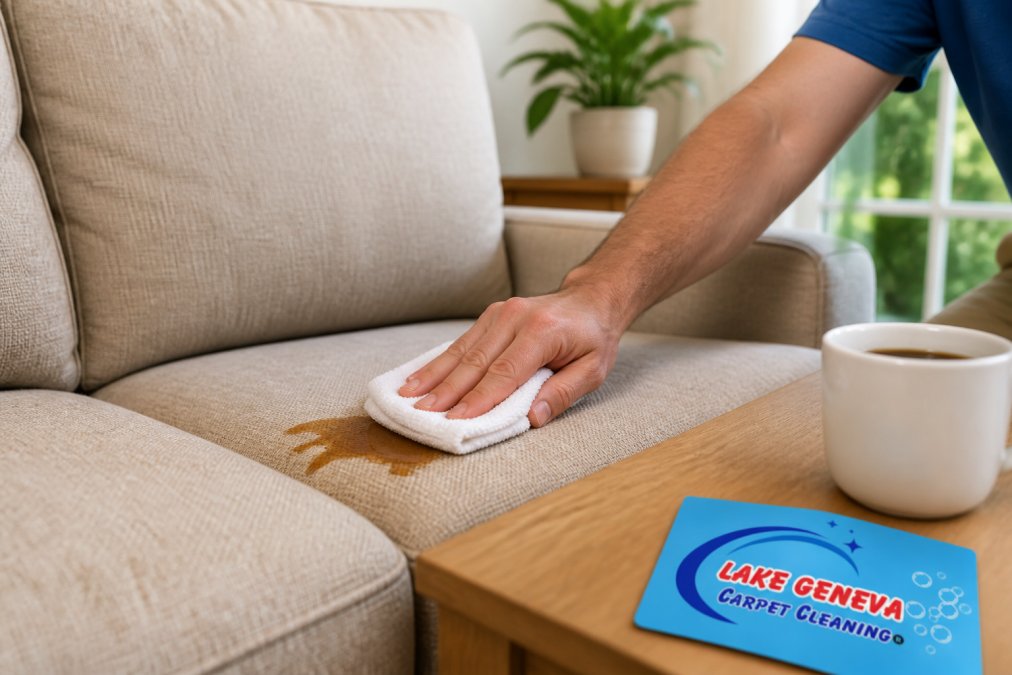
When a spill happens, work quickly but gently. The correct blotting technique for fresh stains starts with a dry cloth to absorb as much liquid as possible before any cleaning solution enters the picture.
Follow these steps in order:
- Blot the spill immediately with a dry white cloth, working from the outside edge toward the center to prevent spreading.
- Apply a small amount of your cleaning solution to a fresh cloth, not directly to the fabric, to control saturation.
- Blot the stain gently, rotating the cloth so you always press with a clean section.
- Repeat until no more color transfers to the cloth, then blot with a damp cloth rinsed in distilled water.
- Blot dry with a clean towel and allow the area to air dry completely.
Never rub a stain, even when it looks like rubbing will speed things up. Rubbing frays the fibers, spreads the stain wider, and drives particles deeper into the cushion where they become nearly impossible to extract.
Fabric saturation is your enemy here. Wetting the cushion all the way through can soak the foam core and create a breeding ground for mold and mildew. Use minimal moisture and let the fabric dry fully between attempts.
Removing Set-In Stains from Upholstery: A Different Approach
Fresh stains respond to blotting; removing set-in stains from upholstery requires more patience and a different strategy. Once a spill has dried or been through a wash cycle, the residue has bonded with the fibers, and surface blotting alone won’t lift it.
For set-in stains, start by vacuuming the area thoroughly to remove loose dirt. Then apply your cleaning solution and let it sit for 10 to 15 minutes so it can break down the bond between the stain and the fabric. Blot, rinse with a damp cloth, and repeat. Old protein stains like milk or blood may need several rounds with an enzymatic cleaner, which digests the organic matter over time.
Some stubborn stains respond to a diluted rubbing alcohol solution on solvent-safe fabrics. Test first, apply sparingly, and blot immediately. If the stain survives three attempts, further DIY treatment will likely damage the fabric. At that point, professional upholstery steam extraction offers the best chance of removal without harming the fibers.
| Stain Type | Best First Approach | If Stain Persists | When to Call a Professional |
|---|---|---|---|
| Fresh coffee or tea | Blot with club soda or mild detergent | Repeat with enzymatic cleaner | After 2 failed attempts |
| Red wine | Blot, then salt or club soda | Diluted dish soap solution | If color remains after drying |
| Pet urine | Blot, then enzymatic cleaner | Repeat enzyme treatment | If odor returns within weeks |
| Grease or oil | Blot, then solvent-based cleaner | Cornstarch to absorb, then vacuum | If ring remains after treatment |
| Ink or marker | Rubbing alcohol on solvent-safe fabric | Professional solvent extraction | Immediately if fabric is delicate |
Upholstery Spot Cleaning Best Practices for Pet Owners
Pet owners face a unique challenge: stains and odors that resurface weeks after cleaning. The smell comes back because ordinary cleaners remove the visible mark but leave behind the uric acid crystals, which reactivate when humidity rises. Effective pet stain removal requires an enzymatic cleaner that actually digests those crystals rather than masking them.
Most general stain removal guides treat pet accidents like any other spill. That’s a mistake. Pet waste contains uric acid, bacteria, and proteins that bond to upholstery fibers and cushion foam in ways that coffee or wine never do. If you don’t break down those components completely, the stain returns, and so does the odor.
Why Enzymatic Cleaners Are Non-Negotiable
Enzymatic cleaners contain specific proteins (enzymes) that catalyze the breakdown of uric acid, urea, and other organic compounds found in pet waste. Unlike detergents that simply lift and suspend dirt, enzymes actively digest the stain at a molecular level. This is why they’re the only DIY product that can truly eliminate pet odors rather than temporarily mask them.
For the enzyme to work, it needs time. Most labels instruct you to let the solution sit for 10 to 15 minutes, but for set-in accidents, leaving it for 30 minutes or longer is often more effective. The enzyme needs moisture to stay active, so cover the treated area with plastic wrap to keep it from drying out too quickly.
Step-by-Step Protocol for Fresh Pet Accidents
When you catch your pet in the act, follow this sequence exactly:
- Blot, don’t wipe. Use dry paper towels or a white cloth to absorb as much liquid as possible. Press firmly and lift. Repeat until the cloth comes up nearly dry.
- Apply the enzymatic cleaner generously. Saturate the stained area, but avoid soaking through to the cushion foam. The goal is to cover the affected fibers completely.
- Let it dwell. Set a timer for at least 15 minutes. For urine that’s soaked in, 30 minutes is better. The enzymes need time to break down the uric acid crystals.
- Blot again. After the dwell time, blot the area to remove the enzyme solution and dissolved waste. Don’t rub.
- Allow to air dry completely. This can take 12 to 24 hours depending on humidity. Do not use a hair dryer or space heater, heat sets protein stains and deactivates the enzymes.
- Vacuum the area once dry to restore the fabric’s texture.
Handling Set-In Pet Stains and Recurring Odors
For accidents you didn’t find until days later, the uric acid has likely crystallized deep within the fibers and possibly the foam. A single enzyme treatment may not be enough. Apply the enzyme cleaner, let it dwell, blot, and repeat the process two or three times over several days. Between treatments, sprinkle a light layer of baking soda over the area to absorb residual odors, then vacuum it up before the next enzyme application.
If the odor returns within a few weeks, the urine has likely soaked through the fabric into the cushion foam or even the wood frame. Surface cleaning won’t solve this. A professional upholstery deodorizing treatment that reaches deep into the padding is often the only lasting fix, which is why many pet owners in Walworth and Kenosha counties turn to Lake Geneva Carpet Cleaning for this exact problem.
The Heat Trap: Why Hot Water Makes Pet Stains Worse
One of the most common mistakes we see is using hot water to clean a pet accident. Heat denatures the proteins in urine and feces, causing them to bond permanently to the fabric fibers. Once that happens, the stain becomes nearly impossible to remove, even with professional equipment. Always use cool or lukewarm water for pet accidents, and never use a steam cleaner on a fresh stain.
What About Older, Dried Accidents?
Dried pet waste requires a different approach. Start by vacuuming the area thoroughly to remove any loose debris. Then apply a small amount of cool water to rehydrate the stain, this helps the enzymes penetrate the dried residue. Let it sit for 5 minutes, then apply the enzymatic cleaner and follow the steps above.
For very old, deeply set stains, you may need to repeat the enzyme treatment several times over the course of a week. If the stain and odor persist after three full treatment cycles, the contamination has likely reached the cushion core. At that point, professional upholstery cleaning is the most reliable option.
Keep a dedicated enzymatic cleaner in your upholstery stain removal kit at all times. When a pet accident happens, you won’t have time to run to the store, and the first 60 seconds are critical for preventing the stain from setting.
Common Upholstery Stain Removal Mistakes to Avoid
Even with the right products, small errors can ruin a piece of furniture. The most frequent upholstery stain removal mistakes we see include over-wetting the fabric, using heat too early, and giving up after a single attempt.
- Over-wetting: Too much water soaks into the foam, causing water rings on the fabric surface and potential mold growth below.
- Using heat: Hot water or a hair dryer sets protein stains permanently. Always use cool or lukewarm water and air dry.
- Skipping the rinse: Leaving cleaning solution residue in the fabric attracts dirt, making the spot reappear faster than before.
- Scrubbing vigorously: Aggressive scrubbing damages the fiber structure and creates a fuzzy, worn patch.
- Mixing chemicals: Combining ammonia with bleach-based products creates toxic fumes. Stick to one solution at a time.
If you’ve made any of these mistakes, the stain may look permanent, but professional cleaning can often still recover the fabric. Truck-mounted hot water extraction reaches deeper than any home method and rinses out both the stain and the residue left behind by earlier attempts.
When to Choose Professional Upholstery Cleaning in Lake Geneva
Some situations call for professional upholstery cleaning in Lake Geneva, and recognizing them early saves you time and money. If your fabric carries an X care code, if the stain has set for weeks, if you’re dealing with a large piece like a sectional, or if pet odors keep returning, DIY methods have reached their limit.
Professional upholstery steam extraction uses hot water injection and powerful vacuum extraction to flush contaminants out of the fabric and the cushion core. Lake Geneva Carpet Cleaning brings over 32 years of experience and eco-friendly cleaning methods to every job, ensuring your furniture is treated with solutions that are safe for kids and pets. Our truck-mounted system also extracts allergens and dust mites that surface vacuuming misses, which matters for households where allergies are a concern. We ensure healthier living and working spaces.
If you’re searching for “upholstery cleaning near me,” look for an owner-operated business that answers its own phone and stands behind the work. A 10-day satisfaction guarantee, like the one we offer, signals confidence in our work.
Conclusion: Restore Your Upholstery with the Right Care
Upholstery stain removal doesn’t have to be a gamble. Identify your fabric, test your solution, blot gently, and know when to stop. For stains that resist your best efforts, or for routine deep cleaning that keeps your furniture looking new, professional help is the reliable path.
At Lake Geneva Carpet Cleaning, we offer upholstery cleaning, pet stain and odor removal, and area rug cleaning for homeowners and businesses across the Lake Geneva area. Our eco-friendly, truck-mounted hot water extraction removes embedded dirt, allergens, and odors that surface methods leave behind. Contact us for a free quote and see why homeowners throughout Wisconsin trust us with their furniture.
Frequently Asked Questions
Can I use dish soap for upholstery stain removal?
A small amount of mild dish soap mixed with water can work on some upholstery stains, but it is not a universal solution. Dish soap can create excess foam that is hard to rinse out, leaving a sticky residue that attracts more dirt. It should only be used on fabrics that tolerate water, and you must test for colorfastness first. For most stains, a dedicated upholstery spot cleaner or a simple vinegar and water solution is safer and more effective.
What is the best way to remove set-in stains from upholstery?
Set-in stains require more than a surface wipe. Start with a gentle blotting action using a solution of white vinegar, distilled water, and a drop of dish soap. For organic stains like coffee or blood, an enzymatic cleaner breaks down the proteins that cause the stain and odor. Work the cleaner into the fabric with a soft-bristled upholstery brush, let it sit, and then blot it up. If the stain remains, professional upholstery cleaning may be needed.
When should I call a professional for upholstery cleaning in Lake Geneva?
Call a professional when you have large or multiple stains, set-in odors from pets, or delicate fabrics like silk or wool that are easy to damage. DIY methods can sometimes set a stain or over-wet the padding, leading to mold. Professional upholstery cleaning in Lake Geneva uses truck-mounted hot water extraction to remove deep dirt and allergens without over-saturating your furniture. If your DIY attempts have not worked, it is time to get a free quote from a local expert.