Table of Contents
- How Enzymatic Cleaners Break Down Old Stains
- Fresh vs. Set-In Stains: Why Age Changes Everything
- How to Remove Set-In Carpet Stains Step by Step
- How Long to Let Enzyme Cleaner Sit on a Stain
- Limitations of Enzymatic Cleaners on Old Stains
- Material-Specific Reactions: Carpet, Upholstery, and Hardwood
- Reactivation Science: Why Old Odors Return
- Post-Cleaning Maintenance and Lake Geneva Climate Challenges
- Frequently Asked Questions
Last Updated: September 17, 2026
How Enzymatic Cleaners Break Down Old Stains
Yes, an enzymatic cleaner can work on old stains, but age changes the job. Fresh spills sit near the surface. Old ones have already soaked into the backing and padding, where the mess keeps bonding to the fibers.
That gap explains why the same bottle that erased last week’s accident can fail on a six-month-old one. This guide from Lake Geneva Carpet Cleaning covers what enzymes actually do, where they stall, and how to give them the best shot.
An enzymatic cleaner is a cleaning product that uses live bacteria and the enzymes they produce to break down organic stains like pet urine, food, and blood. The enzymes digest the waste at a molecular level instead of just lifting it off the surface.
Bacteria, Enzymes, and the Molecular Breakdown Process
Here’s the part most guides skip. The bacteria are the factory, and the enzymes are the tools they make.
- Proteases break down protein-based stains like blood and vomit
- Lipases attack fats and grease
- Amylases handle starches and food residue
- Urease targets the uric acid crystals in pet urine
The bacteria feed on the broken-down matter, multiply, and keep producing more enzymes. That cycle is why enzymatic activity can keep working for days, not minutes. A standard detergent stops the moment it dries. A bio-enzymatic formula keeps going as long as the bacteria stay alive and the area stays damp.
That living cycle is also the weakness. Kill the bacteria with the wrong product, and the whole process stops cold.
Fresh vs. Set-In Stains: Why Age Changes Everything
Age is the single biggest factor in whether a stain comes out. A fresh stain is still sitting in the top layer of carpet fibers. A set-in stain has moved deeper and chemically bonded to the material.
Time does three things to a stain:
- It dries and locks in. Liquid evaporates, leaving concentrated residue behind.
- It wicks downward. Gravity pulls the mess into the backing and padding.
- It oxidizes. Exposure to air darkens the color and makes it harder to lift.
Pet urine adds a fourth problem. As it dries, the uric acid forms crystals that cling to the fibers. Those crystals don’t dissolve in water, and they release odor every time humidity rises. That’s why old pet accidents smell worse on a rainy day.
The practical takeaway: the older the stain, the more dwell time and repeat treatments it needs. One pass rarely finishes the job.
How to Remove Set-In Carpet Stains Step by Step
Set-in stains need patience more than muscle. Follow this sequence, and you’ll give the enzymes what they need to work.
Testing Colorfastness and Preparing the Area
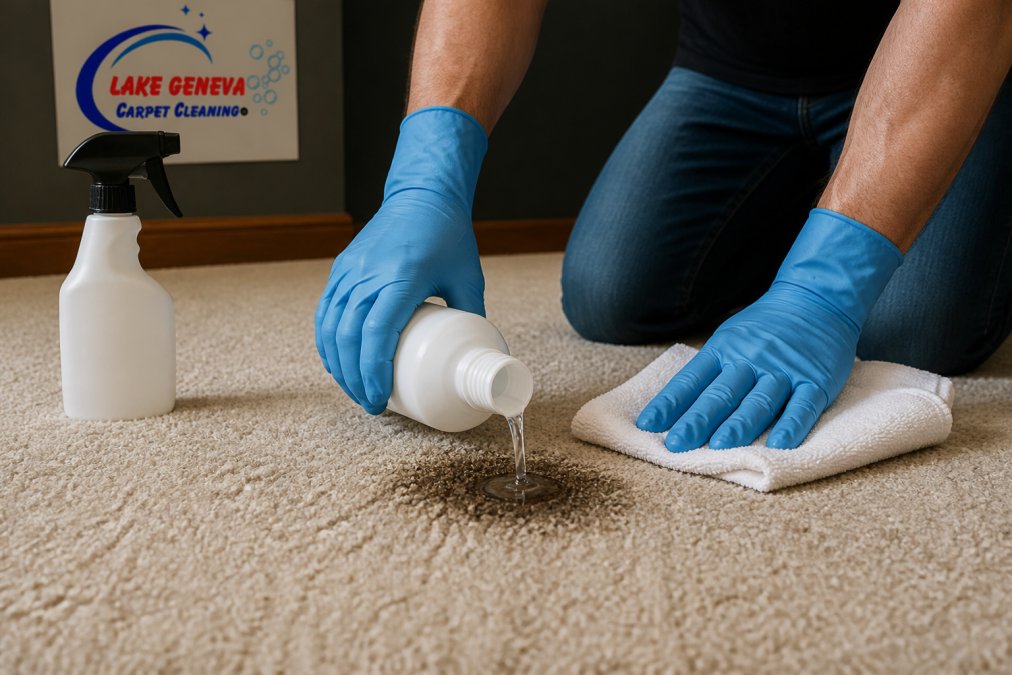
Test before you treat. Dab a small amount of the product on a hidden spot, wait a few minutes, then blot with a white cloth. If color transfers to the cloth, stop. That carpet isn’t colorfast, and a full application could bleach it.
Once the test passes:
- Vacuum the area to pull up loose dirt and hair
- Blot any remaining moisture with a clean towel
- Work from the outside of the stain toward the center
Working inward keeps the stain from spreading into clean fibers.
Applying, Agitating, and Blotting Without Over-Wetting
Apply enough product to reach the backing, not just the surface. Surface saturation matters here. A light mist sits on top and does nothing for a stain that’s already deep.
Then agitate gently with a soft brush. You’re working the cleaner into the fibers, not scrubbing the stain out. Hard scrubbing damages carpet fibers and can fray the tips.
Wait, then blot. Press a clean white towel down and hold it. Don’t rub, because rubbing pushes the mess sideways.
Over-wetting is the most common DIY mistake. Soak the padding and you risk mold, delamination, and a musty smell that lingers for weeks. Apply in light passes, and blot between them.
How Long to Let Enzyme Cleaner Sit on a Stain
Dwell time is where most people quit too early. The product needs time to digest the stain, and that takes longer than a spray-and-wipe.
For a fresh stain, 10 to 15 minutes usually does it. For a set-in stain, plan on 30 minutes to several hours. Some tough pet accidents need an overnight soak with a damp towel over the top to slow evaporation.
Two things control how long you can wait:
- Evaporation rate. Dry product means dormant bacteria. Cover the area with plastic wrap to hold moisture in.
- Temperature. Enzymes work faster in warm conditions and slow down in the cold.
Check the label for the maker’s recommended dwell time, then lean toward the longer end for old stains. After the wait, blot and let the area air dry. If the stain fades but doesn’t vanish, repeat. Old stains often need two or three rounds.
After blotting, leave the area slightly damp and cover it overnight. The bacteria keep working while you sleep, and the covered surface won’t dry out and stall the reaction.
Limitations of Enzymatic Cleaners on Old Stains
Enzymes are not a magic eraser. They have a specific job, and they only do that job well. Understanding the limits isn’t about giving up; it’s about knowing when to change tactics.
The Four Things Enzymes Need (and What Happens When They’re Missing)
Enzymes are biological catalysts. They need four conditions to work, and old stains often violate all of them.
- Organic matter. Enzymes break down proteins, fats, starches, and uric acid. They do nothing for synthetic spills like ink, paint, or rust. If the stain isn’t biological, the enzyme has no target.
- Moisture. Dry product is dormant product. The bacteria that produce enzymes need a damp environment to stay active. Once the area dries, the reaction stops. This is why covering the treated area with plastic wrap or a damp towel is so important for old stains.
- Time. Enzymes work on a molecular level, one bond at a time. A quick spray-and-wipe doesn’t give them enough time to digest a set-in stain. Old stains need hours, not minutes.
- The right temperature. Enzymes work faster in warm conditions and slow down in the cold. In a cold room or on a winter day, expect the process to take longer.
When any of these conditions is missing, the enzyme cleaner underperforms. That’s not a product failure; it’s a chemistry problem.
The Reactivation Problem: Why Old Odors Return
This is the limitation most guides skip, and it’s the one that matters most for old pet stains.
When pet urine dries, the water evaporates but the uric acid remains. Uric acid forms crystals that bond tightly to carpet fibers, backing, and padding. These crystals are stable when dry, which is why the odor seems to disappear after cleaning. But add moisture, from humidity, a spill, or a steam clean, and the crystals release ammonia gas again. The odor returns like it never left.
This is called reactivation, and it’s why surface cleaning fails on old pet stains. You can remove the visible mess and still leave the crystal source buried in the pad. Every damp day reactivates it.
Enzymatic cleaners can break down uric acid, but only if the solution reaches the crystals. On a old stain that has soaked into the padding, a surface application won’t get there. The enzyme needs to be injected or flushed into the padding, which is difficult to do effectively with a consumer spray bottle.
When Enzymes Can’t Win: Stains That Aren’t Biological
Some stains simply aren’t food for bacteria. Save your time and reach for a different method.
- Ink and marker are pigment-based, not organic waste. Enzymes have no effect.
- Nail polish and paint are synthetic polymers. They need a solvent, not a biological cleaner.
- Rust is mineral, not biological. Oxalic acid or a rust remover is the right tool.
- Bleach spots are color loss, not a stain at all. No cleaner can restore color that’s been stripped.
- Dye-based stains from drinks, crafts, or cosmetics have bonded to the fiber. Enzymes can’t break that bond.
For these, enzymes won’t help. In fact, applying them can spread the mess further or set the stain deeper.
The Depth Ceiling: When the Problem Is Below the Surface
There’s a real ceiling on how deep a consumer product reaches. Once a stain has soaked into the padding, surface treatment can’t fully pull it out. That’s when the problem lives below the carpet, not in it.
Signs the stain has reached the padding:
- The odor returns after cleaning, especially on humid days
- The stain reappears after the carpet dries
- You’ve treated the same spot three or more times with no lasting result
- The carpet feels stiff or crunchy in that area
When you hit this ceiling, more enzyme cleaner won’t help. The source is below the surface, and it needs to be flushed out with deep extraction. That’s a job for professional equipment, not another bottle of spot cleaner.
Don’t keep applying enzyme cleaner to a stain that has reached the padding. Over-wetting the pad can cause mold, delamination, and a musty smell that lingers for weeks. If the stain keeps coming back, the problem is below the surface, and it’s time to call a professional.
Material-Specific Reactions: Carpet, Upholstery, and Hardwood
The surface under the stain changes the rules. Enzymatic cleaners behave differently on each material, and using the wrong one can cause damage. Most guides stop at “test first.” Here’s what’s actually happening at the fiber level.
How Enzymes Interact with Different Carpet Fibers
Not all carpet fibers are built the same, and enzymes don’t treat them the same way.
Synthetic fibers (nylon, polyester, olefin) are the most common in American homes. They’re non-absorbent, meaning liquid sits on the surface and in the spaces between fibers rather than soaking into the fiber itself. Enzymes can reach the stain easily, but the lack of absorption also means the stain can wick back up from the backing if you don’t extract it fully. Nylon is the most durable and takes agitation well. Polyester is softer but can pill if you scrub too hard. Olefin is moisture-resistant, which sounds good until you realize it also resists the water in your cleaner, making it harder to flush out residue.
Wool and other natural fibers are a different story. Wool absorbs liquid like a sponge, which means the stain penetrates deeper and the enzyme solution follows it. That’s good for reaching the source, but wool is also alkaline-sensitive. Many enzymatic cleaners have a pH above 8, and prolonged contact can dull the fiber, cause yellowing, or weaken the protein structure of the wool itself. Wool is made of keratin, a protein. Protease enzymes, which break down protein stains, can also attack the wool fiber if left on too long. Use a wool-safe formula with a neutral pH, and never leave it on longer than the label allows.
Plant-based fibers (sisal, jute, coir) are highly absorbent and prone to water staining and shrinkage. Enzymatic cleaners can cause brown discoloration from the natural tannins in the fiber. These are best left to a professional who can control moisture levels.
Upholstery: The Hidden Risks
Upholstery fabric is often a blend of fibers, and the backing and cushion foam add another layer of risk. Water-based enzyme cleaners can leave rings on delicate fabrics like silk, rayon, or velvet. The rings aren’t dirt; they’re from the cleaner pulling dyes or sizing agents to the surface as it dries.
Cushion foam is the bigger problem. If the enzyme solution soaks through the fabric into the foam, it can be nearly impossible to rinse out. The foam stays damp for days, and the bacteria in the cleaner keep working, which can lead to odor or mold inside the cushion. Use minimal moisture, blot immediately, and aim for surface treatment rather than saturation.
Hardwood and Other Hard Surfaces
Enzymes are the wrong tool for hardwood. Moisture warps wood, dulls the finish, and can seep into seams and cause cupping. If a pet accident reaches a hardwood floor, wipe up the liquid immediately, then treat the residue with a cleaner designed for sealed wood. For the odor that lingers in the subfloor or the gap between boards, enzymes won’t reach it. That’s a job for professional extraction or, in severe cases, sealing the subfloor.
Laminate and vinyl are more forgiving but still vulnerable at the seams. Standing moisture can seep under the planks and cause swelling or adhesive failure. Use a damp cloth, not a soaked one.
A Quick Reference for Matching Cleaner to Material
| Surface | Enzyme Safe? | Key Risk | Best Approach |
|---|---|---|---|
| Synthetic carpet (nylon, polyester, olefin) | Yes | Over-wetting the pad; wicking | Light passes, blot between, extract fully |
| Wool carpet | Yes, with care | Fiber damage from alkaline pH or protease attack | Neutral pH formula, gentle agitation, short dwell |
| Upholstery (blends) | Usually | Water rings, shrinkage, foam saturation | Test first, minimal moisture, blot immediately |
| Silk, rayon, velvet | No | Dye bleeding, fiber distortion | Professional dry cleaning only |
| Hardwood | No | Warping, finish damage, subfloor odor | Wipe residue, never soak; call a pro for odor |
| Laminate/vinyl | With caution | Seam swelling, adhesive failure | Damp cloth only, dry immediately |
| Area rugs | Depends on fiber | Color bleed, shrinkage, backing damage | Test a hidden corner; consider professional cleaning |
Match the cleaner to the material, not the stain. The same enzyme formula that rescues a synthetic carpet can ruin a wool rug or a hardwood floor. When in doubt, test a hidden spot and err on the side of less moisture.
Reactivation Science: Why Old Odors Return
That smell that comes back weeks later isn’t a new accident. It’s reactivation.
Here’s what happens. Uric acid crystals from old pet urine stay locked in the padding and backing. They’re stable when dry. Add moisture, from humidity, a spill, or a steam clean, and those crystals release ammonia gas again. The odor returns like it never left.
This is why surface cleaning fails on old pet stains. You can remove the visible mess and still leave the crystal source buried in the pad. Every damp day reactivates it.
Fixing reactivation means treating the source, not the surface. That usually requires flushing the padding and backing, not just the carpet fibers. It’s the difference between masking an odor and removing it.
If you’ve treated the same spot three times and the smell keeps coming back, the source is below the surface. That’s a job for deep extraction, not another bottle of spot cleaner.
Post-Cleaning Maintenance and Lake Geneva Climate Challenges
Keeping carpets clean in Lake Geneva takes more work than in a dry climate. Lake effect weather means humid summers and wet, salty winters, and both feed the problems enzymes are meant to solve.
Winter is the tough season. Road salt, sand, and mud get tracked in from November through March. That grit grinds into fibers and dulls the color. Salt residue also pulls moisture from the air, which keeps the carpet damp and feeds odor-causing bacteria.
Summer brings its own issues. High humidity slows evaporation, so carpets stay damp longer after any cleaning. Damp carpet is a breeding ground for the bacteria behind lingering odors.
A simple maintenance routine helps:
- Vacuum high-traffic areas twice a week
- Place mats at every entry to catch salt and grit
- Blot spills the same day, before they set
- Schedule a deep cleaning before winter and again in spring
For stubborn pet accidents, allergies, or set-in stains that keep returning, professional help makes the difference. Lake Geneva Carpet Cleaning uses truck-mounted hot water extraction to flush embedded allergens, pet odors, and seasonal grit out of the carpet and padding. If you’re searching for a carpet cleaner near me in the Lake Geneva area, our team has served Wisconsin homeowners for over 32 years.
Old stains are a test of patience, and enzymes only win when you give them moisture, warmth, and time. When a stain has soaked into the padding or the odor keeps coming back, surface treatment hits its limit. That’s where Lake Geneva Carpet Cleaning comes in. Our owner-operated team brings over 32 years of experience, eco-friendly methods, and truck-mounted hot water extraction to pull embedded allergens, pet odors, and deep-set stains out of your carpet. Every job is backed by our 10-day satisfaction guarantee. Get started with Lake Geneva Carpet Cleaning and enjoy a healthier, fresher home.
Frequently Asked Questions
Can enzymatic cleaners remove years-old pet stains from carpet?
They can make real progress, but results depend on how deep the uric acid crystals have settled. Enzymatic cleaners break down organic matter on the surface and in the top layers of carpet fibers. For stains that have soaked into the padding over years, the cleaner may reduce odor and lighten the spot without eliminating it fully. Repeated applications with proper dwell time help, and professional hot water extraction reaches contamination the surface application cannot.
How long should an enzymatic cleaner sit on an old stain to be effective?
Most enzyme formulas need 10 to 30 minutes of dwell time on fresh spills, but old set-in stains require longer. Leave the cleaner on the stain for 30 minutes to several hours, keeping the area damp. If the product dries out, the enzymatic activity stops. Cover the spot with a damp towel or plastic wrap to hold moisture. For deeply set stains, some homeowners apply the cleaner, let it work, and repeat the next day.
What are the limitations of enzymatic cleaners on old stains?
Enzymes only break down organic proteins and fats. They cannot remove dye-based stains, ink, rust, or synthetic chemicals. Once a stain has bonded with carpet dye or oxidized over months, enzymatic activity has nothing to target. Very old pet stains where uric acid crystals have reached the padding also resist surface-level treatment. In those cases, professional deep cleaning with hot water extraction is the more reliable option.
Is it necessary to call a professional after using enzyme cleaners?
Not always, but professional cleaning helps when stains have reached the padding or when odor keeps returning. Enzyme cleaners treat the surface and upper fiber layers. Truck-mounted hot water extraction flushes out residue, uric acid crystals, and bacteria that sit below the carpet backing. If you have applied an enzymatic cleaner two or three times and the stain or smell persists, the contamination is deeper than a surface product can reach.