Table of Contents
- Why Pet Odors in Carpet Are So Hard to Remove
- How Long Does Pet Urine Smell Last in Carpet
- Home Remedies for Pet Odor in Carpet That Actually Work
- Best Enzyme Cleaner for Pet Urine: What to Look For
- How to Remove Pet Smells from Carpet Based on Fiber Type
- How to Find Hidden Pet Stains with a Blacklight
- Step-by-Step: How to Remove Pet Smells from Carpet for Deep-Set Odors
- When to Call a Professional Carpet Cleaner in Lake Geneva, WI
- Conclusion
Last Updated: May 22, 2026
Pet odors are one of the most persistent household problems, and knowing how to remove pet smells from carpet is something Lake Geneva Carpet Cleaning has helped Wisconsin homeowners tackle for over 32 years. The challenge runs deeper than most people realize: a single accident can saturate carpet fibers, padding, and even reach the subfloor before you notice the smell. Below, we’ll walk you through exactly why these odors are so stubborn, which home remedies actually work, and when DIY methods simply aren’t enough.
Here’s what most guides get wrong: they treat pet odor as a surface problem. It isn’t.
Why Pet Odors in Carpet Are So Hard to Remove
Pet odors are difficult to eliminate because the source of the smell is rarely confined to the carpet surface. Urine, dander, and wet fur deposits penetrate multiple layers of flooring material, creating odor reservoirs that surface sprays and powders can’t reach.
The science matters here. Pet urine contains uric acid crystals that bind tightly to carpet fibers. When those crystals dry, they become nearly odorless, which creates a false sense of success after initial cleaning. Humidity reactivates the crystals, and the smell returns, often stronger than before. This cycle is why so many pet owners feel like they’re fighting a losing battle.
How Pet Urine Reaches the Carpet Padding and Subfloor
Carpet padding is highly absorbent by design. A moderate-sized accident from a dog or cat can push through the carpet face, saturate the backing, and absorb fully into the padding below within minutes. Larger or repeated accidents can wick down to the subfloor itself, where wood or concrete traps uric acid crystals in porous material.
This is the part nobody tells you: cleaning the carpet surface while the padding remains saturated is like mopping the top of a sponge. The odor will keep rising from below regardless of what product you use above.
Never saturate carpet with water or cleaning solution during spot treatment. Over-wetting pushes contaminants deeper into the padding and can cause mold growth underneath, which compounds the odor problem significantly.
The Role of pH Balance in Odor Persistence
Fresh pet urine is slightly acidic. As it decomposes, it shifts to alkaline, producing ammonia compounds responsible for that sharp, eye-watering smell. This pH shift is why cleaning products matter: an acidic cleaner applied to alkaline dried urine can neutralize odors at the molecular level, while a neutral or alkaline cleaner simply masks the smell temporarily.
According to the EPA’s guidance on indoor air quality and biological contaminants, biological waste products in carpet can affect indoor air quality well beyond the immediate odor, making proper treatment a health consideration, not just a comfort one.
How Long Does Pet Urine Smell Last in Carpet
Pet urine smell can last anywhere from a few days to several years in carpet, depending on how quickly it was treated, how deeply it penetrated, and what cleaning method was used. Untreated accidents that reach the padding can produce persistent odor indefinitely, because the uric acid crystals remain chemically active.
Surface-cleaned stains that weren’t treated with an enzymatic cleaner often return within weeks. The odor timeline breaks down roughly like this:
- Treated within minutes, surface only: Smell may fade in 3-5 days with proper ventilation
- Treated after drying, surface only: Smell typically returns within 1-2 weeks
- Padding saturated, untreated: Odor can persist for months or years
- Padding saturated, properly treated: Smell should resolve within 1-2 weeks of treatment
Repeated accidents in the same spot compound the timeline significantly. Each new deposit reactivates the dormant crystals from previous accidents, which is why some areas seem to smell worse over time even with regular cleaning.
Home Remedies for Pet Odor in Carpet That Actually Work
The most effective home remedies for pet odor in carpet work by either absorbing moisture and odor compounds or chemically neutralizing the uric acid responsible for the smell. Not every popular remedy is equal, and some can actively damage your carpet or permanently set stains. Below, each method is covered with the mechanism behind it, the correct application technique, and, critically, which carpet fibers and pets it is safe for.
Baking Soda Application Methods
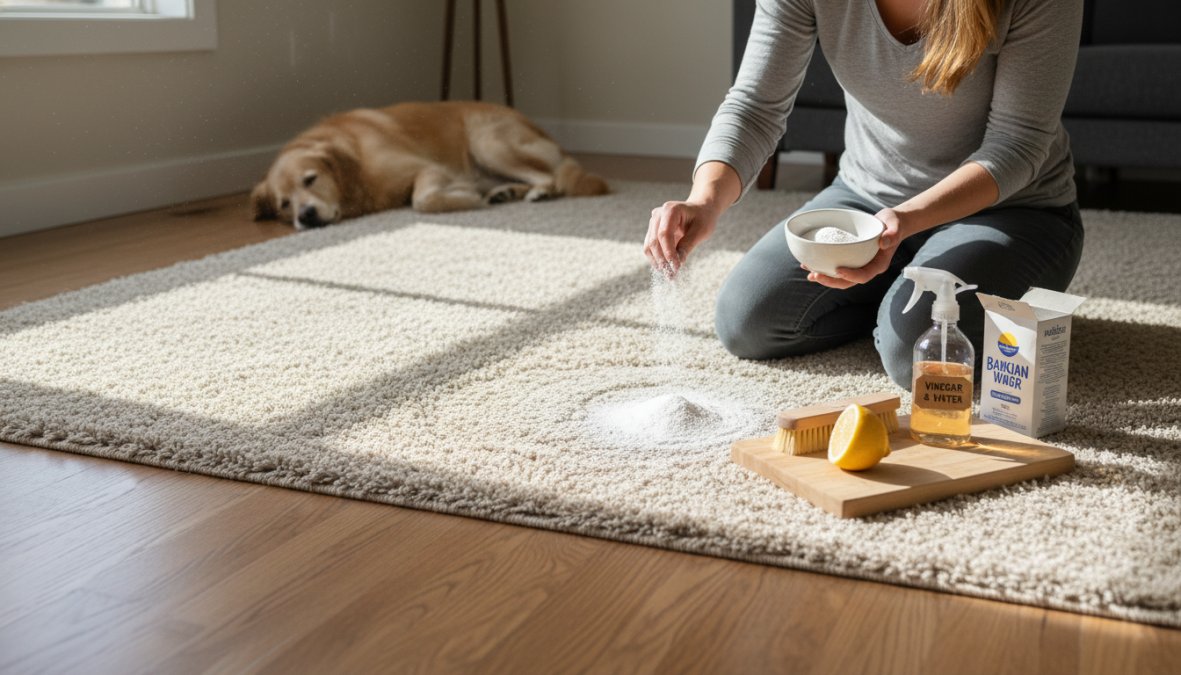
Baking soda (sodium bicarbonate) is a legitimate odor absorber, but most people apply it incorrectly. Sprinkling it on a dry carpet surface and vacuuming after 15 minutes produces minimal results because the powder never contacts the odor-producing uric acid crystals deeper in the pile. The correct method:
- Blot the fresh accident thoroughly with clean white cloths, pressing firmly to pull moisture from the carpet fibers. Stand on the cloths for maximum extraction.
- Apply baking soda generously over the damp area, use a visible, thick coating, not a light dusting, and work it lightly into the pile with your fingertips.
- Allow it to sit for a minimum of 8 hours, ideally overnight, so it can absorb moisture and odor compounds as it dries.
- Vacuum thoroughly using multiple slow passes.
For dried, older stains, lightly dampen the area first with plain water before applying baking soda. This reactivates the dormant uric acid crystals and allows the baking soda to work more effectively.
Fiber safety: Baking soda is safe on nylon, polyester, and olefin. On wool, use sparingly and vacuum promptly, extended contact with moisture and alkaline compounds can cause wool fibers to felt at the base of the pile.
Pet safety: Baking soda ingestion in large quantities can cause electrolyte imbalance in dogs and cats. Keep pets out of the treated area until you have vacuumed completely. This is especially important for cats and small dogs that groom their paws after walking across treated carpet.
Apply baking soda in a thicker layer than feels necessary. A thin dusting barely contacts the carpet fibers where the odor compounds are concentrated. A generous, visible coating produces noticeably better results.
White Vinegar for Odor Neutralization
White vinegar is acidic (roughly pH 2.4), which makes it effective at neutralizing the alkaline ammonia compounds in dried pet urine. The mechanism is straightforward acid-base chemistry: the acetic acid in vinegar reacts with the ammonia salts in decomposed urine to produce water and ammonium acetate, which is far less volatile and odorous.
Mix a solution of equal parts white vinegar and cold water in a spray bottle. Apply generously to the affected area, allow it to sit for 10-15 minutes, then blot dry with clean cloths. The vinegar smell dissipates as it dries, typically within a few hours. If the vinegar odor lingers, a follow-up application of baking soda after the area dries completely will absorb it.
One honest limitation: Vinegar works well on fresh or lightly set odors. For deep-set stains where urine has reached the padding, vinegar applied to the carpet surface will not penetrate far enough to neutralize the source. In those cases, it will temporarily reduce the smell without resolving it.
Fiber safety: Safe on nylon, polyester, and olefin. Do not use vinegar on wool carpet. The acidity can damage the protein structure of wool fibers and cause permanent dulling or weakening of the pile. It can also strip protective lanolin from wool, making the fiber more susceptible to future soiling.
Pet safety: Diluted white vinegar is non-toxic to dogs and cats once dry. However, the strong smell during application can be irritating to pets with sensitive respiratory systems. Remove pets from the room during treatment and ventilate well before allowing them back in.
Hydrogen Peroxide Spot Treatment
A 3% hydrogen peroxide solution combined with a small amount of dish soap can break down urine proteins and lift staining from carpet fibers. The mechanism here is oxidation: hydrogen peroxide releases oxygen radicals that break apart the chromophores (color-producing molecular structures) in urine stains and disrupt the protein chains that bind odor compounds to carpet fibers.
Standard approach: mix one cup of 3% hydrogen peroxide with one teaspoon of plain dish soap (avoid dish soaps with added dyes or fragrance, which can leave residue). Apply to the stained area, work gently into the fibers with a soft brush, and blot clean after 10 minutes.
Fiber safety: Always test on an inconspicuous area first. On light-colored nylon and polyester, 3% hydrogen peroxide is generally safe. On olefin, test carefully, some olefin carpets are solution-dyed and more resistant to bleaching, but others are not. Never use hydrogen peroxide on wool or dark-colored carpet of any fiber type. The oxidizing action will strip color from dark fibers and can cause irreversible damage to wool’s protein structure.
Pet safety: At 3% concentration, hydrogen peroxide is considered low-risk once fully dry. However, it should never be used near a pet’s face or applied to areas where a pet is likely to lick immediately after treatment. Allow the area to dry completely and ventilate the room before pets return. Do not use higher concentrations (6% or above, sold for hair bleaching) on carpet, the fume concentration and oxidizing strength increase the risk to both carpet fibers and pets significantly.
Never saturate carpet with water or cleaning solution during spot treatment. Over-wetting pushes contaminants deeper into the padding and can cause mold growth underneath, which compounds the odor problem significantly. Use enough solution to treat the fibers, not enough to soak through to the backing.
Pet-Safe Cleaning Checklist
Before applying any home remedy, run through this checklist to protect your pets:
- Remove pets from the room before applying any cleaning solution
- Check for essential oils, many commercial carpet sprays contain tea tree oil, eucalyptus, or citrus oils that are toxic to cats even in small concentrations
- Avoid products with phenols, phenol-based disinfectants (including some pine-scented cleaners) are particularly dangerous for cats
- Verify ‘pet safe’ labeling specifically mentions cats if you have feline pets, cat metabolism differs significantly from dogs, and many products safe for dogs are not safe for cats
- Allow complete drying before pets re-enter, wet residue on paw pads is groomed off and ingested
- Vacuum baking soda thoroughly before pets return to the area
- Ventilate for at least 30 minutes after using vinegar or hydrogen peroxide solutions
If you are uncertain about a product’s safety for your specific pet, the ASPCA Animal Poison Control Center maintains a searchable database of household substances and their toxicity levels for dogs and cats at ASPCA Animal Poison Control Center.
Best Enzyme Cleaner for Pet Urine: What to Look For
The best enzyme cleaner for pet urine contains active protease and urease enzymes that biologically break down uric acid crystals, proteins, and bacteria at the molecular level. This is a fundamentally different mechanism than deodorizing sprays, which only mask odor temporarily.
When selecting an enzyme cleaner, look for these characteristics:
- Active enzyme concentration: Products should list specific enzyme types on the label, not just "natural ingredients"
- Contact time requirements: Effective enzyme cleaners need 10-30 minutes of dwell time to work; anything claiming instant results is likely a masking agent
- Coverage for padding: The label should indicate the product is formulated to penetrate to carpet backing
- Pet-safe formulation: Verify the product is non-toxic once dry, particularly important for households with cats, who are sensitive to many cleaning compounds
Bio-Enzymatic Cleaners vs. Standard Cleaners
Bio-enzymatic cleaner is a product containing live beneficial bacteria and enzymes that consume and break down organic waste compounds. Standard cleaners, including most carpet shampoos and deodorizing sprays, use surfactants and fragrance to lift surface soil and mask odor.
The distinction matters enormously for pet odor removal. Standard cleaners address what you can see and smell at the surface. Bio-enzymatic cleaners address the uric acid crystals that cause the smell to return. For any accident that has dried or penetrated below the carpet surface, bio-enzymatic cleaners are the only home solution that produces lasting results.
According to the American Kennel Club’s pet care resource library, enzyme-based cleaners are the recommended approach for eliminating pet urine odor rather than conventional cleaning products.
How to Remove Pet Smells from Carpet Based on Fiber Type
Carpet fiber type determines which cleaning methods are safe and which can cause permanent damage. Applying the wrong product to the wrong fiber is one of the most common mistakes in pet odor removal.
| Fiber Type | Safe for Vinegar? | Safe for H2O2? | Enzyme Cleaner? | Steam Cleaning? |
|---|---|---|---|---|
| Nylon | Yes | Test first | Yes | Yes |
| Polyester | Yes | Test first | Yes | Yes |
| Olefin (Polypropylene) | Yes | Test first | Yes | Low heat only |
| Wool | No | No | Yes (pH-neutral) | Professional only |
Synthetic Carpet: Nylon, Polyester, and Olefin
Synthetic carpet fibers are the most forgiving for pet odor treatment. Nylon and polyester handle most cleaning solutions well, including diluted vinegar, hydrogen peroxide, and enzyme cleaners. Olefin is more heat-sensitive, so steam cleaning should use lower temperature settings to avoid fiber distortion.
One practical note: polyester carpet tends to hold odors longer than nylon because its fibers are less resilient and compact more easily under pet traffic, trapping more organic material deeper in the pile. More frequent vacuuming and prompt treatment of accidents makes a measurable difference with polyester.
Wool Carpet: Extra Precautions Required
Wool carpet requires a completely different approach. Wool is a natural protein fiber that can be permanently damaged by acidic cleaners, including vinegar and hydrogen peroxide. Alkaline cleaners can cause wool to felt and shrink. Steam cleaning at high temperatures can cause irreversible shrinkage and fiber damage.
For wool carpet with pet odors, use only pH-neutral enzyme cleaners specifically labeled safe for wool, apply with minimal moisture, and blot rather than scrub. For anything beyond a fresh surface accident, professional cleaning is the correct choice. The cost of improper treatment on wool carpet far exceeds the cost of professional care.
How to Find Hidden Pet Stains with a Blacklight
Hidden pet stains are identified using a UV blacklight flashlight, which causes the proteins in dried urine to fluoresce as yellow-green spots in a darkened room. This tool is one of the most underused and genuinely useful items in pet odor detection.
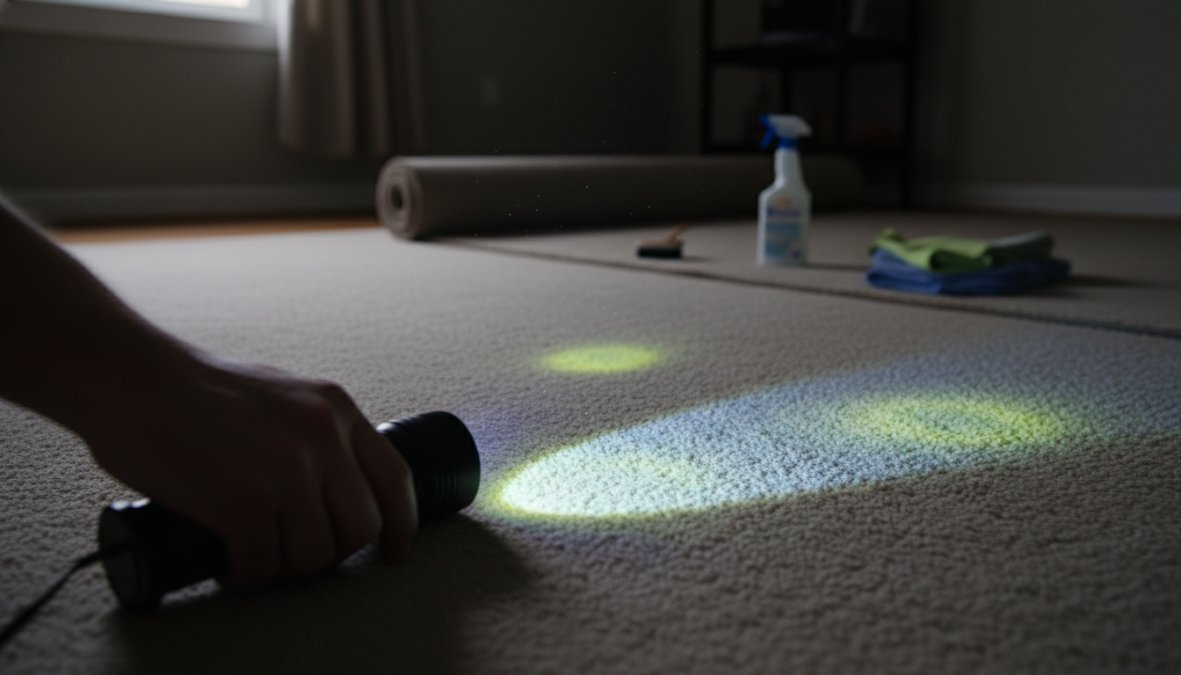
To use a blacklight effectively:
- Wait until dark or block all natural light from the room
- Use a UV flashlight with a wavelength of 365-395nm for best visibility
- Scan slowly across the carpet from a low angle, approximately 6-12 inches above the surface
- Mark each glowing spot with a small piece of painter’s tape before turning lights on
Not everything that fluoresces is pet urine. Cleaning product residue, some food stains, and certain carpet treatments also glow under UV light. The characteristic pattern of pet urine is an irregular spreading stain, often larger than the surface stain visible in normal light, which reveals the true extent of padding saturation.
This tool is particularly valuable before purchasing a home with pets or before professional cleaning, so technicians know exactly where to concentrate treatment.
Step-by-Step: How to Remove Pet Smells from Carpet for Deep-Set Odors
Deep-set pet odors require a systematic approach that addresses both the carpet surface and the padding below. Surface-only treatment produces temporary results. This process is designed for accidents that have dried, for repeated accidents in the same area, or for odors that have returned after previous cleaning attempts.
Total Time: 24-48 hours (including drying time)
Difficulty: Intermediate
What You’ll Need Before You Start
Gather these materials before beginning:
- UV blacklight flashlight
- Painter’s tape for marking stains
- Clean white cloths or paper towels (minimum 10-15)
- Bio-enzymatic cleaner appropriate for your carpet fiber type
- Baking soda (1-2 boxes per large affected area)
- Spray bottle
- Stiff-bristled brush (for working product into pile)
- Wet/dry vacuum or carpet extractor (strongly recommended)
- Fan for accelerating drying
Step 1: Locate all affected areas with the blacklight [Time: 15 minutes]
Mark every glowing spot with painter’s tape before turning on lights. The stain visible in normal light is typically smaller than the actual affected area.
Step 2: Blot and extract moisture from any fresh areas [Time: 10 minutes]
Press firmly with clean cloths. Stand on the cloths for maximum extraction. Replace cloths as they saturate.
Step 3: Apply bio-enzymatic cleaner generously [Time: 5 minutes application, 20-30 minutes dwell]
Saturate the area enough that the cleaner reaches the padding. This is intentional: you need the enzymes to contact the uric acid crystals below the carpet surface.
Step 4: Cover with plastic wrap and allow to dwell [Time: 20-30 minutes minimum]
Covering with plastic keeps the cleaner from evaporating, extending enzyme activity. Longer dwell time produces better results for deep-set odors.
Step 5: Extract with wet/dry vacuum [Time: 10 minutes]
Remove as much moisture as possible. Multiple passes improve results significantly.
Step 6: Apply baking soda and allow to dry completely [Time: 8-12 hours]
Apply generously over the treated area. Do not rush this step. The baking soda absorbs residual moisture and odor compounds as the carpet dries.
Step 7: Vacuum thoroughly [Time: 10 minutes]
Multiple passes with a quality vacuum removes baking soda and any loosened debris.
Expected Result: Odor should be significantly reduced or eliminated within 24-48 hours. If odor persists after drying, the padding is likely saturated beyond what surface treatment can address.
Pet Safety During the Cleaning Process
Pet safety during carpet cleaning is a genuine concern that most guides skip entirely. Several points matter:
Keep pets out of treated areas until the carpet is completely dry. Enzyme cleaners and hydrogen peroxide are generally non-toxic once dry, but wet cleaning solutions can irritate paw pads and be ingested during grooming. Cats are particularly sensitive to residues from cleaning products containing certain surfactants and essential oils.
Baking soda ingestion in large quantities can be harmful to pets. Vacuum thoroughly before allowing pets back on treated areas. For households with cats, verify any cleaning product is specifically labeled safe for cats, as feline metabolism processes many compounds differently than dogs or humans.
Ventilate the room well during and after cleaning. This protects both pets and people from concentrated fumes, particularly when using hydrogen peroxide or vinegar-based solutions.
The single most important step in pet odor removal is treating the carpet padding, not just the surface. Any method that doesn’t address the padding will produce temporary results at best.
When to Call a Professional Carpet Cleaner in Lake Geneva, WI
Professional carpet cleaning is the right call when home treatment hasn’t resolved the odor after two full attempts, when multiple areas of the carpet are affected, or when the odor is clearly coming from the padding or subfloor. But understanding why professional equipment produces results that home methods cannot, and what a proper professional treatment of saturated padding actually involves, helps you make a more informed decision and ask the right questions before you hire anyone.
Clear Signs That Home Treatment Has Reached Its Limit
- The odor returns within days of home treatment, even after using a bio-enzymatic cleaner correctly
- The affected area is larger than roughly 12 inches in diameter, indicating significant padding saturation
- The carpet feels stiff or crunchy after drying, indicating heavy mineral deposit from repeated urine events
- You can smell the odor from a standing position without being near the carpet, this almost always means the padding is the primary odor source, not the carpet face
- The carpet is wool or another delicate natural fiber where improper home treatment risks permanent damage
- Multiple spots are distributed across a room, suggesting a pattern of repeated accidents that has created overlapping zones of padding saturation
- You are preparing to sell the home or have a home inspection scheduled, professional documentation of treatment is more credible to buyers than DIY attempts
What Professional Treatment of Saturated Carpet Padding Actually Involves
This is the part most guides, and many carpet cleaning companies, skip over. Surface extraction, even with professional truck-mounted equipment, does not fully remediate carpet padding that has been saturated with urine multiple times. Understanding the full scope of what proper remediation looks like helps you evaluate whether a company is offering a complete solution or a partial one.
Truck-mounted hot water extraction operates at water temperatures and extraction pressures that consumer rental machines cannot match. The heat helps break down uric acid bonds in the carpet fibers and backing, and the extraction power physically removes contaminated water from deeper in the pile. This is meaningfully more effective than portable machines for carpet-face treatment.
However, for heavily saturated padding, the standard approach is often insufficient on its own. The padding itself, typically a polyurethane foam or rebond foam layer, can hold urine in a volume that surface extraction cannot fully reach. In these cases, a complete remediation may involve:
Flood extraction treatment: Applying a large volume of enzyme solution directly to the carpet and allowing it to dwell long enough to penetrate the full depth of the padding, then extracting with high-powered equipment. Some technicians use a weighted extraction tool that presses against the carpet surface to improve contact with the padding layer.
Carpet and padding removal: In cases of severe or long-term saturation, particularly where the same area has been repeatedly soiled over months or years, the correct remediation is to pull back the carpet, remove and discard the padding entirely, treat the subfloor directly, install new padding, and re-stretch the carpet. This is the only method that guarantees the odor source is physically removed rather than chemically suppressed.
Subfloor treatment: If urine has wicked down to a wood subfloor, the porous wood grain traps uric acid crystals in a way that enzyme cleaners applied from above cannot fully reach. Professional remediation of a wood subfloor typically involves applying an enzyme solution directly to the wood surface after the carpet and padding are removed, allowing it to dwell, and in severe cases, sealing the subfloor with an odor-blocking primer before new padding is installed. Concrete subfloors present a similar challenge, concrete is porous and can hold uric acid in the surface layer, requiring direct treatment and sometimes sealing.
Be cautious of any carpet cleaning company that claims to fully remediate heavily saturated padding without discussing the possibility of padding removal. If a technician inspects the area, confirms significant padding saturation, and proposes only a surface hot-water extraction treatment, ask specifically how they plan to address the odor source in the padding itself. A company offering a satisfaction guarantee is more likely to use the method that actually works.
Questions to Ask Before Hiring a Professional
Not all carpet cleaning companies approach pet odor remediation the same way. Before scheduling service, ask:
- Do you use truck-mounted or portable equipment? Truck-mounted systems provide significantly higher water temperature and extraction power.
- What enzyme product do you use, and does it treat the padding layer? A technician who cannot name the product or explain how it reaches the padding is likely offering surface-only treatment.
- If the padding is saturated, will you recommend removal? A company willing to have this conversation honestly is more trustworthy than one that guarantees results without assessing the extent of saturation.
- Do you offer a satisfaction guarantee, and what does it cover? A guarantee that covers odor recurrence within a defined window indicates the company stands behind the depth of their treatment.
- Can you treat the subfloor if needed? Not every company offers this, but knowing whether it’s available tells you whether you’re working with a full-service remediation provider or a standard cleaning service.
According to the Institute of Inspection Cleaning and Restoration Certification’s carpet cleaning standards, proper remediation of urine-contaminated carpet often requires treatment of the padding and subfloor in addition to the carpet face, a standard that is only achievable with professional-grade equipment and, in severe cases, physical removal of saturated materials.
The Economics of Professional vs. Repeated DIY Treatment
For Lake Geneva homeowners dealing with persistent pet odors, the cost calculation often favors professional treatment more than it initially appears. Repeated purchases of enzyme cleaners, baking soda, and rental equipment for a problem that keeps returning add up quickly, and each failed attempt can push the contamination deeper into the padding as over-wetting occurs. A single professional treatment that resolves the problem at the padding level costs less over time than months of partial solutions that address only the carpet surface.
For situations where padding removal is necessary, the cost of new padding material is typically modest relative to the cost of replacing the carpet itself, and it is the only method that eliminates the odor source entirely rather than suppressing it.
Lake Geneva Carpet Cleaning has addressed this exact problem for over 32 years using truck-mounted hot water extraction technology that reaches the padding and backing where home treatments fall short. With an owner-operated commitment to quality and a 10-day satisfaction guarantee, professional treatment is a straightforward path to a genuinely odor-free result. Contact Lake Geneva Carpet Cleaning to schedule a pet odor treatment and get the problem resolved for good.
Frequently Asked Questions
What is the best way to get pet smell out of carpet?
The most effective approach to remove pet smells from carpet combines spot treatment with a bio-enzymatic cleaner, followed by baking soda deodorizing and thorough vacuuming. For deep-set odors where pet urine has soaked into the carpet padding, a professional hot water extraction cleaning is often the only method that fully eliminates the smell. Always blot fresh accidents immediately rather than rubbing, and treat the area before odor-causing bacteria have time to set.
Does baking soda really remove pet odors from carpet?
Baking soda can help neutralize mild surface odors by absorbing moisture and acting as a deodorizing powder, but it has real limitations. It works best on fresh or light odors near the surface of carpet fibers. For pet urine that has penetrated deep into the carpet padding or reached the subfloor, baking soda alone will not break down the uric acid crystals responsible for persistent odors. Pair it with an enzyme cleaner for more effective results.
How long does pet urine smell last in carpet if left untreated?
Untreated pet urine smell in carpet can last for months or even years. As urine dries, it leaves behind uric acid crystals that reactivate when exposed to humidity, causing odors to return repeatedly. The longer the urine sits, the deeper it penetrates into carpet fibers, padding, and potentially the subfloor, making it progressively harder to eliminate with home remedies alone. Acting within the first few hours of an accident dramatically improves your chances of full odor removal.
How do I find hidden pet stains with a blacklight?
To find hidden pet stains, purchase a UV blacklight flashlight rated at 365-395 nm wavelength. Darken the room as much as possible, then slowly scan the carpet surface. Pet urine will fluoresce as a yellow-green glow under UV light, revealing stains invisible in normal lighting. Mark each stain with painter's tape before turning the lights back on so you can treat every spot accurately with your chosen enzyme cleaner or spot treatment solution.
Is vinegar safe for all types of carpet when removing pet odors?
Diluted white vinegar is generally pet-safe and works well on synthetic carpets like nylon and polyester for neutralizing odors. However, it should be used cautiously or avoided entirely on wool carpet, as its acidity can damage natural fibers and strip protective lanolin coatings. Always dilute vinegar with equal parts water and test it on a hidden area first. Avoid using vinegar on carpets with a jute backing, as moisture can cause the backing to deteriorate.
Will professional carpet cleaning remove pet odors completely?
Professional carpet cleaning using truck-mounted hot water extraction is the most reliable method for eliminating deep-set pet odors, especially when carpet padding saturation is involved. Professionals can apply commercial-grade enzyme treatments, extract moisture from deep within the carpet structure, and address subfloor contamination if needed. Surface-level DIY methods often mask odors temporarily, while professional extraction removes the organic material causing the smell. For severe or recurring odors in Lake Geneva, WI, professional service is strongly recommended.
This article was written using GrandRanker