Table of Contents
- Why Pet Odors in Carpet Are So Hard to Remove
- Immediate Steps to Take After a Pet Accident on Carpet
- How to Remove Pet Odors from Carpet Using Enzyme Cleaners
- How to Get Dog Smell Out of Carpet Without a Machine
- How to Tell If Pet Urine Has Soaked Into the Carpet Padding
- Carpet Material Sensitivity and Safe Cleaning Solutions
- Steam Cleaning, Portable Carpet Cleaners, and When to Call a Pro
- How to Remove Pet Odors from Carpet for Good: Prevention Tips
- Conclusion
Last Updated: May 23, 2026
Pet urine is one of the most chemically stubborn substances a carpet can absorb, and knowing how to remove pet odors from carpet the right way separates a truly clean floor from one that just smells temporarily masked. At Lake Geneva Carpet Cleaning, we’ve spent over 32 years helping Wisconsin homeowners tackle exactly this problem, and the number one thing we see is people treating the symptom instead of the cause. Below, we’ll show you exactly how to neutralize odors at the source, which DIY methods actually work, and when the problem has gone deeper than any home remedy can reach.
Here’s what most guides get wrong: they focus entirely on the surface stain while ignoring the chemistry happening underneath. Pet urine contains uric acid, a compound that bonds tightly to carpet fibers and, once dry, crystallizes into a near-permanent odor source. Water and standard cleaners don’t break uric acid down. They spread it. That single misunderstanding is why so many Lake Geneva homeowners find that the smell comes back after every cleaning, especially during humid Wisconsin summers when moisture reactivates dormant crystals.
Why Pet Odors in Carpet Are So Hard to Remove
Pet odor removal is harder than most stain removal because the problem isn’t just on the surface. When a pet urinates on carpet, the liquid travels downward through the carpet fibers, into the carpet pad, and sometimes into the sub-floor beneath. Each layer traps a different concentration of uric acid and ammonia compounds, and standard cleaning only addresses the top layer.
How Uric Acid and Ammonia Bind to Carpet Fibers
Uric acid is a non-volatile compound found in pet urine that forms salt crystals as it dries. These crystals embed into carpet fibers at a microscopic level and are largely insoluble in plain water. Ammonia, also present in urine, is a volatile compound that contributes to the sharp, pungent odor you notice immediately after an accident.
The real problem is the reaction between uric acid salts and moisture. Every time humidity rises or you clean with water, those crystals partially dissolve and release odor molecules again. This is why a carpet can smell fine in dry conditions but become overwhelming after a rainy week. Standard carpet shampoos are typically alkaline or pH-neutral, which does little to break down acidic uric acid compounds. Only bio-enzymatic cleaners, which contain specific enzymes that digest the uric acid molecules themselves, address the chemistry directly.
According to EPA guidance on indoor air quality and biological contaminants, biological waste like pet urine can also contribute to poor indoor air quality, particularly in homes with inadequate ventilation, making thorough removal important beyond just odor control.
Immediate Steps to Take After a Pet Accident on Carpet
Speed is the single most important factor in preventing a pet accident from becoming a permanent odor problem. The faster you act, the less urine penetrates into the carpet pad and sub-floor.
Follow these steps in order:
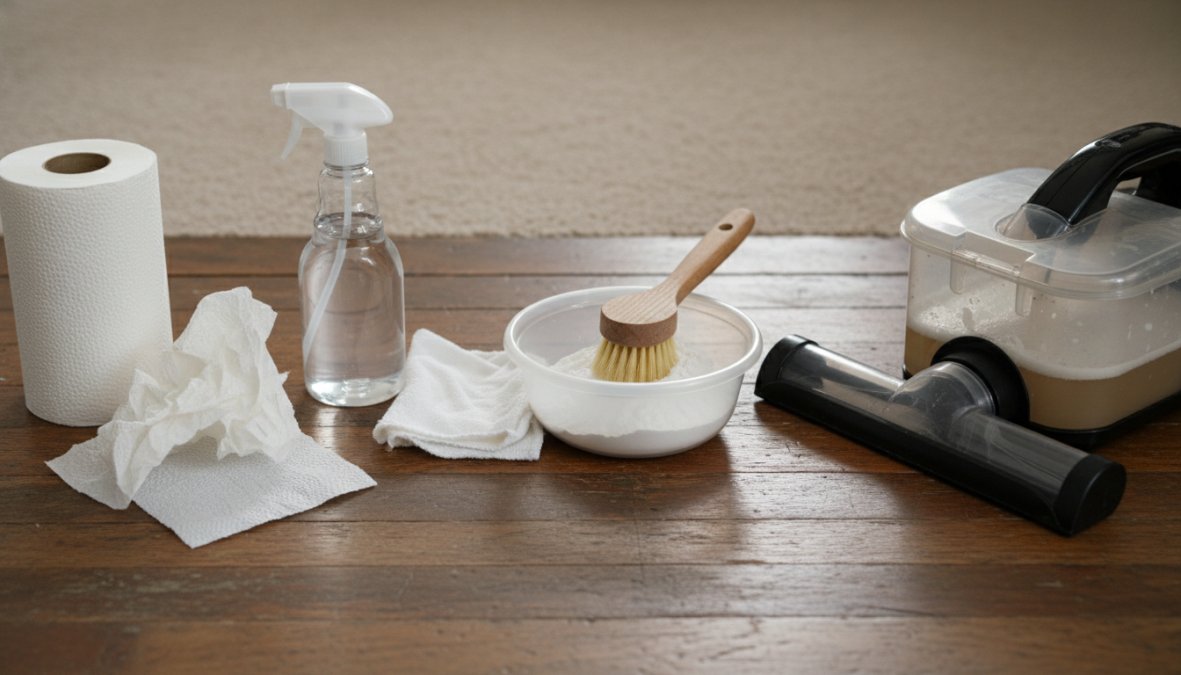
- Blot immediately. Place a thick layer of paper towels or a clean white absorbent cloth over the wet area. Press down firmly for 30-60 seconds. Do not rub.
- Add weight. Stack books or a heavy object on top of the towels for 5-10 minutes to draw moisture upward from the fibers.
- Repeat blotting. Replace saturated towels and blot again until no more moisture transfers.
- Rinse with cold water. Pour a small amount of cold water over the area to dilute remaining urine. Blot again immediately.
- Apply your cleaner. Use a bio-enzymatic cleaner or your chosen cleaning solution at this stage, not before.
- Allow to air dry. Never use a hair dryer or heat source on a fresh urine stain. Heat sets the proteins and makes the odor permanent.
Blotting vs. Scrubbing: Why Technique Matters
Scrubbing a pet urine stain is one of the most common and damaging mistakes homeowners make. Scrubbing does three things, all of them bad: it spreads the urine laterally to unaffected fibers, it pushes the liquid deeper into the carpet pad, and it physically damages the carpet fiber structure, making the area more porous and harder to clean in the future.
Blotting works by capillary action. Pressing absorbent material against the wet fibers draws moisture upward and outward into the towel rather than forcing it downward. Always blot from the outside edge of the stain toward the center to prevent spreading. This technique applies equally to fresh accidents and to areas you’ve just treated with a cleaning solution.
Never use ammonia-based cleaners on pet urine stains. Ammonia is a component of urine, and applying it to a soiled area will reinforce the scent signal that tells pets to return to the same spot.
How to Remove Pet Odors from Carpet Using Enzyme Cleaners
Bio-enzymatic cleaners are the most effective solution for how to remove pet odors from carpet because they eliminate the chemical source of the odor rather than masking it. These products contain live bacterial cultures that produce enzymes specifically designed to break down uric acid, proteins, and other organic compounds in pet waste.
The best enzyme cleaner for pet urine works by digesting the uric acid crystals at a molecular level, converting them into water and carbon dioxide. The result is genuine odor elimination, not temporary suppression.
To use an enzyme cleaner correctly:
- Blot up as much of the urine as possible first.
- Saturate the stained area thoroughly with the enzyme cleaner. The product needs to reach every layer the urine reached.
- Cover the area with a damp cloth or plastic wrap to prevent the cleaner from drying out too quickly. Enzymes need moisture to work.
- Allow the cleaner to dwell for a minimum of 15-30 minutes, or up to several hours for older, set-in stains.
- Blot up the excess and allow to air dry completely.
A common mistake is applying too little product. If urine soaked 3 inches deep into the carpet pad, a light spray on the surface accomplishes nothing. For older stains, you need enough volume of cleaner to fully saturate the same depth the urine reached.
For set-in stains, apply the enzyme cleaner, then place a heavy damp towel over the area and leave it overnight. The extended contact time dramatically improves how deeply the enzymes penetrate into the carpet pad.
How to Get Dog Smell Out of Carpet Without a Machine
Not every household has access to a carpet cleaning machine, and many mild-to-moderate odor problems respond well to DIY methods, provided you match the method to your carpet type and understand exactly where each approach stops working. The most common DIY failure isn’t using the wrong product; it’s using the right product on the wrong carpet, or expecting surface treatments to solve a sub-pad problem.
DIY Carpet Deodorizer Recipes You Can Make at Home
Several home remedies are genuinely effective for odor absorption and surface deodorizing. Here are the most reliable options, with honest notes on where each one reaches its limit:
Baking Soda Method:
Baking soda neutralizes acidic odor compounds through a direct acid-base reaction. Sprinkle a generous, visible layer, enough to lightly coat the fibers, over the affected area. Work it gently into the pile with a soft-bristle brush, and leave it for a minimum of 30 minutes; overnight contact produces meaningfully better results. Vacuum thoroughly using two passes in perpendicular directions.
Safe for: Synthetic (nylon, polyester), wool, Berber, cut pile.
Avoid on: Sisal and jute, baking soda can leave a chalky residue that is difficult to vacuum out of natural fiber weaves.
Honest limit: Baking soda addresses odor compounds sitting on or near the fiber surface. It does not penetrate the carpet pad. If the odor returns within 24-48 hours of vacuuming, the source is below the surface layer and this method is insufficient.
White Vinegar Solution:
Dilute plain white vinegar 1:1 with cold water in a spray bottle. Mist the affected area, do not saturate, and blot with a clean white cloth. Allow to dry fully before evaluating odor. The acetic acid in vinegar temporarily disrupts ammonia-based odor compounds and can help lift residue from fibers.
Safe for: Synthetic carpets only.
Avoid on: Wool and other natural protein fibers. Vinegar is acidic (pH roughly 2.5), and while wool tolerates mild acids better than alkalis, repeated application degrades the lanolin coating on wool fibers over time, causing them to become brittle and dull. A single application in an emergency is unlikely to cause visible damage, but it is not a recommended routine treatment.
Avoid on: Sisal and jute, water-based solutions of any kind cause shrinkage and permanent staining in natural plant-fiber carpets.
Honest limit: Vinegar masks odor temporarily and does not break down uric acid crystals. The vinegar smell itself dissipates within a few hours as it dries, but the underlying odor source remains intact.
Baking Soda and Vinegar Combined:
Apply the diluted vinegar solution first and blot. Allow the area to dry, then apply baking soda. The fizzing reaction you see is a neutralization reaction between the residual acid and the base, it does help lift loosened residue from fiber surfaces. This is a two-step surface treatment, not a deep cleaner.
Safe for: Synthetic carpets only, for the same reasons noted above regarding vinegar and wool.
Honest limit: The combination is useful for fresh accidents on synthetic carpet when enzyme cleaner is unavailable. It is not a substitute for enzymatic treatment on set-in stains or any stain that has reached the pad.
Hydrogen Peroxide Solution:
Mix one part 3% hydrogen peroxide (standard drugstore concentration) with two parts cold water and one small drop of clear dish soap. Apply to the stain, allow to dwell for 10-15 minutes, then blot clean and rinse with cold water.
Safe for: Synthetic carpets. Test on a hidden area first regardless of carpet type.
Avoid on: Wool, silk, and any carpet with dark or vibrant dyes. Hydrogen peroxide is an oxidizing agent and can bleach or permanently lighten carpet color, particularly at concentrations above 3% or with extended contact time. Never use undiluted hydrogen peroxide from a higher-concentration bottle (such as the 12% or 35% concentrations sold for hair or industrial use) on carpet.
Avoid on: Berber loops, the solution can wick unevenly along the loop structure and create a visible tide line.
Honest limit: Effective for surface stains and mild odors on appropriate carpet types. Does not address sub-pad contamination.
Pet Safety After DIY Treatments: What Most Guides Skip
A critical point that most cleaning guides omit entirely: the safety of DIY cleaning residues for pets who will walk on, lie on, or groom themselves after contact with the treated carpet.
Baking soda: Generally recognized as safe once dry. Large ingested quantities can cause gastrointestinal upset in dogs and cats, but the residual amount left in carpet fibers after thorough vacuuming is not a meaningful exposure risk for most pets.
Vinegar: The acetic acid concentration in diluted white vinegar is low enough that residual contact is not considered toxic to dogs or cats. However, cats in particular are sensitive to strong scents, and some cats will avoid or become stressed by areas that smell strongly of vinegar until the scent fully dissipates, typically several hours after the area dries.
Hydrogen peroxide (3% diluted solution): At the dilution recommended above, residual contact after drying is low risk for most pets. However, hydrogen peroxide is a mucous membrane irritant in concentrated form. Ensure the area is fully dry and well-ventilated before allowing pets back onto the surface. If a pet shows signs of paw licking, drooling, or eye irritation after contact with a recently treated area, rinse the affected area with water and contact your veterinarian.
Dish soap residue: The small amount of dish soap used in the hydrogen peroxide solution can leave a residue that attracts dirt if not rinsed thoroughly. More importantly, some dish soaps contain fragrances or surfactants that cause mild skin or paw pad irritation in sensitive animals. Rinse treated areas with cold water and blot dry after the dwell time.
Keep pets out of any treated area until the carpet is completely dry to the touch. Wet carpet concentrates cleaning residues at the surface as moisture evaporates, meaning a pet walking through a damp treated area receives a higher residue exposure than one walking across a fully dried surface.
According to ASPCA Animal Poison Control guidance on household cleaning products, many conventional cleaning products can cause irritation or toxicity in pets, and the safest approach is to ensure complete drying and ventilation before returning animals to cleaned areas.
The honest limitation of all DIY methods is depth. They address carpet fibers but rarely penetrate the carpet pad. For how to get dog smell out of carpet without a machine, these recipes work for fresh accidents and mild odors on appropriate carpet types. Chronic or deep-seated odors, and any odor that has reached the pad, require enzymatic treatment at minimum, and often professional extraction.
How to Tell If Pet Urine Has Soaked Into the Carpet Padding
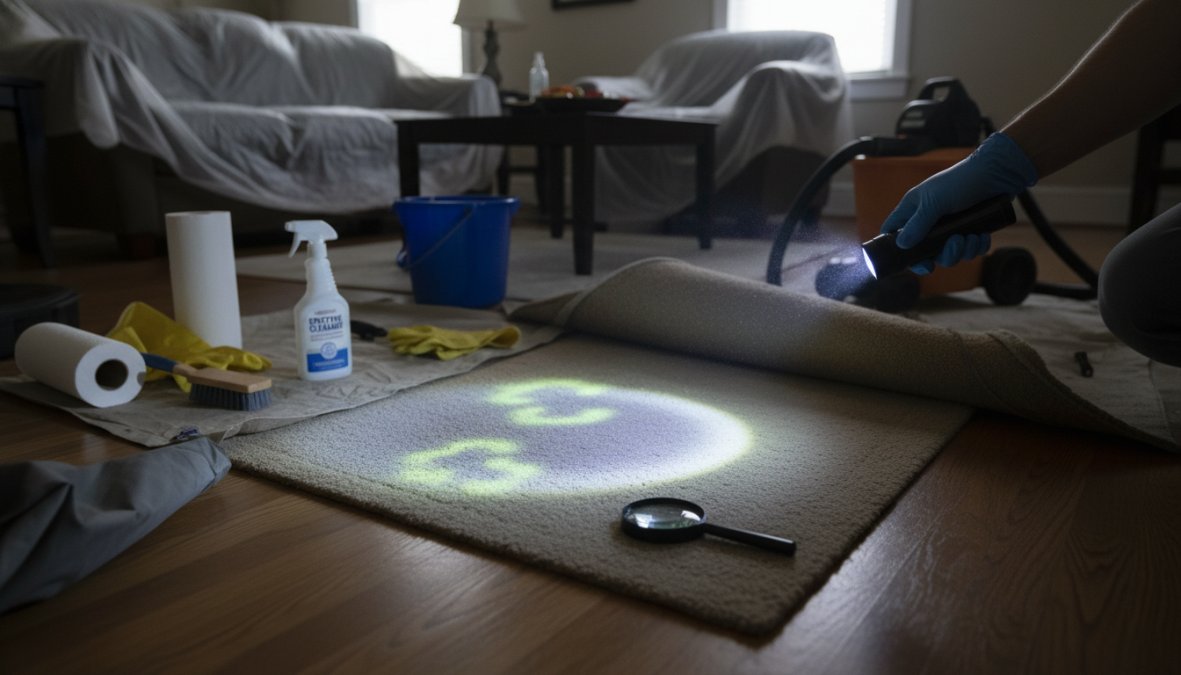
The most reliable way to tell if pet urine has soaked into the carpet padding is to use an ultraviolet (UV) black light flashlight in a darkened room. Urine fluoresces under UV light, revealing stains that are invisible under normal lighting, including old stains that dried months or years ago.
To conduct a UV inspection:
- Turn off all room lights and close blinds to create darkness.
- Scan the carpet slowly with the UV light held at a low angle.
- Mark any glowing areas with painter’s tape or sticky notes.
- Compare the size of the glowing area to the visible stain. If the glowing area is significantly larger, urine has spread laterally in the pad.
Other indicators of deep pad saturation include a persistent odor that returns after surface cleaning, a soft or spongy feel underfoot in the affected area, and visible discoloration on the carpet backing when a corner is lifted.
Sub-Floor Odor Remediation: When the Problem Goes Deeper
Sub-floor contamination is the problem most cleaning guides skip entirely, and it’s the reason many homeowners clean the same spot repeatedly without success.
When urine volume is high or accidents have gone undetected for extended periods, uric acid penetrates through the carpet pad and soaks into the wooden sub-floor beneath. Wood is porous and absorbs urine readily. Once dried, the odor source is completely inaccessible to any surface cleaning method.
Addressing sub-floor contamination requires:
- Pulling back the carpet. This is necessary to access the pad and sub-floor directly.
- Removing and discarding the carpet pad. Saturated padding cannot be effectively cleaned and must be replaced.
- Treating the sub-floor. Apply an odor-sealing primer or a concentrated enzyme cleaner directly to the wood. Allow to dry completely before installing new padding.
- Replacing the padding. Use new padding before reinstalling the carpet.
This is not a DIY-friendly process for most homeowners. It requires proper equipment, knowledge of how to re-stretch carpet correctly, and the ability to identify all affected areas. Attempting sub-floor remediation without experience often results in incomplete treatment or damaged carpet.
Carpet Material Sensitivity and Safe Cleaning Solutions
Not all carpets respond the same way to cleaning solutions, and using the wrong product on a sensitive fiber can cause permanent damage that’s more expensive than the original odor problem.
| Carpet Type | Safe Cleaners | Avoid | Notes |
|---|---|---|---|
| Synthetic (nylon, polyester) | Enzyme cleaners, diluted vinegar, H2O2 | Bleach | Most forgiving; handles moisture well |
| Wool | pH-balanced, wool-safe enzyme cleaners | Alkaline cleaners, vinegar | Alkaline solutions cause fiber damage |
| Berber (looped) | Gentle enzyme cleaners | Scrubbing brushes | Loops snag easily; blot only |
| Natural fiber (sisal, jute) | Dry cleaning methods | Water-based solutions | Water causes shrinkage and staining |
| Cut pile (plush) | Most enzyme cleaners | Excessive moisture | Prone to mold if over-wetted |
Wool carpets deserve special attention. Wool fibers are protein-based, meaning harsh alkaline cleaners that work well on synthetic carpet can dissolve the fiber structure of wool. Always use a pH-balanced or wool-specific enzyme cleaner on natural fiber carpets.
Pet and Child Safety During and After Carpet Cleaning
A point most cleaning guides omit entirely: the safety of the cleaning products themselves matters as much as their effectiveness.
During cleaning, keep pets and children out of the treated area. Many enzyme cleaners are non-toxic once dry, but direct contact with concentrated solutions can cause skin irritation. Ensure adequate ventilation throughout the cleaning process by opening windows or running fans.
After cleaning, allow the carpet to dry completely before allowing pets or children back onto the surface. Drying times vary by product and carpet thickness, but a minimum of 4-6 hours is typical for surface treatments. Deep cleaning with a portable carpet cleaner or professional hot water extraction requires longer drying times, often 12-24 hours.
Choose cleaning products labeled as safe for pets and children after drying. Enzyme cleaners derived from natural bacterial cultures are generally the safest option for households with animals and young children.
For households where pets or children have sensitivities, look for products certified by recognized safety organizations. As documented in American Lung Association guidance on cleaning product safety, many conventional cleaning products release volatile organic compounds (VOCs) that affect indoor air quality, particularly in poorly ventilated spaces.
Steam Cleaning, Portable Carpet Cleaners, and When to Call a Pro
Portable carpet cleaners and steam cleaning represent a meaningful step above DIY methods, but their effectiveness on pet odors depends almost entirely on how they are used, and on understanding what each machine physically cannot do. Most guides treat these as interchangeable upgrades. They are not.
Portable Carpet Cleaners: What They Actually Do
Consumer-grade portable carpet cleaners (upright carpet shampooers and spot extractors) work by injecting a cleaning solution into the carpet pile under low pressure and then vacuuming the loosened solution back out. The key performance variables are water pressure on injection, suction power on extraction, and water temperature.
Consumer machines typically operate at water temperatures between 120°F and 140°F and extraction vacuums in the range of 40-60 inches of water lift. These are adequate for surface and mid-depth contamination on synthetic carpets. Their practical limitation for pet odor removal is twofold:
Incomplete extraction: Consumer machines leave significantly more residual moisture in the carpet than professional equipment, often 20-30% more water by volume remains in the pile after a consumer pass versus a professional truck-mounted pass. This extended drying time (often 12-24 hours for consumer machines versus 4-8 hours for professional extraction) increases the risk of mold and mildew growth in the carpet pad, which introduces a secondary odor problem on top of the original pet odor.
Insufficient penetration for pad-level contamination: The injection pressure on consumer machines is not high enough to fully flush uric acid crystals from the carpet pad. The machine cleans the carpet fiber layer effectively but largely redistributes rather than removes contamination at pad depth.
For fresh accidents and mild odors confined to the carpet fiber layer, a portable carpet cleaner used after enzyme treatment produces good results. For any contamination that has reached the pad, it is a partial solution.
If using a portable carpet cleaner, always apply an enzyme cleaner first and allow the full dwell time before running the machine. Running the extractor over an untreated urine stain with plain water or carpet shampoo can spread uric acid laterally and push it deeper, the opposite of what you want.
Steam Cleaning: The Right Use Case and the Critical Caveat
Steam cleaning uses high-temperature steam, typically generated at 200°F to 250°F at the nozzle, to sanitize carpet fibers, kill bacteria and dust mites, and neutralize some odor compounds through heat. It is genuinely effective at surface-level odor remediation and sanitization.
The critical caveat for pet urine specifically: heat sets protein-based compounds. Pet urine contains proteins alongside uric acid. If those proteins have not been fully broken down by enzymatic treatment before heat is applied, steam cleaning can permanently bond the protein residue to carpet fibers, the same mechanism that makes a blood stain permanent if you wash it in hot water. The result is an odor that is harder to remove after steam cleaning than it was before.
The correct sequence is always: enzyme treatment first, complete drying, then steam cleaning if desired for sanitization. Never steam clean a urine-affected area as the first step.
Safe for: Synthetic carpets, cut pile, most Berber (with care around loop snagging).
Use with caution on: Wool. High-temperature steam can cause wool fibers to felt (permanently mat and shrink) if held in contact too long. If steam cleaning wool, use the lowest temperature setting, keep the nozzle moving continuously, and allow extended drying time.
Avoid on: Sisal, jute, and other natural plant-fiber carpets. Steam introduces moisture that causes irreversible shrinkage and fiber separation in these materials.
Pet and Child Safety During the Drying Window
This is the point most cleaning guides skip entirely, and it matters practically for every household with animals or young children.
When carpet cleaning solutions, whether enzyme cleaners, carpet shampoos, or the cleaning solutions used in portable extractors, are wet, they are present at their full concentration at the fiber surface. As the carpet dries, evaporation draws dissolved compounds upward and concentrates them at the surface before they fully dry out. This means the surface of a damp carpet can have a higher residue concentration than the solution you originally applied.
Enzyme cleaners: Most enzyme cleaners derived from natural bacterial cultures are non-toxic to pets and children once fully dry. During the drying window, direct paw or skin contact with concentrated enzyme solution can cause mild irritation in sensitive animals. Keep pets off treated areas until the carpet is dry to the touch, not just damp.
Carpet shampoo and extractor solutions: Many commercial carpet cleaning solutions contain surfactants, fragrances, and preservatives. Surfactant residue on paw pads can be transferred to the mouth during grooming. Look for cleaning solutions labeled as pet-safe after drying, and rinse treated areas with clean water as a final extraction pass to reduce residue.
Steam cleaning residue: Steam cleaning itself leaves no chemical residue, but if a cleaning solution was applied before steaming, the heat can drive residue deeper into the fiber structure. Allow full drying, typically 4-8 hours with good ventilation, before allowing pets back onto the surface.
Ventilation during cleaning: Many carpet cleaning solutions, including some enzyme products, release volatile organic compounds (VOCs) during application and drying. Cats are particularly sensitive to airborne chemical exposure due to their grooming behavior and relatively small body mass. Open windows, run exhaust fans, and if possible, relocate pets to a different area of the home during cleaning and the first hour of drying.
Never allow pets to walk on carpet that is still wet from cleaning. Beyond residue concentration, wet carpet fibers can trap cleaning solution between paw pads, leading to prolonged skin contact and potential irritation. A minimum of 4-6 hours of drying time with active ventilation is a reasonable baseline before allowing pet access.
As documented in American Lung Association guidance on cleaning product safety, many conventional cleaning products release volatile organic compounds that affect indoor air quality, particularly in poorly ventilated spaces, a concern that applies directly to pets spending time on recently cleaned carpet.
When to Call a Professional: The Technical Case
Professional truck-mounted hot water extraction systems differ from consumer equipment in ways that matter specifically for pet odor removal, not just general cleaning quality.
Truck-mounted systems heat water to 200°F-230°F at the point of injection (versus 120°F-140°F for consumer machines) and generate extraction vacuum levels that are typically three to five times higher than portable consumer units. This combination means the machine can inject cleaning solution deep enough to reach the carpet pad under pressure, and extract the majority of that moisture, along with the dissolved uric acid and other compounds, before it re-settles.
The practical result is a carpet that dries in 4-8 hours rather than 12-24 hours, with meaningfully less residual contamination left in the pad. For pet odor specifically, this matters because any uric acid left behind after cleaning will recrystallize as the carpet dries and become an odor source again.
Call a professional when any of the following apply:
- You have treated the same area twice with enzyme cleaner and the odor returns within a week.
- UV inspection reveals that the glowing area is significantly larger than the visible stain, indicating lateral spread in the pad.
- The affected area covers more than roughly one square foot, or there are multiple chronic accident sites.
- The carpet has a soft or spongy feel underfoot in the affected area, indicating pad saturation.
- The odor is present even in dry conditions (not just when humidity rises), suggesting sub-floor contamination.
- The carpet is wool, silk, or another sensitive natural fiber, professional cleaners can adjust chemistry and temperature precisely in ways that consumer equipment cannot.
For sub-floor contamination specifically, professional intervention is not optional, it is the only practical path to resolution short of carpet replacement. A professional can pull back the carpet, assess pad and sub-floor saturation accurately, treat the sub-floor with appropriate sealants or concentrated enzyme solutions, and reinstall the carpet correctly. Attempting this without experience in carpet re-stretching and seam alignment typically results in visible rippling or edge gaps that require a second service call to correct.
How to Remove Pet Odors from Carpet for Good: Prevention Tips
Eliminating existing odors is half the battle. Preventing recurrence is where most pet owners fall short, and it’s where small investments pay off significantly over time.
Establish a rapid-response routine. Keep enzyme cleaner and absorbent materials in an accessible location so you can treat accidents within minutes rather than discovering them hours later. Speed of treatment is the single largest factor in preventing odor from setting into the carpet pad.
Use a UV light for regular inspections. Conduct a monthly scan of high-traffic pet areas to catch small accidents before they become chronic odor sources. Catching a stain early means surface treatment is sufficient; missing it for weeks means sub-floor remediation.
Address the behavioral root cause. Pets often return to the same spot because residual odor signals them to use it again. Complete odor elimination with an enzyme cleaner breaks this cycle. An air purifier with an activated carbon filter in the affected room also helps capture airborne odor molecules during and after treatment.
Protect vulnerable areas. Washable pet bedding placed over favorite resting spots reduces direct carpet contact. Area rugs in high-risk zones are easier and cheaper to clean or replace than wall-to-wall carpet.
Schedule professional cleaning annually. Even with diligent spot cleaning, deep cleaning removes the accumulated residue, dander, and micro-contamination that surface methods leave behind. Annual professional cleaning also extends carpet life significantly.
According to Humane Society guidance on house training and accident prevention, consistent training combined with prompt accident cleanup is the most effective long-term strategy for reducing indoor accidents in both dogs and cats.
Persistent pet odors in carpet are a problem that gets harder to solve the longer it goes unaddressed, particularly once uric acid crystals reach the carpet pad or sub-floor. For Lake Geneva, Wisconsin homeowners dealing with chronic odor problems that DIY methods haven’t resolved, Lake Geneva Carpet Cleaning offers over 32 years of experience, truck-mounted hot water extraction technology, and eco-friendly cleaning methods that address contamination at every depth. With a 10-day satisfaction guarantee, there’s no guesswork involved. Contact Lake Geneva Carpet Cleaning to schedule a professional pet odor treatment and get a genuinely clean result, not just a temporarily masked one.
Frequently Asked Questions
What is the best way to get pet smell out of carpet?
The most effective way to remove pet odors from carpet is to use a bio-enzymatic cleaner after blotting up as much liquid as possible. Enzyme cleaners break down uric acid and ammonia at a molecular level, which neutralizes the odor rather than masking it. For deep-set smells, the carpet pad or sub-floor may also need treatment. When DIY methods fail, professional hot water extraction cleaning delivers the deepest odor removal results.
Does baking soda really remove pet odor from carpet?
Baking soda is a useful odor-absorbing home remedy for mild, surface-level pet smells. Sprinkle a generous layer over the affected area, let it sit for several hours or overnight, then vacuum thoroughly. However, baking soda cannot break down uric acid crystals embedded deep in carpet fibers or padding. For stronger or older odors, combine baking soda with a pH-balanced enzyme cleaner for better results.
How do you get deep-set pet urine smell out of carpet padding?
If pet urine has soaked into the carpet pad, surface cleaning alone will not eliminate the odor. Saturate the affected area with a bio-enzymatic cleaner and allow it to dwell long enough to reach the padding. In severe cases, the carpet may need to be pulled back so the pad and sub-floor can be treated or replaced. A UV black light can help locate all affected zones before treatment begins.
Will vinegar damage my carpet when removing pet odors?
Diluted white vinegar is generally safe on synthetic carpets and can help neutralize ammonia-based odors. Mix one part white vinegar with one part water and apply carefully. Avoid using vinegar on natural fiber carpets like wool or sisal, as the acidity can damage the fibers. Always test any cleaning solution on a hidden area first. Vinegar works best as a pre-treatment before applying a bio-enzymatic cleaner.
When should I hire a professional to remove pet odors from carpet?
Consider hiring a professional when DIY methods have not eliminated the odor after multiple attempts, when the smell returns after cleaning, or when you suspect urine has saturated the carpet padding or sub-floor. Professionals use truck-mounted hot water extraction equipment that reaches deeper than portable machines. If you have multiple pets or years of accumulated odors, professional cleaning is often the most cost-effective long-term solution.
This article was written using GrandRanker