Table of Contents
- Why Do My Carpets Get Dirty Quickly After Cleaning?
- The Top Carpet Resoiling Causes You Need to Know
- Carpet Fiber Type Sensitivity: Why Not All Carpets Soil Equally
- DIY vs. Professional Equipment: Does It Make a Difference?
- Choosing the Best Vacuum Cleaner for Deep Cleaning Your Carpet
- How Carpet Cleaning Frequency Affects How Quickly Dirt Returns
- Environmental Factors That Make Carpets Dirty Faster in Wisconsin Homes
- Practical Tips to Keep Your Carpets Cleaner for Longer
- Conclusion
Last Updated: May 25, 2026
Carpets that look grimy just days after cleaning are one of the most frustrating problems homeowners face, and the question of why do my carpets get dirty quickly has a more technical answer than most people expect. At Lake Geneva Carpet Cleaning, we’ve spent over 32 years diagnosing exactly this problem for Wisconsin homeowners, and the culprit is almost never what people assume. Most guides blame foot traffic. The real answer involves chemistry, fiber physics, and what happens inside your carpet pad when moisture lingers.
Below, we’ll walk through every major cause of rapid resoiling, explain why certain carpet types are more vulnerable than others, and give you a practical maintenance routine you can start this week. The five-factor framework we cover here has helped hundreds of Lake Geneva, Wisconsin homeowners break the cycle of carpets that never seem to stay clean.
But first, here’s what most guides get wrong: they treat carpet resoiling as a single problem with a single fix. It’s actually a cascade of overlapping issues, and addressing only one of them gets you nowhere.
Why Do My Carpets Get Dirty Quickly After Cleaning?
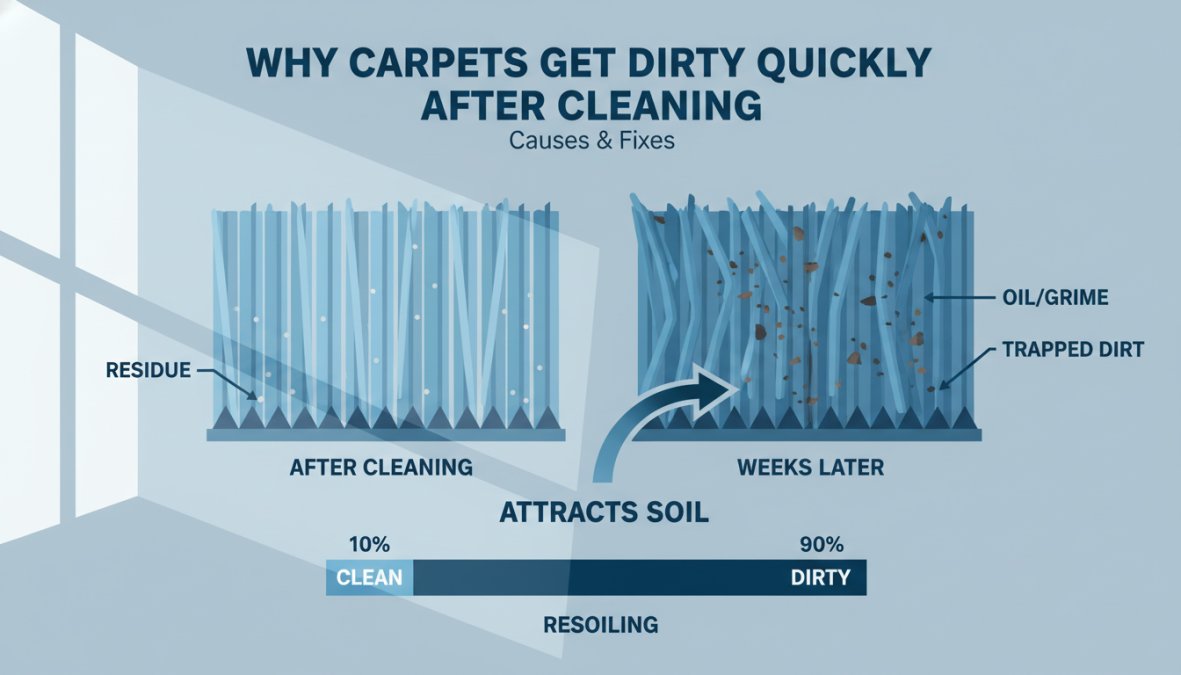
Rapid resoiling after cleaning is caused primarily by sticky chemical residues left in carpet fibers that attract and trap new dirt at an accelerated rate. This is the single most important thing to understand about carpet maintenance. If your carpet looks worse two weeks after cleaning than it did the day before, residue is almost certainly the reason.
Soapy Residue and Sticky Surfactants Left Behind
Surfactant residue is the term for the soapy film that remains in carpet fibers when a cleaning solution isn’t fully extracted. Surfactants are the active cleaning agents in most carpet detergents. Their job is to break the bond between soil and fiber, but they need to be completely rinsed out to be effective long-term.
The problem: many cleaning methods don’t use enough rinse water or extraction power to remove all the surfactant. What’s left behind is a slightly sticky, hydrophilic layer on each fiber. That layer grabs airborne dust, skin flakes, pet dander, and tracked-in grime far more aggressively than a clean fiber would.
A common mistake is assuming that "clean-smelling" means "clean." Fragrance additives can mask the residue entirely while the sticky film continues working against you.
pH balance matters here too. Carpet cleaning solutions should ideally be pH-neutral after rinsing. Alkaline residues are particularly sticky and tend to attract oily soils. If your cleaner doesn’t test pH or doesn’t rinse thoroughly, you’re setting up your carpet for rapid resoiling before the fibers even dry.
Using too much cleaning solution doesn’t mean a deeper clean. [Excess detergent is harder to extract and dramatically increases sticky residue](/why-professional-steam-cleaning-is-healthier/), which is one of the top carpet resoiling causes. Less product with thorough extraction consistently outperforms heavy application.
Wicking: When Moisture Pulls Grime Back Up from the Pad
Wicking is the process by which dissolved soil and grime travel upward through carpet fibers from the saturated pad below as the carpet dries. It’s a physics problem, not a cleaning failure per se, though it’s often caused by over-wetting during the cleaning process.
Here’s what happens: cleaning water penetrates past the carpet backing into the pad, carrying dissolved soil with it. As the surface dries first, capillary action pulls the dirty moisture back upward through the pile. The soil deposits on the surface fibers and dries there, leaving visible staining or a dull, grimy appearance in the same spots that were cleaned.
Wicking is most common in high-traffic areas where the pad has absorbed years of accumulated grime. According to the Carpet and Rug Institute’s cleaning guidance, proper drying time and controlled moisture application are critical to preventing wicking after professional cleaning.
The fix isn’t to use less water overall. It’s to use the right amount of water with sufficient extraction force so the pad never becomes saturated in the first place.
The Top Carpet Resoiling Causes You Need to Know
Understanding carpet resoiling causes requires looking beyond the surface. The three factors below are consistently underestimated by homeowners and, frankly, by many cleaning services.
Loss of Factory Protectors Like Scotchgard
New carpets arrive from the factory with a protective coating applied to the fibers. Products like Scotchgard create a barrier that makes fibers resistant to soil and liquid penetration, giving you time to blot spills before they bond with the fiber. This is why a brand-new carpet seems almost self-cleaning for the first year or two.
The problem: factory protectors wear away. Foot traffic, vacuuming friction, and especially cleaning all degrade the coating over time. Once it’s gone, the raw carpet fiber is exposed directly to soil and moisture. Stain resilience drops dramatically, and the carpet begins soiling faster with each passing month.
This is why professional carpet cleaning should include a reapplication of fiber protector as a standard step. Many budget cleaning services skip this entirely. The result is a carpet that’s technically clean but completely unprotected, making the next round of soiling faster than the one before.
Static Electricity and Soil Attraction in Dry Climates
Static electricity is a genuine carpet resoiling cause that most homeowners never consider. Dry conditions, especially during Wisconsin winters when indoor heating strips humidity from the air, cause carpet fibers to build up static charge. That charge acts like a magnet for fine particulate matter: dust, pet dander, pollen, and airborne skin flakes.
Synthetic carpet fibers, particularly nylon and polyester, are more prone to static buildup than natural fibers like wool. The effect is most visible in high-traffic areas where foot friction compounds the static charge.
Maintaining indoor humidity between 40-50% significantly reduces static-related soil attraction. A whole-home humidifier during heating season is one of the most underrated investments for carpet maintenance in Wisconsin homes.
Dust Mites, Skin Flakes, and Allergen Buildup
Dust mites are microscopic organisms that live in carpet pile, feeding on shed skin flakes. A single human sheds millions of skin cells daily, and a significant portion settles into carpet fibers. Dust mites and their waste products accumulate between vacuuming sessions, contributing both to visible grime and to indoor air quality problems.
This isn’t just an aesthetic issue. According to the American Lung Association’s indoor air quality resources, dust mite allergens are among the most common triggers for respiratory issues in homes with carpeting. Regular deep cleaning and proper vacuuming frequency are the primary defenses.
The key insight: vacuuming removes surface debris but doesn’t extract dust mites or their waste from deep in the carpet pile. That requires hot water extraction with sufficient heat and dwell time to break down allergen proteins.
Carpet Fiber Type Sensitivity: Why Not All Carpets Soil Equally
Not all carpet fibers respond to dirt and cleaning the same way. This is a gap most guides skip entirely, and it directly affects how quickly your specific carpet gets dirty.
Nylon is the most common synthetic fiber and generally the most durable. It holds factory protectors well and responds well to professional cleaning. However, once the protector wears off, nylon’s slight porosity makes it vulnerable to oily soils.
Polyester fibers have a natural resistance to water-based stains but are highly susceptible to oily soil. Cooking oils, body oils, and tracked-in petroleum products bond aggressively with polyester. If you have polyester carpet in a kitchen-adjacent area or a home with pets, you’ll notice it soils faster than comparable nylon in the same conditions.
Olefin (polypropylene) is solution-dyed and highly resistant to water-based stains, but it’s the worst performer for oily soil attraction. It also crushes under traffic more quickly, which traps dirt in the compressed pile.
Wool is naturally soil-resistant and has a built-in lanolin coating that repels both water and oil. Wool carpets generally stay cleaner longer, but they require gentler cleaning chemistry to avoid fiber damage.
The practical implication: if you’re asking why do my carpets get dirty quickly and you have polyester or olefin, the answer is partly in the fiber itself. Cleaning frequency should be adjusted accordingly, and protector reapplication is non-negotiable.
| Fiber Type | Soil Resistance | Oily Soil Vulnerability | Cleaning Frequency |
|---|---|---|---|
| Nylon | High | Moderate | Every 12-18 months |
| Polyester | Moderate | High | Every 9-12 months |
| Olefin | Low-Moderate | Very High | Every 6-9 months |
| Wool | High | Low | Every 18-24 months |
DIY vs. Professional Equipment: Does It Make a Difference?
This is the question most homeowners ask after their rental-machine cleaning produces carpets that look worse within a week. The answer is technical, and it explains exactly why rental equipment is one of the most common causes of accelerated resoiling, not because the machines are poorly made, but because they operate on fundamentally different engineering principles than truck-mounted professional systems.
The Three Variables That Separate Equipment Classes
The performance gap between rental units and truck-mounted professional equipment comes down to three measurable factors: water temperature, extraction vacuum pressure, and solution chemistry. Each one independently affects resoiling. Together, they explain why the same carpet can respond completely differently to two cleaning attempts.
1. Water Temperature
Heat is the primary mechanism for breaking the bond between oily soil and carpet fiber. It also denatures the protein structures in dust mite waste and pet allergens, which is what makes hot water extraction genuinely effective for allergen reduction rather than just cosmetic cleaning.
Portable electric rental units, including the widely available Rug Doctor and Bissell Big Green models, heat water using onboard electric heating elements. These units are constrained by standard household electrical supply (typically 120V circuits), which limits their heating capacity. In practice, rental units deliver cleaning solution at temperatures well below what truck-mounted systems achieve.
Truck-mounted systems run their heating from the vehicle engine, which is not constrained by household electrical limits. This allows water temperatures that are substantially higher, high enough to address oily soil bonding and allergen proteins in a way that cooler water cannot replicate.
The practical consequence: oily soils, cooking grease, body oils, tracked-in petroleum products, are not effectively broken down at lower temperatures. They are partially mobilized by the cleaning solution, redistributed through the pile, and then redeposit as the carpet dries. The carpet may look cleaner immediately after a rental-machine cleaning because surface debris has been removed, but the oily soil layer that drives rapid resoiling is still present, now spread more evenly through the pile.
2. Extraction Vacuum Pressure
Extraction pressure determines how much moisture, and dissolved soil, is removed from the carpet and pad before drying begins. This is the direct mechanical cause of wicking after rental-machine cleaning.
Rental units use self-contained electric vacuum motors. Truck-mounted systems use the vehicle engine to power a much larger vacuum blower. The result is a substantial difference in the volume of air moved per minute and the depth of extraction achieved. Rental machines leave significantly more moisture in the carpet system after cleaning than truck-mounted equipment.
When excess moisture reaches the carpet pad, it dissolves years of accumulated soil that has settled there. As the surface dries first, capillary action draws that dissolved soil back up through the pile, the wicking process described earlier in this article. With rental equipment, the pad is almost always over-wet relative to what the machine can extract, making post-cleaning wicking nearly inevitable in any carpet that has more than a year or two of soil accumulation in the pad.
If you use a rental machine and notice that the same spots that were dirty before cleaning look dirty again within a week, often in a slightly different pattern or with a ring-shaped edge, that is wicking from an over-wet pad, not a failure of the cleaning solution. Adding more solution and cleaning again will make the problem worse, not better.
3. Solution Chemistry and Residue Load
Consumer-grade cleaning solutions sold alongside rental machines are formulated for a different priority set than professional-grade chemistry. They are designed to produce visible results quickly, which means higher surfactant concentrations and, often, added fragrance to signal cleanliness. Both of these characteristics increase residue load.
Higher surfactant concentration means more sticky film left in the fiber when the solution isn’t fully extracted, and as established above, rental machines extract less thoroughly than truck-mounted systems. The combination of high-residue solution and low extraction pressure is the most reliable way to produce a carpet that resoils faster after cleaning than it did before.
Professional-grade solutions are formulated to rinse clean at the extraction pressures and temperatures that professional equipment delivers. They are not interchangeable with consumer products, and using professional-grade solution in a rental machine does not close the performance gap, the extraction limitation remains.
When Rental Equipment Is and Isn’t Appropriate
This is not an argument that rental machines have no legitimate use. They are appropriate for:
- Spot and zone cleaning of a specific area between professional visits, where the goal is surface soil removal rather than deep extraction
- Low-pile commercial carpet in low-traffic areas where pad saturation is less of a concern
- Pre-move-out cleaning where cosmetic appearance is the goal and long-term resoiling is irrelevant
Rental machines are not appropriate as a substitute for professional deep cleaning in:
- Any carpet with more than 12 months of accumulated soil in the pad
- Homes with pets, where protein-based soils require high-temperature extraction
- Polyester or olefin carpets, where oily soil bonding requires heat to break effectively
- Any situation where the goal is allergen reduction rather than cosmetic cleaning
The Rental Machine Resoiling Cycle
The pattern most homeowners experience after repeated rental-machine cleaning follows a predictable trajectory. The first rental cleaning produces reasonable results because the pad soil load is relatively low. The second cleaning, done because the carpet soiled quickly after the first, over-wets a pad that now has dissolved soil from the first cleaning still present. Wicking becomes more pronounced. The carpet looks worse faster. A third cleaning is scheduled sooner, and the cycle accelerates.
Each rental cleaning that over-wets the pad without fully extracting the moisture adds to the cumulative soil load in the pad. At a certain point, no surface cleaning, rental or professional, can fully address the problem without pad replacement or at minimum a dedicated pad-drying protocol with professional air movers.
If you use a rental machine between professional cleanings, always follow the cleaning pass with a plain-water rinse pass using the machine set to extraction-only (no solution). Make two slow extraction passes over each area. This reduces surfactant residue significantly and is the single most effective way to limit resoiling after a DIY cleaning session.
What to Ask a Professional Cleaning Company
Not all professional cleaning services use truck-mounted equipment. Portable electric units are used by some professional services, particularly for high-rise buildings or spaces where a truck cannot be positioned nearby. If you’re hiring a professional cleaner specifically to address a resoiling problem, it’s worth asking directly whether they use truck-mounted or portable equipment, and whether their process includes a rinse pass and fiber protector reapplication. A company that cannot answer those questions specifically is unlikely to break the resoiling cycle, regardless of how the service is priced.
Choosing the Best Vacuum Cleaner for Deep Cleaning Your Carpet
Most vacuum-buying guides treat this as a consumer electronics question. For carpet resoiling specifically, it’s a soil-management question, and the two are not the same. The right vacuum doesn’t just remove visible debris; it interrupts the resoiling cycle by extracting the fine particulates that bond with surfactant residue and accelerate grime buildup between professional cleanings.
Why Vacuum Specification Directly Affects Resoiling Rate
The connection between vacuuming and rapid resoiling is mechanical. Fine soil particles, dust mite waste, skin flakes, pollen fragments, and sub-micron grit, settle into carpet pile and act as a substrate that sticky surfactant residue grabs onto. A vacuum that recirculates fine particles rather than capturing them is essentially redistributing the raw material for resoiling back into the air, where it resettles into the carpet within hours.
This is why sealed HEPA filtration is not a luxury feature for allergy sufferers, it’s a functional requirement for anyone trying to slow resoiling. A vacuum with a non-sealed filtration path allows fine particles to bypass the filter entirely and exhaust back into the room. You can vacuum for 20 minutes and leave the carpet in a worse condition for resoiling than when you started.
Matching Vacuum Type to Carpet Fiber
This is the angle almost no guide covers, and it matters significantly for resoiling outcomes:
Nylon and polyester cut-pile carpets (the most common residential type) respond best to upright vacuums with a motorized brush roll. The brush agitation lifts compacted fibers and dislodges soil that suction alone cannot reach. However, brush roll height must be set correctly, too low and the brush damages fiber tips, creating micro-abrasions that trap soil more aggressively over time. Most uprights have a height adjustment dial; the correct setting produces a slight resistance when pushing the vacuum forward, not a dragging sensation.
Olefin and low-pile commercial-style carpets are prone to fiber crushing, which creates pockets that trap soil. A vacuum with adjustable suction (rather than fixed maximum suction) prevents the pile from being pressed flat against the backing during vacuuming, which would actually reduce soil extraction efficiency.
Wool and natural fiber carpets require a gentler approach. Aggressive brush roll agitation can pull wool fibers and cause pilling, which increases surface texture and, paradoxically, increases soil capture. For wool, a vacuum with a softer brush roll or a dedicated hard-floor/delicate setting is preferable. Suction-only passes with a floor head (brush roll disengaged) are appropriate for wool loop pile.
Polyester carpets in high-traffic areas deserve special mention. Because polyester is highly susceptible to oily soil bonding, vacuuming frequency matters more for polyester than for any other fiber type. Oily soil that sits in polyester pile for more than a few days begins to oxidize and bond more permanently with the fiber. Twice-weekly vacuuming in polyester-carpeted high-traffic zones is not excessive, it’s the minimum effective frequency.
Features That Actually Matter for Resoiling Prevention
- Sealed HEPA filtration system: The filter must be part of a sealed airpath. Look for the term "sealed system" in the product description, not just "HEPA filter," which can mean the filter media is HEPA-rated but the housing leaks.
- Motorized brush roll with height adjustment: Avoid vacuums where the brush roll height is fixed or where adjustment requires tools. You will need to change it between carpet areas.
- Consistent suction maintenance: Bagged vacuums maintain more consistent suction as they fill compared to bagless models, which lose suction as the bin fills and as filters load with fine dust. If you choose bagless, clean the filter after every two to three uses, not monthly as most manuals suggest.
- Brush roll on/off switch: Essential if you have both carpeted and hard-floor areas. Running a brush roll on hard floors throws debris into the air that then settles into adjacent carpet.
For homes with polyester or olefin carpet, run a second slow vacuuming pass perpendicular to the first. Cross-directional vacuuming lifts compressed pile from multiple angles and extracts significantly more embedded soil than a single-direction pass, particularly in high-traffic lanes where the pile is already flattened.
Vacuuming Frequency as a Resoiling Variable
Frequency is as important as equipment quality, and the threshold most homeowners use, vacuuming when the carpet looks dirty, is already too late. By the time soil is visible on carpet pile, it has been grinding against fiber surfaces for days, creating micro-abrasions that make the fiber more receptive to future soil. The goal is to remove soil before it has time to bond.
A practical frequency schedule based on household conditions:
| Household Condition | Recommended Frequency (High-Traffic Areas) |
|---|---|
| No pets, low foot traffic | Once weekly |
| Pets or children | Twice weekly |
| Pets + polyester or olefin carpet | Three times weekly |
| Post-professional cleaning (first two weeks) | Every other day |
The post-cleaning period deserves specific attention. In the two weeks after professional hot water extraction, any residue that wasn’t fully extracted will be working its way to the surface as the pad finishes drying. Vacuuming every other day during this window removes that surface-deposited residue before it has a chance to attract new soil, meaningfully extending the time before the carpet looks dirty again.
According to the Carpet and Rug Institute’s vacuum certification program, CRI-certified vacuums are independently tested for soil removal efficiency, dust containment, and carpet appearance retention. Checking for CRI Green Label certification is a reliable shortcut when comparing models, particularly because marketing claims about suction power are not standardized across manufacturers.
How Carpet Cleaning Frequency Affects How Quickly Dirt Returns
Carpet cleaning frequency creates a direct feedback loop with resoiling rates. This is where the math gets interesting.
Carpets that are cleaned on a regular schedule maintain more intact fiber protectors, accumulate less embedded soil in the pad, and are less likely to suffer from wicking during cleaning because the pad hasn’t become a reservoir of dissolved grime. Regular cleaning is genuinely easier and more effective than infrequent deep cleaning.
The opposite is also true. Carpets that go 3-4 years between cleanings develop layers of embedded soil that become progressively harder to extract. Each cleaning session has to work harder, uses more solution, and is more likely to over-wet the pad. The result is more residue, more wicking, and faster resoiling after each session.
A practical carpet cleaning frequency schedule for most homes:
- Professional deep cleaning: Every 12-18 months for low-traffic areas; every 6-12 months for high-traffic areas or homes with pets
- Spot cleaning: Within 24 hours of any spill, using a pH-neutral spot cleaner
- Vacuuming: Twice weekly in high-traffic areas, weekly elsewhere
The goal is to stay ahead of soil accumulation rather than reacting to visible dirtiness. Reactive cleaning is always more expensive and less effective than preventive maintenance.
Environmental Factors That Make Carpets Dirty Faster in Wisconsin Homes
Wisconsin’s climate creates specific carpet care challenges that generic guides don’t address. Understanding these local factors is part of answering why do my carpets get dirty quickly for homeowners in Lake Geneva and surrounding areas.
Winter salt and sand: Road salt and sand tracked in from November through March are among the most abrasive carpet contaminants. Salt crystals embed in carpet pile and, when dissolved by foot moisture, create a brine solution that wicks into the pad. Sand particles act as micro-abrasives, cutting fiber surfaces and making them more receptive to future soil.
Spring mud season: The thaw period brings significant tracked-in soil. Clay-heavy soils common in Walworth County bind tightly to carpet fibers and are difficult to remove once dry.
Humidity fluctuations: Wisconsin’s swing from dry winter heating to humid summer conditions affects static buildup, mold risk in carpet pads, and the speed at which airborne allergens settle into carpet pile.
Pollen season: Spring and summer bring high airborne pollen loads that settle into carpet fibers, contributing to both visible soiling and allergen accumulation. Homes near Lake Geneva’s wooded areas often see heavier pollen deposition than urban properties.
The practical response to these environmental factors is a seasonal carpet care schedule rather than a fixed annual one. Scheduling a professional cleaning in late spring (after mud season) and again in fall (before salt season begins) aligns cleaning with the highest-impact contamination periods for Wisconsin homes.
Practical Tips to Keep Your Carpets Cleaner for Longer
Keeping carpets clean between professional visits comes down to consistent habits rather than heroic interventions. The following approach addresses the root causes of rapid resoiling rather than just the symptoms.
Step-by-Step Carpet Maintenance Routine
Daily habits:
- Remove shoes at the door. This single habit eliminates the largest source of tracked-in soil and eliminates the road salt problem almost entirely during winter months.
- Address spills immediately with a clean white cloth and blotting pressure. Never scrub. Scrubbing spreads the stain and damages carpet pile structure.
Weekly tasks:
- Vacuum high-traffic areas twice weekly using a CRI-certified vacuum with HEPA filtration.
- Check doormats and shake or wash them. A saturated doormat deposits more soil than it captures.
Monthly tasks:
- Inspect carpet in high-traffic areas for early signs of matting or grime buildup.
- Apply a pH-neutral carpet freshener if needed, avoiding products with heavy fragrance additives that can leave sticky residue.
Seasonal tasks:
- Schedule professional deep cleaning aligned with Wisconsin’s seasonal contamination cycles (late spring and early fall recommended for Lake Geneva area homes).
- Request fiber protector reapplication after each professional cleaning to restore factory-level stain resilience.
- Check carpet pad condition in areas prone to spills or pet accidents. A compromised pad is a reservoir for bacteria and mold that no surface cleaning can address.
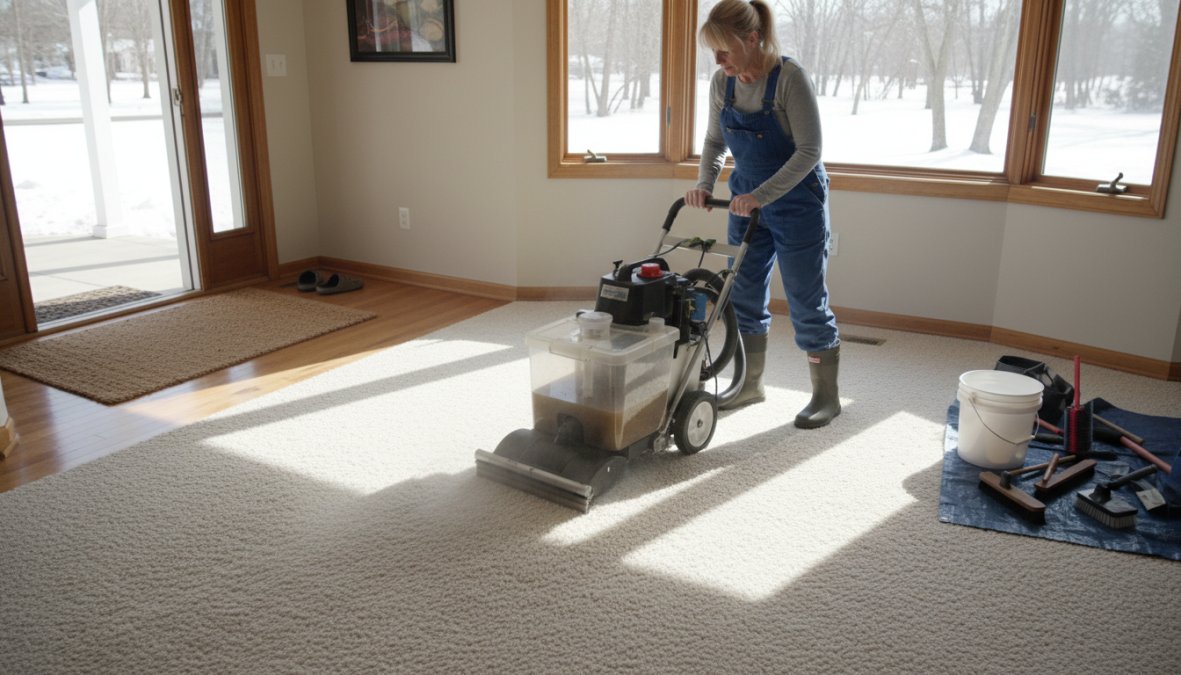
The single most effective habit for reducing carpet resoiling is removing shoes at the entry point. Combined with twice-weekly vacuuming and timely professional cleaning, this eliminates the majority of rapid resoiling causes without any special products or equipment.
The real reason carpets get dirty quickly isn’t foot traffic or poor luck. It’s a combination of residue chemistry, fiber physics, environmental conditions, and cleaning technique that compound over time. Address the root causes systematically and the cycle breaks.
For Lake Geneva homeowners dealing with persistent resoiling, the solution isn’t cleaning more often. It’s cleaning correctly. That means the right equipment, the right chemistry, and the right schedule for Wisconsin’s specific seasonal conditions. According to the EPA’s guidance on indoor air quality and carpet care, proper carpet maintenance directly impacts indoor air quality, making this a health issue as much as an aesthetic one.
Persistent carpet resoiling is a problem that compounds with every ineffective cleaning cycle, and generic advice rarely addresses the real causes. Lake Geneva Carpet Cleaning brings over 32 years of owner-operated experience to exactly this problem, using truck-mounted hot water extraction technology that removes embedded soil and allergens at a level rental equipment cannot match. Every cleaning includes meticulous attention to residue removal, moisture control, and fiber protector reapplication, backed by a 10-day satisfaction guarantee. Get started with Lake Geneva Carpet Cleaning and break the cycle of carpets that never seem to stay clean.
Frequently Asked Questions
Why does my carpet get dirty right after professional cleaning?
Your carpets get dirty quickly after professional cleaning most often because of sticky detergent residue left in the carpet fibers. This residue acts like a magnet, attracting dust, grime, and soil from foot traffic, a process called rapid resoiling. Over-wetting during cleaning can also cause wicking, where dirt trapped deep in the carpet pad travels back up through the fibers as the carpet dries. Choosing a low-residue, pH-balanced cleaning method helps prevent this.
What are the most common carpet resoiling causes?
The most common carpet resoiling causes include soapy surfactant residue left after cleaning, loss of factory-applied protectors like Scotchgard, over-wetting that saturates the carpet pad, and static electricity that pulls airborne soil into the carpet pile. High-traffic areas are especially vulnerable. Environmental factors like tracked-in mud, pet dander, and seasonal debris common in Lake Geneva, Wisconsin homes also accelerate how quickly dirt returns between cleanings.
How often should you professionally clean your carpets?
Carpet cleaning frequency depends on your household. Most carpet manufacturers recommend professional cleaning every 12 to 18 months for average households. Homes with pets, children, or allergy sufferers may need cleaning every 6 to 12 months. High-traffic areas benefit from more frequent attention. Regular vacuuming between professional cleanings, at least twice a week in busy areas, helps extend the life of your carpet and reduces how quickly dirt accumulates.
Does vacuuming too much ruin carpet?
Vacuuming frequently does not ruin carpet when done correctly. In fact, regular vacuuming is one of the best ways to prevent rapid resoiling by removing loose dirt, dust mites, and skin flakes before they work deep into the carpet fibers. Using the wrong vacuum height setting or a beater bar that is too aggressive on delicate carpet fiber types can cause wear over time. Match your vacuum settings to your carpet pile height for best results.
Why is my carpet turning black at the edges?
Dark or black edges along carpet borders, called filtration soiling, happen when air flows through gaps between the carpet and walls or under doors. The carpet fibers act as a filter, trapping fine dust particles, bacteria, and airborne grime that pass through. These deposits are difficult to remove with standard vacuuming because the particles are extremely fine. Professional deep cleaning with truck-mounted hot water extraction is typically the most effective solution for filtration soiling.
This article was written using GrandRanker