
Table of Contents
- Why Salt Stains Appear on Carpet (And Why They’re Harder to Remove Than You Think)
- Tools and Materials You’ll Need Before You Start
- How to Remove Salt Stains from Carpet: Step-by-Step Instructions
- Best Carpet Cleaner for Salt Stains: Choosing the Right Solution
- Material-Specific Safety: Not All Carpets Respond the Same Way
- Visual Troubleshooting: What Your Stain Is Telling You
- How to Prevent Salt Stains on Carpet This Winter
- When to Call a Professional Carpet Cleaner in Lake Geneva, WI
- Conclusion
Last Updated: May 26, 2026
Every winter in Lake Geneva, Wisconsin, the same problem walks right through the front door. Rock salt, ice melt, and calcium chloride get tracked inside on boots and shoes, and before long, white crusty stains appear across entryway carpets and hallways. The good news: you can remove salt stains from carpet with the right technique and a few household supplies. This guide from Lake Geneva Carpet Cleaning covers everything from the chemistry behind why these stains form to a proven step-by-step removal process, material-specific safety tips, and when DIY stops being enough.
Here’s what most guides get wrong: they treat salt stains like ordinary dirt. They’re not. Salt stains are an alkaline residue problem, and if you clean them the wrong way, you’ll push the mineral deposits deeper into the carpet fibers or cause discoloration that’s far harder to fix than the original stain.
Below, we’ll show you exactly how to neutralize that residue, which cleaning solutions work best for different carpet types, and how to prevent the problem from coming back all season long.
Why Salt Stains Appear on Carpet (And Why They’re Harder to Remove Than You Think)
Salt stains are a seasonal inevitability for Wisconsin homeowners. Road crews apply ice melt and calcium chloride to sidewalks and parking lots all winter, and foot traffic carries those minerals straight onto soft surfaces inside your home.
The stain itself is the dried mineral residue left behind after moisture evaporates. What you see as a white crusty stain is essentially a salt deposit bonded to carpet fibers. The problem isn’t the salt itself so much as what it does to the carpet’s pH balance and fiber structure over time.
The pH Imbalance Problem: Alkaline Residue and Carpet Fibers
Alkaline residue is the core reason salt stains are stubborn. Road salts, particularly calcium chloride and magnesium chloride used in ice melt products, are highly alkaline. When these compounds dry into carpet pile, they shift the local pH of the fiber, which can cause a bleached appearance and structural weakening of the carpet if left untreated.
The fix is chemistry, not just scrubbing. An acidic solution, typically white vinegar diluted in distilled water, neutralizes the alkaline residue and releases the mineral deposits from the carpet fibers. This is why the vinegar-and-water approach works so consistently. According to the Carpet and Rug Institute’s care and maintenance guidelines, pH balance is one of the most overlooked factors in effective stain removal.
Skipping the neutralization step and going straight to scrubbing is the most common mistake. Abrasive agitation without a neutralizing solution just grinds the salt deeper into the carpet pile.
Why Salt Stains Keep Coming Back: Understanding Wicking
Wicking is the phenomenon where a stain appears to be gone after cleaning, then reappears as the carpet dries. Salt stains are particularly prone to wicking because mineral deposits often penetrate past the carpet fibers into the backing or padding beneath.
When you apply moisture to clean the surface, dissolved salt migrates upward through capillary action as the carpet dries. The result: the stain comes back, sometimes larger than before. The solution is thorough rinsing and complete drying, which we’ll cover in the step-by-step section.
Tools and Materials You’ll Need Before You Start
Gathering everything before you begin prevents mid-process interruptions that let the cleaning solution over-saturate the carpet. Here’s what you need:
- White vinegar (distilled, not apple cider)
- Distilled water
- Microfiber cloth or clean white terry cloth towels
- Stiff-bristled brush (soft enough for carpet, firm enough to loosen dried debris)
- Spray bottle
- Vacuum with strong suction (preferably with a hose attachment)
- Baking soda (optional, for odor and additional mineral absorption)
- Warm water for rinsing
- Fan or portable dehumidifier for drying
One item many guides skip: a clean white cloth is non-negotiable. Colored cloths can transfer dye to damp carpet fibers, creating a secondary problem on top of the original stain.
Add a few drops of dish soap to your vinegar-water solution for particularly heavy salt buildup. The surfactant in dish soap helps lift mineral deposits that vinegar alone may not fully dissolve. Use sparingly, one or two drops maximum, to avoid leaving a soapy residue.
How to Remove Salt Stains from Carpet: Step-by-Step Instructions
To remove salt stains from carpet effectively, you need to work in sequence: dry removal first, then chemical neutralization, then rinsing, then drying. Skipping steps or reversing the order reduces effectiveness and risks pushing residue deeper into the carpet pile.
Total Time: 30-60 minutes (plus 2-4 hours drying time)
Difficulty: Beginner
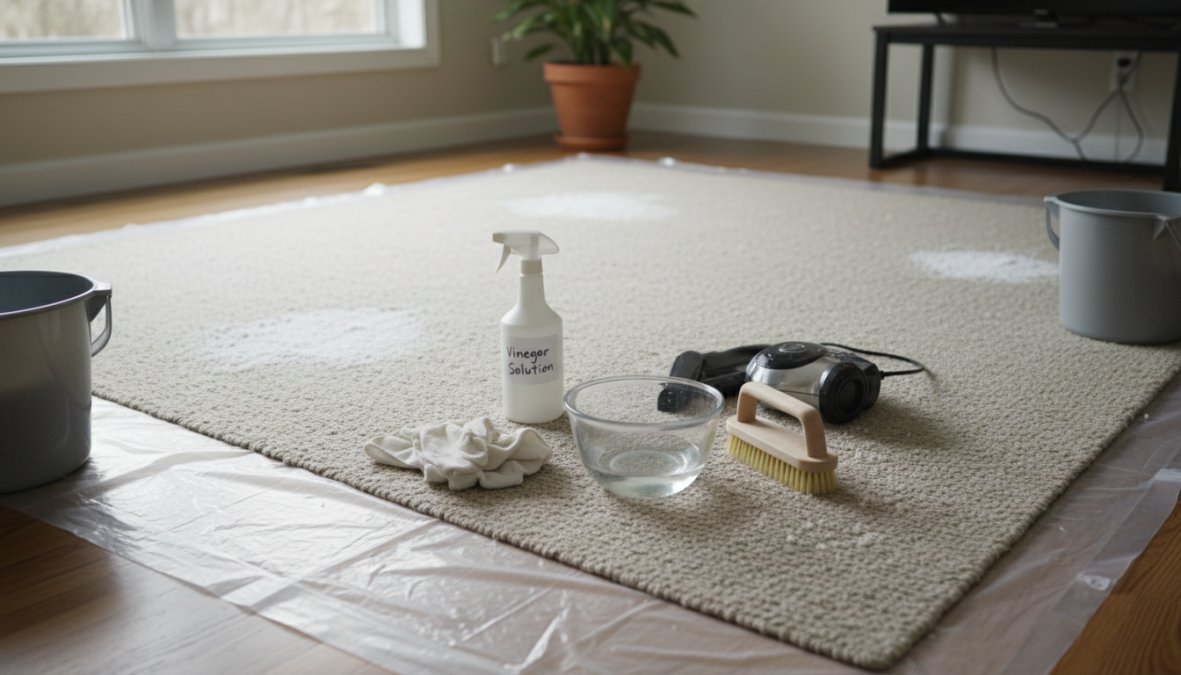
Step 1: Loosen Dried Debris and Dry Vacuum the Area
Start dry. Before applying any liquid, use a stiff-bristled brush to gently break up the white crusty stains on the carpet surface. Work from the outer edges of the stain toward the center to avoid spreading the residue.
Once loosened, vacuum the area thoroughly using a hose attachment. This removes the bulk of the salt residue before you introduce moisture. Skipping this step means you’re dissolving salt into the carpet rather than removing it, which increases the risk of wicking.
Step 2: Mix Your Cleaning Solution
The standard solution for removing salt residue from carpet is one part white vinegar to two parts distilled water. Mix this in a spray bottle.
For stubborn stains with heavy calcium chloride buildup, a slightly stronger ratio of one part vinegar to one part water is acceptable. Avoid using hot water in the spray bottle; warm water works better because it dissolves mineral deposits without over-wetting the carpet backing.
Step 3: Apply the Solution and Allow Dwell Time
Spray the vinegar solution onto the stained area until the carpet is lightly damp, not soaking wet. Over-saturation is one of the leading causes of wicking and can also promote mold growth in the carpet padding.
Allow a dwell time of three to five minutes. This contact time is what allows the acidic solution to neutralize the alkaline residue and release mineral deposits from the carpet fibers. Don’t rush this step. The chemistry needs time to work.
Step 4: Blot, Never Scrub, and Rinse
This is the part most people get wrong. Blotting lifts the dissolved salt out of the carpet fibers. Scrubbing pushes it sideways and deeper, damages the carpet pile, and can cause fraying.
Press a clean microfiber cloth firmly onto the stained area and lift straight up. Repeat with a fresh section of cloth each time. Continue blotting until no more residue transfers to the cloth.
Follow with a rinse: lightly spray the area with plain distilled water and blot again. This removes any remaining vinegar residue and prevents the solution itself from leaving a new mark. According to the Institute of Inspection Cleaning and Restoration Certification’s residential cleaning standards, thorough rinsing after solution application is critical to preventing secondary residue buildup.
Step 5: Dry the Carpet Pile Completely
Incomplete drying is the primary cause of recurring salt stains through wicking. After blotting, place a dry towel over the area and press down firmly to absorb as much remaining moisture as possible.
Then run a fan directed at the area, or use a portable dehumidifier if available. Avoid walking on the damp carpet until it’s fully dry. In a well-ventilated room, most carpet areas dry within two to four hours.
Never use a steam cleaner on a fresh salt stain. The heat can set the mineral deposits deeper into the carpet fibers and make the stain significantly harder to remove. Hot water extraction by a professional is different from a consumer steam cleaner and uses proper chemistry alongside heat.
Best Carpet Cleaner for Salt Stains: Choosing the Right Solution
The best carpet cleaner for salt stains is a pH-neutral or mildly acidic solution, not an alkaline carpet shampoo. Many commercial carpet shampoos are alkaline-formulated, which means they can actively worsen a salt stain by layering more alkaline residue on top of an already alkaline problem. Understanding why each solution type works (or doesn’t) helps you choose the right tool for your specific situation.
How Solution Chemistry Matches the Stain
Salt stains from road ice melt, calcium chloride, magnesium chloride, and sodium chloride blends, leave behind an alkaline mineral residue with a pH typically in the 8-10 range depending on the product used. Effective cleaning requires either neutralizing that alkalinity with a mild acid or using a surfactant system that physically lifts the mineral crystals from the fiber without changing the fiber’s own pH.
This is why solution choice matters more for salt stains than for most other carpet stains. The wrong chemistry doesn’t just fail to clean, it can extend the problem.
| Solution Type | Best For | pH Profile | Risk Level | Notes |
|---|---|---|---|---|
| White vinegar + distilled water (1:2) | Most synthetic carpet types | Mildly acidic (~3) | Low | Most reliable DIY option |
| Commercial floor neutralizer / ice melt remover | Heavy calcium chloride buildup | Near-neutral (6-7) | Low | Look for "salt neutralizer" labeling |
| Enzymatic cleaner (plant-based) | Pet households, sensitive fibers | Near-neutral | Low | Breaks down organic residue alongside mineral deposits |
| Castile soap + distilled water | Light residue, wool-safe option | Slightly alkaline (8-9) | Low if rinsed thoroughly | Use very sparingly; rinse completely |
| Alkaline carpet shampoo | General dirt and food stains | Alkaline (9-11) | High for salt stains | Avoid entirely on salt residue |
| Baking soda paste | Odor absorption, light surface residue | Slightly alkaline | Low if rinsed | Pre-treatment only; not a primary cleaner |
| Warm water only | Very fresh, light salt deposits | Neutral (7) | Low | Effective only within the first hour of tracking |
Eco-Friendly and Pet-Safe Alternatives: A Closer Look
Most cleaning guides mention white vinegar and stop there. But for households with pets, young children, or chemically sensitive occupants, it is worth understanding the full range of non-toxic options, and their real trade-offs.
White vinegar remains the benchmark. It is biodegradable, non-toxic to humans and pets once dry, and genuinely effective at neutralizing alkaline mineral residue. The acetic acid concentration in standard distilled white vinegar (typically around 5%) is sufficient to shift the pH of dried salt deposits without damaging most synthetic carpet fibers. The smell dissipates fully as the carpet dries.
Enzymatic cleaners are the option most guides overlook entirely. These products use plant-derived or microbial enzyme blends, commonly protease, amylase, and lipase combinations, to break down organic matter at a molecular level. While enzymes are most associated with pet urine treatment, they are also effective on the organic residue that often accompanies tracked-in salt: mud, boot residue, and road grime that bonds alongside the mineral deposits. For households where pets walk across the same entryway carpet, an enzymatic cleaner addresses both the salt residue and any incidental organic contamination in a single step. Look for products labeled "plant-based," "enzyme-active," or certified under the EPA’s Safer Choice program, which evaluates ingredient safety for both human health and aquatic ecosystems.
Castile soap (pure vegetable-oil-based soap, unscented) diluted at roughly one teaspoon per two cups of distilled water is a genuinely plant-derived surfactant option. It works by surrounding mineral particles and lifting them from fiber surfaces rather than chemically neutralizing them. The critical caveat: castile soap must be rinsed out completely. Any soap residue left in carpet fibers will attract dirt aggressively, creating a new soiling problem within days. Use it only when you have the time to rinse and blot thoroughly.
What to avoid in pet and child households: Products containing optical brighteners, synthetic fragrances, or quaternary ammonium compounds (often listed as "quats" or "benzalkonium chloride" on labels) are common in commercial carpet sprays and are worth avoiding around pets and young children. These ingredients are not necessary for salt stain removal and add chemical exposure without cleaning benefit.
If you are unsure whether a commercial product is safe for your household, the EPA’s Safer Choice product search (available at epa.gov/saferchoice) lets you look up specific products by name and review their ingredient safety ratings. This is a free, publicly available resource that takes about two minutes to use.
Commercial "Salt and Ice Melt Remover" Products: What to Look For
A growing category of commercial products is specifically formulated for mineral residue from road salt and ice melt. These are distinct from general carpet shampoos and are worth knowing about for households with heavy winter foot traffic.
Effective products in this category typically share a few characteristics: they are pH-balanced in the neutral-to-mildly-acidic range, they include a surfactant to lift mineral deposits, and they are formulated to rinse clean without leaving their own residue. Labels to look for include "floor neutralizer," "salt stain remover," "ice melt residue cleaner," or "winter floor treatment."
Avoid products in this category that list alkaline builders (sodium carbonate, sodium metasilicate) in the ingredients, these are effective for grease and food stains but counterproductive for alkaline salt residue.
For most Wisconsin households, the white vinegar and distilled water solution handles the majority of salt stain situations safely and effectively. Upgrade to an enzymatic cleaner if you have pets, to a commercial salt neutralizer for heavy seasonal buildup, or to castile soap for wool and delicate fiber situations where you want to avoid acid exposure entirely. The one thing all three approaches share: rinse thoroughly and dry completely.
Material-Specific Safety: Not All Carpets Respond the Same Way
A spot test is non-negotiable before applying any cleaning solution to your carpet. Apply a small amount of your chosen solution to an inconspicuous area, wait five minutes, and check for color transfer, discoloration, or fiber damage.
Different carpet materials respond differently to acidic solutions:
- Wool and wool-blend carpets: Use a diluted solution (one part vinegar to three parts water) and minimize dwell time. Wool fibers can be damaged by prolonged acid exposure. Blot immediately and rinse thoroughly.
- Nylon and polyester: These synthetic fibers handle the standard vinegar solution well. Most residential carpets in Wisconsin homes fall into this category.
- Berber and loop-pile carpets: Avoid stiff-bristled brushes entirely. The loop structure can snag and unravel. Use a soft cloth only.
- Natural fiber rugs (sisal, jute, seagrass): Avoid water-based solutions altogether. These fibers absorb moisture readily and can shrink, warp, or develop mold. Professional cleaning is strongly recommended.
The bleached appearance that sometimes appears on darker carpets after salt exposure is often pre-existing fiber damage from the salt itself, not a cleaning error. In these cases, professional assessment is the better path.
Visual Troubleshooting: What Your Stain Is Telling You
Not every white mark on carpet is a salt stain. Knowing what you’re dealing with prevents wasted effort and potential damage.
- White crusty stain with a defined edge: Classic salt or ice melt residue. Proceed with the vinegar solution method.
- White hazy film across a large area: Likely widespread salt tracking from heavy foot traffic. Treat the whole zone, not just visible spots.
- Stain reappears after cleaning: Wicking from the carpet backing or padding. Requires more thorough rinsing and longer drying time, or professional hot water extraction.
- Yellow or brown discoloration alongside white residue: The salt has been there long enough to cause fiber degradation. DIY methods may not fully restore appearance.
- Stain won’t respond to vinegar solution after two attempts: The residue may be from a different source (paint, adhesive, food), or the salt has bonded deeply to the fiber. Time to call a professional.
If a salt stain reappears after two rounds of DIY cleaning, it’s not a technique failure. It means the residue has penetrated the carpet backing, and surface cleaning won’t reach it. Professional hot water extraction is the appropriate next step.
How to Prevent Salt Stains on Carpet This Winter
Prevention is the most effective strategy for keeping carpet clean through a Wisconsin winter. The goal is stopping salt residue at the door before it reaches carpet fibers, and then, when it does get through, restoring the carpet to its pre-damage condition rather than just removing the visible stain.
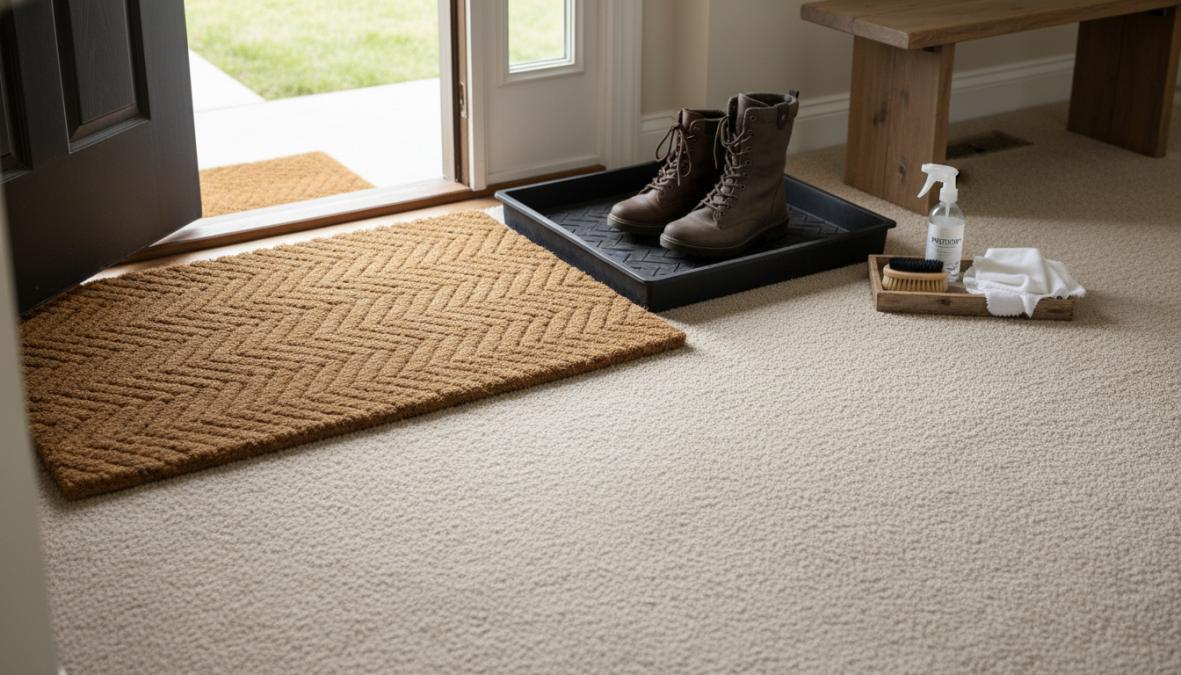
Entryway Defense: Stopping Salt Before It Reaches Carpet
Double-mat systems are the most effective passive prevention tool available. Place a coarse-texture scraper mat outside the door to dislodge salt crystals and ice from boot soles, and a second high-pile absorbent mat immediately inside the door to capture residual moisture and fine mineral particles. A single mat captures a fraction of what a two-mat system intercepts. Replace or clean mats frequently during peak winter months, a saturated mat stops absorbing and begins spreading residue instead.
Boot trays near the entrance keep wet, salt-covered footwear contained and off carpet entirely. A tray with raised edges holds meltwater and prevents it from wicking outward onto adjacent carpet zones.
A no-shoes policy inside the home is the single most effective prevention measure available. For households where a strict policy isn’t practical, designating a hard-surface transition zone (tile, vinyl, or hardwood) between the exterior door and the first carpeted area gives salt residue somewhere to land that can be mopped rather than extracted.
Area rugs over high-traffic carpet zones during winter months are dramatically easier to clean than wall-to-wall carpet. A washable area rug in the entryway can be taken outside, shaken, and laundered, a process that removes salt residue completely rather than just treating it in place.
Inspect high-traffic zones weekly during winter months. Fresh salt stains that have been down for less than 24 hours respond to warm water and blotting alone in many cases. Stains that have dried and bonded over several days require the full vinegar neutralization process. Stains left for a week or more begin to cause fiber degradation that cleaning cannot fully reverse.
Post-Cleaning Carpet Care: Restoring Pile and Texture After Salt Damage
This is the step that virtually no cleaning guide addresses, and it matters more than most homeowners realize.
After salt stains are removed, the carpet in the treated area often looks worse than the surrounding carpet in a specific way: the pile is matted, flattened, or slightly stiff, and the texture looks different from the rest of the floor. This is not a cleaning failure. It is a structural consequence of three things happening in sequence: salt crystals physically pressing down fiber strands as they dry, moisture from the cleaning process temporarily softening the fiber backing, and blotting pressure compressing the pile further during treatment.
Leaving the carpet in this state is a missed step. Here is how to restore it:
Step 1: Vacuum in multiple directions once fully dry. After the cleaned area has dried completely (minimum two to four hours with airflow), vacuum the treated zone using overlapping passes in at least two perpendicular directions. This lifts compressed fibers and redistributes the pile. Use a vacuum with a beater bar or rotating brush head for best results on cut-pile carpets. For loop-pile or Berber, use suction only, no beater bar.
Step 2: Use a carpet rake or stiff-bristled grooming brush. A carpet rake, a long-handled tool with widely spaced plastic tines, is the most effective tool for restoring pile height and direction after matting. Work in the direction of the carpet’s natural pile lean (run your hand across the surface; the direction that feels smooth is the pile direction). Short, firm strokes lift compressed fibers without snagging the backing. A clean, stiff-bristled scrub brush used in the same direction achieves a similar result if you don’t have a carpet rake.
Step 3: Address stiff or crunchy texture with a light steam pass. If the carpet fibers feel stiff or slightly crunchy after drying, a sign that trace mineral residue remains even after cleaning, hold a garment steamer or the steam function of a household iron (held several inches above the surface, not touching) over the area for a few seconds. The steam relaxes the fiber structure and softens any remaining residue. Immediately follow with a carpet rake pass while the fibers are warm and pliable. Do not use this technique on natural fiber rugs or wool without professional guidance.
Step 4: Apply a carpet protector to the restored area. Once the pile is restored and the carpet is fully dry, applying a fluoropolymer-based carpet protector spray to the treated zone creates a barrier that reduces mineral absorption in future incidents. These products work by coating individual fiber strands so that liquids and particles sit on the surface longer rather than bonding immediately to the fiber. This gives you more time to clean up tracked-in salt before it sets. Reapply after each professional cleaning, as hot water extraction removes protector along with soil.
Step 5: Schedule a mid-winter professional extraction if traffic is heavy. Salt residue accumulates in carpet fibers throughout the season even when individual stains are treated. A professional hot water extraction session mid-season, rather than waiting until spring, prevents cumulative mineral buildup from causing the kind of fiber weakening and discoloration that end-of-season cleaning cannot fully reverse. For high-traffic entryways in Wisconsin homes, this is a maintenance investment, not a reactive repair.
If a section of carpet pile refuses to stand back up after vacuuming and raking, place a damp (not wet) white towel over the area and press firmly with a warm iron set to low heat for five to ten seconds. The combination of heat and moisture relaxes compressed synthetic fibers. Lift the towel and immediately rake the pile upright. This technique works on nylon and polyester but should not be used on wool or natural fiber carpets.
Seasonal Maintenance Calendar for Wisconsin Homeowners
Salt stain prevention is most effective as a routine, not a reaction. A simple seasonal schedule reduces both the frequency of stains and the cumulative fiber damage that builds up over a full Wisconsin winter:
- Before first snowfall: Apply carpet protector to entryway and high-traffic zones. Set up double-mat system and boot tray. Establish a shoe-removal area.
- Weekly during winter: Inspect entryway carpet for early-stage salt deposits. Treat fresh stains immediately with warm water and blotting before they dry and bond.
- Monthly during winter: Deep-clean entry mats or replace disposable mats. Vacuum high-traffic carpet zones in multiple directions to prevent pile compression from accumulating.
- Mid-season (January in most Wisconsin locations): Consider professional hot water extraction for entryway and hallway carpet if foot traffic is heavy.
- End of season (March-April): Full professional extraction to remove the season’s cumulative mineral residue before it has a full summer to bond further into the fiber structure.
Removing the stain is only half the job. Restoring the carpet pile after cleaning is what separates a carpet that looks professionally maintained from one that looks worn down by winter. A carpet rake, a light steam pass, and a protector application take less than fifteen minutes and extend the visual life of your carpet significantly.
When to Call a Professional Carpet Cleaner in Lake Geneva, WI
Some salt stain situations are beyond DIY reach. Knowing when to stop and call a professional saves both time and carpet.
Call a professional carpet cleaner near me or in the Lake Geneva area when:
- The stain has been present for more than a week and has bonded deeply to the fibers.
- The stain reappears after two or more DIY cleaning attempts (confirmed wicking from the backing).
- You’re dealing with natural fiber rugs, wool carpets, or antique area rugs where DIY methods carry real risk.
- The affected area is large (more than a few square feet), making thorough DIY rinsing and drying impractical.
- There is visible discoloration or a bleached appearance that suggests fiber damage.
- You notice odor alongside the stain, which may indicate mold development in the padding beneath.
Professional hot water extraction, also called carpet shampooing or steam cleaning in common usage, uses truck-mounted equipment to inject a pH-balanced cleaning solution deep into the carpet pile and extract it along with dissolved residue. This process reaches the carpet backing and padding that surface cleaning cannot, which is why it resolves wicking problems that DIY methods cannot. According to the IICRC S100 Standard and Reference Guide for Professional Carpet Cleaning, hot water extraction is the most effective method for deep soil and mineral residue removal in residential carpet.
Lake Geneva Carpet Cleaning uses truck-mounted hot water extraction technology to address exactly these situations: deep-set salt residue, seasonal contaminant buildup, and recurring stains that keep coming back despite repeated home cleaning attempts.
Salt stains are a persistent winter challenge for homeowners across Lake Geneva and throughout Wisconsin, and the damage compounds when residue is left in carpet fibers through the season. Lake Geneva Carpet Cleaning has spent over 32 years helping Wisconsin homeowners address exactly this problem, using eco-friendly methods and state-of-the-art truck-mounted hot water extraction technology to remove deep-set mineral deposits that surface cleaning cannot reach. With a 10-day satisfaction guarantee and an owner-operated commitment to meticulous detail, the team brings the kind of expertise that makes a measurable difference in carpet appearance and longevity. Contact Lake Geneva Carpet Cleaning this winter and get the deep clean your carpet actually needs.
Frequently Asked Questions
Does vinegar remove salt stains from carpet?
Yes, white vinegar is one of the most effective DIY solutions to remove salt stains from carpet. Because salt and ice melt leave an alkaline residue, the mild acidity of white vinegar helps neutralize the pH imbalance and lift the mineral deposits from carpet fibers. Mix equal parts white vinegar and warm distilled water, apply with a microfiber cloth, allow a short dwell time, then blot, never scrub. Always do a spot test on a hidden area first to check for discoloration.
Why do salt stains keep coming back on my carpet?
Salt stains reappear due to a process called wicking. When the carpet surface dries after cleaning, moisture from deeper in the carpet backing and padding pulls dissolved salt residue back up through the carpet pile to the surface. To prevent this, rinse the area thoroughly with distilled water after applying your cleaning solution, extract as much moisture as possible, and ensure the carpet dries completely and quickly using fans or open windows.
How do you get dried salt out of carpet fibers?
To remove white salt residue from carpet that has already dried and hardened, start by breaking up the crusty deposit with a stiff-bristled brush, then dry vacuum the loosened debris thoroughly. Next, apply a white vinegar and distilled water solution or a pH-balanced carpet cleaner, let it dwell for 5-10 minutes, and blot with a clean microfiber cloth. Repeat as needed. Skipping the dry vacuuming step first is a common mistake that pushes abrasive salt particles deeper into the carpet pile.
What is the best carpet cleaner for salt stains from ice melt or calcium chloride?
The best carpet cleaner for salt stains caused by ice melt or calcium chloride is a pH-balanced, alkaline-neutralizing solution. A simple mix of white vinegar and distilled water works well for most carpets. For stubborn or set-in stains, a commercial carpet shampoo designed for mineral deposits or a professional hot water extraction service delivers the deepest results. Avoid using dish soap in large amounts, as it can leave a soapy residue that attracts more dirt over time.
Is it safe to use a carpet cleaner on all carpet types for salt stain removal?
Not all carpet materials respond the same way to cleaning solutions. Natural fiber carpets like wool or sisal can be damaged by acidic solutions such as vinegar, while synthetic carpets like nylon and polyester are generally more tolerant. Always perform a spot test on a small, hidden section of carpet before full application. If you are unsure about your carpet's material or the stain is persistent, consulting a professional cleaning service helps prevent permanent discoloration or fiber damage.
This article was written using GrandRanker