Last Updated: November 22, 2026
Quick Summary
Identifying upholstery fabric starts with the manufacturer’s care label stitched under the cushions, which lists the fiber content and a cleaning code: W, S, WS, or X. That tag overrides any guess you make by touch, so photograph it before cleaning and follow the stricter instruction when the label conflicts with itself.
- Code W means water-based cleaner only, S means solvent only, WS accepts either, and X means vacuum only.
- Natural fibers like cotton, linen, wool, and silk absorb moisture and are prone to shrinkage and color bleeding.
- Spot test the approved cleaner in a hidden area and wait for a full dry before judging the result.
- Clean blends to the most delicate fiber in the mix, since blends pull toward their weakest link.
- Call a professional when the fabric is delicate, the label is missing, the stain is set, or the piece is too large to test.
Table of Contents
- How Do I Identify My Upholstery Fabric Type?
- How to Identify Couch Fabric by Look, Feel, and Weave
- Natural vs. Synthetic Fibers: What Each One Means for Cleaning
- Upholstery Cleaning Codes: What W, S, WS, and X Mean
- Fabric Cleaning Codes Symbols and Manufacturer Instructions
- Spot Testing and Burn Testing: Limits and Safety
- Cleaning Delicate Upholstery Fabric Without Damage
- Blended, Coated, and Specialty Fabrics
- When to Call a Professional Upholstery Cleaner in the Lake Geneva Area
- Frequently Asked Questions
How Do I Identify My Upholstery Fabric Type?
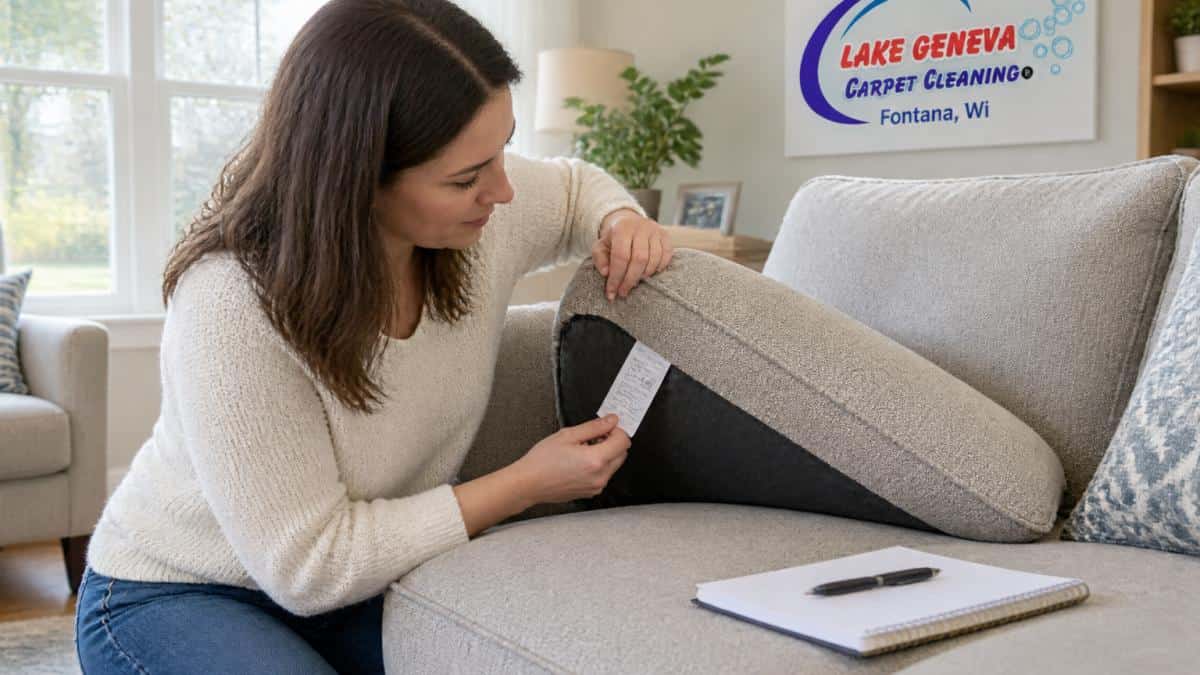
Identifying upholstery fabric types for proper cleaning starts with one source of truth: the manufacturer’s care label stitched under the cushions. That small tag tells you the fiber content and the cleaning code, and it overrides every guess you can make by touch.
At Lake Geneva Carpet Cleaning, we have served homeowners in Lake Geneva and the surrounding towns for 32 years. Skipping that tag is one of the most common mistakes we see. A wrong cleaner can set a stain, shrink a cover, or bleed dye into a cushion you cannot replace.
You can work through the steps below to decode most couch labels. We will walk you through the label, a fallback decision tree, and the cleaning codes that decide what touches your fabric.
Start With the Manufacturer Tag and Care Label
The care label is the first place to look, and it usually hides in plain sight. Flip the seat cushions, check the deck under them, and look along the back frame and under the skirt.
Fabric identification is the process of reading a furniture’s fiber content and cleaning code so you choose a cleaner that will not damage it. The label gives you both in a few lines of text.
Look for these details:
- Fiber names such as cotton, polyester, or a blend
- A cleaning code letter: W, S, WS, or X
- Words like “dry clean only” or “water-based cleaner only”
- A manufacturer name you can call for confirmation
Snap a photo of the tag before you clean anything. It fades, and it is your proof if a spot test goes sideways. For a full walkthrough from tag to stain removal, see our guide to mastering fabric couch cleaning.
When the Label Is Missing: A Simple Decision Tree
No tag? Do not guess. Work through this tree in order, and stop at the first clear answer.
- Check again in hidden spots. Look under the frame, inside cushion zippers, and on the platform under the seats.
- Find the furniture maker. Search the brand name and model online, or call the retailer. Many keep fabric specs on file.
- Look at the weave and feel. Tight, smooth weaves usually take water-based cleaners. Looped or nubby textures need more care.
- Test in a hidden area. Apply a small amount of cleaner to a spot no one sees and let it dry fully.
- Still unsure? Stop. Treat the piece as delicate and call a professional before you touch it.
This tree saves furniture. The fifth step is the one most people skip, and it is the one that matters most.
How to Identify Couch Fabric by Look, Feel, and Weave
Learning how to identify couch fabric by touch is a backup skill, not a replacement for the tag. Use it to confirm what the label says, or to narrow things down when the label is gone.
Run your hand across the surface and answer three questions:
- Is it smooth or textured? Smooth points to microfiber or a tight synthetic weave. Textured points to linen, tweed, or a looped fabric.
- Does it have a sheen? A soft sheen often means silk, velvet, or a synthetic blend.
- Does it stretch or scratch? Looped weaves snag on rings and pet claws, which changes how you clean them.
Fabric weave matters as much as fiber content. A loose weave traps soil deep, while a tight weave keeps spills on the surface. That difference changes your vacuuming routine and how much moisture the fabric can take.
If your eyes and hands still cannot settle it, our guide on decoding care tags and preventing fabric damage goes deeper into the visual clues.
Natural vs. Synthetic Fibers: What Each One Means for Cleaning
Natural and synthetic fibers behave in opposite ways around water, and that single fact drives most cleaning decisions.
Natural fibers come from plants or animals. Cotton, linen, wool, and silk fall here. They absorb moisture readily, which makes them prone to shrinkage and color bleeding when soaked. Wool and silk are the most fragile of the group.
Synthetic fibers are manufactured. Polyester, nylon, and microfiber are common examples. They resist water and hold their shape well, but they attract oils and can pill with harsh scrubbing.
Here is how that plays out in practice:
- Cotton and linen tolerate water-based cleaners but need quick, even drying
- Wool and silk usually need a gentle, low-moisture approach
- Polyester and nylon handle most water-based cleaners well
- Microfiber traps fine dust and needs a clean, soft cloth
A common mistake is treating a cotton blend like pure cotton. Blends pull toward the needs of their most delicate fiber, so clean to the weakest link.
Upholstery Cleaning Codes: What W, S, WS, and X Mean
Upholstery cleaning codes are single letters on the care tag that indicate which cleaner is generally suitable for that fabric. Understanding what the letter does not promise matters just as much.
| Code | What It Means | Safe Cleaner | Watch Out For |
|---|---|---|---|
| W | Water-based cleaners only | Foam or water-based cleaner | Over-wetting the padding |
| S | Solvent-based cleaners only | Dry-cleaning solvent | Water, which can shrink or stain |
| WS | Water or solvent based | Either type | Mixing the two in one pass |
| X | Vacuum only | None | Any liquid at all |
Code W means the fabric takes water-based cleaner. Code S means solvent only, so keep water away entirely. Code WS is the flexible one and accepts either. Code X means vacuum only, with no liquid cleaner of any kind.
What the Code Actually Tells You, and What It Doesn’t
A cleaning code is a compatibility statement, not a performance guarantee. The letter tells you which chemistry will not attack the fiber or the finish. It does not tell you that a stain will lift, that a dye will hold, or that a cushion will dry without a ring. Two couches can both carry a W code and behave very differently because one has a stain-guard finish and the other does not, or because one has been exposed to sunlight and the other has not.
A common pattern: a homeowner reads W, mixes a strong water-based cleaner, soaks the cushion, and gets a water ring at the edge of the wet area. The code was followed. The method was not. The letter approves the chemistry; you still have to control moisture, dwell time, and drying.
Manufacturer Instructions Take Priority
When a tag carries both a code and written instructions, the written instructions win. A furniture maker may allow water-based cleaning but still warn against soaking the cushions, or specify air drying only. Follow the stricter line every time. The code is a floor, not a ceiling.
Keep these points in mind:
- Read the full tag, not just the letter
- Note any drying instructions, such as air dry only
- Save the tag photo with your furniture paperwork
- Call the manufacturer if two lines on the tag conflict
Manufacturers test their own fabrics. Their instructions reflect how that specific fabric performed in testing, which beats any general rule you find online.
Codes on Blends and Finished Fabrics
Blends and finished fabrics complicate the letter. A cotton-polyester blend may carry a W code because the polyester tolerates water, but the cotton portion can still shrink at the seams if the cushion stays damp. A performance fabric with a stain-release finish may carry WS, yet the finish itself can be dulled by a solvent that the code technically permits. When a code and a finish disagree in practice, treat the finish as the more fragile element and spot test first.
A Quick Code Workflow
- Read the letter and any written instructions together.
- If they conflict, follow the stricter instruction.
- Spot test the approved cleaner in a hidden area and let it dry fully.
- Clean with the least moisture and least agitation that gets the job done.
- Dry the piece quickly and evenly to prevent rings and mildew.
Watch out: treating a WS code as permission to switch cleaners mid-cushion. Mixing a water-based and a solvent-based product in one pass can create a residue or a reaction neither product would cause alone. Finish one method, let the fabric dry, and only then decide whether a second approach is needed.
Fabric Cleaning Codes Symbols and Manufacturer Instructions
Some tags use symbols instead of letters, and some use both. Fabric cleaning codes symbols follow the same logic: a water symbol points to water-based cleaning, a solvent symbol points to dry cleaning, and a crossed-out symbol means do not clean with liquid.
When a tag carries both a code and written instructions, the written instructions win. A manufacturer may allow water-based cleaning but still warn against soaking the cushions. Follow the stricter line.
Keep these points in mind:
- Read the full tag, not just the letter
- Note any drying instructions, such as air dry only
- Save the tag photo with your furniture paperwork
- Call the manufacturer if two lines on the tag conflict
Manufacturers test their own fabrics. Their instructions reflect how that specific fabric performed in testing, which beats any general rule you find online.
Spot Testing and Burn Testing: Limits and Safety
Spot testing is the only way to know how a cleaner will behave on your fabric, and it takes five minutes. Burn testing can help identify fiber content, but it has real limits.
How to spot test:
- Pick a hidden area, such as the back of a cushion or under the skirt.
- Apply a small amount of cleaner with a white cloth.
- Blot, do not rub.
- Wait until the area dries completely.
- Check for color change, shrinking, or a ring.
Watch out: testing on a visible area, or skipping the dry time, hides problems until the whole couch is wet. Always wait for a full dry before you judge the result.
Burn testing works by singeing a few loose fibers and reading the ash. Natural fibers tend to smell like burning paper or hair and leave soft ash. Synthetics tend to melt and leave a hard bead. The limits matter here. You need loose fibers to test, the results can be ambiguous on blends, and open flame near furniture carries real risk. We rarely recommend it for homeowners. A tag, a manufacturer call, or a professional pre-inspection is safer.
If you want a proven stain routine with the common mistakes spelled out, read our upholstery stain removal guide.
Cleaning Delicate Upholstery Fabric Without Damage
Delicate upholstery fabric needs less moisture, less friction, and more patience. Velvet, silk, wool, and loose weaves all fall into this group.
Follow this method:
- Vacuum first with a soft brush attachment to lift loose soil
- Test your cleaner in a hidden spot and let it dry
- Apply cleaner to your cloth, not the fabric
- Blot from the outside of the stain inward
- Dry the area quickly with a fan or open window
- Brush velvet and looped weaves back into place once dry
Watch out for two common errors. Over-wetting pushes moisture into the padding, where it can breed odors and mildew. Rubbing spreads the stain and can fuzz the surface.
We keep a full step-by-step method in our guide to cleaning delicate fabric safely. It covers each fabric family and the drying times that protect them.
Blended, Coated, and Specialty Fabrics
Blends and coated fabrics break the simple rules, which is why they trip up so many homeowners.
Blends mix two or more fibers. Clean to the most delicate fiber in the mix. A cotton-polyester blend takes water-based cleaner, but treat it with the care a cotton cover needs.
Coated fabrics carry a protective layer on the surface. Wipe them with a damp cloth and mild cleaner, and skip anything abrasive that could scratch the coating.
Specialty fabrics include leather, faux leather, and performance fabrics. Leather needs its own conditioner routine and should never be soaked. Performance fabrics resist spills but still need spot testing.
When in doubt, treat a specialty fabric as delicate. A slower clean beats a ruined cover every time.
When to Call a Professional Upholstery Cleaner in the Lake Geneva Area
Call a professional when the fabric is delicate, the label is missing, the stain is set, or the piece is too large for a safe home test. Those four signals cover most of the furniture we see, but in this part of Wisconsin there is a fifth: the soil itself is different from what a general guide assumes.
Why Lake Geneva-Area Upholstery Gets Dirty Differently
Homes near lakes in this region can face a soil mix that general guides may not address. Road salt and sand tracked in from November through March work into the lower skirt and the seat deck, where they abrade fibers and hold moisture. Spring mud and lakeside silt come in on shoes and pet paws. Summer humidity off the water keeps cushions damp longer, which is exactly the condition mildew needs. And pollen season in this region coats tight-weave fabrics with a fine film that vacuuming alone will not lift.
That combination matters because salt and sand are abrasive, not just dirty. Surface cleaning pushes them deeper into the padding, where they grind against the fiber every time someone sits down. Wiping a salt-stained skirt with a damp cloth can spread the salt rather than remove it.
The Five Signals to Hand It Off
- The fabric is delicate. Velvet, silk, wool, and loose weaves need controlled moisture and fast, even drying. A home spot test cannot replicate that on a full cushion.
- The label is missing or ambiguous. If you cannot confirm the fiber and the code, the risk of a wrong cleaner outweighs the savings of a home attempt.
- The stain is set. Stains that have dried, been heat-set by a dryer or a sunny window, or been through a failed home attempt are harder to lift and easier to damage with a second try.
- The piece is too large for a safe test. Sectionals, oversized cushions, and pieces with attached backs leave no hidden area big enough to test properly.
- The soil is embedded or seasonal. Salt, sand, silt, and pet odor that have worked into the padding need extraction that reaches below the surface.
What a Professional Pre-Inspection Adds
A pre-inspection is the step most homeowners cannot do at home: confirming the fiber and code, checking for finish wear, testing in a hidden area, and matching the method to the fabric before any cleaner touches the piece. That sequence is what protects a lakefront sofa in Williams Bay as much as a family room couch in Elkhorn.
We serve homeowners in Fontana, Twin Lakes, Genoa City, Walworth, Darien, Burlington, Elkhorn, Williams Bay, Delavan, East Troy, and the surrounding communities. Truck-mounted hot water extraction can reach into fabric and padding to lift embedded soil and odor. A pre-inspection helps match the method to the fabric code before cleaning begins. If you are ready to hand off a delicate piece, look at our professional upholstery cleaning service for the Lake Geneva area, and contact us for a free quote, as pricing depends on the job.
Your furniture is an investment, and one wrong cleaner can undo years of care. If you would rather not risk a delicate cover or a missing tag, Lake Geneva Carpet Cleaning can help. We bring 32 years of owner-operated experience, eco-friendly methods, and a 10-day satisfaction guarantee to every job, from a single armchair to a full living room set. Get started with Lake Geneva Carpet Cleaning and protect the furniture your family uses every day.
Frequently Asked Questions
How can I identify upholstery fabric if the care label is missing?
Check under seat cushions, behind the couch, and along the frame for a second tag, since many manufacturers stitch codes in more than one spot. If none exists, examine the weave and feel, then run a small spot test with a water-based cleaner on a hidden area. When you are still unsure, treat the fabric as delicate and call a professional upholstery cleaner before applying anything stronger.
What does cleaning code W mean on upholstery?
Code W means the fabric can be cleaned with water-based cleaners. It is one of the more forgiving upholstery cleaning codes, but you should still spot test on a hidden area first and avoid over-wetting the fabric. Blot rather than scrub, and let the piece dry fully with good airflow to prevent moisture problems.
Which upholstery fabrics are easiest to clean?
Tight-weave synthetic fabrics such as polyester and nylon blends, along with treated microfiber, are generally the easiest to clean because they resist stains and tolerate water-based cleaners. Natural fibers like cotton and linen clean well but can shrink or bleed, while silk, velvet, and wool need gentler handling. Always confirm with the care label and a spot test before cleaning.
When should I call a professional to clean delicate upholstery?
Call a professional when the care label says dry clean only, when the fabric is silk, velvet, or a coated specialty material, or when a stain has set and home methods have not worked. A trained cleaner can match the method to the fiber and avoid shrinkage or color bleeding. If you live in Lake Geneva, Fontana, or a nearby town, ask for a pre-inspection before any cleaning begins.