
Last Updated: November 16, 2026
Quick Summary
Dog urine odor returns because urine soaks past the carpet fibers into the backing, pad and sometimes the subfloor, where uric acid crystals survive surface cleaning. Remove the smell by blotting, applying an enzymatic pet cleaner, allowing full dwell time, and drying thoroughly.
- Use a blacklight in a dark room to find hidden urine spots, marking each with painter’s tape.
- Blot with dry paper towels and do not rub, since rubbing pushes urine deeper into the backing.
- Choose an enzymatic cleaner made for pet urine, because it breaks down uric acid rather than masking it.
- Leave the enzyme cleaner for the full label dwell time and keep the area moist during that period.
- Bring in professional help if the smell returns after two full treatments or urine has reached the subfloor.
Table of Contents
- Why Dog Urine Odor Keeps Coming Back
- Gather the Supplies You Need to Remove Recurring Dog Urine Odor
- Step 1: Locate Hidden Urine Spots With a Blacklight
- Step 2: Blot and Pre-Treat Fresh or Set-In Stains
- Step 3: Apply an Enzymatic Cleaner and Allow Full Dwell Time
- Home Remedies and Baking Soda: What Works and What Doesn’t
- Why Shampooing Can Make Urine Odor Worse
- Drying, Moisture Checks, and Preventing Repeat Odor
- When to Stop DIY and Call a Professional in East Troy, WI
- Get Expert Help From Lake Geneva Carpet Cleaning
- Frequently Asked Questions
Why Dog Urine Odor Keeps Coming Back
If your carpet smells like dog urine again after a few weeks, the problem is almost never the surface you can see. Urine soaks through the carpet fibers into the carpet backing, the pad and sometimes the subfloor. Our guide to permanent pet stain and odor removal explains why DIY methods fail to reach this layer. Surface cleaning removes what is on top and leaves the source underneath. That is why the smell returns.
Dog urine contains uric acid crystals. Water and ordinary soap do not dissolve them well, so they stay in the carpet and wake up again when humidity rises or the carpet gets damp. Many pet owners in the Lake Geneva area notice the smell most in spring and during humid weather.
Here is the basic rule: you must clean the whole path the urine took, not just the stain you see. We will walk through how to do that below, including when a home method will not be enough.
Gather the Supplies You Need to Remove Recurring Dog Urine Odor
Most of what you need is already in a typical home. Having everything ready before you start keeps the job moving and stops you from using the wrong product partway through.
- A blacklight flashlight to find hidden spots
- White paper towels or clean white cloths for blotting
- A spray bottle filled with cool water
- An enzymatic pet odor cleaner, labeled for urine
- A soft brush for working the cleaner into the fibers
- Old towels for pressing out moisture
- Rubber gloves and a pair of old shoes or socks
- A fan or dehumidifier for drying
Choose an enzymatic cleaner made for pet urine. Enzyme cleaners break down the uric acid that causes the odor, while regular cleaners often just mask it. Before you use any product on a large area, test it on a hidden corner of the carpet, such as inside a closet, to check for color change.
Step 1: Locate Hidden Urine Spots With a Blacklight
Dog urine often reaches far beyond the spot you can see. Turn off the room lights and run a blacklight slowly over the carpet and the baseboards. Urine shows up as yellow-green spots, and older stains can glow in a dull, chalky way.
Mark each spot with a small piece of painter’s tape so you can find it again. Many pet owners in East Troy, WI, discover several old accidents this way, often under furniture or near doorways. Do not skip the edges of the room, where dogs tend to go.
Work from the outside of each spot inward when you clean. This keeps the stain from spreading.
Step 2: Blot and Pre-Treat Fresh or Set-In Stains
Fresh urine is easier to remove than urine that has dried for days. The first job is to lift as much liquid as possible before it sinks deeper.
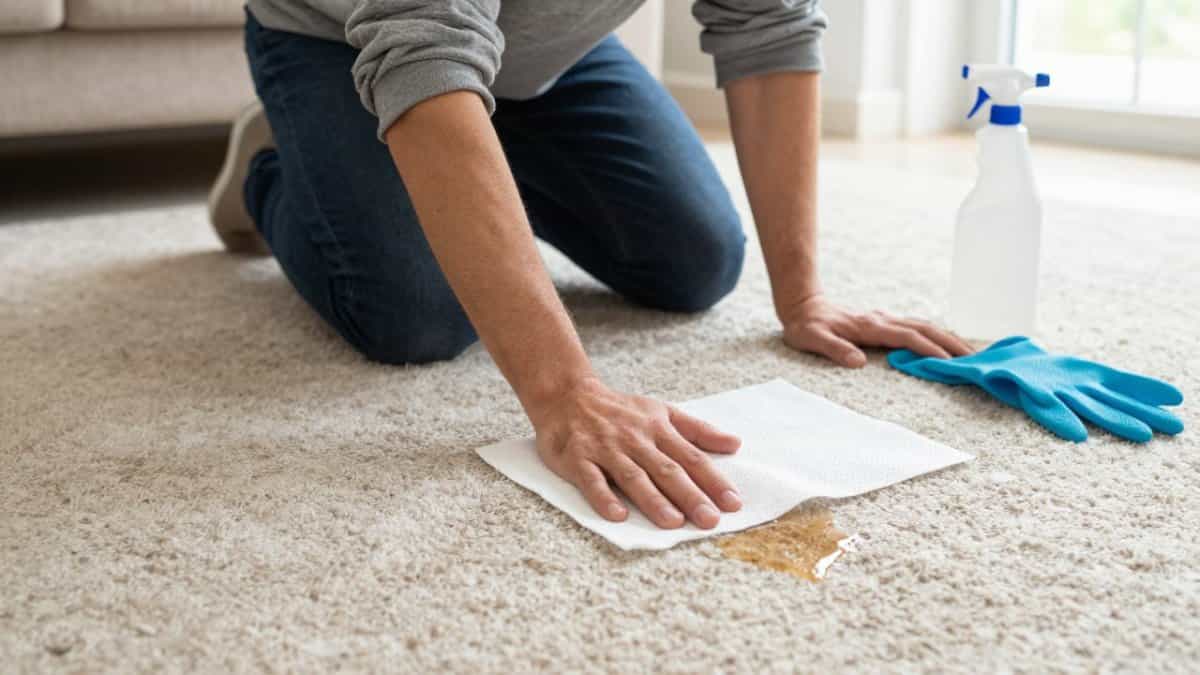
Press a stack of dry paper towels firmly onto the spot and hold for a few seconds. Replace the towels until they come up mostly dry. Do not rub, because rubbing pushes urine deeper into the carpet backing and spreads the stain.
For set-in stains, lightly dampen the area with cool water first. This softens the dried urine so the cleaner can reach it. Then blot again. Pre-treating in this way makes the enzymatic cleaner far more effective in the next step.
Step 3: Apply an Enzymatic Cleaner and Allow Full Dwell Time
Enzyme cleaners work slowly. The enzymes need time to break down the uric acid, and this waiting period is called dwell time. Rushing it is one of the most common reasons the smell comes back.
Follow these steps:
- Spray enough cleaner to saturate the area, reaching the carpet backing if you can
- Gently work it into the fibers with a soft brush
- Cover the area with plastic wrap or a damp towel to keep it wet
- Leave it for the time listed on the label, often several hours or overnight
- Blot the area dry with clean towels once the dwell time is up
Do not let the carpet dry out during dwell time. If the surface starts to dry, mist it lightly with water. Some stubborn stains may need a second treatment, so check the spot with your nose and the blacklight before you move on.
The table below summarizes the three-step process and the timing that matters for each stage.
| Step | What to do | Time or frequency |
|---|---|---|
| Step 1: Locate spots | Run a blacklight over carpet and baseboards; mark spots with tape | Done before cleaning, in a dark room |
| Step 2: Blot | Press dry paper towels firmly; do not rub | Replace towels until mostly dry |
| Pre-treat set-in stains | Lightly dampen with cool water, then blot again | Before applying cleaner |
| Step 3: Enzyme cleaner | Saturate area, brush gently, cover with plastic wrap or damp towel | Leave for label time, often several hours or overnight |
| Keep moist | Mist lightly with water if surface starts to dry | During dwell time |
| Final blot | Blot dry with clean towels | Once dwell time is up |
Home Remedies and Baking Soda: What Works and What Doesn’t
Most homeowners reach for baking soda or vinegar before anything else, and it helps to know exactly what each one can and cannot do before you spend an evening on a treatment that will not hold.
Baking soda is a mild absorbent. For methods that go beyond baking soda, see this practical guide to pet odor removal. Sprinkled on a damp spot and vacuumed up after it dries, it pulls some surface moisture and odor with it. That is useful for a fresh accident you caught within the hour. It does not penetrate the carpet backing or the pad, so it cannot reach the uric acid crystals that cause a recurring smell. If the odor returns a week or two after a baking soda treatment, the source is almost certainly below the surface.
Vinegar is a dilute acid. It can neutralize some odor compounds on contact and is often used as a rinse after a cleaner. The trade-off is that vinegar is not an enzyme and does not break down uric acid, so on its own it is a surface deodorizer, not a fix. It can also affect some carpet dyes if left to sit.
Hydrogen peroxide is a mild oxidizer. It can lighten a stain, which is exactly why it is risky on colored carpet: it can bleach the fibers and leave a permanent pale patch. If you use it at all, test it first on a hidden corner, such as inside a closet or under a piece of furniture, and let it dry fully before judging the result.
Watch out: never mix vinegar with bleach or with any product containing ammonia. That combination can release harmful fumes, and it is a particular risk in a closed room with the windows shut. Keep the room ventilated and read every label before you combine anything.
A simple test for any home remedy is to ask whether it breaks down urine or only covers the smell. Enzyme cleaners break it down. Learn how enzyme cleaners work, their dwell times, and their limits for old stains. Baking soda, vinegar, and most store-bought spot cleaners only cover it up for a short time, which is why the smell keeps returning. If you have tried two or three home remedies and the odor is still there, the urine has likely reached the pad, and that is the point to stop layering products and move to a deeper treatment or a professional assessment.
Why Shampooing Can Make Urine Odor Worse
A carpet shampooer or steam cleaner seems like the obvious fix, but it often makes urine odor worse. Heat and moisture can pull urine residue up from the backing and pad, and that residue returns to the surface with the smell.
If the pad stays soaked, it can also grow mold and mildew, which adds a second odor that is harder to remove. Over-wetting the carpet is a common mistake, so use only as much cleaner and water as the job requires.
For this reason, treat the urine source first with an enzyme cleaner and dry the area thoroughly before you shampoo anything. Shampooing is a finishing step, not the cure.
Drying, Moisture Checks, and Preventing Repeat Odor
Drying is where most home attempts fail, and it is also where you can learn the most about why the smell keeps coming back. A carpet that stays damp underneath can hold urine residue and smell again within days, so treat drying as a step, not an afterthought.
Start by pulling up as much moisture as you can with dry white towels, then run fans on the area for several hours. A dehumidifier helps in a humid room, and opening windows on a dry day speeds things up. Avoid walking on the area while it dries, and do not put furniture back until the carpet is fully dry underneath.
To check whether the carpet is actually dry, press a dry white towel firmly onto the spot and hold it for a few seconds. If the towel comes away damp, keep drying. Repeat the check every few hours. A carpet that feels dry on top can still be wet in the backing and pad, and that hidden moisture is what feeds a returning odor.
This is also the moment to figure out which layer is holding the smell. A common pattern is:
- Odor that fades after treatment and returns within days usually means urine is still in the backing or pad.
- Odor that is strongest near baseboards or under furniture often points to urine that spread sideways along the pad.
- A stiff, crusty patch or a stain that will not lift suggests urine reached the subfloor, which surface cleaning cannot fix.
- A musty, mold-like smell layered on top of urine means the pad stayed wet too long and needs to be assessed, not just cleaned.
Once the area is dry, watch the smell over the next two to three weeks. Keep a simple log of which spots you treated, when, and whether the odor returned. That log tells you whether you are making progress or whether the source is deeper than a surface treatment can reach.
To prevent repeat accidents, clean up immediately, use an enzyme product every time, and consider waterproof pet pads near the spots your dog favors. Regular potty breaks and positive reinforcement reduce indoor accidents, and identifying the locations your dog keeps choosing helps you address the cause rather than just the smell. If the odor returns after two full treatments and a proper drying cycle, the pad or subfloor is the likely source, and that is the point to bring in professional help.
When to Stop DIY and Call a Professional in East Troy, WI
Home methods work well for fresh stains and light odor. You should consider professional help if:
- The smell returns after two or more full treatments
- Urine has soaked into the pad or reached the subfloor
- The carpet feels stiff or discolored in a large area
- Old accidents cover a wide section of the room
- You smell mold or mildew along with urine
Professional carpet cleaners use truck-mounted hot water extraction to reach the backing and pad. If the pad is badly saturated, replacing it may be the only lasting fix. Pricing depends on the size and condition of the job, so contact us for a free quote.
Get Expert Help From Lake Geneva Carpet Cleaning
If the smell keeps coming back, you do not have to guess what is happening under the carpet. Lake Geneva Carpet Cleaning serves homeowners in East Troy and the surrounding area, using eco-friendly, truck-mounted hot water extraction to reach pet urine that home methods leave behind.
Call us or request a free estimate to get a clear plan for your carpet. Our team can help you enjoy a fresh-smelling home again.
Lake Geneva Carpet Cleaning serves Lake Geneva, Twin Lakes, Genoa City, Walworth, Fontana, Darien, Burlington, Elkhorn, Williams Bay, Delavan, East Troy and nearby communities. Call us today for a free quote.
Frequently Asked Questions
Will dog urine smell in carpet eventually go away on its own?
Usually not. Urine leaves salts and organic compounds in the carpet backing, pad, and subfloor, and those compounds keep releasing odor, especially when humidity rises or the area gets damp. Without treatment that reaches the padding, the smell tends to return or stay faint but noticeable. Enzymatic cleaners applied thoroughly and allowed to dry completely are the most reliable way to break down the residue. If the odor persists after two or three careful treatments, the pad may need replacement, and a professional inspection can confirm that.
Why does dog urine odor come back after I clean the carpet?
The smell usually comes back because the cleaning reached only the carpet fibers, while the urine had already soaked into the pad or subfloor. Heat from steam or a strong shampoo can also bind residue deeper into the backing, and a carpet that stays damp for too long can reactivate the odor. Treating the spot from the top down, drying it fully, and checking for a fresh smell a few days later helps confirm whether the source has actually been removed.
Can baking soda remove old dog pee smell from carpet?
Baking soda can absorb some odor and is a reasonable step for mild, recent accidents. Sprinkle it over the dry area, leave it for several hours, then vacuum it up. It does not break down the uric acid crystals that cause lingering smell, though, so it is best used alongside an enzymatic cleaner rather than on its own. For older or recurring stains, expect baking soda to mask the smell temporarily at most.
When should I call a professional for recurring dog urine odor?
Call a professional if the smell returns after you have treated the spot thoroughly, if the stain has been there for a long time, or if you can smell urine near the subfloor or baseboards. Homeowners in East Troy, WI and nearby towns can contact Lake Geneva Carpet Cleaning for an inspection. Pricing depends on the size and condition of the job, so contact us for a free quote.