Table of Contents
- How Hot Water Extraction Works on Carpets
- Understanding the Dust Mite Lifecycle
- Water Temperature Requirements for Killing Mites
- How to Kill Dust Mites in Carpet: What Hot Water Extraction Achieves
- HEPA Filtration and Dead Mite Removal
- How Often to Steam Clean Carpets for Allergy Management
- Professional Carpet Cleaning for Allergies vs. DIY Methods
- Re-infestation Timelines and Humidity Control
- Conclusion
Last Updated: August 12, 2026
How Hot Water Extraction Works on Carpets
Hot water extraction is a deep cleaning method that forces heated water and cleaning solution into carpet fibers under pressure, then immediately vacuums the moisture back out along with embedded dirt and contaminants. The process works by injecting water at temperatures between 130 and 150 degrees Fahrenheit into the carpet pile, where it breaks down soil bonds and suspends particles. A powerful suction system then extracts the water, dirt, and dissolved contaminants in a single pass.
The thermal energy in the water is critical. Heat loosens the grip that dust, allergens, and other particles have on carpet fibers. Unlike surface cleaning or dry methods, hot water extraction reaches deep into the carpet backing and padding where microscopic pests and their allergens accumulate. The combination of temperature, moisture, and suction creates an environment where embedded debris cannot survive extraction.
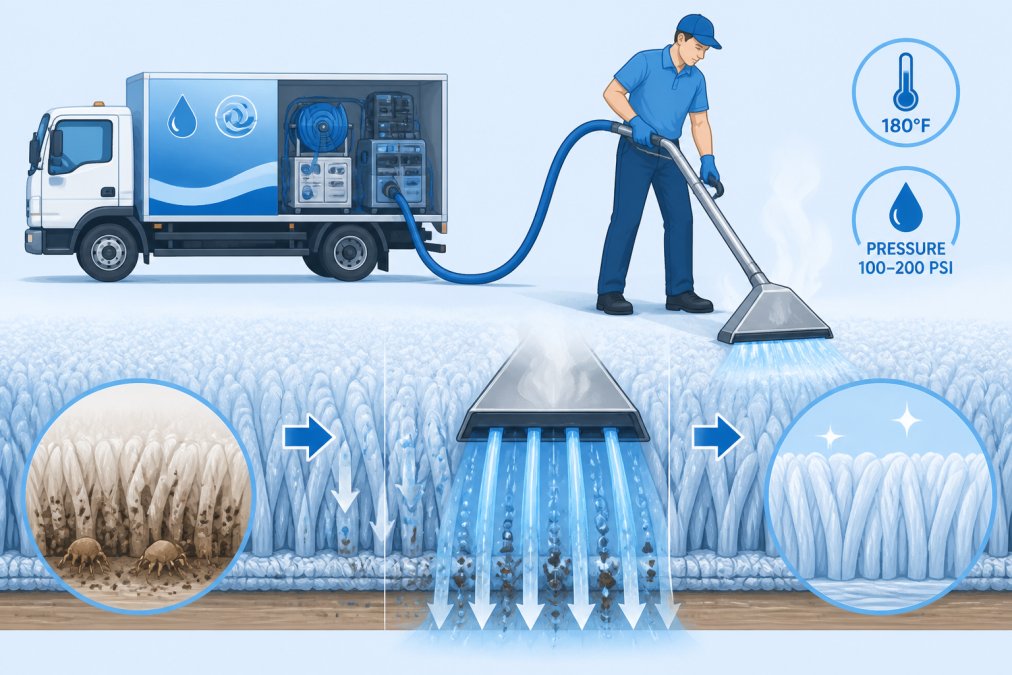
This method is particularly effective because it doesn’t rely on chemicals alone. The mechanical action of the water pressure dislodges particles while the heat accelerates the cleaning process. When performed correctly, the carpet dries within 4-8 hours, which prevents mold growth and allows the space to be used again quickly. The extraction power matters significantly, systems with higher suction capacity remove more moisture and more contaminants, which is why professional-grade equipment outperforms consumer rentals.
Understanding the Dust Mite Lifecycle
Dust mites are microscopic pests that live in carpets, bedding, upholstered furniture, and other fabric environments. A single dust mite is invisible to the naked eye, measuring only about 0.3 millimeters. These creatures thrive in warm, humid environments and feed on dead skin cells that humans shed naturally, roughly 1.5 grams per person per day.
The lifecycle of dust mites spans approximately 2-3 months. A female mite produces 40-80 offspring during her lifetime, which means populations grow rapidly in undisturbed environments. Mites pass through several developmental stages: egg, larva, nymph, and adult. Each stage can last several weeks depending on temperature and humidity levels. In a single gram of carpet dust, there can be thousands of mites at various life stages.
What makes dust mites problematic isn’t the mites themselves, but their waste products. Dust mite allergens are protein-based compounds found in fecal matter and decomposing mite bodies. These allergens are far smaller than the mites themselves and become airborne easily, triggering respiratory reactions and allergic responses in sensitive individuals. A single mite produces roughly 20 fecal pellets per day, each containing these potent allergens. Understanding this lifecycle is essential because it reveals why a single cleaning session isn’t a permanent solution, new mites will recolonize cleaned areas within weeks if conditions remain favorable.
Water Temperature Requirements for Killing Mites
The thermal death point for dust mites is approximately 130 degrees Fahrenheit (55 degrees Celsius). At this temperature, mites and their allergens begin to denature and lose viability. However, the relationship between temperature and mite elimination isn’t linear, higher temperatures kill mites faster and more thoroughly.
Research into carpet sanitation shows that sustained exposure to 130 degrees Fahrenheit kills mites, but many professionals recommend operating at 150-160 degrees Fahrenheit to ensure thorough elimination and to improve the cleaning solution’s effectiveness. The higher temperature also accelerates the breakdown of allergen proteins, making them less likely to trigger allergic reactions even if mite particles remain in the carpet.
Fabric-Specific Heat Tolerance: The Critical Balance
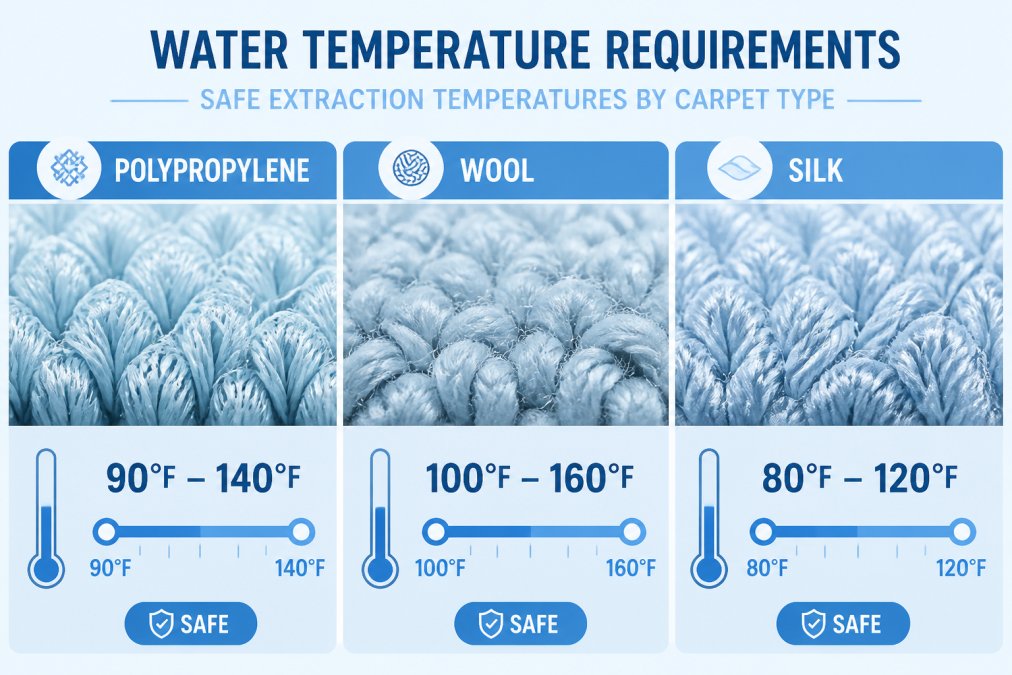
While 130-160 degrees Fahrenheit is necessary to kill mites, not all carpet and fabric types can withstand these temperatures without damage. This is the practical reality that separates effective cleaning from costly mistakes.
Carpets and fabrics that tolerate 130-160°F extraction:
- Solution-dyed synthetic fibers (polypropylene, polyester), the most common residential carpet types
- Wool blends with synthetic content (typically 80/20 or higher synthetic ratio)
- Most commercial-grade nylon carpets
- Standard cotton and polyester upholstery
Fabrics requiring lower temperatures (100-120°F maximum):
- Natural wool carpets and rugs (pure or high-wool blends), heat above 120°F causes shrinkage and fiber damage
- Silk or silk-blend fabrics, extremely heat-sensitive; sustained exposure above 110°F causes permanent discoloration and fiber degradation
- Antique or hand-knotted rugs, often use natural dyes that bleed or fade at elevated temperatures
- Delicate upholstery with natural fibers (linen, cotton velvet), prone to shrinkage and color loss
- Leather and suede, heat causes cracking and permanent stiffness
This distinction is essential because applying 150°F extraction to a wool oriental rug or silk upholstery will destroy the item while attempting to clean it. Professional technicians assess fiber content before extraction begins, adjusting temperature and pressure accordingly. Many homeowners don’t realize their "expensive" carpet or rug requires lower-temperature cleaning, which means standard hot water extraction at the mite-killing temperature range is inappropriate.
The trade-off: Lower-temperature extraction (100-120°F) on delicate fabrics won’t achieve the thermal death point for dust mites. In these cases, alternative methods become necessary: encasement (for bedding and mattresses), frequent HEPA vacuuming, humidity control, and less frequent professional cleaning with gentler methods. For residents with valuable wool rugs or silk furnishings, accepting that hot water extraction at mite-killing temperatures isn’t an option, and building an allergen management strategy around encasement and dehumidification instead, is more practical than risking permanent damage.
One critical limitation: hot water extraction kills mites present during the cleaning, but it doesn’t prevent re-infestation. The temperature is lethal only to organisms actively exposed to the heated water. Mites in deeper carpet backing or padding may survive if the extraction pressure doesn’t reach them. This is why hot water extraction alone, without follow-up humidity control and regular maintenance, provides temporary relief rather than permanent elimination.
How to Kill Dust Mites in Carpet: What Hot Water Extraction Achieves
Hot water extraction removes dust mites and their allergens from carpet, but success depends on proper execution and realistic expectations. The process eliminates mites and allergen particles through thermal action and mechanical extraction, but it doesn’t address the root cause of mite proliferation: humidity and food sources.
Here’s what hot water extraction actually accomplishes:
- Kills active mites exposed to the heated water (130+ degrees Fahrenheit)
- Removes allergen-laden dust and fecal particles through suction
- Reduces allergen load by 85-95% immediately after cleaning
- Temporarily disrupts the mite habitat by removing their food source (dead skin cells)
- Improves air quality by extracting microscopic particles that become airborne
Here’s what it doesn’t do:
- Prevent re-infestation within 2-4 weeks if humidity remains high
- Kill mites in deeper padding if water pressure doesn’t penetrate fully
- Address the structural humidity that allows mites to thrive
- Eliminate allergens on surfaces outside the carpet (furniture, bedding, walls)
The key insight: hot water extraction is a critical part of allergy management, but only when combined with humidity control and regular maintenance. For individuals with severe dust mite allergies, professional extraction every 3-6 months, paired with dehumidification and frequent vacuuming, creates meaningful, sustained relief. Without these supporting practices, the benefits diminish rapidly.
HEPA Filtration and Dead Mite Removal
HEPA filtration captures particles as small as 0.3 microns, which is small enough to trap dead mite bodies and allergen particles. When hot water extraction systems include HEPA filtration in their equipment, they prevent allergen-laden water vapor and microscopic particles from re-entering the air during extraction.
Professional carpet cleaning equipment uses HEPA filters at two critical points: in the recovery tank (where extracted water is collected) and in the exhaust air. This dual-filtration approach ensures that the extraction process doesn’t aerosolize allergens. Consumer-grade equipment often lacks true HEPA filtration, which means it may remove mites and allergens from the carpet but release them back into the indoor air, a counterproductive outcome for allergy sufferers.
The dead mite removal process is straightforward: the suction system pulls mite bodies, fecal matter, and allergen particles into the recovery tank. With HEPA filtration, these particles are trapped and disposed of. Without it, they remain suspended in the air or recirculate through the carpet. For residents in the Lake Geneva area managing dust mite allergies, confirming that your cleaning service uses HEPA-equipped extraction equipment is essential. This distinction separates truly effective allergen removal from surface cleaning that merely redistributes the problem.
How Often to Steam Clean Carpets for Allergy Management
The frequency of hot water extraction depends on allergy severity, household occupancy, environmental conditions, and, most critically, humidity levels. However, most homeowners approach cleaning frequency in isolation, ignoring the biological reality that re-infestation timelines are driven by humidity, not calendar dates.
The Re-infestation Timeline: Why Standard Schedules Fail
Dust mites begin recolonizing cleaned carpets within 1-2 weeks if relative humidity remains above 50%. This timeline is the foundation for determining actual cleaning frequency. A home maintained at 40-50% humidity may need professional extraction only every 6-12 months because mite population rebound is slow. A home with 60-70% humidity will see mite populations return to pre-cleaning levels within 3-4 weeks, making quarterly cleaning necessary just to maintain the same allergen load.
This means cleaning frequency without humidity control is largely ineffective. Extracting a carpet in a humid home is like bailing water from a boat with a hole in the hull, the effort provides temporary relief but doesn’t address the root problem.
Cleaning Frequency Based on Humidity Levels
Low-humidity environments (40-50% relative humidity):
- Professional extraction every 6-12 months
- Weekly HEPA vacuuming
- Mite populations rebound slowly; allergen levels remain manageable
- Ideal scenario for allergy sufferers; humidity control is the primary intervention
Moderate-humidity environments (50-60% relative humidity):
- Professional extraction every 4-6 months
- Twice-weekly HEPA vacuuming in bedrooms and high-traffic areas
- Mite populations rebound at moderate speed; regular maintenance is essential
- Dehumidifier use during humid seasons (spring/summer) extends time between professional cleanings
High-humidity environments (60%+ relative humidity):
- Professional extraction every 3-4 months
- Twice-weekly HEPA vacuuming throughout the home
- Mite populations rebound rapidly; allergen levels spike quickly without intervention
- Year-round dehumidification is necessary; without it, cleaning frequency must increase to every 6-8 weeks to maintain allergen control
Household Occupancy and Skin Cell Load
Households with pets, children, or high occupancy generate more dead skin cells, the primary food source for dust mites, which accelerates mite population growth independent of humidity. A family of four sheds roughly 6 grams of skin cells per day; a single person sheds 1.5 grams. This means:
- Single-occupant homes: Professional extraction every 6-12 months (if humidity is controlled)
- Two-person households: Every 6-9 months
- Families with children or pets: Every 3-6 months, even with humidity control
The combination of occupancy and humidity determines the actual schedule. A family of four in a humid climate requires more frequent cleaning than a single person in a dry climate, even if both have the same allergy severity.
Seasonal Adjustments
Summer humidity typically increases mite numbers, making cleaning before and after summer months strategic. Winter heating can reduce humidity indoors, which naturally suppresses mite populations, though forced-air heating often creates dry conditions that cause static electricity and dust circulation, partially offsetting this benefit.
Practical seasonal approach:
- Spring cleaning (before humidity rises): Remove winter allergen accumulation
- Late summer cleaning (as humidity peaks): Prevent allergen buildup heading into fall
- Fall/winter: Reduce frequency if humidity drops naturally; increase if heating systems create dry, dusty conditions
Between Professional Cleanings: The Maintenance Schedule
Regular vacuuming with a HEPA-filter vacuum removes surface allergens and slows mite population growth more effectively than relying on professional cleaning alone. Weekly vacuuming of high-traffic areas and bedrooms is more effective than monthly deep cleaning without maintenance.
- High-traffic areas and bedrooms: Twice weekly with HEPA vacuum
- Living areas and hallways: Weekly with HEPA vacuum
- Bedding: Wash in hot water (130°F+) weekly
- Mattress encasements: Use on all mattresses to prevent mite colonization
- Air filters: Replace HVAC filters monthly during high-occupancy or high-humidity periods
The Integrated Approach: Cleaning + Humidity Control
The most sustainable strategy combines professional extraction frequency with humidity management. A home at 40-50% humidity with professional cleaning every 6 months and weekly HEPA vacuuming will maintain lower allergen levels than a home at 65% humidity cleaned every 3 months without dehumidification. The humidity control is the multiplier that makes cleaning effective.
For allergy sufferers, the question isn’t "How often should I clean?" but rather "What humidity level can I maintain, and what cleaning frequency does that require?" Starting with humidity measurement (a $15-30 hygrometer provides accurate readings) and then building a cleaning schedule around that baseline delivers sustained relief rather than temporary improvement.
Professional Carpet Cleaning for Allergies vs. DIY Methods
Professional hot water extraction equipment differs fundamentally from consumer rental machines. Truck-mounted systems generate higher water temperatures, greater suction power, and more consistent results than portable units. Professional technicians understand fabric-specific heat tolerance, proper alkaline rinse protocols, and how to avoid over-wetting that leads to mold growth.
Consumer rental equipment typically operates at lower temperatures (100-120 degrees Fahrenheit), which is insufficient to achieve the thermal death point for dust mites. Suction power is also limited, meaning allergen particles remain in the carpet padding. Additionally, rental machines are often used incorrectly, resulting in carpets that stay wet for 24+ hours, creating an ideal environment for mold growth and mite recolonization.
DIY methods like spot-cleaning or steam cleaning with handheld devices are even less effective. These approaches don’t reach deep carpet layers and don’t generate enough heat or suction to meaningfully reduce allergen load. While they may improve appearance, they provide minimal allergy relief.
The professional advantage extends beyond equipment. Experienced technicians recognize different carpet types and adjust water temperature and pressure accordingly. They pre-treat heavily soiled areas, apply appropriate cleaning solutions, and perform proper rinsing to remove residual chemicals. They also understand the relationship between extraction quality and drying time, critical factors for preventing mold and mildew that would reintroduce allergens.
For residents managing dust mite allergies in the Lake Geneva area, professional extraction is the most reliable method. The combination of proper equipment, trained technicians, and proven protocols delivers results that DIY approaches cannot match.
Re-infestation Timelines and Humidity Control
Dust mites begin recolonizing cleaned carpets within 1-2 weeks if humidity remains above 50%. This timeline is the critical reality that most homeowners don’t understand. Hot water extraction eliminates the current population, but it doesn’t prevent new mites from migrating into the carpet from surrounding areas or from eggs that survive the cleaning process in deeper padding.
Relative humidity is the primary driver of mite population growth. Mites thrive at 60-80% humidity and die at levels below 40%. This means that without humidity management, even a perfectly executed professional extraction provides only temporary relief. A dehumidifier maintained at 40-50% relative humidity dramatically slows mite population rebound.
Several practical steps extend the benefits of professional cleaning:
- Use a whole-house or room-specific dehumidifier to maintain 40-50% relative humidity
- Ensure adequate ventilation through windows or HVAC systems
- Wash bedding weekly in hot water (130+ degrees Fahrenheit)
- Vacuum high-traffic areas and bedrooms twice weekly with a HEPA filter
- Consider mattress encasements to prevent mite colonization
- Clean air conditioning and heating filters monthly to prevent allergen circulation
The interaction between humidity and cleaning frequency is important: in dry climates or well-ventilated homes, professional extraction every 6-12 months may be sufficient. In humid environments or homes with poor air circulation, extraction every 3-4 months combined with dehumidification is necessary to maintain low allergen levels.
Re-infestation doesn’t mean the cleaning failed, it means the environment remains hospitable to mites. Understanding this distinction shifts the focus from a single cleaning event to an ongoing allergen management strategy. For allergy sufferers, this integrated approach delivers sustained relief rather than temporary improvement.
Does hot water extraction remove dust mites? Yes, when performed correctly at temperatures of 130 degrees Fahrenheit or higher, hot water extraction kills active dust mites and removes allergen particles from carpet. However, the process provides temporary relief rather than permanent elimination. Mites recolonize cleaned carpets within weeks if humidity remains high and regular maintenance isn’t maintained.
The most effective approach combines professional hot water extraction with humidity control, frequent vacuuming, and regular maintenance. For residents in the Lake Geneva area dealing with dust mite allergies, Lake Geneva Carpet Cleaning delivers professional-grade extraction. Our truck-mounted hot water extraction equipment reaches the thermal death point required to eliminate mites and their allergens, while our team understands the fabric-specific care needed to protect your carpets. With our 10-day satisfaction guarantee and over 32 years of experience serving Wisconsin homeowners, we’re committed to creating healthier living spaces. Contact Lake Geneva Carpet Cleaning to schedule a professional extraction and take the first step toward lasting allergen relief.
Frequently Asked Questions
Will hot water extraction completely eliminate dust mites from my carpet?
Hot water extraction kills dust mites and removes allergens at the moment of cleaning, but it does not prevent future re-infestation. The process reaches deep into carpet fibers and padding where mites live, using water heated to 130 degrees Fahrenheit or higher to achieve thermal death. However, dust mites will gradually return within weeks as humidity levels rise and new organic matter accumulates. Professional extraction combined with regular vacuuming and humidity control provides the best long-term allergen management.
How often should I steam clean my carpets to manage dust mite allergies?
For allergy sufferers, professional hot water extraction every 3-6 months is recommended, depending on household conditions. Homes with pets, children, or high humidity may need cleaning every 3 months. Between professional cleanings, vacuum at least twice weekly with a HEPA-filter vacuum to remove surface allergens and dead mites. Regular extraction combined with weekly vacuuming significantly reduces dust mite allergen loads and helps maintain respiratory health.
Is professional carpet cleaning for allergies better than doing it myself?
Professional hot water extraction removes substantially more dust mites and allergens than DIY methods because truck-mounted systems generate higher water temperatures, greater suction power, and deeper carpet penetration. Professional equipment also includes HEPA filtration to capture microscopic allergens during extraction, preventing them from re-entering your home. While rental equipment can help, it typically does not reach the thermal death point or suction capacity needed for complete allergen removal, making professional cleaning the more effective choice for serious allergy management.
How long does it take for dust mites to return after hot water extraction?
Dust mites typically begin re-infesting cleaned carpets within 2-4 weeks, depending on humidity levels and organic matter in the carpet. Relative humidity above 55% accelerates mite reproduction significantly. To extend the benefits of hot water extraction, maintain indoor humidity between 30-50%, vacuum frequently with a HEPA filter, and schedule professional cleaning every 3-6 months. This integrated approach, combining extraction with humidity control and regular maintenance, provides the most effective long-term dust mite management.
This article was written using GrandRanker