
Table of Contents
- Can You Walk on Carpet After Professional Cleaning?
- Why Drying Time Matters After Professional Cleaning
- Carpet Drying Time After Professional Cleaning
- Risks of Walking on Damp Carpet
- What to Do If You Must Walk on the Carpet
- How to Speed Up Carpet Drying
- Carpet Cleaning Aftercare Tips
- Local Climate Considerations for Drying
- Frequently Asked Questions
Last Updated: September 26, 2026
Can You Walk on Carpet After Professional Cleaning?
The short answer is no, not right away. Your carpet needs time to dry completely after professional cleaning. Walking on damp carpet creates slip hazards, can damage fibers, and may undo the benefits of the cleaning itself. At Lake Geneva Carpet Cleaning, we guide homeowners through the drying process to protect their investment and ensure the best results from professional cleaning.
Why Drying Time Matters After Professional Cleaning
Professional carpet cleaning saturates fibers and padding to remove embedded dirt, allergens, and odors. That moisture must evaporate completely before foot traffic resumes.
Wet carpet becomes slippery, especially on stairs, increasing fall risk. Walking on damp fibers crushes the pile permanently, leaving matting or tracks. Moisture also reactivates soil particles, causing the carpet to re-soil faster.
Moisture trapped in carpet padding creates conditions for mold and mildew growth within 24-48 hours, producing odors and potentially triggering allergies or respiratory issues.
Drying time isn’t optional, it’s essential for safety, fiber protection, and preventing mold growth in carpet padding.
Carpet Drying Time After Professional Cleaning
Most carpets dry within 6 to 12 hours after professional cleaning, though drying time varies based on carpet fiber type, humidity, temperature, and airflow.
How Carpet Material Affects Drying Speed
Different carpet fibers absorb and release moisture at different rates, making material type one of the most important drying variables.
Nylon carpet is the most common residential fiber and typically dries fastest, usually within 6 to 10 hours with adequate airflow.
Polyester carpet typically requires 8 to 12 hours for complete drying.
Wool carpet dries significantly slower than synthetic fibers, often taking 18 to 24 hours or more because wool absorbs water readily and padding stays damp longer.
Wool-blend carpets (wool mixed with nylon or polyester) fall between pure wool and synthetic timelines. Expect 12 to 18 hours for complete drying, depending on the wool percentage. Higher wool content means longer drying times.
Frieze and textured carpets dry slower than low-pile options because their deeper pile traps more moisture, typically requiring 10 to 14 hours.
Other Factors That Affect Drying Time
Humidity and temperature control evaporation rates. Warm air speeds drying; cold, humid conditions slow it dramatically. Winter drying can take 50% longer than ideal conditions.
Airflow and ventilation make the biggest difference you can control. Moving air pulls moisture away from carpet fibers. Rooms with poor airflow, basements, interior bedrooms, or closed spaces, dry much slower than open, well-ventilated areas.
Carpet padding type affects drying time. Rubber-backed padding holds water longer than synthetic blends. Thick, dense padding can extend drying by 4 to 6 hours.
Square footage and room layout matter too. Large open spaces dry faster than small, enclosed rooms. Hallways and closets are the slowest to dry.
Cleaning method intensity affects moisture levels. Hot water extraction saturates carpet more thoroughly but removes more moisture during cleaning, resulting in shorter overall drying times.
If you know your carpet fiber type before professional cleaning, ask your cleaning technician for a specific drying time estimate. Wool carpet in a basement will dry much slower than nylon in a sunny living room, and realistic expectations help you plan household activities around the drying schedule.
Risks of Walking on Damp Carpet
Walking on wet or damp carpet creates immediate and long-term problems: slip and fall hazards (especially on stairs), permanent fiber damage from crushed pile, and faster re-soiling as moisture reactivates soil particles.
Walking on damp carpet while padding is still wet can trap moisture underneath, creating conditions for mold and mildew growth within 24-48 hours. This is especially risky in basements or humid climates.
What to Do If You Must Walk on the Carpet
Sometimes life doesn’t pause for drying schedules. If you must walk on the carpet before it’s completely dry, minimize damage with these strategies.
Wear clean socks or shoe covers instead of regular shoes. Socks provide traction without grinding dirt into wet fibers. Disposable shoe covers work even better, they protect the carpet from contamination while your feet stay clean. This is especially important in homes with young children or pets that track debris.
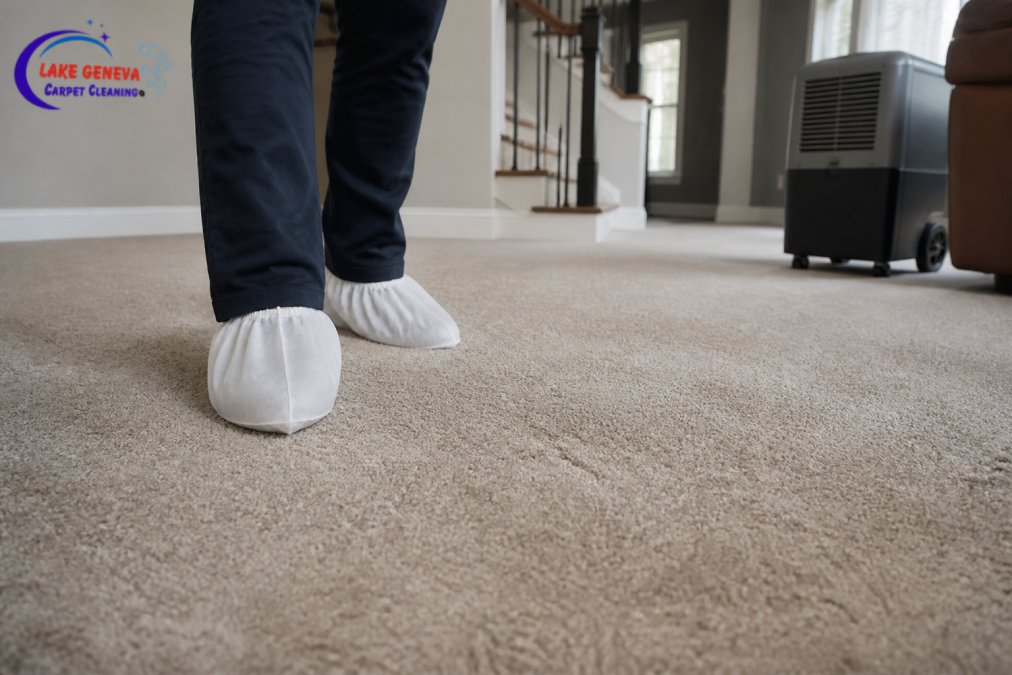
Limit foot traffic to essential pathways only. Designate a narrow route to bathrooms, kitchen, or exits. Keep family members off the carpet in other areas. The less traffic, the less damage to damp fibers.
Walk carefully and slowly. Rushing increases pressure on wet fibers and slip risk. Short, deliberate steps distribute weight more evenly and reduce matting. Avoid pivoting or dragging feet, which crushes fibers in one direction.
Keep the carpet off-limits for children and pets if possible. Children run and play without considering wet carpet hazards. Pets track moisture throughout the home and may slip on damp stairs. Use baby gates or closed doors to restrict access to cleaned areas.
Air dry shoes and paws immediately. Wet footprints spread moisture to other areas of the home. Towel off pet paws before they walk on dry carpet. Remove wet shoes near entryways and let them dry outside or in a mudroom.
How to Speed Up Carpet Drying
Professional carpet cleaning removes substantial moisture during the cleaning process itself. The remaining moisture must evaporate through air circulation and humidity reduction. You can accelerate this process significantly by strategically combining ventilation, temperature, and humidity control techniques.
Strategic Fan Placement for Maximum Airflow
Position box fans to create directional airflow across the carpet surface. Place fans at one end of the room, angled to blow moist air toward windows or open doors. Fans should sit 12 to 18 inches above the carpet, blowing parallel to the floor rather than downward. This creates a low-level air current that pulls moisture away from carpet fibers and pushes it toward exits. In large rooms, use multiple fans positioned to create overlapping air patterns, one fan blowing toward a window, another toward an open door, creating cross-current movement.
Angle fans toward windows or exterior doors. Moisture-laden air needs an exit path. Position fans so they push humid air directly toward open windows or doors where it can escape outside. Avoid pushing air into closed corners or interior walls, which simply redistributes moisture without removing it from the home.
Use ceiling fans to supplement box fans. Set ceiling fans to rotate counterclockwise (when viewed from below) during warm months to pull air upward and toward return vents or open windows. In cooler weather, reverse the direction to push warm air downward and outward. Ceiling fans alone won’t dry carpet quickly, but combined with box fans and open windows, they significantly improve air circulation throughout the room.
Run fans continuously for at least 12 to 24 hours. Intermittent fan use won’t achieve the same drying speed as continuous operation. The longer fans run, the more moisture they remove from the air and carpet. Plan to keep fans running overnight and into the next day if possible.
HVAC System Optimization
Set your thermostat fan to run continuously, not just during heating or cooling cycles. Most thermostats have a “fan on” setting that runs the blower motor constantly, circulating air throughout your home regardless of temperature. This is one of the most effective drying strategies because central HVAC systems move air through every room and return it through filters and return vents. Continuous fan operation distributes moisture evenly and removes it from the home more efficiently than localized fans alone.
Increase your thermostat temperature by 2 to 3 degrees for 24 hours after cleaning. Warm air holds more moisture than cool air, speeding evaporation from carpet fibers. This small adjustment makes a noticeable difference in drying speed without creating discomfort. If outdoor temperatures are mild, you can achieve this by simply closing windows and letting the sun warm your home naturally.
Keep interior doors open between rooms. Closed doors trap moist air in individual spaces and prevent the HVAC system from circulating air effectively. Open all interior doors to allow air to flow freely throughout your home. This distributes moisture more evenly and speeds overall drying by allowing the HVAC system to work on the entire home rather than isolated rooms.
Ensure return air vents are unobstructed. Return vents pull humid air out of rooms and back to the HVAC system. If furniture, curtains, or closed doors block return vents, the system can’t remove moisture efficiently. Clear a 12-inch radius around all return vents to maximize airflow.
Window Ventilation Strategy
Open windows on opposite sides of your home to create cross-ventilation. If you have windows on north and south walls, or east and west walls, open them simultaneously. This creates a pressure differential that pulls moist air through the home and out the opposite side. Cross-ventilation is most effective on mild days when outdoor temperature is within 10 to 15 degrees of indoor temperature.
Open windows even in cool or cold weather for brief periods. A 15-minute window opening in winter, repeated every few hours, removes a surprising amount of moisture without significantly cooling your home. The key is frequency and duration, multiple short openings work better than one long opening because they allow moisture to escape continuously as it evaporates from the carpet.
Close windows during humid weather. If outdoor humidity is high (above 60%), opening windows introduces moisture rather than removing it. On humid days, rely on fans, HVAC, and dehumidifiers instead of window ventilation.
Dehumidifier Deployment
Use a dehumidifier in the room with the most cleaned carpet or in naturally humid spaces like basements. Dehumidifiers extract moisture from the air, creating a drier environment that accelerates evaporation from carpet fibers. Place the unit in the center of the room or in the area with the deepest carpet pile or thickest padding.
Empty the collection tank frequently. Most dehumidifiers fill their collection tanks within 4 to 8 hours of continuous operation in a damp environment. A full tank stops the unit from working. Check the tank every 2 to 3 hours and empty it as needed. Alternatively, if your dehumidifier has a continuous drain option, attach a hose to direct water directly to a floor drain or outside.
Run the dehumidifier continuously for 24 to 48 hours after cleaning. The longer it operates, the more moisture it removes. Dehumidifiers are especially valuable in basements, which naturally retain moisture, and in homes near water (like those in the Lake Geneva area) where ambient humidity is chronically elevated.
Combine dehumidifier use with fans and HVAC for maximum effect. A dehumidifier alone is less effective than a dehumidifier working alongside fans and continuous HVAC operation. The dehumidifier removes moisture from the air, while fans and HVAC move that drier air across the carpet surface, accelerating evaporation.
What NOT to Do During Drying
Avoid using humidifiers or running showers and baths. These add moisture to the air, directly opposing your drying efforts. If family members need humidifiers for health reasons, run them in sealed rooms away from cleaned carpet areas. Delay baths and showers for at least 12 hours after cleaning, or run bathroom exhaust fans continuously if bathing is unavoidable.
Don’t close off cleaned areas to “contain” the drying process. Sealed rooms dry slower because moisture accumulates in stagnant air. Keep doors open and allow air to circulate freely throughout your home.
Avoid placing wet items on the carpet. Don’t set down wet shoes, damp towels, or water-filled containers on drying carpet. These reintroduce moisture to areas that have already begun drying.
The most effective drying strategy combines three elements: directional airflow (fans pushing moist air toward exits), continuous HVAC circulation (fan running constantly), and humidity reduction (dehumidifier in damp climates). Using all three simultaneously cuts drying time by 30-40% compared to passive air drying alone.
Carpet Cleaning Aftercare Tips
Proper care after professional cleaning extends the life of your carpet and protects your investment.
Furniture Placement and Protection
Wait at least 24 hours before replacing furniture on freshly cleaned carpet. Heavy furniture traps moisture underneath and prevents air circulation. Leaving furniture off temporarily allows complete drying.
Use furniture protectors when you do replace items. Felt pads or plastic coasters under furniture legs prevent moisture from being re-trapped and protect carpet from indentation. Without protectors, furniture legs can create permanent dimples in the pile.
Avoid placing wet or damp items on the carpet. Don’t set down wet shoes, damp towels, or water-filled containers. These reintroduce moisture to areas that have already dried.
Keep heavy furniture off high-traffic areas for at least 48 hours. If you must place a sofa or table back on the carpet before full drying, position it in low-traffic zones where air can still circulate underneath.
Protecting Pets and Children
Young children and pets don’t understand “don’t walk on the carpet.” Protect them while keeping the carpet safe.
Use baby gates to restrict access to freshly cleaned rooms. This keeps toddlers and small pets off damp carpet, reducing slip hazards and preventing them from tracking moisture throughout the home.
Wipe pet paws at room entrances. Keep towels near doorways to cleaned areas. Dry your dog’s paws before they step on carpet. Wet paws track moisture and dirt, undoing the cleaning benefits.
Supervise children in cleaned areas. Explain that the carpet is wet and slippery. Encourage them to walk slowly and avoid running or playing until the carpet dries completely.
Delay bath time for pets. Wet pets create puddles on carpet. Wait at least 24 hours after cleaning before bathing dogs or cats. If accidents happen, blot the area immediately with clean towels.
Pets sometimes have accidents on freshly cleaned carpet due to the scent of cleaning solution or the unfamiliar texture of wet fibers. This is temporary. Once the carpet dries completely, accidents typically stop. Professional cleaning removes the odors that encourage repeated marking.
Local Climate Considerations for Drying
Weather in Wisconsin varies dramatically by season, affecting carpet drying times significantly. Understanding your local climate helps you plan realistic drying schedules.
Winter drying is slowest. Cold temperatures reduce evaporation rates. Indoor humidity often rises in winter when homes are sealed tight and heating systems run continuously. Drying times can extend to 18-24 hours or longer in winter conditions. Increase airflow aggressively by running fans and opening windows briefly, even in cold weather.
Summer drying is fastest. Warm temperatures and lower humidity accelerate evaporation. Drying times may drop to 4-6 hours on warm, dry days. Open windows to take advantage of outdoor conditions. However, summer thunderstorms can spike humidity unexpectedly, slowing the process.
Spring and fall present moderate conditions. Drying typically takes 8-12 hours. These seasons offer the most predictable drying times. Take advantage of mild weather by opening windows for cross-ventilation.
Basement and lower-level carpets dry slower than upper floors. Cold concrete foundations and limited airflow create damp microclimates. Basements in the Lake Geneva area, especially near the water table, retain moisture longer. Use fans and dehumidifiers aggressively in basement spaces.
Humidity near lakes and waterfront properties affects drying. Homes close to water experience higher ambient humidity year-round. This slows evaporation and extends drying times by 2-4 hours compared to inland properties. Dehumidifiers become especially valuable in lakeside homes.
Professional carpet cleaning removes dirt, allergens, and odors that accumulate deep in fibers and padding. The process works best when you allow the carpet to dry completely before resuming normal foot traffic. Most carpets dry within 6 to 12 hours with proper ventilation, but drying times vary based on carpet type, humidity, temperature, and airflow in your home.
If you’re uncertain about drying times or need guidance on protecting your carpet after cleaning, Lake Geneva Carpet Cleaning is here to help. With over 32 years of experience serving homeowners throughout the region, our team provides clear aftercare instructions tailored to your specific carpet and home conditions. We use truck-mounted hot water extraction technology that removes maximum moisture during cleaning, reducing your drying time. Contact Lake Geneva Carpet Cleaning for a free quote and learn how professional cleaning can revitalize your carpets while keeping them safe and dry.
Frequently Asked Questions
How long should I wait to walk on carpet after professional cleaning?
Most carpets are safe to walk on after 4 to 8 hours following professional hot water extraction cleaning. However, complete drying can take 12 to 24 hours depending on humidity, airflow, and carpet thickness. In humid conditions or during cooler months, drying may extend beyond 24 hours. If the carpet still feels damp or cool to the touch, wait longer before allowing normal foot traffic. Professional carpet cleaning uses moisture-extraction methods designed to minimize drying time, but patience during the initial hours protects your carpet from damage and prevents slip hazards.
What happens if you walk on carpet too soon after cleaning?
Walking on freshly cleaned, damp carpet can cause several problems. Foot traffic compresses wet carpet fibers, potentially leading to permanent matting and loss of texture. You may also reactivate cleaning solution residue, which can cause re-soiling as dirt reattaches to the carpet. Wet carpet creates slip hazards, especially on stairs or smooth flooring. Additionally, footprints and marks can appear as the carpet dries unevenly. In worst cases, moisture trapped beneath the carpet pile can promote mold and mildew growth, particularly in basements or areas with poor ventilation. Waiting the recommended drying time ensures your carpet dries evenly and maintains its appearance and integrity.
How can I speed up carpet drying after professional cleaning?
Several techniques accelerate the drying process. Open windows and doors to increase airflow and ventilation, weather permitting. Use fans to circulate air across the carpet surface and push moisture toward windows. A dehumidifier significantly reduces moisture in the air, speeding evaporation, especially in humid climates. Keep the thermostat at a comfortable temperature; warm air holds more moisture and promotes faster drying. Avoid closing doors to cleaned rooms, as trapped moisture slows the process. Limit foot traffic to essential movement only. If your carpet is in a basement or low-traffic area, consider running an air conditioner, which removes humidity while cooling. Professional carpet cleaning services often use truck-mounted extraction equipment that removes substantial moisture upfront, reducing drying time compared to rental or consumer-grade machines.
Is it safe to walk on damp carpet with socks or shoes?
Walking on damp carpet is safer with protection than with bare feet. Socks or shoes reduce direct contact with moisture and provide better traction, lowering slip risk. However, socks can absorb moisture and become uncomfortable, and shoes may track dirt onto the wet fibers. Disposable shoe covers or protective booties are the best option if you must walk on damp carpet. These provide traction, keep moisture off your feet, and prevent soiling the carpet. Bare feet on damp carpet increase slip hazards and allow moisture absorption into your skin. If you must traverse the carpet, move slowly and deliberately. Avoid running, especially on stairs, as wet carpet dramatically increases fall risk. The safest approach remains minimizing foot traffic until the carpet dries completely.