
Table of Contents
- Understanding Ventilation vs. Air Circulation
- How to Ventilate a Home Without Windows: Portable Fans and Air Movement
- How to Improve Air Circulation in a Bedroom
- Bathroom Exhaust Fan Ventilation and Fresh-Air Intake
- Installing Mechanical Ventilation Systems
- How to Remove Stale Air From a Room
- Using an Air Purifier for a Room Without Windows
- Cross-Ventilation and Fresh-Air Strategies
- Addressing Humidity, Mold, and Indoor Air Quality
- Basement Ventilation and Make-Up Air Considerations
- Frequently Asked Questions
Last Updated: October 8, 2026
Understanding Ventilation vs. Air Circulation
Ventilation and air circulation are not the same thing, and the distinction matters when keeping a home without windows healthy and comfortable.
Air circulation moves stale air around inside your home. A fan pushes air in a circle, but that air stays inside, it doesn’t remove odors, moisture, or pollutants, just moves them around.
Ventilation brings fresh outdoor air in and pushes stale indoor air out, actually improving indoor air quality. When you ventilate a home without windows, you replace the air itself rather than just moving it around.
In the Lake Geneva area, this difference is critical. Wisconsin homes are sealed tight all winter, so without proper ventilation moisture builds up fast, mold grows, and odors linger.
The best approach uses both: circulation keeps air from stagnating in corners, while ventilation removes stale air and replaces it with fresh air.
Many homeowners think a ceiling fan solves their air quality problem. It doesn’t. A fan feels good and helps with temperature distribution, but it won’t remove odors, reduce humidity, or eliminate allergens. You need actual ventilation for that.
How to Ventilate a Home Without Windows: Portable Fans and Air Movement
Portable fans alone won’t fully ventilate a home without windows, but they’re an inexpensive first step that requires no installation and works immediately.
Box fans and window fans in interior doorways
A box fan placed in an interior doorway moves air between rooms. Position it to push air from a fresher room into a stale one, and open a door elsewhere so air can escape.
Window fans designed for exterior windows don’t help in a windowless space, but box fans are flexible, place one in a doorway and angle it to keep air moving rather than pooling in one area.
This approach has limits: it moves indoor air around without bringing in fresh outdoor air, but it’s a practical starting point while you plan longer-term solutions.
Ceiling fans for air circulation
A ceiling fan in a room without windows keeps air moving but doesn’t ventilate. Run it year-round to prevent stagnant pockets: in summer it makes a room feel cooler, and in winter it pushes warm air down from the ceiling.
For bedrooms and living spaces, a ceiling fan improves comfort and distributes air more evenly throughout the room.
Direction matters. Most ceiling fans have a reverse switch: in summer, blades move counterclockwise to push cool air down; in winter, clockwise to pull cool air up and push warm air down along the walls.
How to Improve Air Circulation in a Bedroom
A bedroom without windows needs special attention. You spend hours there breathing the same air. Poor circulation means poor sleep and potential health effects.
Start with a ceiling fan centered in the room for even distribution, then add a portable fan on the nightstand or dresser to create cross-currents. Together they keep air moving throughout the space.
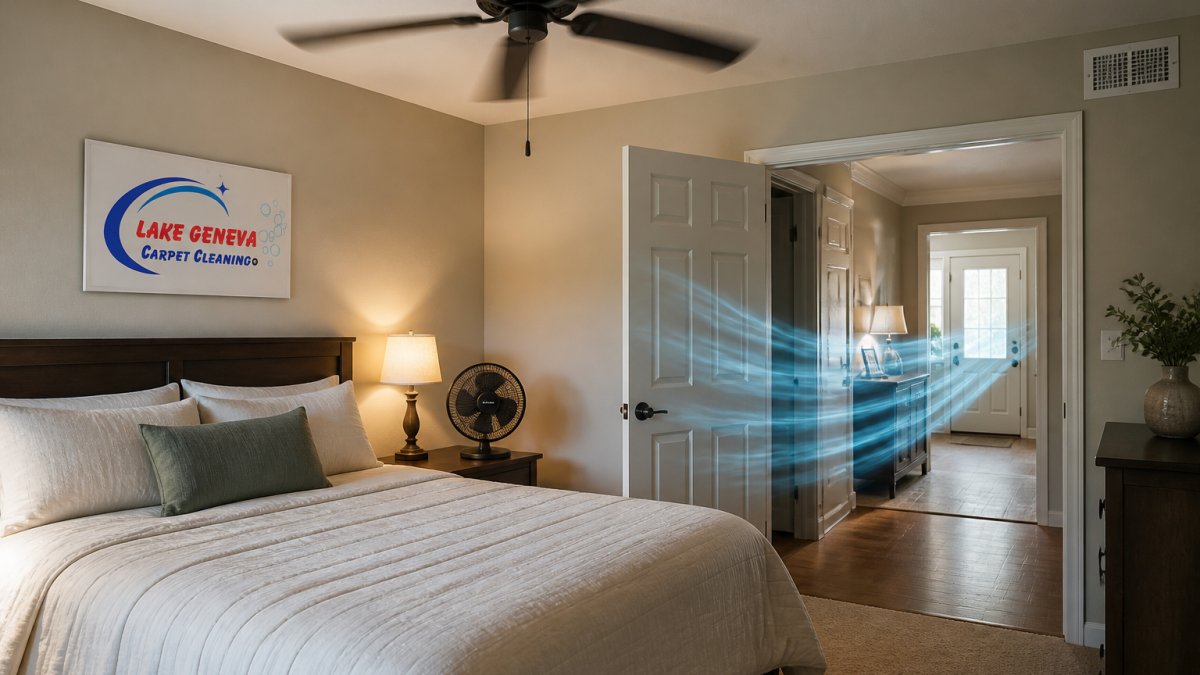
Keep the bedroom door open when possible so air from other parts of your home can flow in. If privacy is an issue, a door wedge holds it open just enough for air movement.
Check for blocked vents or returns. Dust restricts air flow, so clean them monthly and keep furniture away from vents.
Humidity control matters in bedrooms. A dehumidifier removes the excess moisture that causes stuffiness; run it on low overnight for comfort without noise.
The best bedroom without windows has three air movement tools: a ceiling fan, a portable fan, and an open door to the rest of the home. Together, they prevent stale air from accumulating.
Bathroom Exhaust Fan Ventilation and Fresh-Air Intake
Bathrooms are the most critical space for ventilation in a home without windows. Moisture from showers builds rapidly, and without exhaust ventilation mold grows fast on walls and ceilings.
An exhaust fan pulls moist air out and vents it outdoors, essential, not optional. Run it during and for 20-30 minutes after every shower.
The exhaust must discharge outside your home, not into an attic or crawlspace, which only moves the moisture problem. Check where your exhaust duct leads; if it ends in the attic, have it rerouted through a roof or wall.
Fresh-air intake matters too. As exhaust fans remove air, your home needs replacement air; without it, negative pressure pulls outdoor air through cracks and gaps. A trickle vent or fresh-air intake brings controlled, filtered air inside.
In Lake Geneva, bathroom ventilation is especially important in winter, when cold air entering through cracks causes drafts. A fresh-air intake with a damper lets you control when and how much outside air enters.
Bathroom exhaust venting to an attic or crawlspace moves moisture into those spaces where it causes rot, mold, and structural damage. This is a common mistake. Always vent to the outside.
Installing Mechanical Ventilation Systems
When portable fans and single-room exhaust fans aren’t enough, mechanical ventilation systems provide continuous, controlled fresh air automatically. The trick is choosing the right type and size for your home, not just the biggest unit on the shelf.
Heat-recovery and energy-recovery ventilators
A heat-recovery ventilator (HRV) brings fresh outdoor air in while removing stale indoor air. As the airstreams pass each other, heat transfers from outgoing to incoming air, so in a Wisconsin winter fresh air enters already warmed, and in summer the same core helps preserve cooled air.
An energy-recovery ventilator (ERV) does the same job but also transfers moisture between airstreams. That matters in Lake Geneva, where winters are dry indoors and summers humid: an ERV holds onto some indoor moisture in winter and sheds incoming humidity in summer, keeping the home closer to the 30 to 50 percent relative humidity range that discourages mold.
Both run continuously at low speed or on a timer, the closest thing to a “set it and forget it” solution for a windowless home.
How to size a mechanical ventilation system
The rule of thumb is to exchange your home’s air roughly every three hours, or about 0.35 air changes per hour (ACH). To estimate target airflow in cubic feet per minute (CFM), multiply conditioned square footage by average ceiling height, divide by 60, then multiply by 0.35.
Example: a 1,500-square-foot home with 8-foot ceilings holds about 12,000 cubic feet of air. Dividing by 60 gives 200; multiplying by 0.35 gives a target of roughly 70 CFM of continuous ventilation. Larger or leakier homes need more; a tight new build may need less.
For a single windowless room, aim to fully replace the room’s air several times per hour. A 10-by-12-foot bedroom with 8-foot ceilings holds about 960 cubic feet; a 50 CFM exhaust fan exchanges that roughly three times per hour, a reasonable bedroom target.
Matching airflow to noise and energy use
Two fans with the same CFM rating can feel very different. Sound is rated in sones, and lower is quieter: 1.0 sone or less is barely noticeable in a bedroom, while 4.0 sones or higher is loud enough to discourage you from running it, which defeats the purpose.
Energy use matters too for a system running 24/7. Look for the airflow efficiency figure (CFM per watt) on the label, higher is better. A continuous whole-house ventilator at 70 CFM uses far less electricity over a year than a bank of bathroom fans cycling on and off, but only if you compare labels before buying.
Ductless exhaust options and wall sleeves
Ductless ventilation systems move air from room to room without long ducts. They’re simpler to install than ducted systems but less effective at removing moisture and odors at the source, since they don’t push air outdoors.
A wall sleeve lets you install an exhaust fan directly through an exterior wall, cleaner than venting into an attic and simpler than running ducts across a finished ceiling. It also gives a short, straight exhaust path, the most efficient way to move air outdoors; long, winding duct runs can cut a fan’s real-world airflow by half or more.
When to call a professional
Whole-house ventilators, wall sleeves, and any exhaust duct penetrating a roof or exterior wall are not typical DIY projects. They involve cutting into the building envelope, sealing against water and air intrusion, and balancing airflow so the system doesn’t fight your furnace or water heater. In most Wisconsin municipalities, new ductwork or a roof penetration requires a permit and must meet current mechanical and energy code. A licensed HVAC contractor can size the system, pull the permit, and verify the installation delivers the airflow the label promises.
Mechanical ventilation is the only reliable way to guarantee fresh air in a windowless home. Size it by room volume, compare units by sones and CFM per watt, and have a licensed contractor handle anything that cuts into the building envelope.
How to Remove Stale Air From a Room
Stale air accumulates when there’s no air exchange, carrying odors, carbon dioxide, and moisture. Removing it takes ventilation or aggressive circulation.
Open interior doors to allow air movement between rooms, and briefly open any exterior doors or windows elsewhere to create air exchange, even 5-10 minutes of cross-ventilation helps.
Run bathroom and kitchen exhaust fans continuously to pull stale air out, and pair them with open doors so fresh air can enter from other rooms.
Use portable fans to push stale air toward exhaust vents, such as a bathroom exhaust fan or kitchen hood, to speed removal.
For persistent odors, ventilation alone may not be enough, the source needs to be removed or treated. If it’s a carpet issue, professional cleaning removes trapped odors that surface cleaning can’t reach.
Using an Air Purifier for a Room Without Windows
An air purifier cleans the air in a room but doesn’t ventilate it. It removes particles and odors from air that’s already there, helpful, but not a replacement for ventilation.
A HEPA filter removes particles as small as 0.3 microns, including dust, pollen, and pet dander. For homes with allergies or asthma, a purifier reduces symptoms by cleaning the air you breathe.
Activated carbon filters remove odors and some gases. If your room without windows has lingering smells, a purifier with carbon filtration helps. It won’t eliminate the source, but it reduces the smell in the air.
Run a purifier continuously in rooms where you spend time, and replace filters as recommended, a clogged filter reduces effectiveness.
Purifiers work best paired with ventilation: ventilation removes stale air, and a purifier cleans what remains.
Air purifiers are best for rooms where you can’t install ventilation yet. They improve air quality while you plan a permanent ventilation solution.
Cross-Ventilation and Fresh-Air Strategies
Cross-ventilation uses air movement between areas to exchange stale air for fresh air. In a home without windows, it requires strategic door placement and fan positioning.
Open doors on opposite sides of your home to create a path for air flow: air enters one opening and exits another, removing stale air without mechanical systems.
In Wisconsin, cross-ventilation works best in spring, fall, and mild summer days. In winter, opening windows or doors isn’t practical, so mechanical ventilation and fans become essential.
Create pathways for air: close doors to rooms you’re not using and open doors between rooms you are, concentrating air movement where you need it.
A fresh-air intake brings controlled outdoor air inside. Unlike opening a window, it can be filtered and dampered, so you control how much outside air enters and when, especially valuable in winter when outdoor air is cold and dry.
For windowless homes in Lake Geneva, a fresh-air intake with a damper gives flexibility: reduce intake in winter to avoid drafts, increase it in summer for more outdoor air.
Addressing Humidity, Mold, and Indoor Air Quality
Humidity is the biggest challenge in a home without windows: without air exchange, moisture builds, mold grows, and the air feels heavy and stale. But humidity is only one piece of the puzzle, radon, combustion byproducts, and carbon dioxide each behave differently in a sealed space and need their own plan.
Humidity and mold
Target indoor relative humidity between 30 and 50 percent. Below 30 percent the air feels dry and can irritate airways; above 50 percent mold and dust mites thrive. An inexpensive hygrometer shows you where the problem is, room by room.
Bathroom and kitchen exhaust fans remove moisture at the source. Run them during and for 20 to 30 minutes after steam-producing activities; 30 minutes after a shower removes most of the moisture it created.
A dehumidifier pulls moisture from the air. Use one in basements or rooms where humidity stays high despite ventilation. Empty the tank regularly or run a drain hose to a floor drain so the unit doesn’t shut off overnight.
Mold grows in damp, dark spaces. Ventilation and humidity control prevent it. If mold appears, treat the cause, usually excess humidity, to prevent it from returning.
Radon in Wisconsin basements
Radon is a radioactive gas from soil and rock that can seep into any home through foundation cracks, sump pits, and gaps around pipes. Wisconsin sits in a region where elevated radon levels are common, and radon is the second-leading cause of lung cancer in the U.S. after smoking, according to the U.S. Environmental Protection Agency.
Ventilation alone does not solve a radon problem, a windowless basement with a running exhaust fan may actually pull more soil gas in by depressurizing the space. The only way to know your level is to test. Home test kits are widely available, and the Wisconsin Department of Health Services recommends testing every home, retesting every few years, and testing again after any major renovation. If your result is at or above the EPA action level, a radon mitigation system installed by a certified professional is the standard fix.
Combustion safety and depressurization
Any fuel-burning appliance, furnace, water heater, gas stove, or fireplace, produces combustion byproducts that must be vented outdoors. In a tightly sealed windowless home, a powerful exhaust fan without a make-up air path can depressurize the house enough to reverse the draft on those appliances, spilling carbon monoxide and other gases back into the living space instead of up the flue.
This is a real safety issue. The U.S. Consumer Product Safety Commission recommends carbon monoxide alarms outside sleeping areas and on every level. If you run continuous exhaust ventilation, make sure your home has a dedicated make-up air path so pressure stays balanced; a licensed HVAC contractor can measure the pressure difference and confirm your appliances are drafting correctly.
Carbon dioxide and stale-air buildup
Carbon dioxide (CO2) is a good proxy for how stale a sealed room has become. Outdoor air sits around 420 parts per million (ppm); a closed bedroom with one sleeping adult can climb past 1,000 ppm by morning, and higher levels are linked to drowsiness, headaches, and poor concentration. That’s why a windowless bedroom needs real air exchange, not just a ceiling fan, a fan moves CO2 around the room, but only ventilation removes it.
A practical indoor air quality routine
For a windowless home in Lake Geneva, a simple routine covers most of the bases:
- Run bathroom and kitchen exhaust fans during and after every moisture- or odor-producing activity.
- Keep a hygrometer in the dampest room and a dehumidifier ready for humid stretches.
- Test for radon every few years and after any major renovation.
- Keep carbon monoxide alarms on every level and outside sleeping areas.
- Run continuous mechanical ventilation so CO2 and odors don’t accumulate.
- Clean or replace air filters on schedule so circulation equipment keeps working.
For homes with pets or smokers, air quality issues are worse. Ventilation is non-negotiable. Without it, odors and allergens accumulate despite cleaning.
Never run a high-CFM exhaust fan in a tightly sealed home without a make-up air path. The resulting negative pressure can pull carbon monoxide from fuel-burning appliances back into your living space. If you’re not sure whether your home has adequate make-up air, have a licensed HVAC contractor test it.
Basement Ventilation and Make-Up Air Considerations
Basements in homes without windows present unique challenges. They’re naturally damp. Air movement is often poor. Moisture and odors accumulate.
A basement exhaust fan pulls stale, moist air out. Vent it outside, not to the attic, and pair it with a fresh-air intake so replacement air enters the basement rather than being pulled from upstairs.
Make-up air is critical when exhaust fans run. As air leaves your home, replacement air must enter; without it, the home becomes negatively pressured and air is pulled from cracks, gaps, and unintended places, causing drafts, discomfort, and even safety issues with combustion appliances.
A fresh-air intake with a damper controls make-up air. Install it where it can be filtered. In winter, a damper prevents excessive cold air from entering when exhaust fans aren’t running.
Radon is a concern in Wisconsin basements. Ventilation and make-up air help, but radon-specific mitigation may be needed. Test your basement; if levels are high, a radon mitigation system is the solution.
In Lake Geneva, consider the water table and soil conditions. Damp basements need aggressive ventilation: a sump pump removes water, and ventilation removes moisture from the air. Together they keep basements dry and healthy.
A home without windows can be healthy and comfortable. It takes planning and the right combination of ventilation, air circulation, and humidity control. Start with what you can do today: open doors, run fans, and install exhaust ventilation. Then plan for mechanical systems that provide continuous fresh air.
If carpet or upholstery is trapping odors or moisture that affects your indoor air quality, Lake Geneva Carpet Cleaning removes the source. Our eco-friendly hot water extraction technology pulls embedded dirt, allergens, and odors that circulating air alone can’t reach. Combined with proper ventilation, professional carpet cleaning creates a healthier home. Contact us for a free quote and discover how clean carpets improve the air you breathe.
Frequently Asked Questions
Can a fan ventilate a room without windows?
A fan alone cannot true ventilation, it circulates existing air but doesn’t bring in fresh outdoor air. Portable and ceiling fans move stale air around the room, which helps with comfort and reduces odors temporarily, but they don’t exchange indoor air for outdoor air. For actual ventilation in a windowless room, you need exhaust fans, mechanical systems, or trickle vents that pull in fresh air from outside and expel stale air.
How does a bathroom exhaust fan help ventilate a windowless room?
A bathroom exhaust fan removes moisture and odors by drawing air out of the room through a duct that vents to the outside. This creates negative pressure, which pulls fresh air in through cracks and gaps. For best results, run the fan during and 20-30 minutes after showers. To work effectively, the exhaust outlet must discharge outdoors, not into an attic or crawl space, and the system should provide adequate air changes per hour for the room size.
What’s the difference between air circulation and ventilation?
Air circulation moves existing air around a room using fans, it improves comfort and reduces stale spots but doesn’t remove pollutants or bring in fresh outdoor air. Ventilation exchanges indoor air for fresh outdoor air, removing carbon dioxide, odors, humidity, and pollutants. A windowless home needs both: fans for comfort and air movement, plus mechanical ventilation or exhaust systems for true fresh-air exchange and indoor air quality.
How can I reduce mold and humidity in a windowless basement?
Control humidity by running exhaust fans continuously or on a timer, using a dehumidifier, and ensuring proper drainage around the foundation. Install bathroom and kitchen exhaust fans that vent outdoors, not into the basement. Consider a heat-recovery ventilator or energy-recovery ventilator if moisture is persistent. Seal cracks in walls and floors, improve grading away from the foundation, and monitor humidity levels, ideally below 50%.