
Last Updated: November 1, 2026
Quick Summary
The best air purifiers for carpeted rooms are True HEPA units sized to the room’s square footage and ceiling height, with enough dust CADR to deliver at least four air changes per hour. Carpet keeps releasing dust, pollen and pet dander into the air, so a unit should be chosen with that extra load in mind.
- Measure each room’s square footage and ceiling height rather than using the whole home’s size.
- Aim for at least four air changes per hour in a carpeted room, or five or more for bedrooms with pets or allergies.
- Choose a unit labeled True HEPA, which captures at least 99.97% of particles at 0.3 microns.
- Place the purifier in the open, at least a foot from walls and furniture, where people sit or walk most.
- Clean the pre-filter weekly and replace the HEPA filter every six to twelve months, sooner with pets.
Table of Contents
- Why Carpeted Rooms Hold More Airborne Particles
- How to Match an Air Purifier to Your Room Size
- What HEPA Filtration Does and Why It Matters
- HEPA Air Purifiers for Allergy Sufferers
- Clean Air Delivery Rate and Coverage Ratings Explained
- Where to Place an Air Purifier in a Bedroom or Carpeted Living Room
- Filter Replacement, Maintenance and Running Costs to Plan For
- Pet Odors, Smoke and Other Carpet Contaminants
- Booking a Free Quote for Your Carpets in Lake Geneva
- Frequently Asked Questions
Why Carpeted Rooms Hold More Airborne Particles
Carpet acts like a filter that never gets emptied. Every footstep, pet walk and open window pushes dust, pollen and pet dander down into the fibers and padding, where regular vacuuming only reaches the top layer. Those particles come back into the air whenever the room is disturbed, which means a carpeted room often carries a heavier particle load than a hard-floored one.
This is why an air purifier that works well in a bare-floor kitchen can underperform in a carpeted living room. The source of the particles is still there, and the purifier has to keep up with it. We recommend starting with the room itself: how much carpet it has, how often people walk on it, and whether pets spend time on it.
How to Match an Air Purifier to Your Room Size
Room size is the first filter for any purchase, but the coverage number on the box is only a starting point. A unit rated for a small room will struggle in a large living area even if its filter is excellent, and a carpeted room adds a wrinkle that bare-floor rooms do not have: the carpet itself is a reservoir that keeps releasing particles into the air, so the purifier has to clean the same air more often to keep up.
Step 1: Measure the actual room, not the whole floor plan
Measure the room’s length and width in feet and multiply them to get square feet. Do this per room rather than using the square footage of your whole home, because a purifier only cleans the air it can circulate. A 12-foot by 15-foot carpeted bedroom is 180 square feet; a 20-foot by 25-foot carpeted living room is 500 square feet. If the room has an open doorway into a hallway or an open-plan layout, count the connected space too, since air moves freely between zones.
Step 2: Adjust for ceiling height
Most coverage ratings assume an 8-foot ceiling. If your ceiling is 9 or 10 feet, the room holds more air than the rating assumes. Multiply the square footage by the ceiling height and divide by 8 to get an adjusted figure. A 500-square-foot room with a 10-foot ceiling behaves like roughly 625 square feet at the standard height, so size up accordingly.
Step 3: Use air changes per hour to set a target
Air changes per hour (ACH) is the number of times a purifier moves the room’s full volume of air through its filter in one hour. For a carpeted room with normal foot traffic, aim for at least four air changes per hour; for a carpeted bedroom with pets or allergy sufferers, aim for five or more. To estimate ACH from a unit’s dust CADR, multiply the CADR by 60, then divide by the room’s volume in cubic feet. A unit with a dust CADR of 200 in a 180-square-foot room with 8-foot ceilings (1,440 cubic feet) delivers roughly 8 air changes per hour, which is comfortable headroom. The same unit in a 500-square-foot room (4,000 cubic feet) delivers only about 3, which is below target for a carpeted living room.
Step 4: Size up for carpet and traffic
Carpeted rooms with high foot traffic, pets, or open windows usually justify choosing a unit rated somewhat above the room’s actual size. The extra capacity lets the purifier run on a lower, quieter fan speed while still hitting the air-change target, which matters in bedrooms. Open-plan spaces often need a larger model or two smaller units placed in different zones rather than one unit pushed to its maximum.
Our team can also assess a carpet’s allergen load before you decide how much purification the room needs. book a professional carpet inspection
What HEPA Filtration Does and Why It Matters
A true HEPA filter is designed to capture at least 99.97% of airborne particles at 0.3 microns. That size is a useful benchmark because it is harder to capture than larger particles, so a filter that handles it generally handles bigger dust and pollen well too.
Look for “True HEPA” on the product label. Terms like “HEPA-type” or “HEPA-like” describe filters that have not been tested to the same standard. Many units combine a HEPA filter with a pre-filter that catches hair and larger debris, which extends the life of the main filter.
HEPA Air Purifiers for Allergy Sufferers
People with allergies usually react to dust mites, pet dander and pollen, all of which settle into carpet. A HEPA unit can remove these particles from the air, but it cannot remove what is already embedded in the fibers. That is why purifier use works best alongside regular carpet maintenance.
Choose a unit with a sealed filter housing so particles do not leak back out, and run it continuously on a low setting rather than only during bursts of activity. For allergy sufferers who want to reduce dust mites, pet dander and mold in the carpet itself, book a dust mite and allergen removal service to address the source. Many allergy sufferers notice the difference most in the bedroom, where they spend the most hours breathing the same air.
Clean Air Delivery Rate and Coverage Ratings Explained
Clean Air Delivery Rate, or CADR, measures how much filtered air a purifier produces, rated separately for smoke, dust and pollen. A higher CADR means the unit cleans the air faster in a given space.
As a rough guide, the CADR number should be at least two-thirds of the room’s area in square feet for that particle type. Use the rating as a comparison tool across models, not as a precise promise.
The table below sums up the rating terms and the rule of thumb the article gives for reading them.
Term | What it measures | Rule of thumb in this article |
|---|---|---|
CADR | Volume of filtered air a purifier produces | Higher means faster cleaning |
Smoke, dust and pollen CADR | Filtered air rated separately per particle type | Compare models on the same particle type |
Coverage rating | Room size the unit is meant to handle | A starting point, not a guarantee |
CADR target | Minimum CADR for the room | At least two-thirds of room area in sq ft |
Assumed ceiling height | Height the coverage rating is based on | Most ratings assume 8 feet |
Use of the rating | How to treat the number | A comparison tool, not a precise promise |
Where to Place an Air Purifier in a Bedroom or Carpeted Living Room
Placement affects performance more than many buyers expect. Set the unit in the open, at least a foot away from walls and furniture, so air can reach the intake freely. Avoid corners and the space behind curtains.
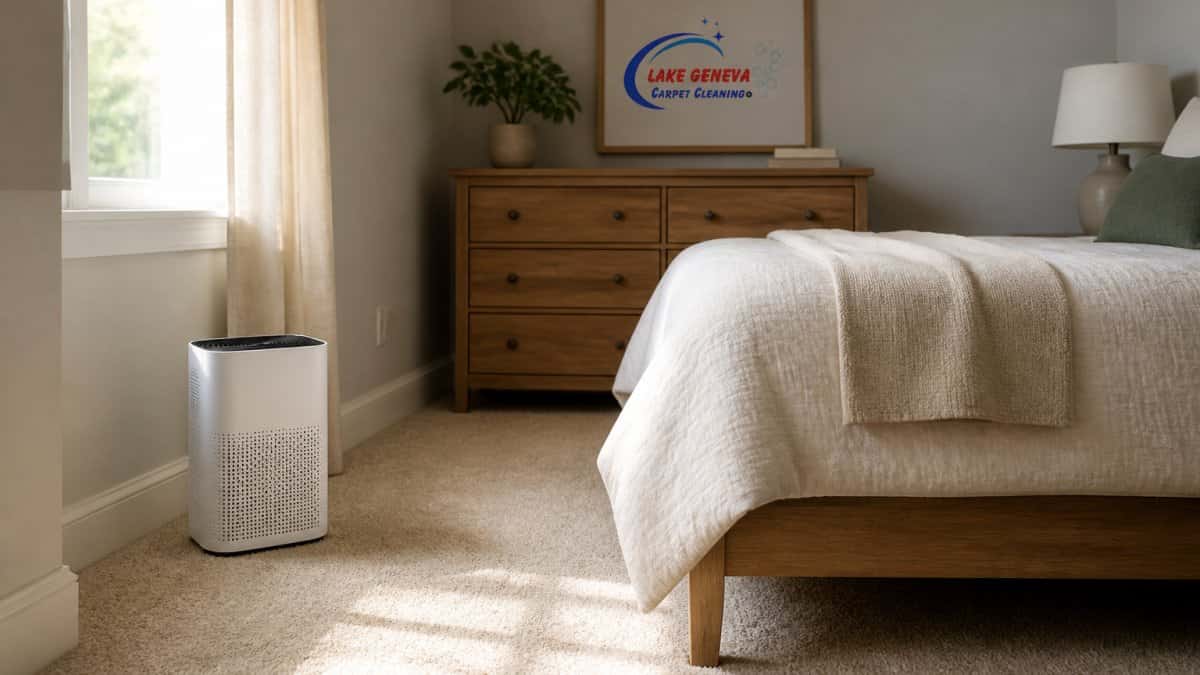
In a bedroom, place the purifier near the bed but not directly against the headboard, so the outflow reaches your breathing zone. In a carpeted living room, position it where people walk or sit most often. Keep the unit away from heat sources and direct sunlight, which can affect the sensors on smart models.
Our team can also assess a carpet’s allergen load before you decide how much purification the room needs. book a professional carpet inspection
Filter Replacement, Maintenance and Running Costs to Plan For
Filters are the main ongoing expense, and the maintenance schedule matters more in a carpeted room because the carpet keeps feeding particles into the air. A purifier that runs continuously in a carpeted bedroom with a pet will load its pre-filter faster than the same unit in a bare-floor hallway, so plan the schedule around your room rather than the label alone.
A practical maintenance schedule
- Weekly: vacuum or rinse the pre-filter if the unit has a washable one. Hair, lint, and carpet fibers collect there first, and a clogged pre-filter cuts airflow before the HEPA filter is anywhere near full.
- Monthly: check the filter indicator or app alert, wipe the intake grille, and vacuum the exterior vents. In carpeted rooms, dust clings to the housing and gets pulled back in.
- Every six to twelve months: replace the HEPA filter, sooner in homes with pets, heavy foot traffic, or windows kept open in pollen season. Most manufacturers publish a replacement interval, but the indicator light and a visible gray cast on the filter are better guides than the calendar.
- Annually: inspect the cord, the fan, and any sensor ports. Smart models with air-quality sensors need the sensor lens cleaned per the manual, or they will misread the room.
What drives filter life in a carpeted room
Three things shorten filter life: pet hair, carpet fibers kicked up by foot traffic, and running the unit on its highest fan speed for long stretches. A unit run on high moves more air but pulls more debris into the filter per hour. Running on a medium speed that still meets your air-change target is usually the better balance for filter life and noise.
Check filter availability before you buy
Before you commit to a model, confirm that replacement filters are stocked and easy to find. A unit with hard-to-find filters becomes a paperweight once the original filter loads up. Look for filters sold directly by the manufacturer and through major retailers, and check whether the unit uses a single combined filter or separate pre-filter and HEPA stages, since combined filters are usually replaced more often.
Plan for electricity and noise together
Check the unit’s wattage on the label and estimate run time, since most homes run a purifier continuously. Noise is the other running consideration: a unit that is quiet on low may be too loud on the high speed needed to hit your air-change target in a large carpeted room. Look for a decibel rating at the speed you will actually use, and favor units with a sleep mode or a low-speed setting that still meets your target.
Pricing depends on the job, so contact us for a free quote if you want to compare professional carpet care with the upkeep a purifier requires.
Pet Odors, Smoke and Other Carpet Contaminants
Air purifiers reduce particles and some airborne odors, but they do not remove the source. If pet odors keep returning, you can learn how to eliminate pet odors at the source rather than relying on filtration alone. Pet urine, spilled food and smoke residue soak into carpet padding and keep releasing smells long after the air is filtered. Activated carbon filters help with odor in the air, while the carpet itself often needs professional treatment. You can also try practical natural ways to neutralize carpet odors and allergens before booking a service.
For persistent pet odors, combine a purifier with thorough carpet cleaning. A purifier handles what floats in the air. Deep cleaning removes what has settled into the carpet and padding.
Booking a Free Quote for Your Carpets in Lake Geneva
If your carpets are holding particles and odors that a purifier cannot fully address, a professional clean can make the next purchase work better. Pricing depends on the size of the job, the type of carpet and the condition of the padding, so the most accurate answer comes from an inspection. Contact our team for a free quote and we will look at your carpets and tell you what to expect. You can also see our full service area and request a free estimate to confirm we serve your location.
Frequently Asked Questions
Do air purifiers help with dust in carpeted rooms?
Yes, a well-sized air purifier with a true HEPA filter can capture fine airborne dust that gets stirred up from carpet fibers while you walk, sit or vacuum. It does not remove dust that is already settled deep in the pile, so it works best alongside regular vacuuming and professional deep cleaning. Run the unit continuously on a medium or high setting in the carpeted room for the best results, and keep the room door closed to limit particles drifting in from hallways.
What size air purifier do I need for a carpeted room?
Check the manufacturer’s room-size rating and choose a unit rated for at least the square footage of the room, since carpeted rooms often need extra capacity to keep up with dust and pet dander. Look at the clean air delivery rate, which tells you how quickly the unit removes particles. For bedrooms and living rooms, a unit rated for a larger room than yours gives you a margin for better air changes per hour.
How often should I replace an air purifier filter?
Most HEPA filters need replacing every six to twelve months, depending on how many hours a day the unit runs and how much dust, pet dander or smoke is in the home. Homes with pets or heavy carpet traffic usually need more frequent changes. Check the filter indicator on your unit and write the replacement date on a calendar, because a clogged filter reduces airflow and capture efficiency.