
Table of Contents
- How Long Does Oriental Rug Cleaning Take
- Factors Affecting Rug Cleaning Turnaround Time
- The Professional Oriental Rug Cleaning Process
- Drying Time and Environmental Controls
- Signs Your Oriental Rug Needs Deep Cleaning
- How to Maintain Oriental Rugs Between Cleanings
- Emergency vs. Routine Cleaning Timelines
- Frequently Asked Questions
Last Updated: August 31, 2026
How Long Does Oriental Rug Cleaning Take
Oriental rug cleaning is a meticulous process that takes longer than standard carpet cleaning, and for good reason. The timeline depends on multiple factors, the rug’s size, material composition, soil level, and whether it’s hand-woven or machine-made. Most professional oriental rug cleaning takes between one and three weeks from pickup to delivery, though the actual hands-on cleaning time spans several days. Understanding this timeline helps homeowners in the Lake Geneva area plan accordingly and appreciate why rushing the process compromises the quality of your investment.
The fastest turnaround time is usually seven to ten days for routine cleaning of smaller rugs. Larger pieces, heavily soiled rugs, or those requiring special treatment for stains or pet odors can extend this to two or three weeks. Rush services are sometimes available but may affect the thoroughness of the work.
Factors Affecting Rug Cleaning Turnaround Time
Several interconnected factors determine how long your oriental rug cleaning will take. Understanding these variables helps you set realistic expectations and plan your home or business accordingly.
Rug Size and Material Composition
The dimensions and fiber type of your rug are the primary drivers of cleaning duration. A small 4×6 foot rug cleans faster than an 8×10 or larger piece simply because there’s less surface area to process through each stage. Hand-woven oriental rugs made from wool or silk require more careful handling than synthetic alternatives, which means slower processing speeds at every step.
Delicate materials like silk demand specialized attention during submersion washing and centrifuge drying to prevent fiber damage or color bleeding. The finer the weave and the more intricate the pattern, the more time technicians spend on inspection and pre-treatment to identify vulnerable areas. Wool rugs, while more durable, still require pH-balanced solutions and controlled water temperatures to preserve their natural oils and prevent shrinkage.
Material composition directly impacts timeline. Wool and silk oriental rugs take longer to clean safely than synthetic fibers, and this extra time is essential for protecting your investment.
Soil Level and Stain Severity
A lightly used rug that needs routine maintenance cleans faster than one caked with ground-in dirt, pet accidents, or stubborn stains. Heavy soiling requires extended dusting and soil extraction phases. Stains demand individual pre-treatment and sometimes multiple rinses to remove completely without leaving residue or discoloration.
Pet urine penetrates deep into the rug’s backing and padding, requiring specialized enzymatic treatments that take time to break down odor-causing compounds. Road salt and mud tracked in from seasonal weather in Wisconsin add another layer of complexity. These contaminants must be fully extracted to prevent resoiling, where the rug looks clean initially but dirt resurfaces within weeks because particles weren’t completely removed.
Hand-Woven vs. Machine-Made Rugs
Hand-woven oriental rugs demand significantly more care than machine-made alternatives. The knot structure and irregular weave patterns of authentic hand-woven pieces create complexity that machine-made rugs don’t have. Technicians must account for variations in fiber tension, potential loose knots, and the risk of fringe damage during washing.
Machine-made rugs have uniform construction that allows for slightly faster processing through standard cleaning protocols. However, even machine-made oriental-style rugs benefit from the same careful handling that protects their appearance and extends their lifespan. The distinction matters for timeline planning: hand-woven pieces typically add three to five business days to the overall turnaround.
The Professional Oriental Rug Cleaning Process
Professional oriental rug cleaning involves multiple stages, each taking time to do correctly. Rushing any step compromises the final result or risks fiber damage.
Inspection and Pre-Treatment
The process begins with a thorough inspection where technicians examine the rug under proper lighting to identify stains, damage, weak areas, and material type. This assessment determines the appropriate cleaning solution pH, water temperature, and any special treatments needed. Pre-treatment involves applying targeted solutions to stains, heavily soiled areas, and the fringe, allowing time for these treatments to break down soil and stains before the main washing phase.
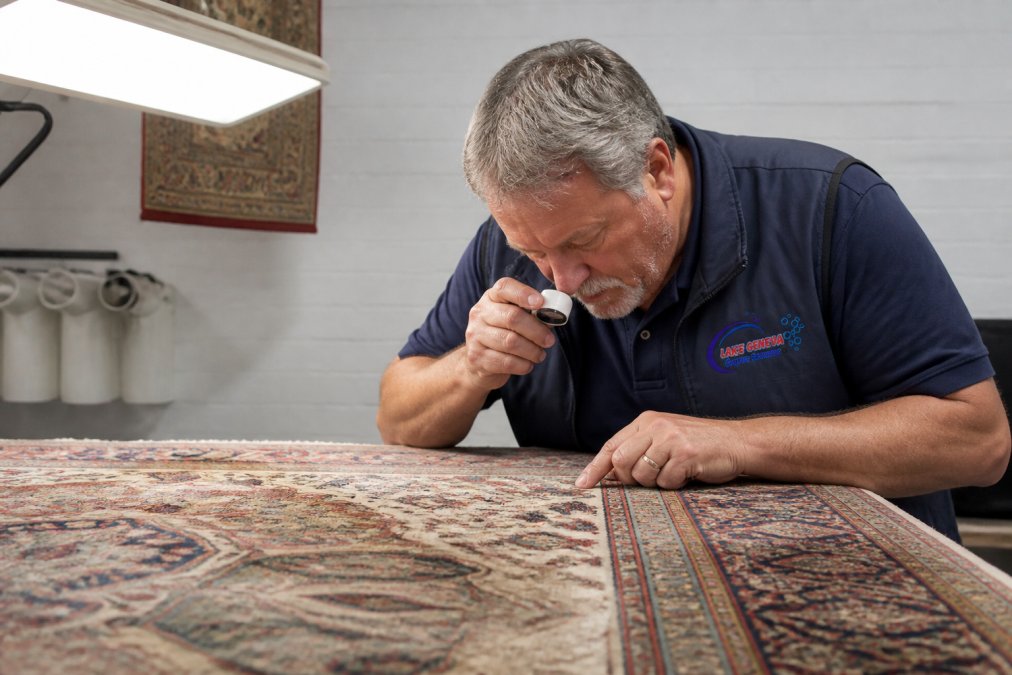
This stage typically takes one to two business days, depending on rug size and complexity. Skipping or rushing inspection leads to missed stains, incorrect treatment choices, and potential damage to delicate fibers.
Dusting and Soil Extraction
Before water touches the rug, professional cleaning removes dry soil through dusting. This critical step uses specialized equipment to dislodge embedded dirt particles that vacuuming alone cannot extract. Dusting prevents these particles from becoming mud when water is introduced and ensures the subsequent washing stages work more effectively.
Soil extraction continues with controlled suction that pulls loose debris from the rug’s surface and upper fiber layers. This phase is essential for rugs with heavy ground-in dirt or seasonal contaminants like road salt and sand common in the Lake Geneva area. Thorough dusting and extraction can take one to two days for larger pieces.
Submersion Washing and Rinsing
Submersion washing immerses the entire rug in pH-balanced water solutions at controlled temperatures, allowing the cleaning solution to penetrate fibers and break down oils, soil, and stains. The rug is gently agitated to ensure thorough cleaning without causing fiber damage or color bleeding. This stage takes several hours, with larger rugs requiring extended soak times.
Rinsing is equally important and time-consuming. Multiple rinses remove all cleaning solution residue, which prevents resoiling and ensures the rug dries cleanly. Incomplete rinsing leaves chemical residue that attracts dirt, causing the rug to look dingy again within weeks. Professional rinsing protocols typically involve three to five separate rinse cycles, depending on soil level and solution type.
Centrifuge Drying and Final Inspection
After washing and rinsing, the rug moves to a centrifuge that spins out excess moisture, reducing drying time significantly. This mechanical extraction is gentler than wringing and preserves fiber integrity. The rug then moves to a controlled drying environment with proper air circulation, humidity control, and temperature management.
The final inspection verifies that all stains are gone, the rug is thoroughly dry, and no damage occurred during cleaning. Any missed spots are retreated before the rug is packaged for return.
Drying Time and Environmental Controls
Drying is where most of the timeline comes from. Even after centrifuge extraction removes bulk moisture, the rug still contains water deep in its fibers and backing that must evaporate completely. Improper drying risks mold growth, musty odors, and color bleeding if different sections dry at different rates.
Professional facilities maintain controlled environments with specific temperature and humidity levels to ensure even drying. Most professional drying protocols operate at temperatures between 65°F and 75°F with relative humidity maintained between 40% and 55%. These ranges prevent fiber shrinkage (which occurs above 80°F) and moisture reabsorption (which occurs below 35% humidity). The rug is placed in a climate-controlled room with air circulation from multiple directions, ensuring the pile, backing, and fringe all dry at the same rate.
For Lake Geneva residents, regional climate considerations matter significantly. Wisconsin’s seasonal humidity swings, from dry winters (often 20-30% indoor humidity) to humid summers (60-70% outdoor humidity), can affect drying timelines. A rug cleaned in summer may take slightly longer to dry than one cleaned in winter because outdoor humidity is higher, even in a controlled facility. Additionally, the area’s freeze-thaw cycles and road salt exposure mean rugs often carry residual moisture in their backing from winter weather, requiring extended drying periods to fully stabilize.
This controlled process typically takes three to seven days for most rugs, depending on size, thickness, and material. A small 4×6 wool rug may dry in three to four days, while a large 9×12 hand-woven piece with dense pile can require seven to ten days. Silk rugs, which are more delicate, often dry on the slower end of this range because air circulation must be gentler to prevent fiber distortion.
Rushing this phase by using high heat or inadequate air circulation can cause fiber shrinkage, color fading, or permanent damage. Some facilities use heated drying to speed the process, but this approach carries risk: rapid moisture loss can cause the rug’s foundation to contract unevenly, leading to buckling or permanent shape distortion. Professional cleaners avoid high-heat drying for this reason, even when clients request faster turnaround.
Never attempt to dry an oriental rug in direct sunlight or with high heat. This causes color fading, fiber brittleness, and potential shrinkage. Controlled, ambient-temperature drying in a professional facility is the only safe method for preserving your investment.
The drying timeline is why turnaround times stretch beyond the actual cleaning hours. A technician might spend six to eight hours actively cleaning your rug, but the overall process requires two to three weeks because drying cannot be rushed without consequences. This is the single largest factor in the 1-3 week standard turnaround time you’ll see quoted by professional services.
Signs Your Oriental Rug Needs Deep Cleaning
Understanding when your rug needs professional attention helps you schedule service before problems worsen. Routine vacuuming and spot cleaning maintain rugs between deep cleanings, but certain conditions signal that professional oriental rug cleaning is necessary.
Visible dirt accumulation, especially in high-traffic areas or along the edges, indicates that soil has penetrated beyond surface fibers. A musty or stale odor suggests moisture, mold, or bacteria growth in the backing and padding. Pet accidents, even old ones, create odors that surface cleaning cannot remove because the urine has soaked into deep layers.
Stains that don’t respond to spot cleaning, discoloration that seems dull or grayish despite vacuuming, and matted or flattened fibers in traffic areas all signal deep cleaning needs. Allergy sufferers often notice improvement after professional cleaning because the process removes dust mites, their droppings, and other allergens trapped in the rug’s structure.
Seasonal contaminants in the Lake Geneva area, road salt, sand, mud, and moisture from winter weather, accumulate in rugs and require professional extraction. These particles are abrasive and grind against fibers with each footstep, accelerating wear if not removed.
How to Maintain Oriental Rugs Between Cleanings
Proper maintenance extends the time between professional cleanings and preserves your rug’s appearance and value. A consistent routine prevents heavy soiling and reduces the need for intensive stain treatments.
Regular Vacuuming and Dusting Techniques
Vacuum your oriental rug at least once weekly, more often in high-traffic areas. Use a vacuum without a beater bar, which can damage delicate hand-woven fibers and fringe. If your vacuum has a beater bar, disable it or use the upholstery attachment instead. Gentle suction removes surface dust and loose soil before they become embedded.
For hand-woven rugs, consider handheld vacuums or specialized rug cleaning tools that provide suction without aggressive agitation. Vacuuming in the direction of the pile, then against it, ensures you capture soil from multiple angles. Pay special attention to fringe, edges, and corners where debris accumulates.
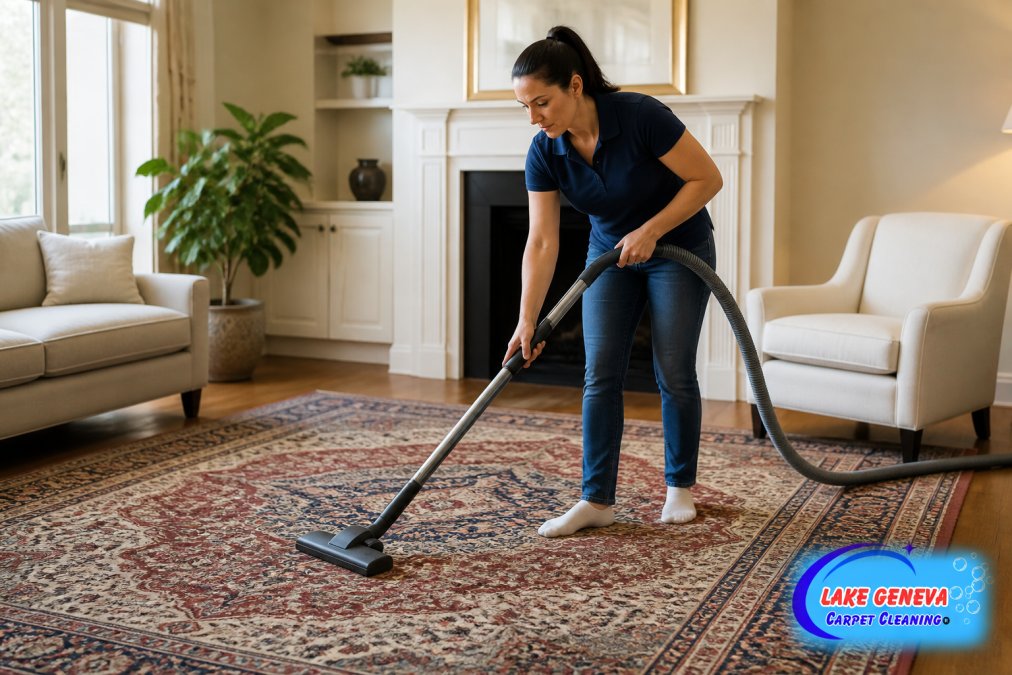
Dusting complements vacuuming by removing particles that suction misses. Hang the rug outdoors and gently beat it with a tennis racket or specialized rug beater, or lay it flat and use a soft-bristled brush to dislodge embedded dust. This technique is especially effective for hand-woven rugs and should be done seasonally or when you notice dust in the pile.
Spot Cleaning and Stain Prevention
Address spills immediately by blotting, never rubbing, with a clean, white cloth. Blotting absorbs moisture and prevents the spill from spreading deeper into fibers. For liquid spills, use cool water and a mild, pH-balanced solution designed for delicate fabrics. Test any cleaning solution on an inconspicuous corner first to ensure it won’t cause color bleeding.
Avoid harsh chemicals, bleach, and vinegar-based solutions, which can damage fibers and dyes. For pet accidents, enzymatic cleaners designed for rugs can help, but professional treatment is more effective for old or deep-set odors. Prevention is simpler than remediation: use area rugs in high-traffic zones, establish pet boundaries, and address accidents within hours rather than days.
Using Rug Pads and Protecting Fiber Integrity
A quality rug pad under your oriental rug serves multiple purposes. It prevents slipping, reduces wear from friction with the floor, and allows air circulation underneath that prevents moisture and mold growth. Rug pads also reduce the impact of foot traffic on fibers, extending the rug’s lifespan.
Choose pads made from natural materials like felt or rubber, avoiding plastic-backed pads that trap moisture. The pad should be slightly smaller than the rug so it doesn’t show at the edges. Replace pads every few years as they compress and lose effectiveness.
Rotate your rug quarterly if possible, which distributes wear evenly and prevents premature fading in one area from sunlight exposure. Keep the rug away from direct sunlight, which fades dyes over time, and maintain consistent humidity levels to prevent fiber brittleness or moisture damage.
Emergency vs. Routine Cleaning Timelines
Emergency cleaning situations, pet accidents, spills, water damage, or sudden odors before an event, sometimes require faster turnaround than routine maintenance. However, speed and thoroughness are in direct conflict, and understanding this trade-off helps you make the right decision for your rug.
When Emergency Cleaning Is Feasible
Emergency cleaning works best for fresh, localized incidents: a spill that happened within the last 24 hours, a single pet accident, or surface-level staining. In these cases, a professional service can often accommodate a rush request and complete the job in seven to ten days by prioritizing your rug in their schedule. The cleaning process itself doesn’t change, inspection, dusting, submersion washing, and rinsing still occur, but the drying phase may be compressed slightly if the rug is smaller or the soil level is light.
Water damage from flooding or leaks is a different category. If your rug has been wet for more than 48 hours, mold and bacterial growth become serious concerns. Emergency extraction and drying are necessary, and professional services often prioritize water-damaged rugs because delaying treatment increases the risk of permanent damage. In this scenario, the rug may be dried using controlled heat and dehumidification equipment to prevent mold, which can actually speed the process to 5-7 days while still maintaining safety.
When Emergency Cleaning Compromises Results
Emergency service becomes problematic when the rug has heavy soiling, multiple stains, or old pet odors that require extended pre-treatment and multiple rinse cycles. Rushing these steps means:
- Incomplete stain removal: Pre-treatment solutions need time to break down soil and stains. Skipping or shortening this phase leaves residue that resurfaces after drying.
- Inadequate rinsing: Multiple rinse cycles remove all cleaning solution. Rushing rinsing leaves chemical residue that attracts dirt, causing the rug to look dingy again within weeks.
- Shortened drying: Compressing the drying phase below three days risks incomplete moisture removal in the rug’s backing and foundation, leading to mold growth, musty odors, or color bleeding weeks later.
- Missed inspection: Thorough inspection identifies weak areas, loose knots, or damage that requires special handling. Emergency timelines may skip detailed inspection, increasing the risk of damage during cleaning.
Routine Cleaning as Prevention
Routine professional cleaning on a regular schedule, typically every 12 to 18 months depending on traffic and household conditions, prevents the heavy soiling and embedded stains that force emergency situations. Regular cleaning is faster, more effective, and less risky than emergency deep cleaning after months of neglect.
A lightly soiled rug cleaned on routine schedule can be completed in 7-10 days. A heavily soiled rug that’s been neglected for years may require 2-3 weeks even with professional attention, because the soil has penetrated deep into fibers and backing, requiring extended dusting, extraction, and rinsing phases.
Planning Ahead for Lake Geneva Residents
If you live in the Lake Geneva area, seasonal timing matters. Winter and early spring are ideal for scheduling routine cleaning because road salt, sand, and mud tracked indoors accumulate heavily during these months. Scheduling cleaning in late March or early April, before summer entertaining season, ensures your rugs are fresh and allows adequate drying time before humidity rises. Avoid scheduling emergency cleaning during peak summer humidity (June-August) if possible, as higher outdoor humidity can extend drying timelines.
If you need your rug cleaned urgently, contact a professional service immediately. Some providers can accommodate rush requests, though these typically require higher scheduling priority and may still take seven to ten days. Planning ahead by scheduling routine cleaning prevents the need for emergency services and ensures your rug receives the thorough attention it deserves.
Frequently Asked Questions
What factors influence the turnaround time for oriental rug cleaning?
Turnaround time depends on several factors: rug size and material (wool, silk, or synthetic fibers), soil level and stain severity, whether the rug is hand-woven or machine-made, and current workload. Hand-woven rugs typically require more careful handling and may take longer. Heavily soiled rugs need extended submersion washing and rinsing cycles. Most professional cleaners complete the process within 1-3 weeks, including drying time in a controlled environment.
How long do oriental rugs take to dry after professional cleaning?
Drying time typically ranges from 24 to 72 hours, depending on humidity, temperature, and air circulation. Professional cleaners use centrifuge drying and controlled environments to accelerate the process safely. In dry conditions with proper ventilation, rugs may be ready for foot traffic within 24 hours. High humidity or cooler temperatures can extend drying to 3-4 days. Proper drying prevents mold and mildew, which is why professionals maintain strict moisture control standards.
Can I clean an oriental rug myself, or should I use professional cleaning?
DIY cleaning carries significant risks for valuable oriental rugs. Hand-woven rugs can suffer dye bleeding, fiber damage, and colorfastness issues if treated with incorrect pH-balanced solutions or improper techniques. Professional cleaners use specialized equipment like centrifuge dryers and submersion washing methods that protect fiber integrity while removing deep-set soil and allergens. For antique or delicate rugs, professional restoration is strongly recommended to preserve their value and condition.
How often should an oriental rug be professionally cleaned?
Most experts recommend professional deep cleaning every 12-18 months for typical household use, or annually in homes with pets or high foot traffic. Regular vacuuming and maintenance between professional cleanings extend the time between deep cleans. Signs that your rug needs cleaning sooner include visible soil accumulation, stains, pet odors, or increased allergens. A professional can assess your specific rug and usage patterns to recommend a personalized maintenance schedule.
This article was written using GrandRanker