Table of Contents
- What a Commercial Steam Cleaning Service Actually Does
- Steam Cleaning vs. Other Commercial Carpet Methods
- Commercial Carpet Cleaning Preparation: A Room-by-Room Checklist
- The Steam Cleaning Process, Step by Step
- Commercial Carpet Drying Time: What to Expect
- Commercial Carpet Cleaning Frequency by Facility Type
- Finding Commercial Carpet Cleaning Services Near Me
- Planning the Visit to Limit Disruption
- Conclusion
- Frequently Asked Questions
Last Updated: October 18, 2026
What a Commercial Steam Cleaning Service Actually Does
A commercial steam cleaning service is a deep-cleaning process that uses heated water and high-pressure extraction to pull soil, oils, and allergens out of carpet fibers and backing. At Lake Geneva Carpet Cleaning, we have run this process in offices, retail spaces, and rental units across the area for more than 32 years.
The method is hot water extraction, the same approach the Carpet and Rug Institute’s cleaning standards describe as the deep-cleaning benchmark for commercial carpet. Heated solution goes into the carpet under pressure, loosens embedded soil, and gets pulled back out along with the dirt.
What separates a real commercial steam cleaning from a surface pass is depth. Surface cleaning lifts what you can see. Extraction reaches the grit packed near the backing, which is where traffic lanes stay gray no matter how often a building gets vacuumed.
The single most useful thing to know: steam cleaning is measured by what comes back out of the carpet, not by how wet it looks going in. Ask any provider how they extract, not just how they clean.
Steam Cleaning vs. Other Commercial Carpet Methods
Steam cleaning wins on soil removal, but it is not the only option, and honest comparisons matter more than a sales pitch. Here is how the main commercial methods stack up for a Lake Geneva business owner weighing choices.
| Method | Soil Removal Depth | Drying Time | Best For |
|---|---|---|---|
| Hot water extraction (steam) | Deep, reaches backing | Longer, needs airflow | High-traffic offices, retail, schools |
| Low-moisture encapsulation | Moderate, surface-focused | Fast, often same day | Quick maintenance between deep cleans |
| Dry compound | Light to moderate | Immediate | Delicate fibers, tight schedules |
| Bonnet cleaning | Light, top layer only | Fast | Interim spotting, not restoration |
Encapsulation and bonnet cleaning have a place as maintenance passes between deep cleans. For commercial restoration, though, extraction is the method that resets a carpet rather than refreshing it.
Here is where most guides get it wrong: they treat these methods as interchangeable. They are not. A building that only ever gets low-moisture passes will slowly accumulate soil at the base of the pile. The carpet looks acceptable and wears out early.
Commercial Carpet Cleaning Preparation: A Room-by-Room Checklist
Preparation is the difference between a smooth visit and a disrupted workday. A little planning the day before lets a crew move fast and gets your spaces back in service sooner.
Use this checklist before any commercial steam cleaning appointment:
- Clear desks, chairs, and floor displays from carpeted zones
- Remove small items, wastebaskets, and floor lamps from traffic lanes
- Tuck loose cables and power strips away from the cleaning path
- Note problem areas: pet accidents, coffee spills, ink, gum, or heavy entry soil
- Confirm which rooms must be usable first and flag them for the crew
- Schedule around deliveries, client meetings, and peak hours
- Plan where staff and customers will walk while carpet dries
- Ask about parking and water access for the truck-mounted unit
A common mistake is leaving furniture in place and expecting the crew to work around it. That slows everything down and leaves untreated patches under desks that show up as dark rectangles a month later.
Walk your space the evening before and mark stains with a small piece of painter’s tape. It takes five minutes and ensures the crew treats the spots you actually care about instead of guessing.
The Steam Cleaning Process, Step by Step
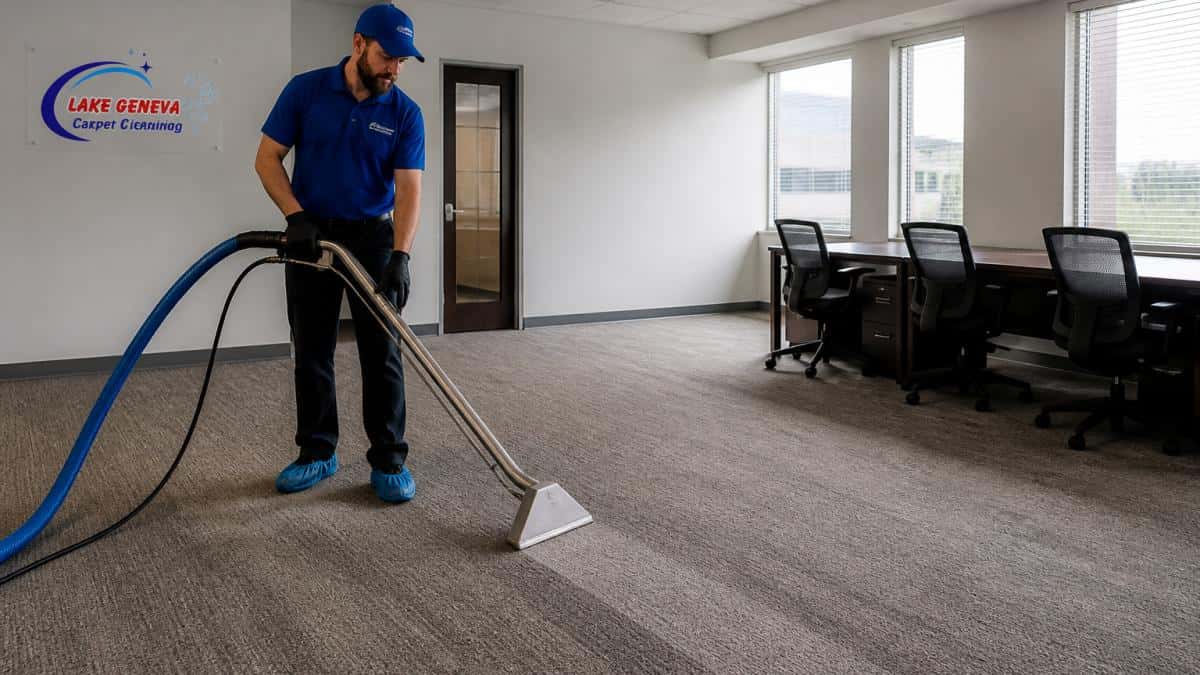
A professional steam cleaning follows a fixed sequence, and knowing it helps you judge whether a crew is doing the job properly. The full process for a typical commercial suite runs in six stages.
- Inspection. The crew walks the space, identifies fiber types, and tests for colorfastness in a hidden spot.
- Pre-vacuum. High-powered vacuums pull loose soil before any moisture touches the carpet.
- Pre-treatment. Cleaning solution goes down on traffic lanes and spots, then dwells to break the bond between soil and fiber.
- Agitation. A brush or groomer works the solution into the pile so it reaches embedded grit.
- Extraction. The hot water extraction wand pushes heated solution in and pulls it back out under pressure, flushing soil with it.
- Grooming and drying. The pile is set in one direction and air movers start moving moisture out of the room.
Each step matters. Skipping the pre-vacuum means you are pushing mud around. Skipping agitation means the solution never reaches the soil it is supposed to lift.
Commercial Carpet Drying Time: What to Expect
Most commercial carpet dries in four to eight hours when air movers and ventilation are used, though heavy pile and humid weather can stretch that. Drying time is the question we hear most from business owners, and it deserves a straight answer.
Several factors decide how fast a floor comes back:
- Airflow. Fans and open doors move moisture out fast. A closed, still room holds it in.
- Humidity. A damp Wisconsin summer day slows evaporation. Dry fall air speeds it up.
- Pile depth. Plush and thick carpet holds more water than tight loop commercial grades.
- Extraction quality. A crew that pulls hard leaves less moisture behind.
If a provider tells you the carpet will be dry in an hour with no airflow, be skeptical. Real drying takes moving air. Plan to keep foot traffic off treated areas until they feel dry to the touch.
Blocking off a wet carpet and turning off the HVAC traps moisture in the pad. That is how musty odors and mold start. Keep air moving and give the floor the hours it needs.
Commercial Carpet Cleaning Frequency by Facility Type
How often a commercial space needs deep extraction depends on foot traffic, soil type, and how the space is used, not the calendar. A busy retail floor and a quiet back office do not share a schedule, and the right interval for each is set by watching the floor, not by a fixed rule.
| Facility Type | Typical Deep-Clean Frequency | Scheduling Window | What Drives the Interval |
|---|---|---|---|
| Retail spaces | Every 3-4 months | Before open or after close | Constant foot traffic, entry soil, and display resets |
| Office buildings | Every 6-12 months | Evenings or weekends | Moderate traffic concentrated in entries and aisles |
| Schools | 2-3 times per year | Breaks and summer | High volume, spills, and seasonal mud |
| Restaurants and clinics | Every 2-3 months | After close | Spills, grease tracking, and hygiene needs |
| Hotels and hospitality | Quarterly, plus turnover spots | Between check-out and check-in | Guest-room resets and lobby traffic |
| Rental turnovers | Between tenants | Vacancy window | Reset the unit before the next occupant |
These are starting points, not rules. A building with a gravel lot out front will need more frequent cleaning than one with a paved entry, because grit walks in every day. Watch your entry zones: when they start looking dull weeks before the rest of the floor, it is time to move the interval up.
Facility-specific scheduling notes
Retail. The floor is your display, so a dull traffic lane costs sales. Schedule before open so the store is dry and shoppable by the time the first customer walks in, and ask the crew to work from the back toward the entrance so the last area treated is the one everyone crosses.
Offices. Entry mats and aisle runners take the wear while private offices stay clean. A crew can focus extraction on the high-traffic zones and spot-treat the rest, which shortens drying time and lets staff return to desks sooner.
Schools. Breaks and summer are the only windows that avoid disrupting classes. Book early, because those windows fill, and flag gymnasiums, cafeterias, and entryways as priority zones.
Restaurants and clinics. Hygiene drives the schedule. After-close visits keep dining rooms and exam areas usable, and grease tracking near kitchens and entrances needs pre-treatment before extraction.
Hotels. Guest rooms turn over daily, so cleaning has to fit between check-out and check-in. A crew that works room-by-room can reset a floor without taking rooms out of inventory for long.
Rentals. A turnover clean resets the unit before the next occupant, and it is the moment to address pet accidents and set-in stains that would otherwise become a complaint.
How to know it is time
Walk the space monthly and look at the entry, the main aisle, and the area in front of the counter or reception desk. When those zones look gray against the rest of the floor, the soil has reached the base of the pile and a deep extraction is due. Waiting until the whole floor looks dull means the wear has already spread.
Set the interval by traffic and soil, not by the calendar. A facility that watches its entry zones and books when they dull will spend less time and money over the life of the carpet than one that cleans on a fixed schedule.
Finding Commercial Carpet Cleaning Services Near Me
Searching for commercial carpet cleaning services near me returns a long list of providers, and the hard part is telling them apart. The right provider shows proof of depth, not just a polished website, and for a business in the Lake Geneva area, it also shows a clear answer to one question most listings dodge: exactly where do you serve, and how far will you travel?
Define the service area before you book
A crew that lists a broad region on its website may still charge travel time or decline a job at the edge of its map. Ask directly which towns are inside the standard service area and which sit at the boundary. For a business in Walworth County, that usually means confirming coverage in Lake Geneva, Twin Lakes, Genoa City, Walworth, Fontana, Darien, Elkhorn, Williams Bay, Delavan, and the East Troy area, plus Burlington in Racine County. A provider based nearby can return for follow-ups and knows the seasonal soils, road salt tracked in from December through March, lake-area mud in spring, and sand from beach traffic in summer.
Questions that separate a deep cleaner from a surface pass
- What extraction method do you use, and is it truck-mounted or portable?
- How do you handle pet odors and set-in stains?
- What is your drying process, and do you bring air movers?
- Are you owner-operated, and how long have you served this area?
- Do you carry a satisfaction guarantee, and what does it cover?
- Can you share references from local businesses similar to yours?
- What is your service-area limit, and is there any travel consideration outside it?
A provider that answers these plainly is usually the one that does careful work. Vague answers about method, drying, or coverage are a warning sign.
Match the provider to your facility
A crew that mostly cleans homes may not have the equipment or scheduling discipline for a retail floor that has to reopen by 9 a.m. Ask what share of their work is commercial, whether they can work after hours or before open, and how they phase a multi-room job so part of the space stays usable. A hotel, a restaurant, a school, and a back office each put different demands on a crew, and a provider who has done all four will tell you so without prompting.
Call two or three providers and ask the same five questions. The differences in how they answer, especially about coverage limits and after-hours scheduling, tell you more than any review score.
Planning the Visit to Limit Disruption
Timing a cleaning around business hours is the part most owners underestimate. A well-planned visit can happen without closing your doors.
Start with the highest-traffic areas and schedule them for the quietest window, whether that is early morning, after close, or a slow weekday. Ask the crew to work in zones so part of the floor stays usable while another dries. Move staff and customers along a marked path, and keep the treated zones blocked until dry.
For a multi-room office, phase the work over two visits rather than one long shutdown. For a retail floor, a single early-morning visit often finishes before the doors open.
Ask the crew to start at the back of the space and work toward the exit. That way the last area treated is the one everyone walks on, and the rest of the floor has a head start on drying.
Conclusion
Keeping commercial carpet clean in a busy building is a real challenge, and getting the method, timing, and frequency right takes experience. At Lake Geneva Carpet Cleaning, we bring over 32 years of owner-operated service, eco-friendly cleaning, and truck-mounted hot water extraction to every job, backed by a 10-day satisfaction guarantee. We serve Lake Geneva, Twin Lakes, Genoa City, Walworth, Fontana, Darien, Burlington, Elkhorn, Williams Bay, Delavan, and the East Troy area. Pricing depends on the job, so contact us for a free quote and get your commercial space on a cleaning schedule that fits your business.
Frequently Asked Questions
What does a commercial steam cleaning service do for carpet?
A commercial steam cleaning service uses hot water extraction to push a cleaning solution into the carpet pile and padding, then pulls it back out along with loosened soil, oils, and allergens. In an office or retail space, that means traffic lanes, entry mats, and chair zones get cleaned below the surface rather than just vacuumed on top. Most providers vacuum first, pre-treat spots, then extract and set up air movers so the space is usable again quickly.
How often should a business schedule commercial carpet cleaning?
Frequency depends on foot traffic. A professional office with light use often does well with cleaning once or twice a year, while retail spaces, lobbies, and schools with heavy daily traffic usually need it quarterly. High-traffic entryways and food service areas may need attention more often. Build a schedule around your slowest season or week so cleaning never competes with customers, and ask about commercial carpet cleaning frequency during the initial walkthrough.
How long does commercial carpet take to dry after steam cleaning?
Most commercial carpet dries in roughly 4 to 8 hours with good air movement, though commercial carpet drying time depends on pile type, humidity, and how much solution was used. Air movers, open doors, and a working HVAC system shorten it considerably. Ask the provider to run blowers and to avoid over-wetting, which is the usual cause of carpets that stay damp for a full day. Plan the visit for after hours if the space must be open early.
Is steam cleaning suitable for every type of commercial carpet?
Hot water extraction works on most synthetic commercial carpets, including loop pile and carpet tiles, but not every fiber tolerates the same heat or moisture. Wool, some natural fibers, and certain glue-down installations need lower moisture and gentler products. A walkthrough should include checking fiber type and any manufacturer care guidance. If a section is glued directly to the floor, the provider should adjust the process rather than treat it like a standard installation.