
Table of Contents
- Why You Should Never Scrub Wet Mud (And What to Do Instead)
- Tools You Need Before You Start Cleaning Mud from Carpet
- How to Get Mud Out of Carpet: A Step-by-Step Method
- How to Remove Dried Mud from Carpet Without Damage
- Carpet Fiber-Specific Advice: Why One Method Does Not Fit All
- How to Clean Mud Out of Carpet Without a Vacuum
- Best Carpet Cleaner for Mud Stains: Comparing Your Options
- When to Call a Professional Carpet Cleaner in Lake Geneva, WI
- Conclusion
Last Updated: May 27, 2026
Mud tracked across your carpet is one of the most common household cleaning challenges, and knowing how to get mud out of carpet correctly makes the difference between a stain that disappears and one that sets permanently. This guide from Lake Geneva Carpet Cleaning covers every step of the process, from the critical first decision you make when mud lands on your carpet to fiber-specific techniques that most cleaning guides never mention. Here’s what most people get wrong: they attack wet mud immediately, and that single mistake turns a manageable problem into a deep-set stain.
Below, we’ll show you exactly how to handle muddy footprints, which cleaning solutions actually work, and when DIY methods hit their limit.
Why You Should Never Scrub Wet Mud (And What to Do Instead)
Scrubbing wet mud is the most damaging thing you can do to a carpet. Wet mud is a suspension of clay, organic matter, and moisture. When you scrub it, you force those particles deeper into the carpet fibers and spread the stain outward across a larger surface area. The porous surface of carpet acts like a sponge, and mechanical friction drives contamination further down toward the backing.
The correct response is to do nothing aggressive. Remove any large clumps of wet mud with a spoon or dull knife, using a lifting motion rather than a scraping one. Then leave the area alone.
Patience is the real first step in removing mud from carpet. Allowing the mud to dry completely changes its physical state from a liquid suspension to a brittle solid, which vacuums out far more effectively. Attempting to clean wet mud almost always results in a larger, more saturated stain that takes significantly longer to treat.
Never rub or scrub wet mud into carpet fibers. The friction spreads the stain and pushes clay particles past the surface pile, making the stain much harder to remove even with professional equipment.
According to The Carpet and Rug Institute’s care guidelines, blotting and allowing stains to dry before treatment is the recommended approach for soil-based stains. This principle applies directly to mud removal on any carpet type.
Tools You Need Before You Start Cleaning Mud from Carpet
Gathering the right supplies before you begin saves time and prevents mid-process mistakes that can worsen the stain. Here’s what you need on hand:
- A vacuum cleaner with strong suction and a functioning brush roll
- A clean white cloth or several white paper towels (colored cloths can transfer dye)
- Liquid dish soap (clear, dye-free varieties work best)
- White vinegar
- Warm water
- A spray bottle
- A soft-bristle brush for stubborn ground-in dirt
- An enzyme cleaner (optional but highly effective for organic matter)
- Cold water for rinsing
The white cloth requirement is not cosmetic. Using a colored cloth risks transferring dye onto wet carpet fibers, which creates a secondary stain on top of the mud. Always use white.
Eco-Friendly and Pet-Safe Cleaning Alternatives
Many commercial carpet cleaning products contain synthetic surfactants and fragrances that linger in carpet fibers long after cleaning. For households with pets or children who spend time on the floor, this matters.
The most effective pet-safe approach uses a simple mixture of white vinegar and warm water in a 1:1 ratio. Vinegar is a mild acid that breaks down the mineral content in clay-based mud without leaving harmful residue. For added cleaning power, a small amount of clear liquid dish soap can be added to the solution.
Enzyme cleaners are another strong option. These products contain biological compounds that break down organic matter at a molecular level, making them particularly effective when mud contains pet waste, grass, or other organic debris. Many enzyme cleaners are formulated to be pet-safe and biodegradable, which aligns well with the eco-friendly cleaning approach that Lake Geneva Carpet Cleaning has built its service around over more than three decades.
As documented in the EPA’s Safer Choice program guidelines, cleaning products carrying the Safer Choice label meet strict standards for human health and environmental safety. Choosing Safer Choice-certified dish soaps and enzyme cleaners is a practical way to clean effectively without introducing harsh chemicals into your home environment.
How to Get Mud Out of Carpet: A Step-by-Step Method
Removing mud from carpet follows a specific sequence. Skipping steps or reversing the order reduces effectiveness significantly.
Total Time: 45-90 minutes (including drying time)
Difficulty: Beginner
Step 1: Let the Mud Dry Completely
Drying time is the most important and most ignored step in mud removal from carpet. Fresh mud contains water that holds clay and soil particles in suspension. Once that moisture evaporates, the mud becomes brittle and loses its adhesion to carpet fibers.
Allow the mud to dry for a minimum of 2-4 hours. In humid conditions or on thick carpet, overnight drying is preferable. Resist the urge to speed up the process with a hair dryer, as heat can set certain stains and damage synthetic carpet fibers.
 white cloth, a spray bottle and small bowl of soapy water visible on the floor nearby, natural window light illuminating the scene](https://cdn.grandranker.com/articles/how-to-get-mud-out-of-carpet-step-by-step-guide-content-2-1779846261.jpg)
Step 2: Vacuum Up Loose Debris
Once the mud is completely dry, use a vacuum with strong suction to remove as much loose debris as possible. Make several passes over the affected area, alternating direction to lift particles from different angles within the carpet pile.
The brush roll on your vacuum agitates the carpet fibers, which helps dislodge dried mud that has settled deeper into the pile. For thick or plush carpets, a vacuum with adjustable brush roll height will perform better on this task.
Do not skip this step. Applying cleaning solution to an area that still contains dry mud particles turns those particles into a muddy paste again, spreading the contamination and making the stain worse.
Step 3: Apply Your Cleaning Solution and Blot
Mix one teaspoon of clear liquid dish soap with two cups of warm water in a spray bottle. For a more natural approach, substitute white vinegar for the dish soap at a 1:1 ratio with water.
Apply the cleaning solution lightly to the stained area. Do not saturate the carpet. Excess moisture penetrates the backing and padding, creating conditions for mold and mildew growth.
Using a clean white cloth, blot the stain from the outside edge toward the center. This inward blotting motion prevents the stain from spreading outward. Apply light to moderate pressure and lift the cloth straight up rather than dragging it across the fibers. Repeat with a fresh section of cloth as each section becomes soiled.
Work in small sections and rotate to a clean part of the cloth with every blot. Using a soiled section re-deposits the mud you just lifted back onto the carpet.
Step 4: Rinse and Remove Soap Residue
This step is where most DIY guides stop too early, and it’s a significant oversight. Soap residue left in carpet fibers acts as a magnet for future dirt. A carpet cleaned with dish soap but not properly rinsed will attract new soil faster than an uncleaned carpet, because the surfactant residue remains sticky and binds to airborne particles.
Rinse the area by blotting with a clean cloth dampened with plain cold water. Repeat until no soap suds appear when you press the cloth into the carpet. For thorough residue removal, a wet/dry vacuum or carpet cleaning machine can extract the remaining moisture and any dissolved soap more effectively than blotting alone.
Allow the area to dry completely, ideally with airflow from a fan or open window.
How to Remove Dried Mud from Carpet Without Damage
Dried mud that has been ground in over time presents a different challenge than fresh mud. The clay particles have had time to bond more firmly with the carpet fibers, and there may be multiple layers of contamination from repeated foot traffic.
The process for how to remove dried mud from carpet follows the same general sequence but requires more patience at the vacuuming stage. Use a stiff-bristle brush to gently break up the dried mud before vacuuming. Work in small circular motions, then vacuum the loosened debris. Repeat this brush-and-vacuum cycle two or three times before applying any liquid cleaning solution.
For deeply ground-in dirt, a carpet cleaning machine with warm water and a small amount of carpet shampoo will outperform manual blotting. The mechanical extraction pulls particles out from deeper in the pile than a cloth can reach.
One common mistake with dried mud is applying too much cleaning solution in an attempt to compensate for the age of the stain. More solution does not mean better results. It means more residue, more drying time, and higher risk of over-wetting the carpet backing.
Carpet Fiber-Specific Advice: Why One Method Does Not Fit All
The generic "dish soap and blot" advice works adequately on many synthetic carpets, but it can cause real damage on certain fiber types. Carpet fiber composition determines how much moisture the carpet can tolerate, how it responds to acidic cleaners like vinegar, and how aggressively you can blot without causing fiber distortion.
Nylon and Polyester Carpets
Nylon and polyester are the most common synthetic carpet fibers, and they handle the standard mud removal process well. Both fiber types resist moisture absorption better than natural fibers, which means they dry faster and are less prone to mold after wet cleaning.
The dish soap and warm water solution is appropriate for both. Vinegar is also safe on nylon and polyester, though it should be diluted to avoid any potential effect on carpet dye. A hidden spot test in an inconspicuous area before treating the visible stain is always worth doing, regardless of fiber type. Colorfastness varies by dye lot and manufacturer, and some carpets bleed color when exposed to acidic solutions.
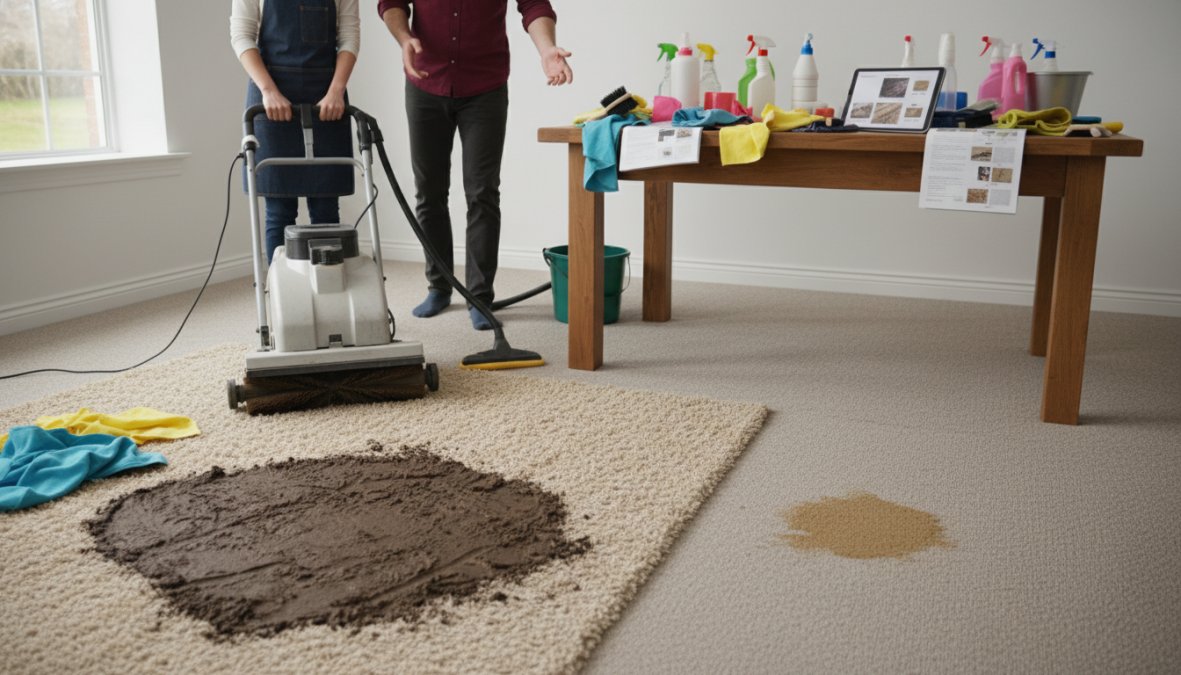
Wool and Natural Fiber Carpets
Wool carpet requires a noticeably different approach. Wool is a natural protein fiber that is highly sensitive to alkaline cleaners, hot water, and aggressive mechanical action. Using standard dish soap, which is typically alkaline, on wool can cause fiber swelling, shrinkage, and permanent texture change.
For wool and other natural fiber carpets:
- Use cold or lukewarm water only, never hot
- Choose a pH-neutral cleaner specifically formulated for wool
- Avoid white vinegar, which, despite being a mild acid, can still affect wool dye stability
- Blot with minimal pressure and avoid any scrubbing motion
- Dry as quickly as possible to prevent fiber distortion
If you have a wool area rug or a natural fiber carpet and the mud stain is significant, professional cleaning is the lower-risk option. The cost of professional treatment is considerably lower than replacing a damaged wool carpet.
Always identify your carpet fiber type before applying any cleaning solution. The label on your carpet or its original documentation will specify the fiber content. When in doubt, a hidden spot test protects against irreversible damage.
How to Clean Mud Out of Carpet Without a Vacuum
Knowing how to clean mud out of carpet without a vacuum is useful when you’re dealing with a stain in a location without power access, in a vehicle, or when your vacuum is unavailable. But this scenario also exposes the single most overlooked problem in DIY mud removal: soap residue. Without suction to extract dissolved cleaning solution, the residue problem is significantly worse, and most guides never address it at all.
Step 1: Manual Dry Debris Removal
Before any liquid touches the carpet, remove as much dried mud as possible by hand. A stiff-bristle scrub brush or a clean fork works well for breaking up brittle dried mud. Work in short strokes from the outside of the stain inward to avoid spreading debris. Once loosened, lift the particles using one of these no-vacuum methods:
- Packing tape or duct tape: Press a strip firmly onto the loosened debris and peel it straight up. Repeat with fresh strips until no more particles transfer to the tape.
- Lint roller: Effective on low-pile and Berber carpets where debris sits near the surface.
- Damp rubber glove: Dampen a rubber dishwashing glove and rub the surface in one direction. The static and friction pull loose particles into a collectible pile.
- Stiff cardboard edge: Use the edge of a piece of cardboard to scrape loosened debris into a pile, then pick it up with tape.
Repeat the brush-and-lift cycle two or three times. The more dry material you remove at this stage, the less work the cleaning solution has to do, and the less residue you’ll be fighting later.
Step 2: Apply Cleaning Solution Sparingly
When cleaning without a vacuum or extractor, the single most important rule is use less solution than you think you need. Without suction to pull moisture back out, every extra drop of cleaning solution becomes residue that stays in the fiber.
Mix no more than half a teaspoon of clear, dye-free dish soap with two cups of cold water. Apply the solution with a spray bottle set to a fine mist, not a stream. The goal is to dampen the stained fibers, not saturate them. Alternatively, dampen a clean white cloth with the solution and press it onto the stain rather than spraying directly, this gives you more control over the amount of liquid introduced.
Blot from the outside edge of the stain toward the center, lifting the cloth straight up with each press. Rotate to a clean section of cloth with every blot.
Step 3: The Residue Problem, And How to Solve It Without a Vacuum
This is the step every competitor skips, and it is the most consequential step when you have no extraction equipment.
Dish soap contains surfactants, molecules designed to surround and lift dirt particles. Those same surfactants do not simply disappear after cleaning. When left in carpet fibers, the surfactant residue remains tacky and continues to attract and bind airborne dust, pet dander, and tracked-in soil. A carpet cleaned with dish soap but not properly rinsed will visibly re-soil faster than a carpet that was never cleaned, because the sticky residue acts as a continuous dirt trap.
Without a wet/dry vacuum or carpet cleaning machine, residue removal requires a deliberate multi-pass cold-water rinse:
- Dampen a clean white cloth with plain cold water, no soap, no vinegar.
- Press the cloth firmly into the cleaned area and hold for 3-5 seconds to allow the water to dilute the surfactant.
- Lift straight up and check the cloth. If you see suds or a soapy film, the residue is still present.
- Repeat with a fresh damp cloth until pressing into the carpet produces no visible suds on the cloth.
- Finish by pressing a dry cloth or a stack of paper towels firmly into the area and weighting them down with a heavy book for 15-20 minutes. This wicks remaining moisture and dissolved soap upward into the absorbent material rather than letting it settle back into the pile.
Skipping the cold-water rinse after dish soap treatment is the most common reason a DIY-cleaned carpet looks dull or re-soils within days. The carpet isn’t dirty again, the surfactant residue is simply doing what surfactants do: attracting particles. Rinsing until no suds appear is not optional; it is the step that determines whether the cleaning actually worked.
When No-Vacuum Cleaning Has Reached Its Limit
Manual blotting and rinsing can handle fresh mud stains on low-pile synthetic carpet reasonably well. The method reaches its limit in three situations:
- Thick or plush carpet: The pile depth means debris and cleaning solution both penetrate further than blotting can reach.
- Ground-in or layered mud: Multiple passes of foot traffic compact the mud into the lower pile, where manual tools cannot dislodge it effectively.
- Natural fiber carpets (wool, sisal, jute): These fibers absorb moisture readily and are prone to shrinkage and fiber distortion when wet-cleaned without rapid extraction. Manual blotting without suction leaves too much moisture in contact with the fiber for too long.
In any of these cases, borrowing or renting a wet/dry shop vacuum, even a small household model, dramatically improves results. The extraction step is not about cleaning power; it is about removing the moisture and dissolved residue that blotting alone cannot fully recover.
The no-vacuum method works, but its success depends almost entirely on the rinse stage. Use minimal cleaning solution, rinse with cold water until zero suds appear on the cloth, and wick remaining moisture upward with dry cloths weighted in place. Skipping the rinse trades a mud stain for a soap-residue problem that compounds with every day of foot traffic.
Best Carpet Cleaner for Mud Stains: Comparing Your Options
Choosing the best carpet cleaner for mud stains is not simply a matter of picking the strongest product. Mud is a combination stain, it contains both inorganic particulate matter (clay and mineral sediment) and organic material (decomposed plant matter, bacteria, and in many cases pet or human contamination). The right cleaner depends on which component of the mud is causing the most visible staining, what fiber your carpet is made from, and, critically, how that cleaner interacts with your carpet’s dye.
Understanding What Each Cleaner Actually Does to Mud
Dish soap and water
Dish soap works on mud because its surfactant molecules have a water-attracting end and an oil/particle-attracting end. The surfactant surrounds clay and organic particles, suspending them in the water so they can be blotted away. This mechanism is effective on fresh mud on synthetic fibers. The trade-off is residue: surfactants do not rinse out completely with a single water pass, and the sticky film they leave behind attracts new soil. On polyester and nylon, this is manageable with a thorough cold-water rinse. On wool, the alkaline pH of most dish soaps (typically pH 7-9) can cause the protein fiber to swell and lose its texture, making dish soap a poor choice for natural fiber carpets regardless of how well it is rinsed.
White vinegar and water
Vinegar’s cleaning action on mud comes from its mild acidity (typically 5% acetic acid), which helps break down the mineral content of clay-based mud and neutralizes some odors. It leaves less residue than dish soap and is safe for most synthetic fibers. The colorfastness risk is real and underreported: vinegar’s acidity can shift the pH of carpet dye, particularly on older carpets or those dyed with acid-sensitive colorants. This does not mean vinegar damages every carpet, it means a hidden-area spot test is not optional, it is the only way to know. Apply a small amount of diluted vinegar solution to an inconspicuous area, blot, and check the cloth for color transfer before treating the visible stain. If any dye transfers to the cloth, stop and use a pH-neutral cleaner instead.
Vinegar is commonly described as safe for all carpets, but this is not accurate. Carpets dyed with certain acid dyes, common in wool and some nylon products, can experience color shift or bleeding when exposed to acetic acid. Always test in a hidden area first, and never use undiluted vinegar directly on carpet.
Enzyme cleaners
Enzyme cleaners contain biological catalysts (protease, amylase, and lipase enzymes, depending on the formula) that break down organic molecules at a molecular level rather than simply surrounding and suspending them. For mud that contains pet waste, grass, or other organic debris, enzyme cleaners outperform dish soap because they eliminate the organic component rather than just lifting it. They also leave minimal residue and are typically formulated to be biodegradable and pet-safe. The limitation is time: enzyme cleaners require dwell time, usually 5-10 minutes of contact with the stain, to work effectively. Blotting too quickly reduces their effectiveness. Check the product label for the manufacturer’s recommended dwell time and follow it.
Carpet shampoo and foam cleaners
Commercial carpet shampoos are formulated for broader soil removal and often contain optical brighteners and fragrance in addition to surfactants. For mud stains, they offer no meaningful advantage over dish soap and water on synthetic fibers, and they carry the same residue risk. Foam-based carpet cleaners reduce over-wetting risk because the foam delivers less liquid than a spray, but they still require thorough extraction or rinsing to prevent residue buildup. Most are not recommended for wool without explicit label confirmation of pH neutrality.
Professional hot water extraction
Truck-mounted hot water extraction operates at temperatures and pressures that portable machines and manual methods cannot replicate. The high-temperature water loosens embedded clay particles from deep in the pile, and the simultaneous high-suction extraction removes both the dislodged debris and the cleaning solution in a single pass. This eliminates the residue problem entirely and reaches contamination in the lower pile and backing that blotting cannot access. For ground-in mud, wool carpets, or stains that have not responded to two or three rounds of DIY treatment, professional extraction is not a luxury, it is the method most likely to produce a genuinely clean result without fiber damage.
Fiber-Aware Product Selection at a Glance
| Cleaner Type | Best For | Nylon / Polyester | Wool / Natural Fiber | Residue Risk | Pet-Safe |
|---|---|---|---|---|---|
| Dish soap + cold water | Fresh mud, synthetic fibers | Yes | No, alkaline pH risks fiber damage | Moderate, rinse thoroughly | Generally yes |
| White vinegar + water (1:1) | Light stains, odor, synthetic fibers | Yes, spot test first | No, acid can shift dye | Low | Yes |
| Enzyme cleaner | Organic mud, pet contamination, older stains | Yes | Most formulas, check pH | Low | Yes, check label |
| pH-neutral wool cleaner | Wool, silk, natural fiber carpets | Yes | Yes, purpose-built | Low | Varies by formula |
| Carpet shampoo / foam | Large areas, ground-in dirt on synthetic | Yes | Only if pH-neutral confirmed | Moderate | Varies |
| Professional extraction | Deep stains, natural fibers, failed DIY | All types | All types | None | Yes |
The Colorfastness Test: A Step Competitors Skip
Every cleaning agent you apply to carpet carries some risk of affecting the dye, and mud stains often prompt people to use stronger solutions than they would for a routine spill. Before applying any cleaner to a visible area, perform a colorfastness test:
- Choose a hidden area, inside a closet, under a piece of furniture, or along the baseboard edge where the carpet tucks under the wall trim.
- Apply a small amount of your chosen cleaning solution.
- Press a clean white cloth firmly onto the area and hold for 30 seconds.
- Lift the cloth and examine it under good light. Any color on the cloth means the dye is not stable with that cleaner.
- If color transfers, switch to a milder or pH-neutral alternative and test again.
This test takes under two minutes and is the single most reliable way to prevent a cleaning attempt from creating a permanent bleached or discolored patch on top of the original mud stain.
According to the Carpet and Rug Institute’s care and maintenance guidelines, testing cleaning solutions in an inconspicuous area before full application is a standard recommendation for all fiber types, precisely because dye stability varies significantly between manufacturers, dye lots, and fiber compositions.
No single cleaner is best for all mud stains on all carpets. Match the cleaner to the fiber type and the composition of the mud, always perform a colorfastness test before treating the visible stain, and treat residue removal as a required step rather than an optional one. The cleaner that removes the mud but leaves a soap-residue dirt trap has not solved the problem, it has delayed it.
When to Call a Professional Carpet Cleaner in Lake Geneva, WI
Some mud stains are simply beyond what DIY methods can fully address. Knowing when to stop and call a professional saves you from over-wetting your carpet, damaging fibers, or setting a stain further.
Call a professional carpet cleaner near me when:
- The stain covers a large area or has been ground in by repeated foot traffic
- The carpet is wool, silk, or another natural fiber requiring specialized care
- DIY treatment has lightened but not removed the stain after two or three attempts
- The mud contained pet waste, creating both a stain and an odor problem
- You notice moisture or a musty smell after cleaning, suggesting the backing got wet
For Lake Geneva, Wisconsin homeowners, Lake Geneva Carpet Cleaning has addressed exactly these situations for over 32 years. The business uses truck-mounted hot water extraction technology, which delivers cleaning power and suction that no portable machine or manual method can replicate. This approach removes not just the visible stain but the embedded debris, allergens, and bacteria that settle deep into carpet pile over time, improving indoor air quality in the process.
The 10-day satisfaction guarantee means that if the stain returns or the result doesn’t meet your expectations, the job isn’t finished. That’s a meaningful commitment for a stain as stubborn as ground-in mud.
Mud stains that have been scrubbed, over-wetted, or treated with the wrong product for the fiber type are the most common reason DIY carpet cleaning fails. For straightforward cases, the dry-first, blot-inward method described in this guide will handle most muddy footprints on synthetic carpet. For deeper stains, natural fiber carpets, or situations where multiple cleaning attempts haven’t produced a clean result, professional treatment is the practical choice. Lake Geneva Carpet Cleaning brings over 32 years of owner-operated experience, eco-friendly methods, and truck-mounted extraction technology to every job in the Lake Geneva, Wisconsin area. Get started with Lake Geneva Carpet Cleaning and restore your carpet to a genuinely clean condition, backed by a satisfaction guarantee.
Frequently Asked Questions
Should I let mud dry before cleaning it out of carpet?
Yes, letting mud dry completely before attempting to clean it is one of the most important steps. Wet mud spreads easily when touched, pushing moisture and ground-in dirt deeper into carpet fibers and the porous surface beneath. Once fully dry, the mud becomes brittle and can be broken up and vacuumed away much more effectively, reducing the risk of a larger, harder-to-treat stain.
Does mud stain carpet permanently?
Mud does not typically cause permanent stains if treated correctly and promptly. However, mud that is scrubbed while wet, left untreated for a long time, or worked into delicate carpet fibers can become a deep-set stain that is very difficult to remove without professional cleaning. Acting quickly, and using the right method for your carpet type, gives you the best chance of full stain removal.
What is the best household cleaner for mud on carpet?
A simple mixture of one teaspoon of liquid dish soap and one cup of warm water is widely regarded as one of the best household cleaning solutions for mud stains. For tougher or older stains, adding a small amount of white vinegar can help break down ground-in dirt. Always perform a hidden spot test first to check for colorfastness before applying any solution to a visible area of your carpet.
How do you get dried mud out of carpet without a vacuum?
If you do not have a vacuum, start by using a stiff-bristled brush or a dry scrubbing brush to loosen and lift the dried mud debris from the carpet fibers. Collect the loosened dirt with a dustpan or sticky tape. Then apply a dish soap and warm water cleaning solution using a clean white cloth, blotting, never scrubbing, until the stain lifts. Rinse with cold water and blot dry to remove any residue.
Will vinegar remove mud stains from carpet?
White vinegar can be effective at helping to remove mud stains from carpet, particularly when combined with liquid dish soap and warm water. Vinegar helps break down residue and neutralize odors without harsh chemicals, making it a practical eco-friendly and pet-safe option. However, it should not be used on wool or natural fiber carpets, as the acidity can damage delicate fibers. Always test on a hidden spot first.
This article was written using GrandRanker