Last Updated: November 13, 2026
Quick Summary
Pet odor removal works by reaching the source of the urine, not just the surface stain. Urine soaks into padding and subfloor, so effective treatment finds every affected spot, treats deeper layers, and confirms the odor is gone after drying. Enzyme cleaners break down the compounds that cause the smell.
- Blot fresh urine right away with a clean, dry towel, and do not rub.
- Use a UV flashlight to reveal urine spots that are invisible in normal light.
- Choose an enzyme cleaner labeled for pet urine and follow its contact time.
- Avoid vinegar and ammonia products, since ammonia can attract pets back to the spot.
- Check the padding if odor persists after the carpet dries completely.
Table of Contents
- Why Pet Odors Come Back After a Quick Clean
- Finding the Real Source of Pet Urine Odor
- How to Remove Dog Urine Smell from Carpet Step by Step
- Choosing an Enzyme Cleaner for Pet Urine
- What Professional Pet Odor Removal Involves
- How Long Carpet Takes to Dry After Pet Odor Treatment
- Keeping Pet Odors From Returning in Williams Bay Homes
- Get a Free Pet Odor Assessment From Lake Geneva Carpet Cleaning
- Frequently Asked Questions
Why Pet Odors Come Back After a Quick Clean
Pet odor returns for a simple reason: the source was never removed. Urine soaks past the carpet fibers into the padding and the subfloor, where it dries and keeps releasing odor long after the surface looks clean. A quick surface rinse or a store-bought spray removes what you can see and smell for a day or two, then the smell comes back as the area warms and humidity rises.
Homeowners often find that a carpet looks fine after a first attempt, then the odor returns within weeks. Learn why pet odors keep coming back after cleaning and what a deeper fix looks like. That usually means the treatment reached the top of the carpet but not the material underneath.
Pet odor removal works only when the cleaning reaches the actual source. That means finding every affected spot, treating the padding as well as the carpet, and confirming the odor is gone once the area has dried. The sections below explain how to do each part.
Finding the Real Source of Pet Urine Odor
Visible stains are only part of the problem. Urine often travels well beyond the spot you can see, and a dog or cat may have marked areas you never noticed. Start by looking for the obvious stains, then check the edges of rooms, under furniture, and along baseboards where pets tend to mark.
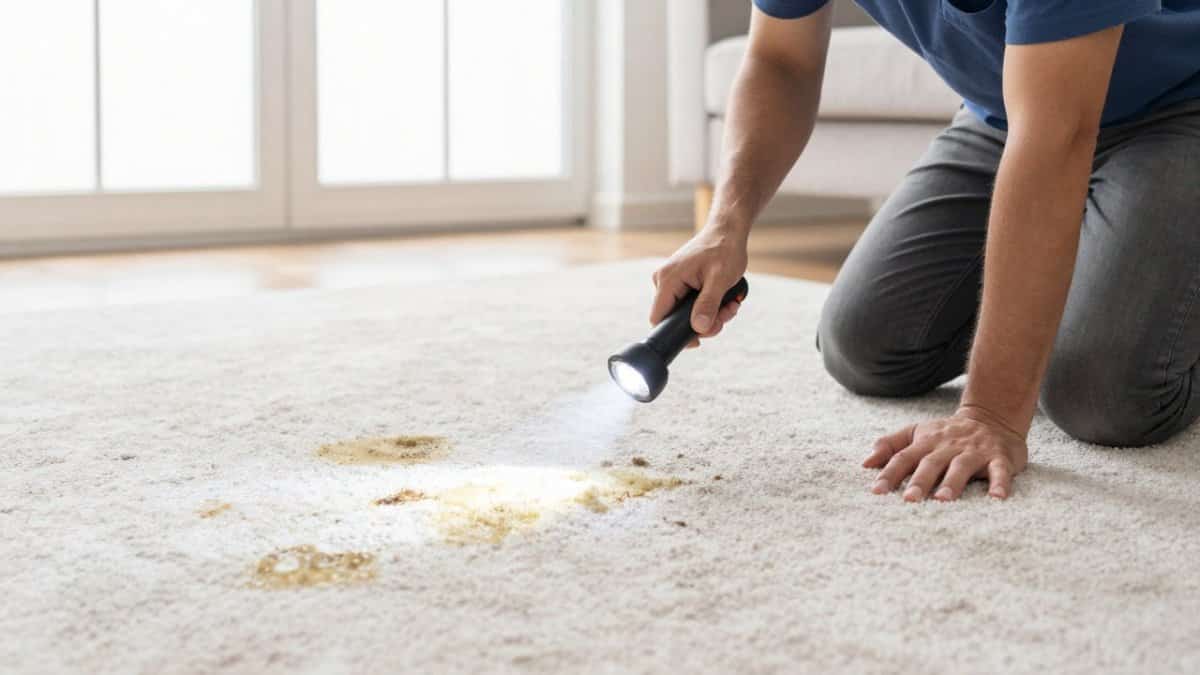
A UV flashlight is one of the most useful tools for this step. Urine fluoresces under ultraviolet light, so spots that are invisible in normal lighting often glow clearly in a dim room. Work slowly, mark each spot, and check the padding edge where the carpet meets the wall.
Pay attention to smell as well. A persistent odor with no visible stain usually means urine has reached the subfloor or padding. If you can smell it but cannot find a stain, the source is probably underneath, and surface cleaning alone will not solve it.
How to Remove Dog Urine Smell from Carpet Step by Step
Removing dog urine smell requires treating the source, not just covering the scent. Follow these steps in order:
- Blot fresh urine right away. Press a clean, dry towel into the spot to pull up as much liquid as possible. Do not rub, since rubbing pushes urine deeper into the fibers.
- Rinse with cool water. Dilute remaining urine by lightly soaking the area and blotting again. Repeat until the towel comes up mostly clean.
- Apply an enzyme cleaner. Saturate the area according to the product label and let it sit for the full recommended time. Enzymes break down the odor-causing compounds rather than masking them.
- Blot and allow the area to dry completely. Lay towels on the spot and weigh them down if needed. Air circulation speeds drying.
- Check the padding. If the odor persists after the carpet dries, the padding is likely holding urine. Treating the padding requires a deeper process than home cleaning usually allows.
Avoid vinegar and ammonia-based products on urine stains. Ammonia can smell similar to urine and may encourage pets to return to the same spot.
The steps below follow the same order each time, so each one builds on the last.
| Step | What to do | Timing |
|---|---|---|
| Blot fresh urine | Press a clean, dry towel into the spot | Right away |
| Rinse with cool water | Lightly soak the area and blot again | Repeat until towel is mostly clean |
| Apply enzyme cleaner | Saturate per product label | Full recommended contact time |
| Dry completely | Lay towels on spot and weigh down | Until fully dry |
| Check the padding | Look for odor that persists after drying | After carpet dries |
Choosing an Enzyme Cleaner for Pet Urine
An enzyme cleaner is the most reliable choice for pet urine because its active ingredients digest the proteins and uric acid that cause lingering odor. Look for a product labeled specifically for pet urine rather than a general-purpose cleaner, and check that the label lists enzymes as the active ingredient.
Read the label before you buy. Many enzyme products require a set contact time, often several minutes to hours, and will not work well if the area dries out early. Some are safe for most carpet fibers, while others can discolor certain materials, so test a hidden spot first.
Enzyme cleaners also work best on fresh and established urine alike, but they cannot fully reach urine that has soaked into the subfloor. That is why a product alone often fails on heavily soaked areas. Knowing when to stop trying home methods matters as much as choosing the right product.
What Professional Pet Odor Removal Involves
Professional pet odor removal goes beyond surface treatment. See how our pet stain and odor removal service works from inspection to treatment. A trained technician inspects the affected areas, identifies how far the urine has traveled, and treats the carpet, padding, and subfloor as needed. The goal is to remove the source, not just reduce the smell for a short time.
Careful pet odor work depends on the process around the cleaning: how the source is traced, how the work is documented, and how the result is verified after the carpet dries.
Inspection and Documentation Before Treatment
Before any treatment begins, a thorough approach walks every affected room and maps the problem rather than guessing at it. A typical inspection includes:
- A slow UV sweep of the room. Urine fluoresces under ultraviolet light, so we check the full floor area, not just the visible stains, room edges, corners, under furniture, along baseboards, and the seam where carpet meets the wall.
- A padding and subfloor check. Where the carpet can be lifted at a corner or seam, we check whether urine has wicked into the padding and whether the subfloor beneath is affected. Odor that persists with no visible stain almost always means the source is underneath.
- A nose test at floor level. We smell the area at carpet level before and after treatment, because odors that are faint standing up can be obvious close to the fibers.
- Written notes on each spot. We record the location, approximate size, and condition of every affected area, plus what was treated and how. You get a clear picture of what was found, which also sets realistic expectations for the result.
This step matters because pet odor often hides in places the homeowner has not noticed. A dog or cat may have marked the same corner repeatedly, or a single accident may have spread farther than the visible stain suggests. Mapping each spot prevents the common failure of cleaning the obvious stain while leaving the real source untouched.
Professional Treatment Versus Do-It-Yourself Methods
Do-it-yourself methods work well for small, fresh spots on the surface of the carpet. Compare professional treatment with sprays that only mask odor. They fall short in three situations: when urine has soaked into padding or a subfloor, when the odor has been present for months, and when a pet keeps returning to the same spot because the scent marker was never fully removed.
Store-bought sprays and rental machines typically reach the carpet fibers but not necessarily the padding beneath. Home methods also depend on the user finding every spot, which is where repeated attempts often go wrong.
For a pet owner dealing with repeated accidents or a persistent smell, a professional inspection can help locate sources that are easy to miss.
How We Verify the Result
A clean-smelling room on the day of service is not the same as a lasting fix, so we confirm results before we consider a job complete. After the treated areas dry, we recheck each documented spot at floor level and compare it to the notes from the inspection. If odor is still detectable, the source was not fully reached, and we treat further rather than declaring the job done.
How Long Carpet Takes to Dry After Pet Odor Treatment
Drying time depends on how thoroughly the area was treated, the carpet and padding thickness, the room’s humidity, and how much air moves through the space. Most carpets dry within several hours to a day after a standard cleaning, while padding can take longer.
Run fans, open windows when the weather allows, and keep foot traffic off the area until it is fully dry. Wet padding left too long can hold moisture and encourage odor or mildew, so proper drying is part of the treatment.
Keeping Pet Odors From Returning in Williams Bay Homes
Preventing a return of pet odor starts with addressing accidents quickly and completely. Clean fresh urine within minutes, keep an enzyme cleaner on hand, and check the spots where your pet tends to go, the same corner, the same edge of the rug, the same spot by the door. Regular cleaning also prevents the buildup that holds odor in the fibers.
Why Williams Bay and Lake Geneva-Area Homes See Odor Return
Homes around Williams Bay and the rest of the Lake Geneva area face conditions that can bring old pet odor back to the surface. Humidity during warmer months raises moisture in carpet and padding, and that moisture releases odor compounds that stayed locked away in cooler, drier weather. Homes near the lake and in low-lying areas tend to hold more moisture in basements and ground-floor rooms, which is where lingering pet odor often shows up first.
A common pattern in this area is a carpet that smelled fine all winter and then developed a noticeable odor in late spring. That is usually not a new accident, it is an old source in the padding or subfloor reacting to higher humidity. If the smell returns with the season, the source was never fully removed.
Practical Steps That Hold Up Locally
- Run a dehumidifier in damp basements and ground-floor rooms during humid stretches, and keep airflow moving in rooms where pets spend time.
- Check the padding, not just the carpet. If a spot smells after cleaning and drying, the padding is likely holding urine and needs deeper treatment.
- Use a UV flashlight periodically on the areas your pet favors, especially after a change in routine, a move, or a new pet in the home.
- Keep pets from re-marking treated spots. Residual scent markers encourage repeat accidents, so a thorough treatment matters as much as the cleaning itself.
- Address accidents in the same visit. Waiting a few days lets urine wick deeper into padding, which turns a small spot into a bigger job.
If odor keeps returning despite consistent home care, the source is probably deeper than surface cleaning can reach. That is the point where an inspection and targeted treatment save repeated effort.
Get a Free Pet Odor Assessment From Lake Geneva Carpet Cleaning
If pet odor keeps coming back, the source may be deeper than a home cleaning can reach. Lake Geneva Carpet Cleaning can help you find where the urine has traveled and recommend the right treatment. Read our checklist for choosing a carpet cleaner in Williams Bay before you book. Pricing depends on the size and condition of the job, so contact us for a quote tailored to your home.
Serving Lake Geneva, Twin Lakes, Genoa City, Walworth, Fontana, Darien, Burlington, Elkhorn, Williams Bay, Delavan, and East Troy, WI for 32 years. Reach out to Lake Geneva Carpet Cleaning today and let our team help you get your home fresh again.
BUTTON: Book Your Free Assessment
CARD_TITLE: Is pet odor still lingering in your home?
CARD_TEXT: Lake Geneva Carpet Cleaning can help you find and treat the source of pet odor.
Frequently Asked Questions
How do professional carpet cleaners remove pet urine odor?
Professionals start by locating every affected area, often with a UV light, because urine can travel into padding and the subfloor. An enzyme treatment is designed to break down the uric compounds that cause the smell, rather than covering it up. The goal is to remove the source so the odor does not return once the carpet dries. Results depend on how long the urine has been present and how far it spread, so a site visit helps set realistic expectations. Contact Lake Geneva Carpet Cleaning to discuss your home.
How long does carpet take to dry after professional cleaning?
Drying time depends on how deeply the carpet was saturated, the padding type, airflow, and humidity in the room. Many carpets feel dry on the surface within several hours, but the padding underneath can take longer. Running fans and keeping windows open helps speed drying and reduces the chance of mildew. Pet odor treatments that use enzyme products may require a few extra hours of ventilation. Pricing for service depends on the job, so contact Lake Geneva Carpet Cleaning to discuss your needs.
Why does my house still smell like dog after I clean?
The most common reason is that the urine reached the padding or subfloor, where ordinary surface cleaning cannot reach it. Odor can also persist when only the visible stain was treated and not the area around it. Old residue can reactivate with humidity or moisture. A careful inspection looks beyond the stain to find where the odor is actually coming from. Contact Lake Geneva Carpet Cleaning to discuss your situation.