
Table of Contents
- Why Office Chairs Wear Down Carpet Over Time
- Choosing an Office Chair Mat for Thick Carpet
- Chair Casters for Carpet: Which Wheels Are Gentlest
- Step-by-Step Setup for Protecting Carpet Under Your Chair
- Daily and Weekly Habits That Prevent Dents and Matting
- How to Fix Carpet Dents from an Office Chair
- How to Clean Carpet Under an Office Chair Mat
- Book a Carpet Inspection in Burlington and Lake Geneva
- Frequently Asked Questions
Last Updated: November 18, 2026
Why Office Chairs Wear Down Carpet Over Time
An office chair puts far more pressure on carpet than most people realize, and an office chair carpet setup with the wrong mat can make it worse. Each caster, the small wheel at the base of the chair, concentrates the chair’s weight onto a tiny contact point. Over weeks and months of rolling back and forth, those points crush carpet fibers flat and drag them out of position.
Most people notice the damage late. The first sign is usually a worn path under the desk, where the carpet looks thin, matted, or faded. The fibers haven’t torn; they’ve been compressed and pushed sideways, so the surface loses its bounce and its color.
Homeowners and businesses often see this in home offices where the same chair sits in the same spot every workday. Protecting the office chair carpet is easier and cheaper than repairing it later.
Choosing an Office Chair Mat for Thick Carpet
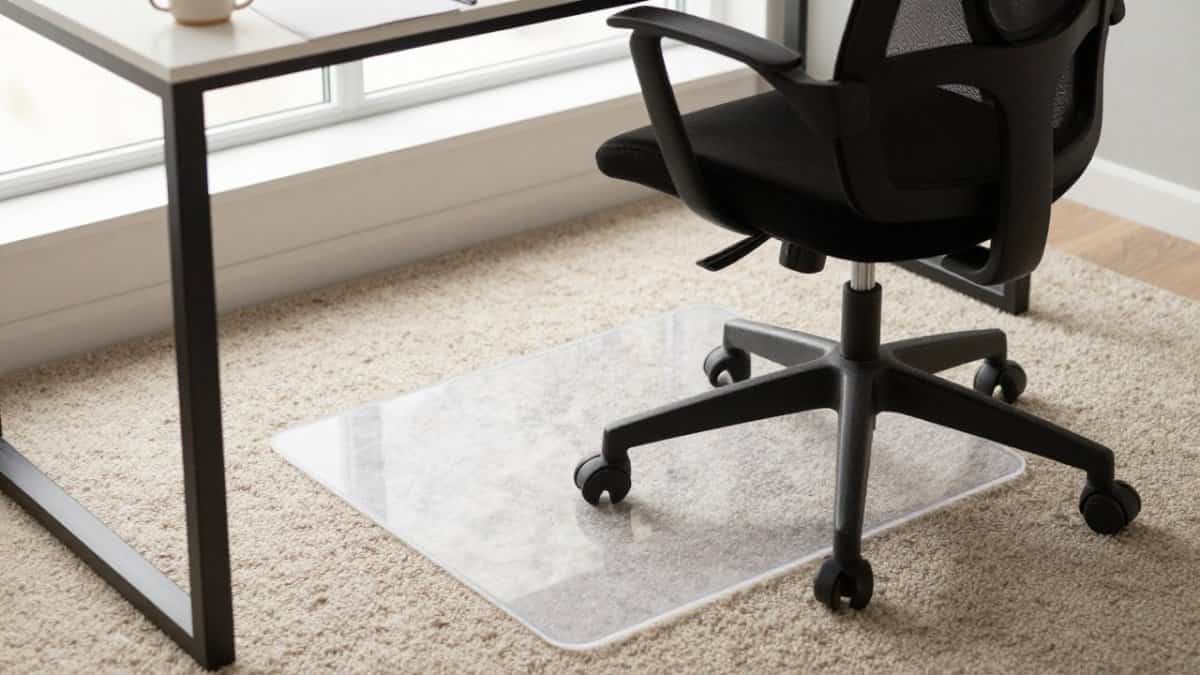
A chair mat is the most effective way to protect carpet under a rolling chair. It spreads the chair’s weight across a wider area and gives the casters a smooth surface to roll on. But a mat that is wrong for your carpet can slide, curl, crack, or sink into the pile and leave the fibers just as exposed as before. The goal is a mat whose rigidity, underside, and size match the carpet it sits on.
Start With the Carpet, Not the Mat
Before you shop, identify three things about the carpet in the office:
- Pile height. Measure from the carpet backing to the top of the fibers. Under about 1/4 inch is low pile; roughly 1/4 to 1/2 inch is medium pile; anything plush, frieze, or shag is high pile.
- Construction. Tight loop and flat-weave carpets are dense and stable. Cut pile, frieze, and cable carpets have longer, looser fibers that bend and mat easily.
- Backing and cushion. A thick pad under the carpet lets a mat sink and rock. Glue-down or thin-pad installations are far more forgiving.
A common cause of a failed chair mat is buying for the chair instead of the carpet. A mat rated for hard floors will skid on plush pile no matter how heavy the chair is.
Matching Mat Thickness and Rigidity to Pile
- Low pile or flat weave: A thinner, semi-rigid mat usually works well. It lies flat and the casters roll easily.
- Medium pile: Choose a sturdy mat with a firm, flat base and short cleats that bite into the fibers without tenting the carpet.
- Thick or plush pile: Pick a rigid mat, often a thicker polycarbonate or a studded mat with longer cleats, that will not sink into the fibers. Flexible vinyl mats are the usual failure here.
Look for a mat that stays flat when you step on it. If it curls at the edges or sinks underfoot, the chair will still catch on the fibers and the mat will creep across the floor.
Cleats, Grips, and Mat Size
Cleats are the small rubber or plastic studs on the underside of a mat. They hold the mat in place so it doesn’t slide when the chair moves. On thick carpet, short cleats barely reach the backing and the mat walks; longer cleats grip but can leave dimples if the pad is soft.
- Choose a mat that extends at least 36 inches in front of the chair, so the chair stays on the mat when you roll forward.
- Make sure the mat covers the full area the chair travels, including the path to the door or filing cabinet.
- Test the grip by pushing the chair across the mat. If the mat shifts, try a different model.
Watch out: A mat that is too small is worse than no mat at all, because the chair rolls off the edge and the casters dig into bare carpet at the lip, concentrating wear right where the mat ends.
A Quick Compatibility Test
Before you commit to a mat, lay it on the carpet for a day without the chair. Step on the center and the edges. If it rocks, tents, or lifts at the corners, it is the wrong mat for that carpet. Then place the chair and roll in every direction for a few minutes. A mat that stays flat and still under that test will protect the fibers; one that moves will not.
The right mat depends on the carpet’s pile height, so this quick guide matches each pile type to the mat that suits it.
| Carpet type | Mat to choose | Why |
|---|---|---|
| Low pile or flat weave | Thinner, semi-rigid mat | Lies flat; casters roll easily |
| Medium pile | Sturdy mat with short cleats | Grips fibers without tenting the carpet |
| Thick or plush pile | Rigid mat with longer cleats | Will not sink into the fibers |
| Any carpet, mat too small | Extend at least 36 inches in front | Keeps the chair on the mat |
Chair Casters for Carpet: Which Wheels Are Gentlest
The wheels on your chair matter as much as the mat. Hard plastic casters dig into carpet, while soft, wide wheels spread the load and roll more smoothly.
Many office chairs come with hard casters designed for hard floors. Replacing them with carpet-friendly wheels is a simple fix that protects the fibers underneath.
Look for wheels labeled for carpet use. They usually have wider contact surfaces and rubber or polyurethane tread. Some chairs also let you swap in stationary glides, which are fixed feet that do not roll at all. Stationary glides are the gentlest option for carpet, but they make it harder to move around the desk.
Step-by-Step Setup for Protecting Carpet Under Your Chair
Follow these steps to set up protection the right way.
- Measure the area. Note the space the chair covers when you roll it in every direction.
- Pick a mat for your carpet pile. Use the thickness guide above.
- Place the mat before the chair. Lay it flat and smooth out any ripples.
- Check the caster type. Swap hard wheels for carpet-safe wheels if needed.
- Test the movement. Roll the chair slowly across the mat and check for slipping.
- Adjust the position. Move the mat until the chair stays on it during normal use.
- Recheck after one week. Look for shifting or wear at the edges.
Watch out: Never place a chair mat on carpet that is wet or still damp from cleaning. Trapped moisture can cause odor and fiber damage, so let the carpet dry fully first.
Daily and Weekly Habits That Prevent Dents and Matting
A good mat helps, but daily habits make the biggest difference over time.
- Roll the chair gently instead of pushing off hard from the desk.
- Lift the chair when you need to move it sideways, rather than dragging it.
- Vacuum the mat and the surrounding carpet once a week to remove grit that wears down fibers.
- Rotate the mat every few months so the carpet beneath it wears evenly.
- Keep the chair’s casters clean. Hair and debris wrapped around wheels can scratch the mat.
These small habits take seconds and prevent the slow compression that leads to permanent wear.
How to Fix Carpet Dents from an Office Chair
Dents from a chair are often reversible if you act early. The key is telling compression from damage. Compressed fibers are bent but intact; damaged fibers are crushed, cut, or pulled loose from the backing, and no amount of steaming brings them back.
Tell Compression From Damage
- Compression: The dent springs back partway when you press it, the color returns when you rub the fibers, and the spot feels soft rather than crunchy.
- Fiber damage: The spot stays flat after vacuuming, feels stiff or brittle, and may show a lighter or grayish patch where the fiber tips have been worn away.
- Backing damage: You can see or feel the backing through the pile, the carpet tears at the edges of the dent, or the seam near the chair is opening.
If you are seeing backing damage, protection is already too late for that spot and the question becomes repair, not prevention.
Lifting Shallow Dents
Start by removing the mat and vacuuming the spot with a beater bar to pull the fibers upright. Then steam the area lightly with a clean, damp cloth and a household iron held above the carpet, never touching it, and gently brush the fibers upright with a soft brush. Work in small sections and let the carpet dry completely before you put the mat back.
Watch out: Never place a chair mat back on carpet that is still damp. Trapped moisture under a mat can cause odor, delamination of the backing, and fiber damage that is far worse than the original dent.
When to Repair or Replace
- Repair: A single crushed path or a small torn area can often be patched by a professional using matching carpet from a closet or leftover roll.
- Replace the section: If the wear path runs across a seam or covers a large area under the desk, a partial replacement may be the practical fix.
- Replace the carpet: If the backing is failing across the room or the wear path is one of several, replacement may be the better long-term choice.
If the carpet has torn or the backing is exposed, the damaged section may need a repair or replacement. Chair damage is most common in home offices with plush carpet and thin pads, where the mat sinks and the casters reach the backing.
How to Clean Carpet Under an Office Chair Mat
Dirt collects under chair mats and stays there. Clean the area regularly to avoid grit grinding into the fibers.
- Lift the mat and set it aside.
- Vacuum the carpet thoroughly, including the edges where the mat sat.
- Spot-clean any stains with a carpet-safe cleaner and blot, not scrub.
- Let the carpet dry completely before putting the mat back.
- Clean the underside of the mat with a damp cloth to remove grit.
If the carpet under the mat looks dull or smells musty, schedule a professional deep cleaning. Heavy dirt that builds up under a mat can be hard to remove with a vacuum alone. Professional truck-mounted hot water extraction can remove embedded dirt, allergens, and odors from the fibers and padding.
Book a Carpet Inspection in Burlington and Lake Geneva
Protecting carpet under an office chair takes the right mat, the right casters, and steady daily habits.
Lake Geneva Carpet Cleaning serves Burlington and the surrounding towns, including Lake Geneva, Twin Lakes, Genoa City, Walworth, Fontana, Darien, Elkhorn, Williams Bay, Delavan, and East Troy. Lake Geneva Carpet Cleaning has served the area for over 32 years. Pricing depends on the size and condition of the job, so contact us for a free quote to have your carpet reviewed and get a recommendation.
Frequently Asked Questions
Do office chair mats protect carpet?
Yes. A chair mat spreads the weight of a rolling chair over a larger area and keeps the casters from grinding the same fibers over and over. Choose a mat sized to cover the full chair travel zone, not just the area under the chair. Check that the mat is designed for carpet and has grips on the underside so it stays in place. Without a mat, the repeated pressure is the main cause of flattened pile and worn patches near desks in Burlington and Lake Geneva homes.
What type of chair mat works on thick carpet?
For thick or plush carpet, look for a mat with a firm, rigid surface and a lip or edge that keeps the carpet from bunching under it. A thicker mat holds its shape better on deep pile. Avoid very thin vinyl sheets on plush carpet, because they can sink in and leave ridges. Test the mat by rolling the chair across it; it should stay flat and not shift. If the carpet pile is very high, a clear mat with raised cleats can help the chair glide smoothly.
Can office chair casters damage carpet?
Hard plastic or small metal casters can crush carpet fibers and cause fraying, especially when the chair is rolled back and forth in the same spot. Casters designed for carpet use softer, wider wheels that spread the load. Keeping the chair on a mat removes most of this risk. If you notice the casters catching or the carpet fuzzing, replace them with carpet-friendly wheels before the damage spreads.
How often should I move or clean under an office chair mat?
Lift the mat and check the carpet underneath every few weeks, and move the mat occasionally so the pile can recover evenly. Vacuum the area under the mat during your regular cleaning, because dust and grit trapped there act like sandpaper. Professional carpet cleaning in Lake Geneva and Burlington can refresh the area and help you spot early wear. For a visit tailored to your carpet, contact Lake Geneva Carpet Cleaning for a free quote, since pricing depends on the job.